


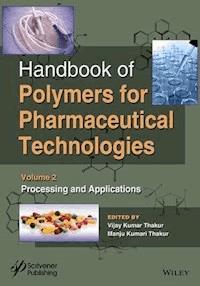
Handbook of Polymers for Pharmaceutical Technologies, Volume 2, Processing and Applications E-Book
Vijay Kumar Thakur
193,99 €
Mehr erfahren.
- Herausgeber: John Wiley & Sons
- Kategorie: Wissenschaft und neue Technologien
- Sprache: Englisch
Polymers are one of the most fascinating materials of the present era finding their applications in almost every aspects of life. Polymers are either directly available in nature or are chemically synthesized and used depending upon the targeted applications. Advances in polymer science and the introduction of new polymers have resulted in the significant development of polymers with unique properties. Different kinds of polymers have been and will be one of the key in several applications in many of the advanced pharmaceutical research being carried out over the globe. This 4-partset of books contains precisely referenced chapters, emphasizing different kinds of polymers with basic fundamentals and practicality for application in diverse pharmaceutical technologies. The volumes aim at explaining basics of polymers based materials from different resources and their chemistry along with practical applications which present a future direction in the pharmaceutical industry. Each volume offer deep insight into the subject being treated. * Volume 1: Structure and Chemistry * Volume 2: Processing and Applications * Volume 3: Biodegradable Polymers * Volume 4: Bioactive and Compatible Synthetic/Hybrid Polymers
Sie lesen das E-Book in den Legimi-Apps auf:
Seitenzahl: 933
Veröffentlichungsjahr: 2015
Ähnliche














Contents
Cover
Half Title page
Title page
Copyright page
Dedication
Preface
About the Editors
Chapter 1: Particle Engineering of Polymers into Multifunctional Interactive Excipients
1.1 Introduction
1.2 Polymers as Excipients
1.3 Material Properties Affecting Binder Activity
1.4 Strategies for Improving Polymeric Filler-Binder Performance for Direct Compression
1.5 Preparation and Characterization of Interactive Excipients
1.6 Performance of Interactive Excipients
1.7 Investigation of the Effect of Polymer Mechanical Properties
1.8 Conclusion
References
Chapter 2: The Art of Making Polymeric Membranes
2.1 Introduction
2.2 Types of Membranes
2.3 Preparation of Membranes
2.4 Modification of Membranes
2.5 Characterization of Membrane by Different Techniques
2.6 Summary
References
Chapter 3: Development of Microstructuring Technologies of Polycarbonate for Establishing Advanced Cell Cultivation Systems
3.1 Introduction
3.2 Material Properties of Polycarbonate
3.3 Use of Polycarbonate Foils in Structuration Processes
3.4 Simulation of Microstructuring of a Polycarbonate Foil
3.5 Chemical Functionalization of Polycarbonate
3.6 Surface Micropatterning of Polycarbonate
3.7 Application Examples
3.8 Conclusion and Further Perspectives
Acknowledgements
References
Chapter 4: In-Situ Gelling Thermosensitive Hydrogels for Protein Delivery Applications
4.1 Introduction
4.2 Polymers for the Design of Hydrogels
4.3 Pharmaceutical Applications of Hydrogels: Protein Delivery
4.4 Application of Hydrogels for Protein Delivery in Tissue Engineering
4.5 Conclusions
References
Chapter 5: Polymers as Formulation Excipients for Hot-Melt Extrusion Processing of Pharmaceuticals
5.1 Introduction
5.2 Polymers for HME Processing
5.3 Polymer Selection for the HME Process
5.4 Processing of HME Formulations
5.5 Improvements in Processing
5.6 Conclusion and Future Perspective
References
Chapter 6: Poly Lactic-Co-Glycolic Acid (PLGA) Copolymer and Its Pharmaceutical Application
6.1 Introduction
6.2 Physicochemical Properties
6.3 Biodegradation
6.4 Biocompatibiliy, Toxicty and Pharmacokinetics
6.5 Mechanism of Drug Release
6.6 PLGA-Based DDS
6.7 Bone Regeneration
6.8 Pulmonary Delivery
6.9 Gene Therapy
6.10 Tumor Trageting
6.11 Miscellaneous Drug Delivery Applications
6.12 Conclusion
References
Chapter 7: Pharmaceutical Applications of Polymeric Membranes
7.1 Introduction
7.2 Obtaining Pure and Ultrapure Water for Pharmaceutical Usage
7.3 Wastewater Treatment for Pharmaceutics
7.4 Controlled Drug Delivery Devices Based on Membrane Materials
7.5 Molecularly Imprinted Membranes
7.6 Conclusions
References
Chapter 8: Application of PVC in Construction of Ion-Selective Electrodes for Pharmaceutical Analysis: A Review of Polymer Electrodes for Nonsteroidal, Anti-Inflammatory Drugs
8.1 Introduction
8.2 Properties and Usage of Poly(vinyl)chloride (PVC)
8.3 PVC Application and Properties in Construction of Potentiometric Sensors for Drug Detection
8.4 Ion-Selective, Classic, Liquid Electrodes (ISEs)
8.5 Ion-Selective Solid-State Electrodes
8.6 Application of Polymer-Based ISEs for Determination of Analgetic, Anti-Inflammatory and Antipyretic Drugs: Literature Review (2000–2014)
8.7 Conclusion
References
Chapter 9: Synthesis and Preservation of Polymer Nanoparticles for Pharmaceutical Applications
9.1 Introduction: Polymer Nanoparticles Production
9.2 Production of Polymer Nanoparticles by Solvent Displacement Using Intensive Mixers
9.3 Freeze-Drying of Nanoparticles
9.4 Conclusions and Perspectives
Acknowledgements
References
Chapter 10: Pharmaceutical Applications of Maleic Anhydride/Acid Copolymers
10.1 Introduction
10.2 Maleic Copolymers as Macromolecular Drugs
10.3 Maleic Copolymer Conjugates
10.4 Noncovalent Drug Delivery Systems
10.5 Conclusion
References
Chapter 11: Stimuli-Sensitive Polymeric Nanomedicines for Cancer Imaging and Therapy
11.1 Introduction
11.2 Pathophysiological and Physical Triggers
11.3 Stimuli-Responsive Polymers for Patient Selection and Treatment Monitoring
11.4 Conclusions and Future Perspectives
Acknowledgments
References
Chapter 12: Artificial Intelligence Techniques Used for Modeling of Processes Involving Polymers for Pharmaceutical Applications
12.1 Introduction
12.2 Artificial Neural Networks
12.3 Support Vector Machines
12.4 Modeling of Processes Involving Polymers for Pharmaceutical Applications
12.5 Conclusion and Future Perspective
References
Chapter 13: Review of Current Pharmaceutical Applications of Polysiloxanes (Silicones)
13.1 Introduction
13.2 Variety of Polysiloxane – Structure, Synthesis, Properties
13.3 Polysiloxanes as Active Pharmaceutical Ingredient (API)
13.4 Polysiloxanes as Excipients
13.5 Conclusion and Future Perspective
References
Chapter 14: Polymer-Doped Nano-Optical Sensors for Pharmaceutical Analysis
14.1 Introduction
14.2 Processing
14.3 Application of Optical Sensor for Pharmaceutical Drug Determination
14.4 Conclusion
References
Chapter 15: Polymer-Based Augmentation of Immunosuppressive Formulations: Application of Polymer Technology in Transplant Medicine
15.1 Introduction
15.2 Polymer-Based Immunosuppressive Formulations
15.3 Conclusion and Future Perspective
References
Chapter 16: Polymeric Materials in Ocular Drug Delivery Systems
16.1 Introduction
16.2 A Brief Description of Ocular Anatomy and Physiology
16.3 Polymeric Ocular Drug Delivery Systems
16.4 Conclusion and Future Perspective
References
Index
Handbook of Polymers for Pharmaceutical Technologies
Scrivener Publishing100 Cummings Center, Suite 541JBeverly, MA 01915-6106
Publishers at ScrivenerMartin Scrivener([email protected])Phillip Carmical ([email protected])
Copyright © 2015 by Scrivener Publishing LLC. All rights reserved.
Co-published by John Wiley & Sons, Inc. Hoboken, New Jersey, and Scrivener Publishing LLC, Salem, Massachusetts.Published simultaneously in Canada.
No part of this publication may be reproduced, stored in a retrieval system, or transmitted in any form or by any means, electronic, mechanical, photocopying, recording, scanning, or otherwise, except as permitted under Section 107 or 108 of the 1976 United States Copyright Act, without either the prior written permission of the Publisher, or authorization through payment of the appropriate per-copy fee to the Copyright Clearance Center, Inc., 222 Rosewood Drive, Danvers, MA 01923, (978) 750-8400, fax (978) 750-4470, or on the web at www.copyright.com. Requests to the Publisher for permission should be addressed to the Permissions Department, John Wiley & Sons, Inc., 111 River Street, Hoboken, NJ 07030, (201) 748-6011, fax (201) 748-6008, or online at http://www.wiley.com/go/permission.
Limit of Liability/Disclaimer of Warranty: While the publisher and author have used their best efforts in preparing this book, they make no representations or warranties with respect to the accuracy or completeness of the contents of this book and specifically disclaim any implied warranties of merchantability or fitness for a particular purpose. No warranty may be created or extended by sales representatives or written sales materials. The advice and strategies contained herein may not be suitable for your situation. You should consult with a professional where appropriate. Neither the publisher nor author shall be liable for any loss of profit or any other commercial damages, including but not limited to special, incidental, consequential, or other damages.
For general information on our other products and services or for technical support, please contact our Customer Care Department within the United States at (800) 762-2974, outside the United States at (317) 572-3993 or fax (317) 572-4002.
Wiley also publishes its books in a variety of electronic formats. Some content that appears in print may not be available in electronic formats. For more information about Wiley products, visit our web site at www.wiley.com.
For more information about Scrivener products please visit www.scrivenerpublishing.com.
Cover design by Russell Richardson
Library of Congress Cataloging-in-Publication Data:
ISBN 978-1-119-04138-2
To my parents and teachers who helped me become what I am today.
Vijay Kumar Thakur
Preface
The modern pharmaceutical market is under relentless pressure from slowing new drug product approvals, blockbuster drug patent expiry, price pressure and global competition. In addition, new opportunities exist due to an evolving patient population, numerous unmet medical needs and growing disease awareness. In order to sustain performance, the pharmaceutical industry must evolve and improve product development and processing efficiencies. Therefore, efficient and cost-effective product development and processing are continually being explored to meet the challenge of not only reducing cost, but also the risk of product recalls. In the last few decades, much importance has been given to the use of polymers in pharmaceutical systems. Huge opportunities in the design, synthesis and modification of the physical and chemical properties of polymers have made them the most rapidly growing group of materials with great importance and possible applications in pharmacy, medicine and cosmetology. Polymeric materials having biomedical applications can be classified into different groups depending upon the application. For example, they are generally divided into two major groups according to use: those employed in prosthetic devices such as cardiovascular and orthopedic prostheses; and those employed as therapeutic systems such as drug carriers. Among the prosthetic systems, polymeric materials can be used as coatings or as cemented prostheses. Some of the major advantages in using polymeric materials for biomedical applications are their flexibility, biocompatibility, the possibility of tailoring their mechanical properties and their ability to incorporate therapeutic agents into their matrix in order to allow drug administration at a specific site.
Both natural and man-made polymers have been widely utilized as tablet binders and filler-binders in the pharmaceutical industry. The physico-chemical and mechanical properties such as particle size, shape and deformation behavior of polymeric binders are key to their effective use. Polymeric membranes are also becoming increasingly important in the field of separation processes in the pharmaceutical industry and artificial organs. Some polymers are obtained from natural sources (natural polymer) and then chemically modified for various applications, while others are chemically synthesized (synthetic polymer). Polymeric membranes can be fabricated in different configurations, such as flat sheet, tubular hollow fibers, nanofibers, etc., via different techniques. Since the performance of the membrane is largely controlled by its surface (active layer), the design of membrane surface and its characterization, either by chemistry or morphology, are extremely important. Hence, emphasis is being placed on the membrane surface. Hot-melt extrusion (HME) technique is used to create a dispersion of the active pharmaceutical ingredient (API) in a polymer matrix in order to achieve solubility enhancement, release rate modulation, mask taste, or to develop a new dosage form. However, polymers must fulfill a number of requirements in order to be suitable for HME processing. The relatively recent introduction of HME in the pharmaceutical industry has opened new areas of applications for old and newly synthesized polymers, and enabled drug manufacturers to scale up the production of solid dispersions. A variety of chemically diverse polymers with different physico-chemical properties are available, which enable formulators to fine-tune the solid form of the extruded product by the selection of suitable polymer, drug-polymer ratio and operating conditions. Scientists in collaboration with pharmaceutical industries are extensively developing new classes of pharmaceutical materials. This second volume of Handbook of Polymers for Pharmaceutical Technologies is primarily focused on the pharmaceutical polymers and deals with the processing and applications of these polymers. Numerous critical issues and suggestions for future work are comprehensively discussed in this book with the hope that it will provide a deep insight into the state-of-art of pharmaceutical polymers. The prime topics extensively described in this book include: particle engineering of polymers into multifunctional interactive excipients; the art of making polymeric membranes; pharmaceutical applications of polymeric membranes; development of microstructuring technologies of polycarbonate for establishing advanced cell cultivation systems; in-situ gelling thermosensitive hydrogels for protein delivery applications; polymers as formulation excipients for the hot-melt extrusion processing of pharmaceuticals; poly lactic-co-glycolic acid (PLGA) copolymer and its pharmaceutical application; application of PVC in construction of ion-selective electrodes for pharmaceutical analysis; a review of polymer electrodes for nonsteroidal, anti-inflammatory drugs; synthesis and preservation of polymer nanoparticles for pharmaceutical applications; pharmaceutical applications of maleic anhydride/acid copolymers; stimuli-sensitive polymeric nanomedicines for cancer imaging and therapy; artificial intelligence techniques used for modeling of processes involving polymers for pharmaceutical applications; a review of current pharmaceutical applications of polysiloxanes (silicones); polymer-doped nano-optical sensors for pharmaceutical analysis; and finally, polymer-based augmentation of immunosuppressive formulations – application of polymer technology in transplant medicine.
Several critical issues and suggestions for future work are comprehensively discussed in this book with the hope that it will provide a deep insight into the state-of-art of processing and applications of pharmaceutical polymers. We would like to thank the publisher and Martin Scrivener for their invaluable help in the organization of the editing process. Finally, we would like to thank our parents for their continuous encouragement and support.
Vijay Kumar Thakur, PhDWashington State University, USA
Manju Kumari Thakur, MSc, MPhil, PhDHimachal Pradesh University, Shimla, IndiaMay 2015
About the Editors
Vijay Kumar Thakur, Ph.D.
Email: [email protected]
Dr. Vijay Kumar Thakur has been working as Research Faculty (staff scientist) in the School of Mechanical and Materials Engineering at Washington State University, USA, since September 2013. His former appointments include being a research scientist in Temasek Laboratories at Nanyang Technological University, Singapore, and a visiting research fellow in the Department of Chemical and Materials Engineering at LHU-Taiwan. His research interests include the synthesis and processing of biobased polymers, nanomaterials, polymer micro/nanocomposites, nanoelectronic materials, novel high dielectric constant materials, electrochromic materials for energy storage, green synthesis of nanomaterials, and surface functionalization of polymers/nanomaterials. He did his post doctorate in Materials Science at Iowa State University and his PhD in Polymer Science (2009) at the National Institute of Technology. In his academic career, he has published more than 80 SCI journal research articles in the field of polymers/materials science and holds one United States patent. He has also published 15 books and thirty book chapters on the advanced state-of-the-art of polymers/materials science with numerous publishers.
Manju Kumari Thakur, M.Sc., M.Phil., Ph.D.
Email: [email protected]
Dr. Manju Kumar Thakur has been working as an Assistant Professor of Chemistry at the Division of Chemistry, Govt. Degree College Sarkaghat Himachal Pradesh University, Shimla, India, since June 2010. She received her BSc in Chemistry, Botany and Zoology; MSc, MPhil in Organic Chemistry and PhD in Polymer Chemistry from the Chemistry Department at Himachal Pradesh University, Shimla, India. She has rich experience in the field of organic chemistry, biopolymers, composites/nanocomposites, hydrogels, applications of hydrogels in the removal of toxic heavy metal ions, drug delivery, etc. She has published more than 30 research papers in several international journals, co-authored five books and has also published 25 book chapters in the field of polymeric materials.
Chapter 1
Particle Engineering of Polymers into Multifunctional Interactive Excipients
Sharad Mangal, Ian Larson, Felix Meiser and David AV Morton*
Monash Institute of Pharmaceutical Sciences, Monash University, Melbourne, Australia
*Corresponding author: [email protected]
Abstract
Both natural and man-made polymers are widely utilized as tablet binders and filler-binders. The physicochemical and mechanical properties such as particle size, shape and deformation behavior of polymeric binders are key in their effective use. Many such binders are applied as solution in a wet granulation process, which facilitate its facile distribution leading to improved effectiveness as a binder. Direct compression and dry granulation are recognized as routes with reduced process complexity and cost. These processes require a binder to be employed in a dry form and it can be more difficult to obtain a homogeneous distribution of a dry binder in a powder formulation. Therefore, these binders are required in high proportions to generate mechanically strong tablets. At lower proportions, they often are insufficient to create mechanically strong tablets. Recently, innovations in the generation of co-processed excipients have been proposed. Co-processing is a popular means of improving excipient functionalities, where two or more existing excipients are combined by some suitable means to generate new structures with improved and often combined functionalities as compared to the component excipients. Particle size reduction is known to improve the binder properties of an excipient, but also makes it highly cohesive and hard to blend. Via particle engineering, surface structure of smaller particles can be tailored to optimize the cohesive-adhesive balance (CAB) of the powder, allowing formation of interactive mixtures. This chapter reviews recent efforts to engineer surface-modified polymeric micro-excipient structures with the inherent ability to not only form an interactive mixture efficiently and provide flow enhancement, but also to create harder tablets at lower proportions. Hence, this approach represents a potential novel multifunctional prototype polymeric micro-excipient for direct compression and dry granulation processes.
Keywords: Particle engineering, powder technology, interactive mixtures, tablets, binder, multifunctional excipients
1.1 Introduction
The modern pharmaceutical market is under relentless pressure from slowing new product approvals, patent expiries and global competition. In addition, new opportunities exist with an evolving patient population, numerous unmet medical needs and growing disease awareness. The pharmaceutical industry must evolve and improve product developing and manufacturing efficiencies for sustainable performance. Efficient and cost-effective product development and manufacturing are continually being explored to meet the challenge of not only reducing cost but also reducing the risk of product recalls.
Tablets are the most commonly used pharmaceutical preparation, accounting for more than 80% of all dosage forms administered [1]. The principal reasons for their continued popularity include convenience of administration and patient preference, high-precision dosing, stability and cost effectiveness [2].
Tablets are typically manufactured by applying pressure to active pharmaceutical ingredient(s) (APIs) and excipients powder blends in a die using a punch, which compresses the powder into a coherent compact. Under compression, bonds are established between the particles, thus conferring a certain mechanical strength to the compact. A formulation must exhibit good flow and high compactability for an API to be transformed into tablets of satisfactory quality. Good flow is necessary to ascertain the rapid and reproducible filling of powder into the die to minimize weight variation; while high compactability is required to ensure that the tablets are sufficiently strong to withstand handling during manufacturing and transportation [3].
The majority of API(s) lack the requisite flow and compactability for direct tablet manufacturing [4]. Therefore, the flow and compactability of the API(s) need to be adjusted to ensure formation of high-quality tablets. Typically, the flow and compactability of a tablet formulation is improved by a granulation step (wet or dry granulation) in which the particles of API(s) and excipients are agglomerated into larger particulate structures referred to as granules. Wet granulation of the input materials can improve the flow properties for further processing and can create non-segregating blends of powder ingredients [5]. However, it involves multiple manufacturing steps, which can add significant time and cost to the process. Conversely, direct compression merely involves mixing of API(s) and excipients followed by immediate compression (Figure 1.1). Therefore, direct compression is an attractive manufacturing process, with fewer steps, for reducing cost and improving manufacturing output.
Figure 1.1 The various steps involved in wet granulation, dry granulation and direct compression tablet manufacturing.
Adapted and modified from [6].
1.2 Polymers as Excipients
Excipients form an integral part of any pharmaceutical tablet formulation. They play the fundamental role in creation of robust tablet formulations by carrying out an extensive range of functions such as fillers, binders, disintegrants, lubricants, glidants, coating agent and anti-adherents. Currently, a wide range of polymeric materials are used as excipients [6,7], and polymers are the largest overall consumed product segment for the global excipients market, accounting for over 30% [8]. The excipient market is expected to grow at an annual rate of 5.2% from 2013 to 2018, to reach around $7.35 billion by 2018 [8].
Lesen Sie weiter in der vollständigen Ausgabe!
Lesen Sie weiter in der vollständigen Ausgabe!
Lesen Sie weiter in der vollständigen Ausgabe!
Lesen Sie weiter in der vollständigen Ausgabe!
Lesen Sie weiter in der vollständigen Ausgabe!
Lesen Sie weiter in der vollständigen Ausgabe!
Lesen Sie weiter in der vollständigen Ausgabe!
Lesen Sie weiter in der vollständigen Ausgabe!
Lesen Sie weiter in der vollständigen Ausgabe!
Lesen Sie weiter in der vollständigen Ausgabe!
Lesen Sie weiter in der vollständigen Ausgabe!
Lesen Sie weiter in der vollständigen Ausgabe!
Lesen Sie weiter in der vollständigen Ausgabe!
Lesen Sie weiter in der vollständigen Ausgabe!
Lesen Sie weiter in der vollständigen Ausgabe!
Lesen Sie weiter in der vollständigen Ausgabe!
Lesen Sie weiter in der vollständigen Ausgabe!




