


143,99 €
Mehr erfahren.
- Herausgeber: John Wiley & Sons
- Kategorie: Wissenschaft und neue Technologien
- Serie: Wiley Handbooks in Applied Statistics
- Sprache: Englisch
THE COMPLETE COLLECTION NECESSARY FOR A CONCRETE UNDERSTANDING OF PROBABILITY
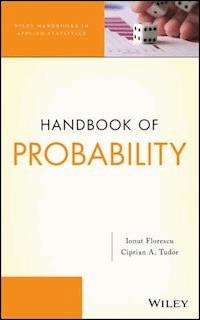
Written in a clear, accessible, and comprehensive manner, the Handbook of Probability presents the fundamentals of probability with an emphasis on the balance of theory, application, and methodology. Utilizing basic examples throughout, the handbook expertly transitions between concepts and practice to allow readers an inclusive introduction to the field of probability.
The book provides a useful format with self-contained chapters, allowing the reader easy and quick reference. Each chapter includes an introduction, historical background, theory and applications, algorithms, and exercises. The Handbook of Probability offers coverage of:
- Probability Space
- Probability Measure
- Random Variables
- Random Vectors in Rn
- Characteristic Function
- Moment Generating Function
- Gaussian Random Vectors
- Convergence Types
- Limit Theorems
The Handbook of Probability is an ideal resource for researchers and practitioners in numerous fields, such as mathematics, statistics, operations research, engineering, medicine, and finance, as well as a useful text for graduate students.
Sie lesen das E-Book in den Legimi-Apps auf:
Seitenzahl: 504
Veröffentlichungsjahr: 2013
Ähnliche


















Contents
Cover
Wiley Handbooks in Applied Statistics
Title Page
Copyright
List of Figures
Preface
Introduction
Chapter One: Probability Space
1.1 Introduction/Purpose of the Chapter
1.2 Vignette/Historical Notes
1.3 Notations and Definitions
1.4 Theory and Applications
1.5 Summary
Exercises
Chapter Two: Probability Measure
2.1 Introduction/Purpose of the Chapter
2.2 Vignette/Historical Notes
2.3 Theory and Applications
2.4 Lebesgue Measure on the Unit Interval (0,1]
Exercises
Chapter Three: Random Variables: Generalities
3.1 Introduction/Purpose of the Chapter
3.2 Vignette/Historical Notes
3.3 Theory and Applications
Exercises
Chapter Four: Random Variables: The Discrete Case
4.1 Introduction/Purpose of the Chapter
4.2 Vignette/Historical Notes
4.3 Theory and Applications
4.4 Examples of Discrete Random Variables
Exercises
Chapter Five: Random Variables: The Continuous Case
5.1 Introduction/Purpose of the Chapter
5.2 Vignette/Historical Notes
5.3 Theory and Applications
5.4 Examples
Exercises
Chapter Six: Generating Random Variables
6.1 Introduction/Purpose of the Chapter
6.2 Vignette/Historical Notes
6.3 Theory and Applications
6.4 Generating Multivariate Distributions with Prescribed Covariance Structure
Exercises
Chapter Seven: Random Vectors in
7.1 Introduction/Purpose of the Chapter
7.2 Vignette/Historical Notes
7.3 Theory and Applications
Exercises
Chapter Eight: Characteristic Function
8.1 Introduction/Purpose of the Chapter
8.2 Vignette/Historical Notes
8.3 Theory and Applications
8.4 Calculation of the Characteristic Function for Commonly Encountered Distributions
Exercises
Chapter Nine: Moment-Generating Function
9.1 Introduction/Purpose of the Chapter
9.2 Vignette/Historical Notes
9.3 Theory and Applications
Exercises
Chapter Ten: Gaussian Random Vectors
10.1 Introduction/Purpose of the Chapter
10.2 Vignette/Historical Notes
10.3 Theory and Applications
Exercises
Chapter Eleven: Convergence Types. Almost Sure Convergence. Lp-Convergence. Convergence in Probability
11.1 Introduction/Purpose of the Chapter
11.2 Vignette/Historical Notes
11.3 Theory and Applications: Types of Convergence
11.4 Relationships Between Types of Convergence
Exercises
Chapter Twelve: Limit Theorems
12.1 Introduction/Purpose of the Chapter
12.2 Vignette/Historical Notes
12.3 Theory and Applications
12.4 Central Limit Theorem
Exercises
Chapter Thirteen: Appendix A: Integration Theory. General Expectations
13.1 Integral of Measurable Functions
13.2 General Expectations and Moments of a Random Variable
Chapter Fourteen: Appendix B: Inequalities Involving Random Variables and Their Expectations
14.1 Functions of Random Variables. The Transport Formula
Bibliography
Index
Wiley Handbooks inApplied Statistics
The Wiley Handbooks in Applied Statistics is a series of books that present both established techniques and cutting-edge developments in the field of applied statistics. The goal of each handbook is to supply a practical, one-stop reference that treats the statistical theory, formulae, and applications that, together, make up the cornerstones of a particular topic in the field. A self-contained presentation allows each volume to serve as a quick reference on ideas and methods for practitioners, while providing an accessible introduction to key concepts for students. The result is a high-quality, comprehensive collection that is sure to serve as a mainstay for novices and professionals alike.
Chatterjee and Simonoff. Handbook of Regression Analysis
Florescu and Tudor. Handbook of Probability
Forthcoming Wiley Handbooks in Applied Statistics
Montgomery, Johnson, Jones, and Borror. Handbook in Design of Experiments
Florescu and Tudor. Handbook of Stochastic Processes
Rausand. Handbook of Reliability
Vining. Handbook of Quality Control
Copyright 2014 by John Wiley & Sons, Inc. All rights reserved.
Published by John Wiley & Sons, Inc., Hoboken, New Jersey.
Published simultaneously in Canada.
No part of this publication may be reproduced, stored in a retrieval system, or transmitted in any form or by any means, electronic, mechanical, photocopying, recording, scanning, or otherwise, except as permitted under Section 107 or 108 of the 1976 United States Copyright Act, without either the prior written permission of the Publisher, or authorization through payment of the appropriate per-copy fee to the Copyright Clearance Center, Inc., 222 Rosewood Drive, Danvers, MA 01923, (978) 750-8400, fax (978) 750-4470, or on the web at www.copyright.com. Requests to the Publisher for permission should be addressed to the Permissions Department, John Wiley & Sons, Inc., 111 River Street, Hoboken, NJ 07030, (201) 748-6011, fax (201) 748-6008, or online at www.wiley.com/go/permission.
Limit of Liability/Disclaimer of Warranty: While the publisher and author have used their best efforts in preparing this book, they make no representations or warranties with respect to the accuracy or completeness of the contents of this book and specifically disclaim any implied warranties of merchantability or fitness for a particular purpose. No warranty may be created or extended by sales representatives or written sales materials. The advice and strategies contained herein may not be suitable for your situation. You should consult with a professional where appropriate. Neither the publisher nor author shall be liable for any loss of profit or any other commercial damages, including but not limited to special, incidental, consequential, or other damages.
For general information on our other products and services or for technical support, please contact our Customer Care Department within the United States at (800) 762-2974, outside the United States at (317) 572-3993 or fax (317) 572-4002.
Wiley also publishes its books in a variety of electronic formats. Some content that appears in print may not be available in electronic formats. For more information about Wiley products, visit our web site at www.wiley.com.
Library of Congress Cataloging-in-Publication Data
Florescu, Ionut, 1973-
Handbook of probability / Ionut Florescu, Ciprian Tudor.
pages cm
“Published simultaneously in Canada”–Title page verso.
Includes bibliographical references and index.
ISBN 978-0-470-64727-1 (cloth) –1. Probabilities. I. Tudor, Ciprian, 1973-II. Title.
QA273.F65 2013
519.2–dc23
2013013969
To the memory ofProfessor ConstantinTudor
List of Figures
Preface
Our motivation when we started to write the Handbook was to provide a reference book easily accessible without needing too much background knowledge, but at the same time containing the fundamental notions of the probability theory.
We believe the primary audience of the book is split into two main categories of readers.
The first category consists of students who already completed their graduate work and are ready to start their thesis research in an area that needs applications of probability concepts. They will find this book very useful for a quick reminder of correct derivations using probability. We believe these student should reference the present handbook frequently as opposed to taking a probability course offered by an application department. Typically, such preparation courses in application areas do not have the time or the knowledge to go into the depth provided by the present handbook.
The second intended audience consists of professionals working in the industry, particularly in one of the many fields of application of stochastic processes. Both authors' research is concentrated in the area of applications to Finance, and thus some of the chapters contain specific examples from this field. In this rapidly growing area the most recent trend is to obtain some kind of certification that will attest the knowledge of essential topics in the field. Chartered Financial Analyst (CFA) and Financial Risk Manager (FRM) are better known such certifications, but there are many others (e.g., CFP, CPA, CAIA, CLU, ChFC, CASL, CPCU). Each such certificate requires completion of several exams, all requiring basic knowledge of probability and stochastic processes. All individuals attempting these exams should consult the present book. Furthermore, since the topics tested during these exams are in fact the primary subject of their future work, the candidates will find the Handbook very useful long after the exam is passed. xvii
This manuscript was developed from lecture notes for several undergraduate and graduate courses given by the first author at Purdue University and Stevens Institute of Technology and by the second author at the Université de Paris 1 Panthéon-Sorbonne and at the Université de Lille 1. The authors would like to thank their colleagues at all these universities with whom they shared the teaching load during the past years.
IONU FLORESCU AND CIPRIAN TUDOR
Hoboken, U.S. & Paris, France
April 18, 2013
Introduction
The probability theory began in the seventeenth century in France when two great French mathematicians, Blaise Pascal and Pierre de Fermat, started a correspondence over the games of chance. Today, the probability theory is a well-established and recognized branch of mathematics with applications in most areas of Science and Engineering.
The Handbook is designed from an introductory course in probability. However, as mentioned in the Preface, we tried to make each chapter as independent as possible from the other chapters. Someone in need of a quick reminder can easily read the part of the book he/she is concerned about without going through an entire set of background material.
The present Handbook contains fourteen chapters, the final two being appendices with more advanced material. The sequence of the chapters in the book is as follows. Chapters 1 and 2 introduce the probability space, sigma algebras, and the probability measure. Chapters 3, 4, and 5 contain a detailed study of random variables. After a general discussion of random variables in Chapter 3, we have chosen to separate the discrete and continuous random variables, which are analyzed separately in Chapters 4 and 5 respectively. In Chapter 6 we discuss methods used to generate random variables. In today's world, where computers are part of any scientific activity, it is very important to know how to simulate a random experiment to find out the expectations one may have about the results of the random phenomenon. Random vectors are treated in Chapter 7. We introduce the characteristic function and the moment-generating function for random variables and vectors in Chapters 8 and 9. Chapter 10 describes the Gaussian random vectors that are extensively used in practice. Chapters 11 and 12 describe various types of convergence for sequences of random variables and their relationship (Chapter 11) and some of the most famous limit theorems (the law of large numbers and the central limit theorems), their versions, and their applications (Chapter 12). Appendices A and B (Chapters 13 and 14) focus on the more general integration theory and moments of random variables with any distribution. In this book, we choose to treat separately the discrete and continuous random variables since in applications one will typically use one of these cases and a quick consultation of the book will suffice. However, the contents of the Appendices show that the moments of continuous and discrete random variables are in fact particular cases of a more general theory. xix
Each chapter of the Handbook has the following general format:
IntroductionHistorical NotesTheory and ApplicationsExercisesThe Introduction describes the intended purpose of the chapter. The Historical Notes section provides numerous historical comments, especially dealing with the development of the theory exposed in the corresponding chapter. We chose to include an introductory section in each chapter because we believe that in an introductory text in probability, the main ideas should be closely related to the fundamental ideas developed by the founding fathers of Probability. The section Theory and Applications is the core of each chapter. In this section we introduce the main notion and we state and prove the main results. We tried to include within this section as many basic examples as was possible. Many of these examples contain immediate applications of the theory developed within the chapter. Sometimes, examples are grouped in a special section. Each chapter of the Handbook ends with the Exercises section containing problems. We divided this section into two parts. The first part contains solved problems, and the second part has unsolved problems. We believe that the solved problems will be very useful for the reader of the respective chapter. The unsolved problems will challenge and test the knowledge gained through the reading of the chapter.




