


2,99 €
Mehr erfahren.
- Herausgeber: Books on Demand
- Kategorie: Gesellschafts- und Liebesromane
- Sprache: Englisch
My reader. Perhaps you have had the good fortune to visit Egypt! If such be the case, you have undoubtedly stood among the giant columns of the Temple to the Sun-god Amen in the Northern Apt (Karnak). You have marveled at the ever changing colors which light up the walls and columns of the Temple of the Southern Apt (Luxor), so that at one moment they seem to have been carved from blocks of amber, at another from coral, jasper, amethyst or, as the last bright rays of the sinking sun fall full upon them, from colossal bars of red Nubian gold. You have gazed in awe and reverence at the mummy of King Amenhotep, lying in his granite sarcophagus, peacefully asleep he seemed, deep down in the very heart of the Theban Hills. In an alcove nearby you may recall the three bodies lying, uncoffined, upon the bare rock of the tomb chamber. You were informed that the bodies had been removed from their own tombs to this secret chamber of a dead Pharaoh, that they might be saved from the hands of tomb-robbers. "The mummies of unknown royal personages," your Arab guide informed you. Perhaps the guide permitted you to touch the long black tresses of one of the three. He pointed out what he called the mark of an arrow, which caused the death of another. He told you that the boy had undoubtedly met his death at the hands of a strangler. He hinted at foul murder! If what he said of the three was true, he might well have attempted to identify the bodies. They are, perhaps, those of Wazmes, Queen Hanit's murdered son, the beautiful slave girl Bhanar, and her one-time mistress, the Princess Sesen, whose wavy black hair appears as soft to-day as when Ramses and Menna wooed her, as when Renny the Syrian died for her. All this, and more, you have doubtless seen.
Das E-Book können Sie in Legimi-Apps oder einer beliebigen App lesen, die das folgende Format unterstützen:
Seitenzahl: 214
Veröffentlichungsjahr: 2020
Ähnliche




















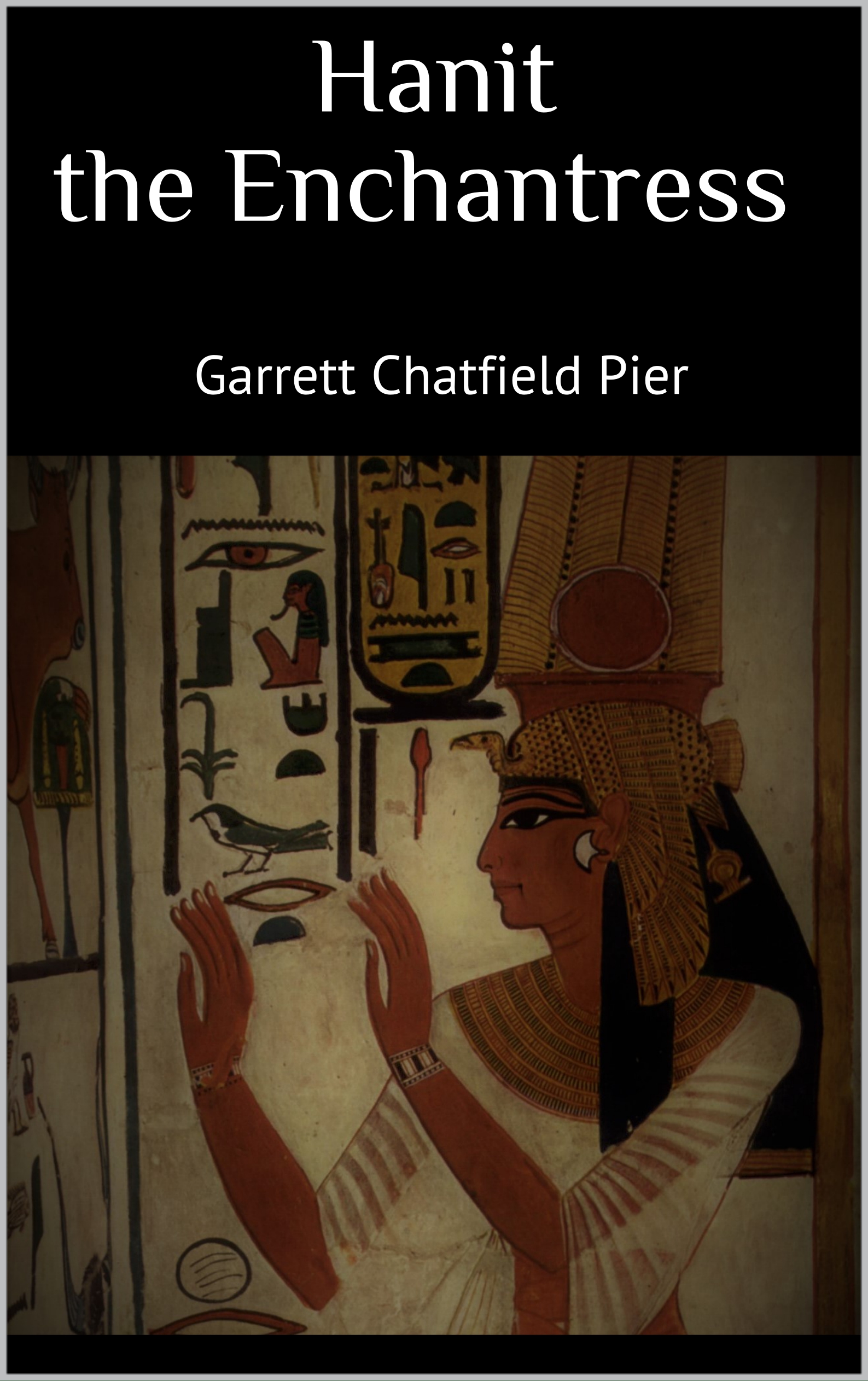
Hanit the Enchantress
Hanit the Enchantress FOREWORDCHAPTER I Tells of How Professor Ranney Purchased an Ancient Manuscript and of What He Found Therein.CHAPTER II A Fall Down Thirty CenturiesCHAPTER III Enana, the Magician, Would Prove That a Resemblance Between a Queen and a Priestess May Be Turned to His Advantage.CHAPTER IV How Bhanar Came to ThebesCHAPTER V The Pleasure Barge of Thi, the Queen-MotherCHAPTER VI How Bhanar Found a Home in EgyptCHAPTER VII How Renny the Syrian Escaped the CrocodilesCHAPTER VIII Nōfert-āri Dances Before PharaohCHAPTER IX The Luminous BookCHAPTER X Pharaoh Seeks to Exalt a Foreign GodCHAPTER XI The Statue of Amen DisappearsCHAPTER XII Enana Calls to His Aid the Gods Justice and VengeanceCHAPTER XIII Ramses and SesenCHAPTER XIV A Rash PromiseCHAPTER XV A Statue of Hathor, Goddess of LoveCHAPTER XVI The Curse of Huy, Great High Priest of AmenCHAPTER XVII Why Menna’s Chairbearer Staked His AllCHAPTER XVIII What Happened When Menna, Son of Menna, Went A-wooingCHAPTER XIX The Hittites AdvanceCHAPTER XX How Bar and Renny Meet for the Last TimeCHAPTER XXI Of the Capture of Belur, the HittiteCHAPTER XXII The “Double” of HanitCopyrightHanit the Enchantress
Garrett Chatfield Pier
FOREWORD
CHAPTER I Tells of How Professor Ranney Purchased an Ancient Manuscript and of What He Found Therein.
The shop of Tanos the Greek, “Dealer in Genuine Antiques,” as the sign above the door advised, might well have been named a museum of ancient art and curiosities. Entered from the front of the Sharia Kamel, one of the main thoroughfares of Cairo, the shop appeared at first glance to consist of but two long narrow rooms, the one immediately behind the other. Both rooms were filled to the very ceiling with curios of all sorts, from little agate beads to vast and shapeless mummies of Sacred Bulls. A half dozen bodies of Egyptian priests, unwrapped and black with natron, stood propped against the walls of the upper room. The odor of cinnamon, myrrh and other embalming essences filled the rooms and drifted out through the open door to blend with the indefinable, but never forgettable, odor of the Cairene streets.
A nearer view of the upper room disclosed the approach to what Tanos called the “holy of holies.” This third, or innermost chamber, was screened from the eyes of the ordinary souvenir hunter by an ivory-inlaid door of ancient Coptic woodwork.
Connoisseurs generally knew that here were kept the treasurespar excellence. Here Tanos would display rare statuettes, bronzes, ivories and richly glazed potteries for the archæologist; inscriptions on stone or papyrus for the philologist; diadems or pendants in the precious metals, necklaces, bracelets and bangles of varicolored gems,—all such rich treasure from the seemingly inexhaustible storehouse of antiquity as would be most likely to tempt the antiquarian, or dazzle the mere man of millions seeking to enrich his curio cabinet or the shelves of his pet museum or institution.
During the course of an unusually hot afternoon in late March three Europeans paused at the threshold of Tanos’ shop.
Following their exit from the Ezbekiyeh Gardens their footsteps had been dogged by that genial soul, Ali Nubi, whose efforts to dispose of fly-whisks and sunshades were in no wise affected by the temperature. He was soon joined by a troupe of exceedingly dirty Arab children. These turned handsprings along the gutter in hopes of some small coin with which to buyloukum.
Finally, the nerves of the three Europeans had been set on edge by the insistent whine of a deformed Egyptian, whose ceaseless cry for dole, “baksheesh, baksheesh, ya khawageh,” finally caused one of the trio to turn upon him with an impatient,Allah yalik, kelb ibn kelb. This, in plain English, might be rendered, “May God give to thee, dog, son of a dog,” at once a pious wish and a curse.
The sound of the guttural Arabic sufficed to scatter at one and the same instant all three disturbing elements.
The ragged boys fled. Ali Nubi sauntered off to display his merchandise and his famous smile elsewhere, whilst the cripple, with a frightened glance up and down the street, made off as fast as his deformities would allow. The white man was doubtless apasha, abey. Abut Talib felt the sting of the bastinado upon his withered limbs!
With a laugh the “bey” turned to his companions:
“ Enter, Mrs. Gardiner! After you, Clem! I want you to see my latest find.”
Professor Ranney followed his companions into the shop. In answer to his call Tanos himself appeared at the door of the sanctum. His face lit up with a smile of genuine pleasure when he recognized his visitors.
He crossed the room with that peculiar crooking of the spine which appears to be an ineradicable heritage of the ages to Levantines of his stamp wherever met. How well did the Egyptian sculptor of the late New Empire catch that deferential abasement of self!
Professor Ranney shook hands with Tanos. Gardiner, too, greeted him, and introduced the lady of the trio as his bride. For an instant Tanos searched his fertile brains for a suitable congratulatory quotation from the Arabian classics. Oriental etiquette demanded that he rise to the emergency. Finally, bending over Mrs. Gardiner’s hand, Tanos murmured those charming lines from Abu Selim’s poem on the love of Omar and Leila.
“ Oh, Mr. Tanos! What exquisite verses. What a wonderful gift of improvisation!”
Tanos bowed again. He made a deprecatory gesture, murmuring as he did so something about the meter of the second line.
Mrs. Gardiner shot a covert glance in the direction of her husband.
The minx, thought he. He well knew that she had recognized the true authorship of the verses. Mrs. Gardiner had been a former student of her husband at the University of London, where he taught Semitics.
These small social amenities attended to, Tanos ushered his visitors into the innermost room. In another moment all four were seated about a low Turkish table. Upon this reposed two objects, a turquoise-blue goblet of ancient Egyptian pottery and a linen roll, seemingly of great antiquity, if one might judge by its condition.
Meeting the Gardiners in the tea-house of the Gardens, Professor Ranney had urged them to walk over to the shop, in order that they might see the contents of this linen roll, a papyrus scroll of greatest importance, not alone on its own account, but, more especially, for the remarkable document which it contained.
Professor Ranney carefully unrolled the frail, discolored linen in which, three thousand years before, the scroll had been wrapped. At once the air was filled with a strange, aromatic perfume.
At sight of the brightly painted vignettes which ornamented each and every page of the closely written sheets, Mrs. Gardiner burst into repeated exclamations of rapture. Even Dr. Gardiner, her husband, who may be said to have lived in an atmosphere charged with the odor of ancient parchments, could not repress his interest.
This interest was intensified when he read, on the front page of the manuscript, the names of an ancient Egyptian monarch “Nibmara Amenhotep, King of Upper and Lower Egypt, Triumphant.”
“ This is indeed a treasure, Steven! A perfect copy of the Book of the Dead. You did well to purchase it before I got wind of it. By Jove! It is in better condition than the Papyrus of Ani in the British Museum!”
Without replying Steven Ranney turned to the last two pages of the scroll. Inserted between them was a brown stained sheet of hieroglyphics written in red ink.
“ Read this, Clem. To me it appears to be a find of far more importance than the Ritual itself.”
Gardiner translated aloud the lines of somewhat tremblingly written hieroglyphics:
“ A Contract which the Hereditary Prince, the Count, Sole Companion of the King, Instructor of the Royal Princess, and Chief Royal Architect, Amenhotep, son of Hap, made with Hotepra, Great High Priest of Amen.
“ It is ordained that there be given to the statue of Amenhotep which is in his tomb on the western shore, 1,000 loaves of bread, 1,000 fatted geese, 1,000 jars of wine and 100 bulls, upon the 1st day of the 1st month of the year, what time the servants bring presents to their lord, and lights are lit in house, in tomb and in temple!
“ In payment of this endowment of his tomb, Amenhotep, son of Hap, engages to reveal to Hotepa, Great High Priest of Amen, the secret hiding-place of the Luminous Book of Thoth, Scribe of the Gods!
“ Behold! Amenhotep, son of Hap, he saith: ‘By the magic incantation contained within this book the Gods are compelled! By its hekau-charms the Boat of the Sun is stopped, the Moon is darkened!
“ Lo, he that reciteth the formulæ contained therein, may descend into the Underworld and return to mingle again with mortal men.
“ Lo, the possessor of this Book becomes as the Scribe of the Gods, Thoth himself! For Ra hath breathed upon it; Shu hath entered it!
“ Saith Amenhotep, son of Hap: ‘Behold, as Ra the Sun-god liveth, the Magic Book may be found in a box behind the wall of the false door built within the western end of my tomb chamber!’
“ Now, Hotepra heard the oath of Amenhotep and the saying which he said.
“ Lo, Hotepra, Great High Priest of Amen, believed the words of the son of Hapi.
“ Hotepra, Great High Priest of Amen, signed the contract, taking the Great Gods, Osiris, Ptah and Ra as witnesses.”
“ There, Clem! In all your years of research among ancient documents have you ever run across the Luminous Book, the Book of Thoth? Could it, by any chance, be that mysterious book made use of long ago by the sorcerers and magician attached to the great Temple of Amen at Thebes? If such be the case, it is an undoubted reference to the book from which Moses studied, the source of Aaron’s successful attempt to confound the magicians of Pharaoh. At any rate, Clem, you will agree with me that this faded sheet, this last will and testament of the old architect, may turn out to be of far greater interest than even this splendid copy of the Ritual. I wonder if the will was placed in the Ritual on purpose or through the carelessness of someone. Hotepra himself it may have been, three thousand years ago!”
Dr. Gardiner smiled at his friend’s enthusiasm: “One thing at a time, Steven! Yes, I have met with the Book of Thoth before. And in each and every case it was referred to as a book containing magical incantations of great power. In one case an unknown architect states that he ‘raised this monument whose pylons reach the dome of heaven by means of the magic Book of Thoth.’ Your man, Amenhotep, son of Hap, has left an inscription, now in the Leiden Museum, in which he affirms that he ‘possessed the Eye of Horus’—whatever that may mean—and further that he was ‘one who knew all the Wisdom contained in the Book of Thoth, scribe of the Gods.’ That this was no empty boast we may sight the stupendous temples raised by him at Thebes, not forgetting ‘the Colossi,’ which alone would have assured him undying fame, if indeed he erected them. The tomb to which he refers in this testament is thought to be beneath the Temple of Der el-Medinet. Possibly it is included in your concession, Steven. Your men may stumble upon the mummy of Amenhotep, Magic Book and all!”
Dr. Gardiner turned to his wife: “Well, Dear! We must be off, to help Ali with the packing. I hope you have a successful winding up of the diggings, Steven!”
“ And Steven,” broke in his wife, “do let those abominable old brick ruins alone and hunt for the Book instead. By the way, do you suppose Hotepra had a wife? The name is similar to that of Potiphar?”
“ My dear,” interposed Gardiner, as he assumed an expression of shocked delicacy, “the subject is hardly one for a bride to discuss, especially as Great High Priests of Amen, by the uninitiated at least, arepresumedto have had no wives.”
He turned to Ranney: “Steven, we both hope that you can stop over at ‘Sevenoaks’ as usual, for a few days at least, on your way through to Liverpool. Whew! It is difficult to realize that we shall be enjoying the Mediterranean breezes to-morrow. Which reminds me. Tanos, don’t forget to have the Museum authorities place theirviséon that statue of Isis. Bénédict has his eagle eye upon it, and what Bénédict wishes he usually obtains. A littlebaksheeshin the clammy palm of Pintsch Pasha will help to get it through!”
Dr. Gardiner turned again to his wife: “Now, Miriam, don’t drop that goblet! We could never pay for it, though I read manuscripts until the crack of doom!”
With exaggerated care Mrs. Gardiner restored the beautiful goblet to its place. She then shook hands with Tanos, reiterated her husband’s wish that Professor Ranney visit them in their new home, and left on the arm of Dr. Gardiner.
Steven Ranney turned to the Greek: “Tanos, put the scroll in your safe until I return. The will of Amenhotep I will take with me. I want to show it to Todros Pasha. He’s pretty familiar with the tombs of the western bank. I’ll see you in about three weeks’ time. Meanwhile, if you manage to get that statue of Hathor from Nahman, I’ll take it.”
With a friendly nod the young American again braved the heat of the unprotected sidewalk.
Ranney took his way northward, along the Sharia Kamel, in the direction of Doctor Braintree’s tree-embowered villa.
During his three days’ relaxation from the strain of acting as chief-of-excavations amid the heat and dust of work in Upper Egypt, Ranney had contrived to see more of Susan Braintree than usually fell to his lot. Ranney had loved her from the very first moment he had seen her, and that was as far back as February, nearly two months!
It is unnecessary to describe Susan. Ranney did that in every letter he wrote home to his mother and sister in beautiful Greenwich, Connecticut. Susan was there described as a paragon of beauty and sweetness. Yet, there seemed to be a fly in the ointment. A tall and “not a bad looking sort of chap,” so Ranney described him, a lieutenant of the Seaforth Highlanders, apparently caused Steven not a little worry. It seemed that back in their Highland home he lived in the same Scottish village as the Braintrees, brother and sister.
“ By George, I’ll take old Amenhotep’s will to Braintree’s dinner to-night. I’m sure Susan will be interested; at any rate, she’ll pretend to be, bless her. Perhaps she’ll find it more to her taste than that Egyptian flint knife I showed her yesterday. Yet, I am surprised that a surgeon’s sister, and a head-nurse at that, should evince such horror of a knife, even though that ancient instrument had served the embalmer to make the last great incision.”
Late that evening, after a few short but blissful hours spent by Susan’s side—Lieutenant Angus Hector McPherson being then on duty at the Garrison—Ranney threw his kitbag into a sleeper of the night train to Upper Egypt.
After some ten hours of fitful sleep amidst the choking dust and fine sand which would persist in floating into the compartment, Steven Ranney found himself once again upon the very modern station platform of Thebes, the world’s most ancient city.
CHAPTER II A Fall Down Thirty Centuries
The research work conducted by Professor Ranney, as chief of the Yale expedition to Egypt, had lain in and about the site of the Mortuary Temple of King Amenhotep the Third, well-named “Magnificent.” The low depression which to-day marks the site of this once gorgeous edifice lies well down upon the broad Theban Plain, and immediately fronts that long line of rocky mounds, refuse heaps and ruined tombs which rises, tier upon tier, along the lower slopes of the towering Libyan Hills.
It had been a site of rare possibilities from an Egyptologist’s point of view. On this account excavation privileges hereabouts had been sought by representatives of every great museum or seat-of-learning both in the Old World and the New.
When, finally, the news was telegraphed from Cairo that this most coveted concession had fallen to the Yale Expedition, and that together with a substantial area of the unexplored mounds to the north and south of the temple site, great had been Professor Ranney’s joy.
The recent unearthing of the body and rich treasure of Pharaoh Akhten-aton, son to that Pharaoh by whom the temple was built, and the discovery of the rich and comprehensive tomb-equipment of Akhten-aton’s father and mother-in-law, together with the marvelously preserved mummies of those ancient worthies, had fired the dampened ardor both of the workers in the field, and, more important still, perhaps, of those holders of the purse-strings, the sponsors for the expedition at home.
As I have said above, the site of King Amenhotep’s Mortuary Temple had been freely acknowledged to be a very promising one, and so far these hopes had been entirely justified.
Many and rare had been the finds during the season’s work now drawing to a close. And it was not improbable that some other find of the first importance might still fall to the spades of the excavators during the next few weeks of work upon the site.
Think what the nearby Temple of Medinet might at this very moment hold for Professor Ranney! The tomb of Amenhotep, son of Hap; the Magic Book of the Sorcerers of Pharaoh, the Luminous Book of Thoth!
Had they had the least suspicion of Professor Ranney’s secret it is safe to say that many of his brother scientists would gladly have bartered five years of their lives for a chance at the site. And yet, could any one of those enthusiasts have foreseen the disaster that would here befall him, not a man among them would have approached it.
But let us take up the tale, as long as we may, in Professor Ranney’s own words.
I had recently completed my work in and about the site of the Mortuary Temple of the illustrious Pharoah Amenhotep the Third and had already promised myself a trial excavation at the nearby tomb of Pharaoh’s famous architect and namesake, Amenhotep, when something unexpected occurred to effectually put an end to all my plans. What that something was you shall now hear!
As near as I can piece together the amazing threads of my story, this is what happened to me that last eventful evening in Thebes. My diary, in part, supplies the clue.
Under date of April 28, 1913, and immediately following the rough translation of a great memorial tablet which had been found the previous day, I note this entry: “Sandstorm just blown over. Headache, feverish. Finished making plan of palace to scale.”
Now, in spite of the temperature and headache to which I here refer, and which, had I not been so keen on my work, I should most certainly have recognized as a symptom of trouble to come, I had evidently sought to catch up with a somewhat neglected report of the season’s work.
This occupation had apparently kept me at my desk well on towards dawn. I deduce this from the fact that immediately following the above short entry, I find a number of fragmentary hieroglyphic inscriptions having to do with the history of the foundation and erection of Pharaoh’s Mortuary Temple, upon which I had been so long at work.
One of these entries is of special interest in this connection, since, after a lapse of some three thousand years, the two colossal statues of King Amenhotep III, to whom it refers, may still be seen gazing stolidly and immutably eastward across the broad reaches of the Theban Plain.
The following graphic description of the now vanished building itself, a literal translation from the original hieroglyphic, is the last entry in my diary, the last for many a long day, I may add. Further, and for an excellent reason, this last entry was never completed. The translation runs in the following somewhat grandiloquent and semi-poetic vein: “It hath been given me to set up in a holy place two great statues of the Son of Ra, Amenhotep, Conqueror of Asia. These are they which stand before the entrance portal of the Mortuary Temple of His Majesty (Life, Stability and Health to him). Carved from solid blocks of the hard grit-stone of On, they tower seventy feet into the air. Their golden headdresses touch the very dome of heaven. On either side, gold-capped obelisks of red granite reach high above the temple pylons. Four cedar flag-staffs tipped with gold rise from grooves cut in the sculptured sandstone of the temple front. The walls of the temple are carved and richly painted with scenes representing the Asiatic conquests of Pharaoh, Lord of Might. Its great bronze doors are inlaid in gold with the figure of the God Min of Coptos. Through this jeweled outline of his ‘double’ twice daily doth the Great God enter the Holy Sanctuary, there to partake of the offerings spread upon its jeweled altars. In his honor are the ceilings covered with true lazuli of Babylon, its floors enriched with silver and sprinkled with powdered turquoise. Its gleaming walls are engraved with designs representing the New Year’s procession of the Sun Barque, from the Northern to the Southern Apt. Beside the High Altar stands a tablet thirty feet in height, covered with gold and inlaid with sard and emerald. Thus is marked ‘The-Place-Where-His-Majesty-Stands-at-the-Sacrificing.’ Beq, son of Beq, carved the statues and erected the obelisks. Renny, the Syrian, overlaid and enriched the tablet.”
Inserted here was a drawing of the above mentioned tablet, and, upon it, the following additional fragment: “Memorial-tablet found face downwards. I enclose drawings and translations. Evidentlymineis a very ancientname? All traces of——.”
Here the diary abruptly stops!
Now, I directly trace the mishap which thereafter befell me to the discovery of this same tablet.




