


0,49 €
Mehr erfahren.
- Herausgeber: e-artnow Collections
- Kategorie: Gesellschafts- und Liebesromane
- Sprache: Englisch
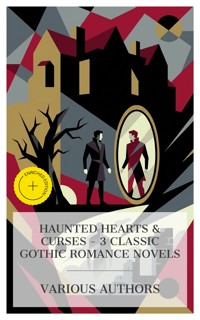
Haunted Hearts & Curses – 3 Classic Gothic Romance Novels encapsulates the haunting and opulent world of Gothic romance through the riveting tales penned by masterful authors such as Mary Shelley, Emily Brontë, and Oscar Wilde. This anthology weaves together themes of passion, madness, and the supernatural, characteristic of the Gothic tradition. Immersed in a variety of literary styles that range from the epistolary and poetic to the melodramatic and satirical, the collection presents a tapestry of eerie atmospheres and dark, brooding settings. Noteworthy within these pages are tales that mesmerize with their atmospheric description and psychological depth, leaving readers entranced. The anthology is enriched by the distinct voices of its contributing authors, each bringing an individual flair that elevates the Gothic genre. Mary Shelley, revered as one of the progenitors of Gothic literature, offers the collection a foundation of existential contemplation and horror. Emily Brontë infuses the anthology with intense emotion and wild, tempestuous landscapes that reflect her literary prowess, while Oscar Wilde provides an articulate exploration of beauty intertwined with moral decay and wit. These authors collectively beckon readers into a realm where history and imagination conspire to challenge societal norms and delve into the human psyche. Readers are invited to explore Haunted Hearts & Curses for its unparalleled contribution to the Gothic romance tradition. This uniquely curated anthology offers an encounter with multiple narrative voices, each bringing profound insights and fostering a rich dialogue across time and imagination. Dive into this volume for an unforgettable literary experience that reveals the variegated tapestry of the Gothic romance genre, supremely crafted by the genre's finest voices. Perfect for scholars and aficionados alike, it's a collection that stimulates both mind and senses. In this enriched edition, we have carefully created added value for your reading experience: - An Introduction draws the threads together, discussing why these diverse authors and texts belong in one collection. - Historical Context explores the cultural and intellectual currents that shaped these works, offering insight into the shared (or contrasting) eras that influenced each writer. - A collective Analysis highlights common themes, stylistic variations, and significant crossovers in tone and technique, tying together writers from different backgrounds. - Reflection questions encourage readers to compare the different voices and perspectives within the collection, fostering a richer understanding of the overarching conversation.
Das E-Book können Sie in Legimi-Apps oder einer beliebigen App lesen, die das folgende Format unterstützen:
Veröffentlichungsjahr: 2026
Ähnliche










Haunted Hearts & Curses – 3 Classic Gothic Romance Novels
Table of Contents
Introduction
Curatorial Vision
This collection brings together Mary Shelley's Frankenstein, Emily Brontë's Wuthering Heights, and Oscar Wilde's The Picture of Dorian Gray as a concentrated study in Gothic romance at its most intimate and disturbing. Each work binds desire to transgression and turns inward feeling into an outward atmosphere of dread, estrangement, and moral pressure. Read together, they reveal a tradition concerned not simply with terror, but with attachment under conditions of obsession, secrecy, and self-division. The aim is to show how Gothic romance became a vehicle for examining passion when it exceeds social measure and unsettles the boundaries between love, identity, and conscience.
The selection rests on a shared philosophical terrain. In all three novels, longing is inseparable from consequence, and beauty or vitality appears shadowed by corruption, injury, or loss. Shelley, Brontë, and Wilde each test the limits of human aspiration, asking what follows when creation, affection, or self-fashioning rejects ordinary restraints. Their protagonists move through charged moral landscapes where private impulses acquire almost supernatural force. By placing these works side by side, the collection traces an arc from haunted making, to haunted attachment, to haunted self-regard, showing how Gothic romance can dramatize both the hunger for transcendence and the cost of pursuing it.
Presented together, these novels illuminate one another in ways less visible when encountered alone. Frankenstein explores responsibility through acts of making and abandonment; Wuthering Heights turns emotional extremity into a whole climate of memory and reprisal; The Picture of Dorian Gray refines Gothic anxiety into an artful meditation on appearance, influence, and decay. The curatorial purpose is therefore comparative rather than merely accumulative. This grouping foregrounds a lineage of inward disturbance expressed through memorable images, heightened settings, and ethically fraught relationships, allowing the reader to follow recurring concerns across different moments of nineteenth-century writing without reducing their distinct achievements.
The collection also distinguishes itself by framing these novels not only as canonical Gothic works, but as a sustained conversation about romance under pressure. Rather than treating terror, passion, and moral crisis as separate categories, it highlights their persistent entanglement. Shelley gives the mode a speculative and tragic reach, Brontë intensifies its emotional violence within domestic and elemental settings, and Wilde turns it toward aesthetic temptation and self-corruption. Considered in sequence, they map changing forms of Gothic interiority while preserving strong formal contrast. The result is a focused encounter with three authors who made the genre a means of testing what the heart can desire and endure.
Thematic & Aesthetic Interplay
These novels speak to one another through a shared language of doubles, reflections, and divided selves. In Frankenstein, Wuthering Heights, and The Picture of Dorian Gray, inner states do not remain private; they return in figures, images, or environments that seem to confront the characters with what they would evade. The self appears unstable, pursued by its own consequences. This pattern creates a rich conversation among the works, since each imagines moral recoil differently: as the burden of creation, as the persistence of attachment beyond social order, and as the visible pressure of hidden corruption. Gothic romance here becomes a theater of inward exposure.
Recurring motifs deepen that exchange. Beauty is never secure in these novels; it invites desire while concealing danger, fragility, or decay. Houses, rooms, and thresholds hold emotional residue, giving architecture and enclosure a moral charge. Nature, too, is more than background. In Shelley and Brontë especially, landscape registers extremes of isolation, aspiration, and unrest, while Wilde translates atmospheric tension into interiors shaped by taste and secrecy. Across all three, memory behaves like a haunting force, preserving injuries that resist conclusion. The recurring dilemma is whether feeling can remain innocent once bound to possession, vanity, resentment, or ambition. Each novel answers by intensifying romance into ethical crisis.
Their contrasts are as important as their affinities. Frankenstein carries a grave, searching intensity shaped by questions of knowledge and accountability. Wuthering Heights is harsher, more turbulent, and more elemental, converting emotional fixation into a stark social and familial drama. The Picture of Dorian Gray is cooler on the surface, sharpened by wit and cultivated sensibility even as it descends into spiritual unease. These tonal differences create a productive dialogue within the collection. Shelley's tragic expansiveness, Brontë's fierce compression of feeling, and Wilde's polished morbidity demonstrate how Gothic romance can move among speculative meditation, passionate violence, and aesthetic seduction while remaining recognizably part of one tradition.
There are also meaningful lines of influence and allusion among these authors. Shelley establishes a foundational modern Gothic pattern in which the desire to exceed limits generates forms of self-estrangement that are at once psychological and uncanny. Brontë inherits and transforms that inheritance, stripping away ornament to produce a rawer vision of attachment as haunting persistence. Wilde, writing later, engages a tradition already shaped by such earlier intensities and redirects it toward the relation between art, self-fashioning, and moral decomposition. Without collapsing their differences, this collection shows a discernible continuity: each author revisits the Gothic as a mode for testing how desire alters perception, memory, and responsibility.
Enduring Impact & Critical Reception
These works remain vital because they continue to furnish language and form for persistent modern anxieties. Frankenstein speaks to debates about creation, responsibility, and the unforeseen life of human acts. Wuthering Heights endures as a searching account of desire that resists sentimental simplification and exposes the violence entwined with possession. The Picture of Dorian Gray retains its force in discussions of beauty, performance, influence, and the costs of treating the self as an object to be perfected. Together they show that Gothic romance is not an antique curiosity but a living framework for thinking about intimacy, ambition, and moral fracture in unsettled times.
Their critical standing has long been marked by both admiration and dispute, which is itself part of their power. Each novel has prompted argument about ethics, form, and the relation between sympathy and judgment. Shelley has been read through questions of scientific aspiration and social neglect, Brontë through the problem of whether destructive passion can be represented without endorsement, and Wilde through the tensions among aestheticism, morality, and self-concealment. Broadly considered, these debates have kept the novels active in literary study because none yields a single settled meaning. Their ambiguities sustain serious rereading and ensure that admiration remains inseparable from scrutiny.
The cultural afterlives of these works are equally expansive. Frankenstein has become a central modern myth, invoked across discussions of invention, monstrosity, and unintended consequence. Wuthering Heights has inspired enduring responses in performance and visual culture, where its atmosphere of elemental longing continues to signify romance at its most troubling and intense. The Picture of Dorian Gray persists wherever youth, image, and moral erosion are imagined in relation to one another. Such broad circulation matters because it confirms that these novels exceed their immediate narratives. Their figures and situations have entered common cultural memory, carrying Gothic romance into new artistic and public vocabularies.
As a collection, Haunted Hearts & Curses underscores why these three novels continue to matter most when read in concert. They reveal a tradition able to absorb philosophical inquiry, emotional extremity, and aesthetic self-consciousness without losing narrative urgency. Mary Shelley, Emily Brontë, and Oscar Wilde each made Gothic romance a serious instrument for examining the desires that animate and deform human life. Their works remain enduring not because they offer consoling answers, but because they render conflict with unusual clarity and imaginative force. Read together, they present a durable history of haunted feeling, one that still shapes how love, beauty, secrecy, and conscience are understood.
Historical Context
Socio-Political Landscape
The world surrounding Mary Shelley, Emily Brontë, and Oscar Wilde was marked by rapid and often unsettling change. From the aftermath of the French Revolution through the height of the British Empire, political authority in Britain was repeatedly challenged by war, industrial expansion, and demands for reform. Gothic romance flourished in this atmosphere because it could dramatize anxieties that polite realism sometimes softened: unstable inheritance, threatened households, social outsiders, and the fear that progress might carry hidden costs. Each novel in this collection emerges from a different phase of the nineteenth century, yet all are shaped by societies negotiating power, class, gender, and moral regulation.
Frankenstein belongs to the post-Napoleonic moment, when Europe was still reckoning with revolutionary violence and restored conservative order. Mary Shelley wrote in a climate haunted by the promises and disasters of radical change. The generation before her had witnessed the collapse of old certainties, and debates over liberty, authority, and human perfectibility remained vivid. Her novel reflects a world in which ambition can seem both heroic and catastrophic, mirroring wider fears about what happens when inherited limits are rejected. The book’s landscapes of pursuit, exile, and responsibility resonate with a continent trying to stabilize itself after war while still haunted by political and moral upheaval.
The early nineteenth century was also transformed by industrialization, enclosure, and changing class relations, developments especially relevant to Wuthering Heights. Emily Brontë’s Yorkshire setting may appear remote from cities and factories, yet its fierce conflicts over property, dependency, and status belong to a society increasingly organized by ownership and legal power. Rural households were not outside modernity; they were sites where inheritance law, patriarchal authority, and economic calculation operated with great intensity. The novel’s emotional violence gains historical force from these pressures. Desire is never merely private, because land, lineage, and household command shape who may belong, who may rise, and who remains precarious.
Victorian Britain, the setting from which The Picture of Dorian Gray emerged, was dominated by imperial confidence yet troubled by moral strain. By the late nineteenth century, London stood as a center of wealth, bureaucracy, and spectacle, but also of surveillance and anxiety about degeneration, vice, and social fragmentation. Oscar Wilde’s novel speaks to a culture obsessed with respectability while fascinated by transgression. Debates over urban anonymity, luxury, and the hidden life of the metropolis inform its atmosphere. The apparent polish of elite society becomes historically legible as part of a broader system that linked class privilege, public image, and the anxious policing of private conduct.
Across the century, legal and political reforms altered British society without resolving its inequalities. Expanding print culture, parliamentary reform, and debates over poor relief, labor, and education created new reading publics and sharpened awareness of social hierarchy. For women writers, publication itself occurred within restrictive assumptions about authority, intellect, and decorum. Mary Shelley and Emily Brontë wrote in periods when female authorship could be scrutinized through gendered expectations, while Wilde confronted a different but equally coercive regime of moral judgment. These novels therefore arise not only from private imagination but from systems that sorted voices by class, sex, and reputation, defining which desires and forms of knowledge could appear legitimate.
Questions of gender and domestic power connect all three novels to major nineteenth-century controversies. The family was often treated as the foundation of social order, yet it was also a site of coercion, inheritance conflict, and emotional discipline. Frankenstein imagines the consequences of severing creation from ordinary kinship; Wuthering Heights explores how households can become theaters of domination rather than refuge; and The Picture of Dorian Gray exposes the fragility of masculine self-fashioning under intense social scrutiny. In each case, intimate life reflects public structures. The Gothic mode makes visible how authority operates through affection, dependency, and moral expectation, not simply through formal laws or institutions.
By the fin de siècle, the pressures of censorship and scandal gave Wilde’s novel especially charged political significance. Its reception cannot be separated from a culture eager to defend conventional morality while consuming stories of decadence and sensation. The controversy surrounding The Picture of Dorian Gray illustrates how literary form could become entangled with legal and social power, especially where questions of desire, beauty, and influence were concerned. Read alongside Frankenstein and Wuthering Heights, Wilde’s work shows the persistence of a Gothic politics across the century: what society labels monstrous, improper, or dangerous often reveals the fears embedded within its own norms.
Intellectual & Aesthetic Currents
These three novels stand at the intersection of major nineteenth-century intellectual movements. Gothic romance provided a language for terror, sublimity, haunting memory, and moral ambiguity, but each author adapts that language to a distinct historical moment. Mary Shelley writes where Enlightenment rationality meets Romantic unrest; Emily Brontë transforms Gothic inheritance through psychological intensity and elemental landscape; Oscar Wilde reworks it through aestheticism, urban sophistication, and late-Victorian unease. Together they trace a long arc in which the Gothic ceases to be merely antiquarian or sensational and becomes a flexible instrument for probing consciousness, ethics, and the unstable relation between outer beauty and inner disturbance.
Frankenstein was shaped by the clash between Enlightenment confidence in reason and Romantic suspicion of unchecked mastery. Mary Shelley inherited a culture fascinated by experiment, discovery, and the expansion of human knowledge, yet equally drawn to the sublime power of nature and the emotional depths of the individual mind. Her novel does not simply reject science; it dramatizes the moral vacuum that can arise when technical capability outruns sympathy and responsibility. This tension reflects an age excited by chemistry, electricity, anatomy, and exploration. The Gothic here absorbs scientific modernity, turning laboratories and intellectual ambition into sources of dread previously associated with ruins and superstition.
Romanticism also informs the emotional weather of Wuthering Heights, though Emily Brontë’s use of it is singular. The novel takes familiar Romantic elements—wild landscape, intense feeling, rebellion against restraint—and subjects them to a harsher discipline. Nature is not merely consoling or spiritually elevating; it is resistant, fierce, and entangled with obsession. The moors are less a picturesque backdrop than an extension of turbulent inward life. At the same time, the novel departs from easy sentimentalism by presenting passion as historically and materially grounded. Brontë fuses lyric intensity with social realism, creating a Gothic romance that feels at once mythic, local, and psychologically unsettling.
Questions of narration and subjectivity are central to the anthology’s aesthetic importance. All three novels rely on forms of mediation that complicate truth: embedded testimony, recollection, portraiture, rumor, and selective self-presentation. Such structures reflect a nineteenth-century preoccupation with the limits of knowledge about the self and others. Rather than offer stable omniscience, these works make readers navigate competing perspectives and uncertain motives. This formal instability aligns with Gothic themes of doubleness and concealment, but it also anticipates modern psychological fiction. The haunted quality of these novels comes partly from their narrative methods, which suggest that consciousness itself is layered, elusive, and vulnerable to distortion.
The Picture of Dorian Gray belongs to the world of aestheticism and decadence, movements that challenged the demand that art serve straightforward moral instruction. Wilde’s emphasis on style, surface, wit, and cultivated sensation reflects a broader late-Victorian insistence that beauty has its own intellectual seriousness. Yet the novel does not merely celebrate aesthetic autonomy; it tests the costs of treating life itself as an artistic performance. This inquiry was sharpened by contemporary interests in consumer luxury, collecting, design, and refined self-presentation. Gothic romance is thus renewed through the language of exquisite surfaces, where the polished object becomes a vehicle for unease, corruption, and divided identity.
Scientific and pseudo-scientific thought evolved dramatically between Shelley and Wilde, and these changes help explain the anthology’s range. Frankenstein reflects early nineteenth-century speculation about life processes and the boundaries of creation. By contrast, The Picture of Dorian Gray emerges amid later Victorian discussions of heredity, degeneration, nerves, and the effects of environment and influence. Wuthering Heights occupies a middle position, less overtly scientific but deeply engaged with questions of temperament, inheritance, and embodied feeling. Across the three works, the human being is never a settled category. The novels repeatedly ask whether identity is made by origin, passion, choice, or external force, and they refuse easy answers.
A final unifying current is the transformation of the Gothic from an external architecture of fear into an interior and social one. In these novels, dread does not depend chiefly on castles or medieval remnants, though echoes of older Gothic conventions remain. Instead, terror migrates into the mind, the family, the artwork, and the body. Mary Shelley brings terror into the domain of modern knowledge; Emily Brontë into intimate memory and desire; Oscar Wilde into self-conscious performance and urban secrecy. This evolution helps explain the anthology’s enduring coherence. Each work uses Gothic romance not as escapism from modernity, but as one of the most powerful forms for understanding it.
Legacy & Reassessment Across Time
The reputations of Frankenstein, Wuthering Heights, and The Picture of Dorian Gray have shifted profoundly as later generations found new historical meanings in them. Works once treated as sensational, morbid, or morally dubious came to be recognized as central to debates about modern identity, ethics, and artistic form. Their afterlives were shaped by industrial modernity, the growth of universities, changing gender politics, and the expansion of mass media. As criticism professionalized in the twentieth century, these novels became touchstones for discussing the Gothic not as a minor or escapist mode, but as a serious literary response to crisis, desire, and social contradiction.
Frankenstein has undergone especially dramatic reinterpretation. Nineteenth-century readers often approached it as a powerful tale of horror and speculation, but the twentieth century, marked by mechanized warfare, nuclear science, and bioethical controversy, made its questions newly urgent. The novel came to symbolize fears about invention without accountability, while also inviting sympathy for the excluded being produced by systems of ambition and neglect. Later scholarship expanded this frame further, reading the book through gender, parenthood, ecology, and global histories of exploration and empire. Rather than yielding one stable moral lesson, Frankenstein has remained a flexible lens for understanding the responsibilities that accompany creative power.
Wuthering Heights, initially received with bewilderment or alarm by some readers, later became central to discussions of psychological depth, narrative complexity, and the representation of desire. Twentieth-century criticism often moved beyond viewing it as merely wild or excessive, emphasizing its formal sophistication and its embedded analysis of class, property, and social enclosure. Feminist and historicist scholars in particular reshaped its standing, showing how domestic spaces can encode wider structures of violence and exclusion. The novel’s emotional extremity, once treated as a flaw, became evidence of Brontë’s radical exploration of attachment, memory, and power. Its bleak intensity has proven remarkably adaptable to successive critical languages.
The Picture of Dorian Gray has been repeatedly reassessed through changing attitudes toward morality, sexuality, and censorship. What scandalized many early readers later appeared as a brilliant diagnosis of a culture divided between public virtue and private appetite. Wilde’s own historical fate transformed the novel’s significance, encouraging interpretations attentive to coded desire, performance, and the punitive mechanisms of respectability. In the later twentieth century, it became indispensable to queer literary history, while also remaining central to studies of consumerism, celebrity, and self-image. Its treatment of beauty and corruption has continued to resonate in eras preoccupied with media surfaces and the manufacture of identity.
Adaptation has played a major role in all three works’ cultural persistence. Frankenstein entered popular imagination through stage and screen versions that often simplified its philosophical tensions even as they amplified its iconic imagery. Wuthering Heights inspired film, television, music, and visual reinterpretation that foregrounded its stormy emotional atmosphere, sometimes romanticizing what the novel renders more harshly. The Picture of Dorian Gray has repeatedly been adapted as a fable of youth, vanity, and hidden consequence, with each era emphasizing different moral anxieties. These transformations have broadened readership while also generating debate about what is lost or gained when complex Gothic novels become cultural myths.
Current scholarship tends to read the three novels comparatively, not because they are identical, but because their differences illuminate the evolution of Gothic romance across the nineteenth century. Scholars continue to debate how strongly to emphasize class conflict, gendered authorship, scientific discourse, aesthetic autonomy, empire, and queer subtext in each work. Yet a broad consensus holds that their lasting power lies in their ability to bind private feeling to historical pressure. They endure because they make love, beauty, ambition, and suffering inseparable from the social worlds that shape them. In that sense, their curses are never merely supernatural: they are also the inheritances of modern history.
Haunted Hearts & Curses – 3 Classic Gothic Romance Novels
The Haunted Self — Doubling, Reflection, and the Gothic Other
Transgression and Its Price — Ambition, Desire, and Moral Consequences
Emily Brontë
Wuthering Heights
Chapter I
1801. — I have just returned from a visit to my landlord — the solitary neighbour that I shall be troubled with. This is certainly a beautiful country! In all England, I do not believe that I could have fixed on a situation so completely removed from the stir of society. A perfect misanthropist’s heaven: and Mr. Heathcliff and I are such a suitable pair to divide the desolation between us. A capital fellow! He little imagined how my heart warmed towards him when I beheld his black eyes withdraw so suspiciously under their brows, as I rode up, and when his fingers sheltered themselves, with a jealous resolution, still further in his waistcoat, as I announced my name.
‘Mr. Heathcliff?’ I said.
A nod was the answer.
‘Mr. Lockwood, your new tenant, sir. I do myself the honour of calling as soon as possible after my arrival, to express the hope that I have not inconvenienced you by my perseverance in soliciting the occupation of Thrushcross Grange: I heard yesterday you had had some thoughts — ’
‘Thrushcross Grange is my own, sir,’ he interrupted, wincing. ‘I should not allow any one to inconvenience me, if I could hinder it — walk in!’
The ‘walk in’ was uttered with closed teeth, and expressed the sentiment, ‘Go to the Deuce:’ even the gate over which he leant manifested no sympathising movement to the words; and I think that circumstance determined me to accept the invitation: I felt interested in a man who seemed more exaggeratedly reserved than myself.
When he saw my horse’s breast fairly pushing the barrier, he did put out his hand to unchain it, and then sullenly preceded me up the causeway, calling, as we entered the court, — ‘Joseph, take Mr. Lockwood’s horse; and bring up some wine.’
‘Here we have the whole establishment of domestics, I suppose,’ was the reflection suggested by this compound order. ‘No wonder the grass grows up between the flags, and cattle are the only hedge-cutters.’
Joseph was an elderly, nay, an old man: very old, perhaps, though hale and sinewy. ‘The Lord help us!’ he soliloquised in an undertone of peevish displeasure, while relieving me of my horse: looking, meantime, in my face so sourly that I charitably conjectured he must have need of divine aid to digest his dinner, and his pious ejaculation had no reference to my unexpected advent.
Wuthering Heights is the name of Mr. Heathcliff’s dwelling. ‘Wuthering’ being a significant provincial adjective, descriptive of the atmospheric tumult to which its station is exposed in stormy weather. Pure, bracing ventilation they must have up there at all times, indeed: one may guess the power of the north wind blowing over the edge, by the excessive slant of a few stunted firs at the end of the house; and by a range of gaunt thorns all stretching their limbs one way, as if craving alms of the sun. Happily, the architect had foresight to build it strong: the narrow windows are deeply set in the wall, and the corners defended with large jutting stones.
Before passing the threshold, I paused to admire a quantity of grotesque carving lavished over the front, and especially about the principal door; above which, among a wilderness of crumbling griffins and shameless little boys, I detected the date ‘1500,’ and the name ‘Hareton Earnshaw.’ I would have made a few comments, and requested a short history of the place from the surly owner; but his attitude at the door appeared to demand my speedy entrance, or complete departure, and I had no desire to aggravate his impatience previous to inspecting the penetralium.
One stop brought us into the family sitting-room, without any introductory lobby or passage: they call it here ‘the house’ pre-eminently. It includes kitchen and parlour, generally; but I believe at Wuthering Heights the kitchen is forced to retreat altogether into another quarter: at least I distinguished a chatter of tongues, and a clatter of culinary utensils, deep within; and I observed no signs of roasting, boiling, or baking, about the huge fireplace; nor any glitter of copper saucepans and tin cullenders on the walls. One end, indeed, reflected splendidly both light and heat from ranks of immense pewter dishes, interspersed with silver jugs and tankards, towering row after row, on a vast oak dresser, to the very roof. The latter had never been under-drawn: its entire anatomy lay bare to an inquiring eye, except where a frame of wood laden with oatcakes and clusters of legs of beef, mutton, and ham, concealed it. Above the chimney were sundry villainous old guns, and a couple of horse-pistols: and, by way of ornament, three gaudily-painted canisters disposed along its ledge. The floor was of smooth, white stone; the chairs, high-backed, primitive structures, painted green: one or two heavy black ones lurking in the shade. In an arch under the dresser reposed a huge, liver-coloured bitch pointer, surrounded by a swarm of squealing puppies; and other dogs haunted other recesses.
The apartment and furniture would have been nothing extraordinary as belonging to a homely, northern farmer, with a stubborn countenance, and stalwart limbs set out to advantage in knee-breeches and gaiters. Such an individual seated in his armchair, his mug of ale frothing on the round table before him, is to be seen in any circuit of five or six miles among these hills, if you go at the right time after dinner. But Mr. Heathcliff forms a singular contrast to his abode and style of living. He is a dark-skinned gipsy in aspect, in dress and manners a gentleman: that is, as much a gentleman as many a country squire: rather slovenly, perhaps, yet not looking amiss with his negligence, because he has an erect and handsome figure; and rather morose. Possibly, some people might suspect him of a degree of underbred pride; I have a sympathetic chord within that tells me it is nothing of the sort: I know, by instinct, his reserve springs from an aversion to showy displays of feeling — to manifestations of mutual kindliness. He’ll love and hate equally under cover, and esteem it a species of impertinence to be loved or hated again. No, I’m running on too fast: I bestow my own attributes over-liberally on him. Mr. Heathcliff may have entirely dissimilar reasons for keeping his hand out of the way when he meets a would-be acquaintance, to those which actuate me. Let me hope my constitution is almost peculiar: my dear mother used to say I should never have a comfortable home; and only last summer I proved myself perfectly unworthy of one.
While enjoying a month of fine weather at the sea-coast, I was thrown into the company of a most fascinating creature: a real goddess in my eyes, as long as she took no notice of me. I ‘never told my love’ vocally; still, if looks have language, the merest idiot might have guessed I was over head and ears: she understood me at last, and looked a return — the sweetest of all imaginable looks. And what did I do? I confess it with shame — shrunk icily into myself, like a snail; at every glance retired colder and farther; till finally the poor innocent was led to doubt her own senses, and, overwhelmed with confusion at her supposed mistake, persuaded her mamma to decamp. By this curious turn of disposition I have gained the reputation of deliberate heartlessness; how undeserved, I alone can appreciate.
I took a seat at the end of the hearthstone opposite that towards which my landlord advanced, and filled up an interval of silence by attempting to caress the canine mother, who had left her nursery, and was sneaking wolfishly to the back of my legs, her lip curled up, and her white teeth watering for a snatch. My caress provoked a long, guttural gnarl.
‘You’d better let the dog alone,’ growled Mr. Heathcliff in unison, checking fiercer demonstrations with a punch of his foot. ‘She’s not accustomed to be spoiled — not kept for a pet.’ Then, striding to a side door, he shouted again, ‘Joseph!’
Joseph mumbled indistinctly in the depths of the cellar, but gave no intimation of ascending; so his master dived down to him, leaving me vis-à-vis the ruffianly bitch and a pair of grim shaggy sheep-dogs, who shared with her a jealous guardianship over all my movements. Not anxious to come in contact with their fangs, I sat still; but, imagining they would scarcely understand tacit insults, I unfortunately indulged in winking and making faces at the trio, and some turn of my physiognomy so irritated madam, that she suddenly broke into a fury and leapt on my knees. I flung her back, and hastened to interpose the table between us. This proceeding aroused the whole hive: half-a-dozen four-footed fiends, of various sizes and ages, issued from hidden dens to the common centre. I felt my heels and coat-laps peculiar subjects of assault; and parrying off the larger combatants as effectually as I could with the poker, I was constrained to demand, aloud, assistance from some of the household in re-establishing peace.
Mr. Heathcliff and his man climbed the cellar steps with vexatious phlegm: I don’t think they moved one second faster than usual, though the hearth was an absolute tempest of worrying and yelping. Happily, an inhabitant of the kitchen made more despatch: a lusty dame, with tucked-up gown, bare arms, and fire-flushed cheeks, rushed into the midst of us flourishing a frying-pan: and used that weapon, and her tongue, to such purpose, that the storm subsided magically, and she only remained, heaving like a sea after a high wind, when her master entered on the scene.
‘What the devil is the matter?’ he asked, eyeing me in a manner that I could ill endure, after this inhospitable treatment.
‘What the devil, indeed!’ I muttered. ‘The herd of possessed swine could have had no worse spirits in them than those animals of yours, sir. You might as well leave a stranger with a brood of tigers!’
‘They won’t meddle with persons who touch nothing,’ he remarked, putting the bottle before me, and restoring the displaced table. ‘The dogs do right to be vigilant. Take a glass of wine?’
‘No, thank you.’
‘Not bitten, are you?’
‘If I had been, I would have set my signet on the biter.’ Heathcliff’s countenance relaxed into a grin.
‘Come, come,’ he said, ‘you are flurried, Mr. Lockwood. Here, take a little wine. Guests are so exceedingly rare in this house that I and my dogs, I am willing to own, hardly know how to receive them. Your health, sir?’
I bowed and returned the pledge; beginning to perceive that it would be foolish to sit sulking for the misbehaviour of a pack of curs; besides, I felt loth to yield the fellow further amusement at my expense; since his humour took that turn. He — probably swayed by prudential consideration of the folly of offending a good tenant — relaxed a little in the laconic style of chipping off his pronouns and auxiliary verbs, and introduced what he supposed would be a subject of interest to me, — a discourse on the advantages and disadvantages of my present place of retirement. I found him very intelligent on the topics we touched; and before I went home, I was encouraged so far as to volunteer another visit tomorrow. He evidently wished no repetition of my intrusion. I shall go, notwithstanding. It is astonishing how sociable I feel myself compared with him.
Chapter II
Yesterday afternoon set in misty and cold. I had half a mind to spend it by my study fire, instead of wading through heath and mud to Wuthering Heights. On coming up from dinner, however, (N.B. — I dine between twelve and one o’clock; the housekeeper, a matronly lady, taken as a fixture along with the house, could not, or would not, comprehend my request that I might be served at five) — on mounting the stairs with this lazy intention, and stepping into the room, I saw a servant-girl on her knees surrounded by brushes and coal-scuttles, and raising an infernal dust as she extinguished the flames with heaps of cinders. This spectacle drove me back immediately; I took my hat, and, after a four-miles’ walk, arrived at Heathcliff’s garden-gate just in time to escape the first feathery flakes of a snow-shower.
On that bleak hill-top the earth was hard with a black frost, and the air made me shiver through every limb. Being unable to remove the chain, I jumped over, and, running up the flagged causeway bordered with straggling gooseberry-bushes, knocked vainly for admittance, till my knuckles tingled and the dogs howled.
‘Wretched inmates!’ I ejaculated, mentally, ‘you deserve perpetual isolation from your species for your churlish inhospitality. At least, I would not keep my doors barred in the daytime. I don’t care — I will get in!’ So resolved, I grasped the latch and shook it vehemently. Vinegar-faced Joseph projected his head from a round window of the barn.
‘What are ye for?’ he shouted. ‘T’ maister’s down i’ t’ fowld. Go round by th’ end o’ t’ laith, if ye went to spake to him.’
‘Is there nobody inside to open the door?’ I hallooed, responsively.
‘There’s nobbut t’ missis; and shoo’ll not oppen ’t an ye mak’ yer flaysome dins till neeght.’
‘Why? Cannot you tell her whom I am, eh, Joseph?’
‘Nor-ne me! I’ll hae no hend wi’t,’ muttered the head, vanishing.
The snow began to drive thickly. I seized the handle to essay another trial; when a young man without coat, and shouldering a pitchfork, appeared in the yard behind. He hailed me to follow him, and, after marching through a wash-house, and a paved area containing a coal-shed, pump, and pigeon-cot, we at length arrived in the huge, warm, cheerful apartment where I was formerly received. It glowed delightfully in the radiance of an immense fire, compounded of coal, peat, and wood; and near the table, laid for a plentiful evening meal, I was pleased to observe the ‘missis,’ an individual whose existence I had never previously suspected. I bowed and waited, thinking she would bid me take a seat. She looked at me, leaning back in her chair, and remained motionless and mute.
‘Rough weather!’ I remarked. ‘I’m afraid, Mrs. Heathcliff, the door must bear the consequence of your servants’ leisure attendance: I had hard work to make them hear me.’
She never opened her mouth. I stared — she stared also: at any rate, she kept her eyes on me in a cool, regardless manner, exceedingly embarrassing and disagreeable.
‘Sit down,’ said the young man, gruffly. ‘He’ll be in soon.’
I obeyed; and hemmed, and called the villain Juno, who deigned, at this second interview, to move the extreme tip of her tail, in token of owning my acquaintance.
‘A beautiful animal!’ I commenced again. ‘Do you intend parting with the little ones, madam?’
‘They are not mine,’ said the amiable hostess, more repellingly than Heathcliff himself could have replied.
‘Ah, your favourites are among these?’ I continued, turning to an obscure cushion full of something like cats.
‘A strange choice of favourites!’ she observed scornfully.
Unluckily, it was a heap of dead rabbits. I hemmed once more, and drew closer to the hearth, repeating my comment on the wildness of the evening.
‘You should not have come out,’ she said, rising and reaching from the chimney-piece two of the painted canisters.
Her position before was sheltered from the light; now, I had a distinct view of her whole figure and countenance. She was slender, and apparently scarcely past girlhood: an admirable form, and the most exquisite little face that I have ever had the pleasure of beholding; small features, very fair; flaxen ringlets, or rather golden, hanging loose on her delicate neck; and eyes, had they been agreeable in expression, that would have been irresistible: fortunately for my susceptible heart, the only sentiment they evinced hovered between scorn and a kind of desperation, singularly unnatural to be detected there. The canisters were almost out of her reach; I made a motion to aid her; she turned upon me as a miser might turn if any one attempted to assist him in counting his gold.
‘I don’t want your help,’ she snapped; ‘I can get them for myself.’
‘I beg your pardon!’ I hastened to reply.
‘Were you asked to tea?’ she demanded, tying an apron over her neat black frock, and standing with a spoonful of the leaf poised over the pot.
‘I shall be glad to have a cup,’ I answered.
‘Were you asked?’ she repeated.
‘No,’ I said, half smiling. ‘You are the proper person to ask me.’
She flung the tea back, spoon and all, and resumed her chair in a pet; her forehead corrugated, and her red under-lip pushed out, like a child’s ready to cry.
Meanwhile, the young man had slung on to his person a decidedly shabby upper garment, and, erecting himself before the blaze, looked down on me from the corner of his eyes, for all the world as if there were some mortal feud unavenged between us. I began to doubt whether he were a servant or not: his dress and speech were both rude, entirely devoid of the superiority observable in Mr. and Mrs. Heathcliff; his thick brown curls were rough and uncultivated, his whiskers encroached bearishly over his cheeks, and his hands were embrowned like those of a common labourer: still his bearing was free, almost haughty, and he showed none of a domestic’s assiduity in attending on the lady of the house. In the absence of clear proofs of his condition, I deemed it best to abstain from noticing his curious conduct; and, five minutes afterwards, the entrance of Heathcliff relieved me, in some measure, from my uncomfortable state.
‘You see, sir, I am come, according to promise!’ I exclaimed, assuming the cheerful; ‘and I fear I shall be weather-bound for half an hour, if you can afford me shelter during that space.’
‘Half an hour?’ he said, shaking the white flakes from his clothes; ‘I wonder you should select the thick of a snowstorm to ramble about in. Do you know that you run a risk of being lost in the marshes? People familiar with these moors often miss their road on such evenings; and I can tell you there is no chance of a change at present.’
‘Perhaps I can get a guide among your lads, and he might stay at the Grange till morning — could you spare me one?’
‘No, I could not.’
‘Oh, indeed! Well, then, I must trust to my own sagacity.’
‘Umph!’
‘Are you going to mak’ the tea?’ demanded he of the shabby coat, shifting his ferocious gaze from me to the young lady.
‘Is he to have any?’ she asked, appealing to Heathcliff.
‘Get it ready, will you?’ was the answer, uttered so savagely that I started. The tone in which the words were said revealed a genuine bad nature. I no longer felt inclined to call Heathcliff a capital fellow. When the preparations were finished, he invited me with — ‘Now, sir, bring forward your chair.’ And we all, including the rustic youth, drew round the table: an austere silence prevailing while we discussed our meal.
I thought, if I had caused the cloud, it was my duty to make an effort to dispel it. They could not every day sit so grim and taciturn; and it was impossible, however ill-tempered they might be, that the universal scowl they wore was their everyday countenance.
‘It is strange,’ I began, in the interval of swallowing one cup of tea and receiving another — ‘it is strange how custom can mould our tastes and ideas: many could not imagine the existence of happiness in a life of such complete exile from the world as you spend, Mr. Heathcliff; yet, I’ll venture to say, that, surrounded by your family, and with your amiable lady as the presiding genius over your home and heart — ’
‘My amiable lady!’ he interrupted, with an almost diabolical sneer on his face. ‘Where is she — my amiable lady?’
‘Mrs. Heathcliff, your wife, I mean.’
‘Well, yes — oh, you would intimate that her spirit has taken the post of ministering angel, and guards the fortunes of Wuthering Heights, even when her body is gone. Is that it?’
Perceiving myself in a blunder, I attempted to correct it. I might have seen there was too great a disparity between the ages of the parties to make it likely that they were man and wife. One was about forty: a period of mental vigour at which men seldom cherish the delusion of being married for love by girls: that dream is reserved for the solace of our declining years. The other did not look seventeen.
Then it flashed on me — ‘The clown at my elbow, who is drinking his tea out of a basin and eating his broad with unwashed hands, may be her husband: Heathcliff junior, of course. Here is the consequence of being buried alive: she has thrown herself away upon that boor from sheer ignorance that better individuals existed! A sad pity — I must beware how I cause her to regret her choice.’ The last reflection may seem conceited; it was not. My neighbour struck me as bordering on repulsive; I knew, through experience, that I was tolerably attractive.
‘Mrs. Heathcliff is my daughter-in-law,’ said Heathcliff, corroborating my surmise. He turned, as he spoke, a peculiar look in her direction: a look of hatred; unless he has a most perverse set of facial muscles that will not, like those of other people, interpret the language of his soul.
‘Ah, certainly — I see now: you are the favoured possessor of the beneficent fairy,’ I remarked, turning to my neighbour.
This was worse than before: the youth grew crimson, and clenched his fist, with every appearance of a meditated assault. But he seemed to recollect himself presently, and smothered the storm in a brutal curse, muttered on my behalf: which, however, I took care not to notice.
‘Unhappy in your conjectures, sir,’ observed my host; ‘we neither of us have the privilege of owning your good fairy; her mate is dead. I said she was my daughter-in-law: therefore, she must have married my son.’
‘And this young man is — ’
‘Not my son, assuredly.’
Heathcliff smiled again, as if it were rather too bold a jest to attribute the paternity of that bear to him.
‘My name is Hareton Earnshaw,’ growled the other; ‘and I’d counsel you to respect it!’
‘I’ve shown no disrespect,’ was my reply, laughing internally at the dignity with which he announced himself.
He fixed his eye on me longer than I cared to return the stare, for fear I might be tempted either to box his ears or render my hilarity audible. I began to feel unmistakably out of place in that pleasant family circle. The dismal spiritual atmosphere overcame, and more than neutralised, the glowing physical comforts round me; and I resolved to be cautious how I ventured under those rafters a third time.
The business of eating being concluded, and no one uttering a word of sociable conversation, I approached a window to examine the weather. A sorrowful sight I saw: dark night coming down prematurely, and sky and hills mingled in one bitter whirl of wind and suffocating snow.
‘I don’t think it possible for me to get home now without a guide,’ I could not help exclaiming. ‘The roads will be buried already; and, if they were bare, I could scarcely distinguish a foot in advance.’
‘Hareton, drive those dozen sheep into the barn porch. They’ll be covered if left in the fold all night: and put a plank before them,’ said Heathcliff.
‘How must I do?’ I continued, with rising irritation.
There was no reply to my question; and on looking round I saw only Joseph bringing in a pail of porridge for the dogs, and Mrs. Heathcliff leaning over the fire, diverting herself with burning a bundle of matches which had fallen from the chimney-piece as she restored the tea-canister to its place. The former, when he had deposited his burden, took a critical survey of the room, and in cracked tones grated out — ‘Aw wonder how yah can faishion to stand thear i’ idleness un war, when all on ’ems goan out! Bud yah’re a nowt, and it’s no use talking — yah’ll niver mend o’yer ill ways, but goa raight to t’ divil, like yer mother afore ye!’
I imagined, for a moment, that this piece of eloquence was addressed to me; and, sufficiently enraged, stepped towards the aged rascal with an intention of kicking him out of the door. Mrs. Heathcliff, however, checked me by her answer.
‘You scandalous old hypocrite!’ she replied. ‘Are you not afraid of being carried away bodily, whenever you mention the devil’s name? I warn you to refrain from provoking me, or I’ll ask your abduction as a special favour! Stop! look here, Joseph,’ she continued, taking a long, dark book from a shelf; ‘I’ll show you how far I’ve progressed in the Black Art: I shall soon be competent to make a clear house of it. The red cow didn’t die by chance; and your rheumatism can hardly be reckoned among providential visitations!’
‘Oh, wicked, wicked!’ gasped the elder; ‘may the Lord deliver us from evil!’
‘No, reprobate! you are a castaway — be off, or I’ll hurt you seriously! I’ll have you all modelled in wax and clay! and the first who passes the limits I fix shall — I’ll not say what he shall be done to — but, you’ll see! Go, I’m looking at you!’
The little witch put a mock malignity into her beautiful eyes, and Joseph, trembling with sincere horror, hurried out, praying, and ejaculating ‘wicked’ as he went. I thought her conduct must be prompted by a species of dreary fun; and, now that we were alone, I endeavoured to interest her in my distress.
‘Mrs. Heathcliff,’ I said earnestly, ‘you must excuse me for troubling you. I presume, because, with that face, I’m sure you cannot help being good-hearted. Do point out some landmarks by which I may know my way home: I have no more idea how to get there than you would have how to get to London!’
‘Take the road you came,’ she answered, ensconcing herself in a chair, with a candle, and the long book open before her. ‘It is brief advice, but as sound as I can give.’
‘Then, if you hear of me being discovered dead in a bog or a pit full of snow, your conscience won’t whisper that it is partly your fault?’
‘How so? I cannot escort you. They wouldn’t let me go to the end of the garden wall.’
‘You! I should be sorry to ask you to cross the threshold, for my convenience, on such a night,’ I cried. ‘I want you to tell me my way, not to show it: or else to persuade Mr. Heathcliff to give me a guide.’
‘Who? There is himself, Earnshaw, Zillah, Joseph and I. Which would you have?’
‘Are there no boys at the farm?’
‘No; those are all.’
‘Then, it follows that I am compelled to stay.’
‘That you may settle with your host. I have nothing to do with it.’
‘I hope it will be a lesson to you to make no more rash journeys on these hills,’ cried Heathcliff’s stern voice from the kitchen entrance. ‘As to staying here, I don’t keep accommodations for visitors: you must share a bed with Hareton or Joseph, if you do.’
‘I can sleep on a chair in this room,’ I replied.
‘No, no! A stranger is a stranger, be he rich or poor: it will not suit me to permit any one the range of the place while I am off guard!’ said the unmannerly wretch.
With this insult my patience was at an end. I uttered an expression of disgust, and pushed past him into the yard, running against Earnshaw in my haste. It was so dark that I could not see the means of exit; and, as I wandered round, I heard another specimen of their civil behaviour amongst each other. At first the young man appeared about to befriend me.
‘I’ll go with him as far as the park,’ he said.
‘You’ll go with him to hell!’ exclaimed his master, or whatever relation he bore. ‘And who is to look after the horses, eh?’
‘A man’s life is of more consequence than one evening’s neglect of the horses: somebody must go,’ murmured Mrs. Heathcliff, more kindly than I expected.
‘Not at your command!’ retorted Hareton. ‘If you set store on him, you’d better be quiet.’
‘Then I hope his ghost will haunt you; and I hope Mr. Heathcliff will never get another tenant till the Grange is a ruin,’ she answered, sharply.
‘Hearken, hearken, shoo’s cursing on ’em!’ muttered Joseph, towards whom I had been steering.
He sat within earshot, milking the cows by the light of a lantern, which I seized unceremoniously, and, calling out that I would send it back on the morrow, rushed to the nearest postern.
‘Maister, maister, he’s staling t’ lanthern!’ shouted the ancient, pursuing my retreat. ‘Hey, Gnasher! Hey, dog! Hey Wolf, holld him, holld him!’
On opening the little door, two hairy monsters flew at my throat, bearing me down, and extinguishing the light; while a mingled guffaw from Heathcliff and Hareton put the copestone on my rage and humiliation. Fortunately, the beasts seemed more bent on stretching their paws, and yawning, and flourishing their tails, than devouring me alive; but they would suffer no resurrection, and I was forced to lie till their malignant masters pleased to deliver me: then, hatless and trembling with wrath, I ordered the miscreants to let me out — on their peril to keep me one minute longer — with several incoherent threats of retaliation that, in their indefinite depth of virulency, smacked of King Lear.
The vehemence of my agitation brought on a copious bleeding at the nose, and still Heathcliff laughed, and still I scolded. I don’t know what would have concluded the scene, had there not been one person at hand rather more rational than myself, and more benevolent than my entertainer. This was Zillah, the stout housewife; who at length issued forth to inquire into the nature of the uproar. She thought that some of them had been laying violent hands on me; and, not daring to attack her master, she turned her vocal artillery against the younger scoundrel.
‘Well, Mr. Earnshaw,’ she cried, ‘I wonder what you’ll have agait next? Are we going to murder folk on our very doorstones? I see this house will never do for me — look at t’ poor lad, he’s fair choking! Wisht, wisht; you mun’n’t go on so. Come in, and I’ll cure that: there now, hold ye still.’
With these words she suddenly splashed a pint of icy water down my neck, and pulled me into the kitchen. Mr. Heathcliff followed, his accidental merriment expiring quickly in his habitual moroseness.
I was sick exceedingly, and dizzy, and faint; and thus compelled perforce to accept lodgings under his roof. He told Zillah to give me a glass of brandy, and then passed on to the inner room; while she condoled with me on my sorry predicament, and having obeyed his orders, whereby I was somewhat revived, ushered me to bed.
Chapter III
While leading the way upstairs, she recommended that I should hide the candle, and not make a noise; for her master had an odd notion about the chamber she would put me in, and never let anybody lodge there willingly. I asked the reason. She did not know, she answered: she had only lived there a year or two; and they had so many queer goings on, she could not begin to be curious.
Too stupefied to be curious myself, I fastened my door and glanced round for the bed. The whole furniture consisted of a chair, a clothes-press, and a large oak case, with squares cut out near the top resembling coach windows. Having approached this structure, I looked inside, and perceived it to be a singular sort of old-fashioned couch, very conveniently designed to obviate the necessity for every member of the family having a room to himself. In fact, it formed a little closet, and the ledge of a window, which it enclosed, served as a table. I slid back the panelled sides, got in with my light, pulled them together again, and felt secure against the vigilance of Heathcliff, and every one else.
The ledge, where I placed my candle, had a few mildewed books piled up in one corner; and it was covered with writing scratched on the paint. This writing, however, was nothing but a name repeated in all kinds of characters, large and small — Catherine Earnshaw, here and there varied to Catherine Heathcliff, and then again to Catherine Linton.
In vapid listlessness I leant my head against the window, and continued spelling over Catherine Earnshaw — Heathcliff — Linton, till my eyes closed; but they had not rested five minutes when a glare of white letters started from the dark, as vivid as spectres — the air swarmed with Catherines; and rousing myself to dispel the obtrusive name, I discovered my candle-wick reclining on one of the antique volumes, and perfuming the place with an odour of roasted calf-skin. I snuffed it off, and, very ill at ease under the influence of cold and lingering nausea, sat up and spread open the injured tome on my knee. It was a Testament, in lean type, and smelling dreadfully musty: a flyleaf bore the inscription — ‘Catherine Earnshaw, her book,’ and a date some quarter of a century back. I shut it, and took up another and another, till I had examined all. Catherine’s library was select, and its state of dilapidation proved it to have been well used, though not altogether for a legitimate purpose: scarcely one chapter had escaped, a pen-and-ink commentary — at least the appearance of one — covering every morsel of blank that the printer had left. Some were detached sentences; other parts took the form of a regular diary, scrawled in an unformed, childish hand. At the top of an extra page (quite a treasure, probably, when first lighted on) I was greatly amused to behold an excellent caricature of my friend Joseph, — rudely, yet powerfully sketched. An immediate interest kindled within me for the unknown Catherine, and I began forthwith to decipher her faded hieroglyphics.
‘An awful Sunday,’ commenced the paragraph beneath. ‘I wish my father were back again. Hindley is a detestable substitute — his conduct to Heathcliff is atrocious — H. and I are going to rebel — we took our initiatory step this evening.
‘All day had been flooding with rain; we could not go to church, so Joseph must needs get up a congregation in the garret; and, while Hindley and his wife basked downstairs before a comfortable fire — doing anything but reading their Bibles, I’ll answer for it — Heathcliff, myself, and the unhappy ploughboy were commanded to take our prayer-books, and mount: we were ranged in a row, on a sack of corn, groaning and shivering, and hoping that Joseph would shiver too, so that he might give us a short homily for his own sake. A vain idea! The service lasted precisely three hours; and yet my brother had the face to exclaim, when he saw us descending, “What, done already?” On Sunday evenings we used to be permitted to play, if we did not make much noise; now a mere titter is sufficient to send us into corners.
‘“You forget you have a master here,” says the tyrant. “I’ll demolish the first who puts me out of temper! I insist on perfect sobriety and silence. Oh, boy! was that you? Frances darling, pull his hair as you go by: I heard him snap his fingers.” Frances pulled his hair heartily, and then went and seated herself on her husband’s knee, and there they were, like two babies, kissing and talking nonsense by the hour — foolish palaver that we should be ashamed of. We made ourselves as snug as our means allowed in the arch of the dresser. I had just fastened our pinafores together, and hung them up for a curtain, when in comes Joseph, on an errand from the stables. He tears down my handiwork, boxes my ears, and croaks:
‘“T’ maister nobbut just buried, and Sabbath not o’ered, und t’ sound o’ t’ gospel still i’ yer lugs, and ye darr be laiking! Shame on ye! sit ye down, ill childer! there’s good books eneugh if ye’ll read ’em: sit ye down, and think o’ yer sowls!”
‘Saying this, he compelled us so to square our positions that we might receive from the far-off fire a dull ray to show us the text of the lumber he thrust upon us. I could not bear the employment. I took my dingy volume by the scroop, and hurled it into the dog-kennel, vowing I hated a good book. Heathcliff kicked his to the same place. Then there was a hubbub!
‘“Maister Hindley!” shouted our chaplain. “Maister, coom hither! Miss Cathy’s riven th’ back off ‘Th’ Helmet o’ Salvation,’ un’ Heathcliff’s pawsed his fit into t’ first part o’ ‘T’ Brooad Way to Destruction!’ It’s fair flaysome that ye let ’em go on this gait. Ech! th’ owd man wad ha’ laced ’em properly — but he’s goan!”




