


4,99 €
Mehr erfahren.
- Herausgeber: Imaginarium Kim
- Kategorie: Gesellschafts- und Liebesromane
- Sprache: Englisch
In a world where immortality is the ultimate secret, one moment of truth unleashes decades of deadly consequences.
When college freshman Henry Ward asks Celeste a seemingly innocent question—”Are you a vampire?”—she makes the fatal mistake of answering honestly.
What begins as an intoxicating romance between a curious human and a lonely immortal spirals into a dangerous game of manipulation spanning twenty years. After suddenly disappearing with a vial of her blood, Henry returns as humanity’s self-proclaimed savior, leading a crusade against the very creatures he secretly admires.
Now Celeste must confront the monster she created, unravel his web of lies, and face the devastating truth of her own betrayal.
*A blood-soaked exploration of loneliness, power, and the brutal honesty that can destroy worlds—or possibly save them.
Das E-Book können Sie in Legimi-Apps oder einer beliebigen App lesen, die das folgende Format unterstützen:
Veröffentlichungsjahr: 2022
Ähnliche









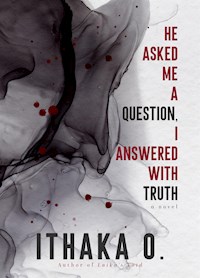
HE ASKED ME A QUESTION, I ANSWERED WITH TRUTH
A NOVEL
ITHAKA O.
IMAGINARIUM KIM
© 2022 Ithaka O.
All rights reserved.
This story is a work of fiction. Names, characters, places, and incidents either are the products of the author’s imagination or are used fictitiously. Any resemblance to actual persons, living or dead, businesses, companies, events, or locales is entirely coincidental.
No part of this story may be reproduced in any form or by any electronic or mechanical means, including information storage and retrieval systems, without written permission from the author.
CONTENTS
Chapter 1
Chapter 2
Chapter 3
Chapter 4
Chapter 5
Chapter 6
Chapter 7
Chapter 8
Chapter 9
Chapter 10
Chapter 11
Chapter 12
Chapter 13
Chapter 14
Chapter 15
Chapter 16
Chapter 17
Chapter 18
Chapter 19
Chapter 20
Chapter 21
Chapter 22
Chapter 23
Chapter 24
Chapter 25
Chapter 26
Chapter 27
Chapter 28
Chapter 29
Chapter 30
Chapter 31
Chapter 32
Chapter 33
Chapter 34
Chapter 35
Thank you for reading
1
When I reached his office, I was surprised.
First of all, the door stood open. He hadn’t attempted to lock himself in for protection. Also, he was sitting behind his immense oak desk, looking tranquil and calm, facing the windows of his plush corner office instead of me. It was as if he had noticed absolutely nothing that had taken place within this twenty-story building in the past ten minutes.
Of course, he couldn’t have smelled me coming. He couldn’t have perceived the reek of blood from the ruptured surface vessels of dozens of people, as well as from their deepest buried organs, recently torn out and forced to breathe the external air. I stood only a few feet away from him, and still, he probably couldn’t smell me. Neither could he detect the blood of his friends and coworkers on my leather clothes, black from top to bottom, from jacket to boots. Black and bleak, like tonight.
Unlike him, I had smelled my way to this office. My entire body reacted to the crimson life force that his kind could gift mine. Particularly, the life force that was so familiar to me: his.
Lush, like the greenery under the brilliant sun after a refreshing shower—like our time together.
Fleeting, like the smoke from burned leaves—like my lost twenty years.
And bitter. Like his betrayal.
My heart pumped in a frenzy. My pupils were dilated. I could taste my own excitement.
But him? The opposite. This level of composure was unexpected, even from a human who, as a species, had dull senses. It was as if he had gone deaf and hadn’t heard the screams, alarm bells, and the incessant phone calls that still shook the building with the maddening optimism of those outside—those who weren’t our target tonight. Someone’s got to be alive in there, they thought. Someone.
“Henry,” I said.
“Celeste,” he said, and lifted his left hand in a sort of wave without facing me. “Are you Celeste, still?”
Celeste, Emma, Sophia, Charlotte.
Madison, Victoria, Penelope, Zoe.
What did names matter? He could memorize the dozen names I had used in my lifetime, and still he wouldn’t know me. And I could call his one name, Henry, however many times I wanted, and his case wouldn’t be any different for mine. I didn’t know him.
“Sure, Celeste. Why not,” I said. “For tonight.”
He chuckled softly. It was the sound of waves rippling in the center of the ocean. Hiding something.
His hand was wrinkled, as the hands of middle-aged men tended to be. I had expected this type of deterioration. I knew of the force of time, from common sense, from years of living among his kind, and from seeing him on TV. Yet I cringed. These weren’t merely the wrinkles on the skin of some random passerby on the city streets. These were wrinkles right in front of me, tangible and real, on Henry.
My Henry.
Once upon a time.
This man wasn’t him anymore. I had to remind myself of that. Instead of jeans and a T-shirt, he wore black clothes that resembled a priest’s, though he was no priest. The golden watch the governor had gifted him last Christmas reflected the light beams from the helicopters outside. I could clearly see the silhouettes of those flying tanks, despite the strong backlight and the dancing white snowflakes. But there was no way Henry could distinguish the shapes of the helicopters. His eyes weren’t built for nocturnal performance. Night vision for humans was basically nonexistent. And piercing searchlights, when targeted at you, didn’t exactly help solve that problem.
The helicopters chop-chop-chopped from nearby—almost as infuriatingly as the unceasing phone calls from the adjacent offices. Why couldn’t these humans just accept that they had lost? Why couldn’t they admit that, for once in their modern history, we had won? They could’ve remained the victors. We’d had no desire to claim the throne as the dominant species on Earth. In fact, we had liked that humans thought we were imaginary creatures. So, they were the ones who pushed us out of our hiding. The result was this. Their defeat.
They could try to rescue their Henry Ward, sure. The many framed photographs hanging on the wall proved that to them, he was worth the risk. In one, he shook hands with the president. In another, he raised his glass while one NBA MVP mirrored this act next to him. And many more photographs filled the walls. Photographs with politicians. Celebrities. Business luminaries. These were evidence of his social status. His glory. His power.
Carefully sprinkled among them, however, were the photographs of charity. One, where he knelt to beam amidst a dozen hairless children with cancer. Another, where he lured a street dog from its hiding place to rescue it. To top it off, one where he had taken off his helmet and wiped off the sweat from his face while the sun blazed on a construction site, a sign clearly reading: New Life for the Homeless.
Because of their strategic placements, the photographs of his victories and the photographs of his philanthropy reflected the beams from the helicopters in equal amounts. Henry’s world was fair, oh so honorable. He, the master of fakery, knew exactly what he had to show to make his target fall irresistibly in love with him. In a way, I appreciated the craft behind this carefully calculated setting. I guess a master recognizes another master. Though, in so many ways, Henry was a grander master than I had ever been.
But I had other advantages. Well before the infatuated world of humans could take the first step to rescue him from this building, I could cut his throat with the smooth swipe of my pinky nail. Not that I wouldn’t cut his throat anyway, with or without action on their part. But unlike my former self, these days I liked to get all the information before acting.
What else could the humans do, besides trying to rescue him? They could try to eliminate me. How were they going to accomplish that without risking Henry’s life? They weren’t. There was no way. Did they want to risk Henry, their savior, their prophet, their crusader of morals? No. Otherwise, someone in those choppers would’ve jumped through the windows already.
Then there was the third option: negotiation.
I glanced at the old-fashioned landline phone that stood on the desk, wondering why it didn’t ring like the rest of them. The governor, and maybe even the president, was probably preparing for political demands from my group. No beings, human or otherwise, could be stupid enough to ambush the Malcreature Eradication Headquarters “just because.” More importantly, beings with a lineage as long as that of the humans wouldn’t have killed almost all occupants of said building just for fun.
“I didn’t want to be interrupted,” Henry Ward said, still not turning around to face me. He tipped his head toward the edge of the desk.
There, the phone line, cut in the middle, dangled gently.
He had read my mind. So, he still had that sixth sense. He knew what I was, therefore knew what I thought, without prejudice. He didn’t need to use his limited sensory organs. And logic, as recommended by the larger society, didn’t hinder his judgment.
I say “recommended” because frequently, what people call logic is actually just common sense. Most people who think they’re logical don’t use their brains at all as they go through their lives. They have set rules, set expectations, and live in set environments that rarely change even as their elements pretend to be developing (or even evolving) at an incredible speed, especially in these modern days. So, logic is just this: a recommended guideline that people think they follow as a result of their brain activity, when, really, it’s more like muscle memory. A habit.
Henry agreed with me in this regard. Used to, at least. He used to laugh at the idea of logic in most people. We were stuck up like that, back then. Back when we were together. He had been one of the few people in my life who had accepted the painful limits of the human brain. It streamlines to process the flood of information that bombards it every second. Simplification leads to omission. Inevitably. That’s why habits are, mostly, so helpful. So is common sense, or at least the idea of common sense. Keeps you calm. Keeps you thinking you’re prepared. And thusly the space for logic diminishes, in so many tragic cases, with each additional year “experienced” on this Earth. Yet most people (and their overprotective parents) aren’t willing to let the sixth sense manifest. They force that all too feeble “logic” to take the reins. By the time a person is ten or twelve, the sixth sense has been so battered that it doesn’t dare rear its head.
But Henry still had it now, and he still had it when we met. And I guess no amount of intuition can prepare a vampire brain for a total anomaly: a human with an instinct as good as her own.
2
That was why we were drawn to each other as “young” college students. Him, actually young. Me, looking as young as him, but having been dead in my soul for a long, long time.
He had the ability not to look away when faced with an inexplicable sense of danger, and not just in that foolishly sexual way in which most immature male specimen of his kind acted. When he introduced himself in the quad one autumn day twenty years ago, just after freshman orientation week, he damn well knew he wasn’t merely attracted to me because he could sense my being “different” in a seductive way. He knew right then: I was of a different kind.
We began dating, because in the beginning I thought, Heck, why not? I must entertain myself somehow. I was no newbie in dating humans. It’s a skill someone like me must learn. This, because, believe it or not, people are more suspicious of singles than of couples. It’s a sad testament to the lack of independent decision-making. Instead of looking at the person, people quickly catch clues:
Male/female? Check.
Married/single? Check.
Tall/short? Fat/skinny? Skin color? Check, check, check.
So, in the beginning, Henry Ward was a tool. A convenient insurance option I adopted to keep myself inconspicuous. Lots of girls dated boys they had met during orientation week.
Autumn passed and winter came. It took him some time to consciously figure out just how different I was. One can imagine the many logical hoops that a pre-med student has to jump through—despite, or perhaps because of his awareness of their limits—in order to accept that his first (and last) college girlfriend is, in fact, a vampire.
A creature of horror stories so unoriginal that it fails to trigger horror in half the population.
A nonexistent creature, at least according to the “real world.”
And if it were to exist in spite of “reality,” a dangerous one.
But once he did get over his logical/emotional barriers, he didn’t hesitate to ask.
Can you believe it? He asked.
Are you a vampire?
It had been just before Christmas. Overnight, the snow had formed a web of ice on the outside of my dorm room window. I couldn’t see the bare branches of the many trees surrounding the building. But I could smell the plant remains and animal corpses buried under the thick white blanket of the season of rest. Although the door to the hallway stood open, that frozen web and the smell of rest, combined with the quietness of the deserted building, made me feel like we were the only ones who breathed in the whole world.
Most other students had left school for the holidays, to family gatherings, good food, warmth, jolly songs, gift exchanges, and storytelling. They were going to share their early victories, early miseries. Their love stories, their heartbreak stories.
Not Henry. Not me.
With his back turned toward the window, he sat by my desk under a warm orange lamp. He had placed the chair in such a way that he half faced me in my bed, and half faced his textbooks, which he had been poring over for days. Something about different proteins. There was to be an exam after winter break, and he was eager to defend his title as the highest-graded student in the department.
Hemoglobin. Insulin. Keratin. Lots of names ending with -in. Give me another few centuries of life, and I still wouldn’t know what to do with all those names. I can barely remember my own retired ones.
Which was why I was reading a novel as part of an assignment. For decades I had chosen the same exact major: English Literature. Storytelling was something that humans (which I used to be) had been doing for thousands of years, with or without conscious knowledge. The core of it didn’t change much, so that I didn’t have to “study” harder and harder every time I returned as a student.
Imagine trying to keep up with rocket science. First, you would have to deal with the birth of the concept of a rocket, then follow its development, until, within only a few decades, a human ended up on the moon. That’s not even counting everything that came before someone imagined that humans could land on the moon. I mean, all the time people thought the Earth was flat? That’s a lot of change. A lot of different ideas to digest. What if you got “the correct answer” mixed up on the tests?
I imagined that the field of medicine was similar to rocket science. Simply too much to memorize, too much to learn every time a new theory sprung up. Remember, people used to be oblivious to the fact that they needed to wash hands. I can attest to that. I was born at a time when handwashing wasn’t the norm for doctors and nurses. Did you know there were conspiracy theories around handwashing? Some fools thought the government was trying to control them by making them wash their hands! Even more horrible: people also used to think smoking was healthy.
If you’re going to die in a hundred years, you can study a subject like that, thinking you’ll only have to change your frame of mind once, maximum twice or thrice in your lifetime. If you’re like me, who’ll live forever, studying such a subject becomes a lot less appealing. What’s the point of “study” if it can’t even last as long as a pebble in a brook?
Nothing like that with Literature. Read a book from two hundred years ago. Society has changed. Tastes have changed. But humans? Not so much. That’s why you can understand a nun who doesn’t know what the internet is. That’s why you can feel for a tenant farmer who doesn’t know what compound interest is. And you can even sympathize with anthropomorphized animals and aliens.
Literature. Eternal.
At the same time, despite this timeless quality, humans always manage to find some way to make it seem different. For example, they figure out a way to look down upon certain types of writing. (A female writer? A colored protagonist?) Then, decades later, suddenly the same “abhorrent” writing becomes cool. But you know what’s more amazing? That while they’re “discovering” how not so abhorrent an abhorrent piece of writing from the past is, they still try to define “bad” literature for the next generation to find not so bad. You’d think humans would learn from their mistakes. They don’t. Better for me, the eternal returning freshman.
And neither Henry nor I planned to go home that winter.
Henry, because small talk among the family friends bored him. His parents didn’t have many relatives they kept in touch with, he said, which was why they always hung around with the same group of friends who always talked about the same things. About what? I had asked once. Nothing, he said. Absolutely nothing that’s meaningful in any shape or form, because for words to have meaning, they must be accompanied by action. They never act. They always talk. So there’s no meaning. I don’t want to be part of that lack of meaning.
Me, I didn’t go home because I had no other home. Wherever I happened to exist at a particular moment was my home. My parents had long been dead, and even longer before that, I had left them. No one wants to tell their parents they became a vampire. Better pretend to be dead. And just because I said “better” doesn’t mean that it was a walk in the park. I would’ve cried my eyes out if I had been a human. But because I wasn’t, my eyes healed themselves. That’s why I still have eyes.
Anyway. Back to us. Just before Christmas. Alone together. In the dorm.
And him asking, Are you a vampire? out of the blue, while studying protein names.
He was looking straight at me, dead honest. I was clutching my novel. Even with the blanket covering my legs, even with my thick winter pajamas and vampire skin, I felt chilly.
Though his features were plain, the intent he put behind his facial muscles was what made him so dangerous. You can be blessed with all the beauty in the world and it would be useless unless there’s some life behind the smooth skin, the chiseled chin, the ocean-blue eyes. Henry had none of that. He had average skin, average chin, pleasant-to-behold but unremarkable gray-blue eyes. Yet as he looked at me, I was captivated. Oh, the life in those eyes. The purpose! The will!
I had underestimated him. I had thought he was like everyone else, like all my college boyfriends. (I won’t tell you how many, because the number will shock some of the more conservative-leaning readers… if anyone who self-identifies as such has made it up to this point.)
No one had asked me this question before. Prior to Henry, everyone who had come to know that much about me had died. Upon finding out the truth about me, either they had done something stupid (such as jumping into the path of a speeding car while running away from me) or I had killed them. Either way, it hadn’t mattered. I had wanted them dead. You see, the only reason those people had known what I was, was that I let them know, precisely so that I’d have a reason to kill. A justification. A being has the right to protect itself, right? And an outed vampire is a being in danger.
So, basically, if I liked you, you were never going to find out my deepest secret. If I liked you, I only showed you what I thought “normal” humans could handle. Then, one day, when too much time had passed to hide the fact that I didn’t age while you did, I disappeared. As simple as that. This was my way of protecting those I was fond of. It wasn’t that difficult in a college setting. You said you got a job in another state and moved away. You lost contact, gradually. Easy.
Henry was the first human who noticed what I was without my intending for him to know. A century, I had lived believing to be in control, and then this guy asks me that incredibly open question? I had been a fool, wrong to think that only humans fell for the traps of habitual thinking. I didn’t know how to react.
And that was a first, me not knowing what to do. Which was why, before him, I had been bored. All the time. Bored to death. (Ha-ha.) Bored from living for more than a century, mostly in hiding, and sometimes among crowds that looked my age but possessed the maturity level of those a quarter of my age. Bored by the pretense of constant change in human society, when, really, nothing ever changed. (Remember literature. Either with a capital L or a small l. Doesn’t matter. The very existence of a debate over capital L and small l proves my point. How eternally trivial!)
People were given birth to. They were grown. Then they were died; wiped from existence.
I put it that way because I always thought “growing” and “dying” should also be passive verbs, just like “born.” It isn’t as if people can choose between growing and not growing, dying and not dying. So, growth and death are like birth. See? They even all end with “th.” That can’t be a coincidence.
Anyway, at the time, around when Henry had asked me the fateful question, the thing I was bored with was myself. If I didn’t like most college kids, why did I keep enrolling in this and that school, just to prove that I still hated them after half a decade of taking a break from them? If I hated human society, why did I delude myself that any contact with it could function as an effective stimulant? Clearly, I wasn’t as intelligent as I should be, after having lived for so long. What a boring creature. And I couldn’t hope for an end to my boringness. I couldn’t hope for the reliably passive bodily functions of humans. I had been born, but wasn’t being grown and didn’t face an automatic death. So, perhaps it was sheer lazy inertia that drove me to yet another school that autumn, when I met Henry. And driven by the same inertia, I let the relationship roll on.
To make matters worse, certain changes that had indeed occurred in the human civilization had been detrimental to that particular iteration of my college life. These children, who thought they were all grown up, hid nothing from the world. More social media, more personal publicity. These younglings uploaded pictures of what they ate for breakfast, believed that others would “like” them, and in fact saw their belief come true. People actually “liked” random pictures of pancakes and obviously staged “candids”! That was the changed world where I found myself in.
In all the previous iterations, I had been able to hide my true identity like the rest of them. My pretense had been no worse than theirs. I had hung pictures on my dorm room walls: family pictures, pictures of pets, pictures of past vacations. Of course, they weren’t really my family, my pets, and my vacations. But like I said, people don’t use logic. And one of the reasons they don’t is that they don’t really care about you. Sometimes that’s good. They aren’t going to investigate whether that family in the picture is really yours, whether that poodle or beagle or chihuahua really is your dog, whether you were actually in Rome or Venice or Madrid when you said you were there.
They believed me, my blond hair, my dotted pretty dresses. Or they were in the habit of politely pretending to believe me. And in turn, I had pretended to believe them. One for you, one for me. In those earlier days, the girls used to fake chastity (if the females could be found on a college campus at all) and the boys used to bluff they had bigger dicks than they actually had. Was someone willing to publicly confirm the true state of affairs, one way or another? No. What had to be left in the deepest corners of the drawers of private truths were left buried, just so. No one claimed that digging them out was healthy.
But at the school where Henry and I met? In that era? My heavens. The age of public true feelings and vulnerability and sharing had arrived. And that which was shared stayed online forever. That was the one irreversible change that finally awaited me after decades of sameness. And in the middle of that, I had been feeling more powerless than I had ever expected I could feel.
What was I supposed to share publicly about my true feelings and vulnerability? Hi, everyone, my name is Celeste. I look twenty but actually, I’m a hundred and twenty. This is because I was bitten when I was twenty, and the asshole who did it didn’t let me die. Do I hate him? Yes, yes I do. Which is why I left. Which is why I’m sometimes lonely. In his desperate need to tell someone that he was a vampire, he made one out of me.
Do you know what’s worse? I understand him. He needed to tell someone. he was lonely too.
Yes, I am a vampire.
Ridiculous. And if it had been any other place, any other time, any other person, my answer to a question such as Henry’s might have been: No, I am not a vampire. There’s no such thing as vampires. Don’t you know that?
But instead, I answered:
“Yes, I am a vampire.”
The light that filled Henry’s young face changed everything. I was freed. Unlike ever before, I could talk to someone, and that someone wasn’t the one who had turned me into a being who could talk to no one else. (If you haven’t noticed already, I was a loner, and I wasn’t alone in being a loner. Solitude used to be the default mode of existence for my kind. Predators who hunt in secret must be like that. You need your territory. If things get too crowded, you’ll get noticed. So, vampires back then weren’t social beings. Even the one who had turned me would’ve left me if I hadn’t left him first. It was only after Henry started ruining things that I felt the need to assemble my kind, and the others agreed.)
With my truth unleashed, no one could get between me and Henry. He was my outlet, my window, my connection to the greater world. I was his study subject, his lover, and—I’m not ashamed to say this—his goddess. We were so infatuated with each other, he even offered to become like me.
“Then we can be together, forever,” he said.
I said I couldn’t do that to him. I wasn’t going to be like my creator. Henry seemed hurt, but compared to the hurt he would experience once he became a vampire, that was nothing. Everyone he knew would die, without the hope of him ever joining them, unless he committed something akin to suicide. The other option was to turn everyone around him—which wasn’t feasible. Even the slowest person on Earth would notice something was off.
So, without him becoming like me, we loved. I answered his harmless questions patiently.
“The sun thing, where you can’t go outside during the day—that’s a lie, then, huh?”
“A total lie.”
“Do you really fully regenerate from most injuries?”
“Not most. All. It may take time to heal, but heal we do. Unless we die.”
“So it’s possible for you to die.”
“Everything’s possible. Even my existence. And my death too. It’s just very unlikely.”
“Do you really need less sleep than humans?”
“Almost no sleep at all. But it’s nice to lie down and pretend you’re resting. That’s why I like staying in bed.”
I even let him examine my fangs. It was something that I hadn’t bothered to do myself. But of course, Henry approached them with the curiosity and precision of a pre-med student.
“They’re hollow,” he said.
“ ’Eally?” I said awkwardly, my mouth open as Henry looked in.
“Yes, and there’s a tiny hole at their ends. Almost invisible.”
“Inerestin’.”
“You think something comes out of your fangs when you bite, or something goes in?”
“I on no.”
“Both ways?”
I shrugged.
“Maybe your blood enters the person’s bloodstream, and vice versa.”
“ ’Aybe.”
When winter break ended and the students returned to the dorms, they noticed that we had become even more inseparable than before. By the time the first flowers bloomed, everyone knew us as Henry and Celeste, that couple—you know what I mean. You probably know one such couple too.
And like all such couples that delude themselves that their love can last forever, ours ended. Abruptly. When Henry left.
3
He didn’t just leave me. He left the school. He left the city.
If he had left in the spring after learning my secret, I wouldn’t have been so surprised. If he had left a season after that, I wouldn’t have been surprised either. Cold feet, I would’ve thought. Scared. Or bored. Humans grew tired of novelty very quickly. Just look at the trash islands floating in the ocean.
But instead, he waited for three years. In the spring of our senior year—when everyone thought that Henry and Celeste, that couple, were sure to get married and have a million children looking just like them—that was when he left. Just before graduation.
That first morning without him, I awoke with a painful headache. He was supposed to be lying next to me, in bed, but wasn’t there. His stuff was gone.
I didn’t think he had left out of his own will. I thought someone had kidnapped him. Someone from my kind. That had to be why he wasn’t picking up his phone, why no one had seen him leave. Maybe, though solitary beings we are, someone got wind of my intimacy with Henry. Maybe, collectively, my kind had decided to eliminate him.
But I had never shared with him the details of how I fed. At nights, when I vanished, he must have guessed that I was hunting, of course. He might have thought the violent crime scenes that were found the next day had been my doing, when in reality, I had only shown up after the crime and had drunken a cup or two from the victims after they were dead. I didn’t know what Henry made of my nocturnal outings and the crimes; I didn’t know if he connected them, or didn’t connect them, because we never spoke of them. We only ever spoke of the faraway things: regeneration, eternal life, and possible death as ideas, without the bloody specifics. Sort of the way humans—before the era of pancake picture taking for Likes—used to talk about birth. When a child is born, you don’t ask the mother how gory it was down there during the process; you just congratulate her and move on.
Henry knew nothing. He didn’t deserve to be punished or killed by others of my kind. I had to rescue him…
Then, after half a day of roaming around the campus, searching for him to no avail, I noticed:
Ravens fluttering away from me. Frogs croaking in alarm. Stray cats hissing.
They sensed my presence. Animals, unlike humans, had no parents to advise against fostering their instinct. While the students huddled together, wondering what strange spell had befallen these animals, the animals knew. They couldn’t articulate their knowledge with words, but that didn’t mean that it wasn’t there.
I stopped under a secluded arch near a courtyard that smelled of freshly mowed grass. Being near a different source of strong smell helped cover my own, so that the ravens, frogs, and cats ceased to express their dismay as I examined myself.
How come those animals had sensed me, and on top of that, thought it wise to react so openly? I couldn’t possibly be bleeding. I wasn’t hurt. I hadn’t hunted last night. Besides, even if I had been wounded, I would’ve healed by now. All that the animals should’ve been able to perceive would’ve been a slight unease, not this level of panic. I had attended this school for years. By now, they should know: this weird presence isn’t here to hurt me. So then why—
There was a tiny hole in my arm. The vague ache in my head hadn’t faded. Someone had drugged me. Someone had drawn blood from me. The animals hadn’t just “sensed” me—a vague and imprecise term; rather, they had smelled me. Based on the degree of weakness I felt, hours after waking up, I concluded that the mysterious blood thief had taken about a vialful, a container the size of an index finger.
That meant that the taking had been fully intentional. To get that much blood out of me, from a single tiny hole, you needed to inject a substance that prevented blood clotting.
Someone had taken Henry and also taken blood from me. But…
How to explain the fact that Henry had graduated a quarter early, unbeknownst to me? Because that was what I found out when I went to the Chemistry Department in search of him. Someone happened to mention his early graduation; they figured I already knew, since I was his girlfriend.
Finally, I had to accept: No one had kidnapped Henry. He wasn’t coming back. His early graduation had been planned. He hadn’t told me—intentionally.
And he had taken my blood. He was the one.
People wondered about us, or rather, about the sudden lack of an “us.” For a while. Then they forgot, as they always did. No surprise there. There’s a reason my kind has managed to exist for centuries.
Eventually, I left school, too, as graduates are required to do. Everywhere, I looked for him. What did he plan on doing with my blood? Had he just taken it as some twisted token of dead love? Had he one day woken up, thought he couldn’t spend the rest of his life with me, but wanted something to remember me by?
I needed answers. My whole life, as a human as well as a vampire, I had never felt so insecure. Henry’s actions were inexplicable, and in the past few years, I had made myself utterly reliant on that person of inexplicable actions. If he meant harm to me, why wasn’t he doing something with my blood? If he didn’t love me still, why hadn’t he simply dumped me? Because he was scared? Because he had feared I would kill him? Was that what he thought I was, a monster who killed an ex-boyfriend and fed on him just because he wanted to break up?
With my night vision, with my monstrous sense of smell, I searched.
Through many cities.
Through endless countryside fields.
Across the vast ocean.
Scary. Yes. I understand that in hindsight. A human ex-lover who comes after you is scary enough. A vampire ex-lover is truly dangerous.
One winter, I went to the place where his family lived. I remembered Henry’s tales: his father, mother, and younger sister, who didn’t keep in touch with their relatives, but did have a regular circle of friends. They lived in a little suburban town, two states farther south from where we went to school.
They were gone. Had been missing for quite a while now. Never found the bodies, although the search, back then, had gone on for weeks. The local police of their hometown had cooperated with the other police from three towns east, where there was a popular vacation spot near a lake. It was into that lake that Henry’s father had driven the family car, on the last day of the younger sister’s first high school summer vacation.
Which summer was this? When? I asked.
Hmm, said a particularly chatty old man, who had been so kind as to inform me on the matter.
I tried reframing the question: How much older was Henry, compared to his sister?
Let’s see. Eh, one, two, three, four… Oh, yes: the summer between his junior and senior years, I think. That’s gotta be it.
I recalled that summer vividly. Henry hadn’t joined his family that summer, just like he hadn’t joined them during the freshman winter break when he had asked me the fateful question. He had been busy assisting one of his professors, one of those award-winning, hate-to-teach-undergraduates old jerks who deluded himself into thinking that every single student at a given school had chosen that school for his genius, when, let me attest to this: well before his jerky existence, students had always filled that campus. So it wasn’t like, when he was finally born, thunder roared and lightning struck and the entirety of the civilized population ceased all its internet searching, vlog filming, and MMORPG playing, because the absence of that birth event had been the only reason they had resorted to internet searching, vlog filming, and MMORPG playing. It wasn’t like, now that he was here, they could rest assured they would be saved from eternal ignorance, so long as they patiently waited for him to be employed by a university, and then enrolled there.
Henry and I, we used to make fun of that professor. Professor Jang. Jang the Jerk. We made fun of him and no one else, because his loathing for the undergraduates had been too evident, and we were both undergraduates. Even as an English Lit major, I’d had to take his chemistry class once, long before that summer when Henry worked for him. I’d needed the credit for Gen Ed. A terrible experience. The only reason I took it was because of Henry.
Why did Jang have to teach a 101 class when he was such an Eminent Scholar? Because of some sort of office politics going on amongst the faculty. Apparently, Jang the Jerk didn’t get along with anyone. The dean convinced him to teach this 101 class as a sort of, what, atonement? Had that been the word Henry said he had heard through the grapevine? As if teaching freshmen were a punishment! Although, I guess, whether or not an act can or should be defined as a punishment by the greater society matters less than the fact that the recipient of the punishment interprets it as such. Jang the Jerk didn’t want to teach undergraduates, especially not a 101 class, and therefore the other professors wanted to see him doing it.
So, once a week for 90 minutes, Jang the Jerk had to endure the torture of facing two hundred freshmen. We glared—okay, most of us stared, but I glared—down that lecture hall, one of those giant auditoriums where there are multiple entrances and multiple stairways leading into its depth. A pit. At the bottom of the pit was Jang, and I glared down at him while he talked something about molecules and atoms.
He was about fifty then, wore perfectly round glasses without rims, and had a straight back. A really straight back. The type that never bends to anything. And he was much shorter than average. The general consensus was that, had he been an inch taller, he would’ve been even more unpleasant to deal with, for he exuded unbearable confidence in every direction. He was like the human version of a glass-and-silver disco ball that reflected the sunshine when the day shift came in and opened the windows of the dance club to clean the place after a wild night of partying. He never wore black or gray or any such mundane color. Instead, he always wore a fancy flashy suit. Not pink or neon green, mind you, but definitely peppermint and violet. Such suits were part of his iconic image, as well as his wild flailing of arms when he talked about the composition and structure in a molecule.
For someone who was supposed to hate freshmen, he did try his best, I gotta give him that. It seemed that he was one of those people who vehemently resisted an unpleasant future event until it became evident that it was unavoidable. At that point, they pivoted as if their protests had never happened. They did their best, because not to do so was an insult to their reputation and ability. And his suits were nice. I admit that too. Even when you live for more than a century, you don’t come across many men who can pull off color so masterfully. Still, that didn’t mean that I liked the guy. He didn’t want to be liked, and I wasn’t going to beg him to please let me like him.
But Henry, the ever-resourceful young man he was, had somehow managed to earn the man’s trust. He snuck into the after-work happy hours of the research assistants who toiled under Jang. In their circle, Henry managed to establish a good rapport with the group leader. Then, on top of that, he hung around the cranky professor’s office in an unofficial capacity whenever neither of them had class.
All this was quite a feat. Usually, when some youngling pushes his way into a group, the present leader among the underlings, no matter how much he says he dislikes the boss, is bound to get the most territorial. Yet Henry had gracefully formed bonds with both the leader among the research assistants and the professor. He was paving for himself the road to an assistant professorship, and professorship, and eventually, Nobel laureateship.




