


90,99 €
Mehr erfahren.
- Herausgeber: John Wiley & Sons
- Kategorie: Wissenschaft und neue Technologien
- Serie: IEEE Press Series on Power Engineering
- Sprache: Englisch
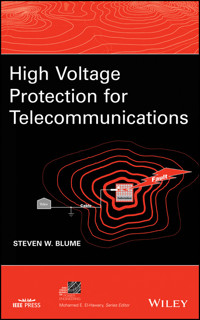
There is growing concern that new engineers, planners, and field technicians are not aware of the danger and reliability issues surrounding proper protection of telecommunications circuits. Using a practical, hands-on approach, High Voltage Protection for Telecommunications combines all the essential information and key issues into one book. Designed for professional training and self-study, the text will help guide managers, engineers, planners, and technicians through the process of planning, designing, installing, and maintaining safe and reliable data and voice communications circuits that are exposed to High Voltage events.
Sie lesen das E-Book in den Legimi-Apps auf:
Seitenzahl: 272
Veröffentlichungsjahr: 2011
Ähnliche


















Table of Contents
Cover
Series page
Title page
Copyright page
Preface
ABOUT THE BOOK
CHAPTER SUMMARIES
DISCLAIMER
Acknowledgments
About the Author
CHAPTER 1 Overview of High Voltage Protection for Telecommunications
BASIC PURPOSE AND APPLICATIONS
THE HV PROTECTION CHALLENGE
HV ISOLATION STANDARDS
CHAPTER 2 Electric Power System Fundamentals
POWER TERMINOLOGY FOR TELECOMMUNICATIONS
ELECTRIC POWER SYSTEM OVERVIEW
AC VOLTAGE GENERATION
SUBSTATION EQUIPMENT
TRANSMISSION LINES
DISTRIBUTION LINES
SYSTEM PROTECTION EQUIPMENT AND CONCEPTS
CHAPTER 3 Ground Potential Rise (GPR) and Zone of Influence
INTRODUCTION TO GROUND POTENTIAL RISE (GPR)
GPR
GPR LOCATIONS
FACTORS AFFECTING GPR
CALCULATION OF GPR
ZOI
EARTH RESISTIVITY
GPR AND ZOI CALCULATION METHODS
LIGHTNING FAULTS
ELECTROMAGNETIC INDUCTION UNDER FAULT CONDITIONS
TOTAL ELECTRICAL CABLE STRESS
THE ROLE OF PROTECTION ENGINEERS
CHAPTER 4 Critical Telecommunications Circuits in HV Environments
GENERAL
SERVICE PERFORMANCE OBJECTIVES (SPOs)
NORTH AMERICA ELECTRIC RELIABILITY CORPORATION (NERC) CRITICAL INFRASTRUCTURE PROTECTION (CIP) STANDARDS
PROTECTIVE RELAYING SCHEMES THAT REQUIRE CLASS A CIRCUITS
POWER APPLICATIONS THAT REQUIRE CLASS B CIRCUITS
POWER COMMUNICATION SERVICE TYPES
SMART GRID AND CYBER SECURITY
CHAPTER 5 High Voltage Protection Equipment
GENERAL
BASIC SHUNT PROTECTION
LEVELS OF PROTECTION
SPECIAL CONSIDERATION FOR NEARBY FACILITIES
CHAPTER 6 Level III HV Protection Equipment, Installation, and Testing
GENERAL
LEVEL III COPPER HVI COMPONENTS
COPPER HVI SYSTEM DESIGN
COPPER HVI INSTALLATION EXAMPLES
COPPER HVI SYSTEM INITIAL TESTING
COPPER HVI MAINTENANCE AND INSPECTION
FIBER HVI SYSTEMS INSTALLATION
FIBER HVI INSTALLATION EXAMPLES
WIRELESS SITES ON ELECTRICAL POWER TOWERS
PROTECTION AT NON-POWER COMPANY LOCATIONS
CHAPTER 7 Personnel Safety Working with HV Protection Equipment
ELECTRICAL SAFETY
ELECTRICAL PROTECTION PRIORITIES
TOUCH AND STEP POTENTIALS
Glossary
Appendix: Service Request Form
Bibliography
Index
IEEE Press Series on Power Engineering
IEEE Press
445 Hoes Lane
Piscataway, NJ 08854
IEEE Press Editorial Board
Lajos Hanzo, Editor in Chief
R. AbhariM. El-HawaryO. P. MalikJ. AndersonB-M. HaemmerliS. NahavandiG. W. ArnoldM. LanzerottiT. SamadF. CanaveroD. JacobsonG. ZobristKenneth Moore, Director of IEEE Book and Information Services (BIS)
Copyright © 2011 by the Institute of Electrical and Electronics Engineers, Inc.
Published by John Wiley & Sons, Inc., Hoboken, New Jersey. All rights reserved.
Published simultaneously in Canada
No part of this publication may be reproduced, stored in a retrieval system, or transmitted in any form or by any means, electronic, mechanical, photocopying, recording, scanning, or otherwise, except as permitted under Section 107 or 108 of the 1976 United States Copyright Act, without either the prior written permission of the Publisher, or authorization through payment of the appropriate per-copy fee to the Copyright Clearance Center, Inc., 222 Rosewood Drive, Danvers, MA 01923, (978) 750-8400, fax (978) 750-4470, or on the web at www.copyright.com. Requests to the Publisher for permission should be addressed to the Permissions Department, John Wiley & Sons, Inc., 111 River Street, Hoboken, NJ 07030, (201) 748-6011, fax (201) 748-6008, or online at http://www.wiley.com/go/permissions.
Limit of Liability/Disclaimer of Warranty: While the publisher and author have used their best efforts in preparing this book, they make no representations or warranties with respect to the accuracy or completeness of the contents of this book and specifically disclaim any implied warranties of merchantability or fitness for a particular purpose. No warranty may be created or extended by sales representatives or written sales materials. The advice and strategies contained herein may not be suitable for your situation. You should consult with a professional where appropriate. Neither the publisher nor author shall be liable for any loss of profit or any other commercial damages, including but not limited to special, incidental, consequential, or other damages.
For general information on our other products and services or for technical support, please contact our Customer Care Department within the United States at (800) 762-2974, outside the United States at (317) 572-3993 or fax (317) 572-4002.
Wiley also publishes its books in a variety of electronic formats. Some content that appears in print may not be available in electronic formats. For more information about Wiley products, visit our web site at www.wiley.com.
Library of Congress Cataloging-in-Publication Data:
Blume, Steven Warren.
High voltage protection for telecommunications / Steven Blume.—1st ed.
p. cm.—(IEEE press series on power engineering ; 44)
ISBN 978-0-470-27681-5 (hardback)
1. Telecommunication–Equipment and supplies–Protection. 2. Telecommunication lines–Protection. 3. Transients (Electricity) 4. Overvoltage–Prevention. I. Title.
TK5103.B58 2011
621.382028'4–dc23
2011018344
oBook ISBN: 9781118127018
ePDF ISBN: 9781118127056
ePub ISBN: 9781118127100
eMobi ISBN: 9781118127032
Preface
ABOUT THE BOOK
This book is intended to help electric power and telephone company personnel and individuals interested in properly protecting critical telecommunications circuits and equipment located in high voltage (HV) environments and to improve service reliability while maintaining safe working conditions. Critical telecommunications circuits are often located in HV environments such as electric utility power plants, substations, cell sites on power towers, and standalone telecommunications facilities such as 911 call centers and mountaintop telecommunications sites. The need for highly reliable telecommunications circuits during power faults and lightning strikes when controlling our nation’s electric power grids, communicating via wireless phones, and conversing with public safety support individuals at 911 call centers has never been higher. The utilization of information provided in this book should help provide higher reliable telecommunications circuits and improve the safety of personnel working in HV environments. Several industry standards and best practices are referenced throughout this book. These standards and practices are based on power and telecommunications company experience, field testing, workgroup committees, equipment manufacturers’ support, and the advice of construction contractors and industry experts/consultants. This book is very comprehensive in that it combines several detailed references into a practical general purpose applications reference guide.
There is a power and telecommunications industry concern that a high percentage of people knowledgeable in this subject area have either retired or are approaching retirement, and these industries are losing valuable expertise for proper application solutions. This book is intended for individuals new to this subject area who want a working knowledge of the concepts, design techniques, and industry’s best practices. Likewise, subject area professionals require knowledge of the dos and don’ts regarding the special electrical phenomena that affect telecommunications circuits that are required to be reliable and safe to maintain.
The target audience is managers, engineers, planners, and technicians involved in protecting critical telecommunications circuits from the adverse effects of electric power faults and lightning strikes. Personnel in public safety, natural gas, water, public utilities, and others involved in assuring that critical telecommunications circuits are reliable under lightning conditions should find benefit from reading this book.
What is not covered in this book are the details surrounding each type of telecommunications circuit such as digital subscriber line (DSL), high speed DSL, T1, plain old telephone service, the difference between two-wire and four-wire circuits, and so on. This information is readily available on the Internet and from other resources such as the following:
Subscriber Loop Signaling and Transmission Handbook—Analog by Whitman D. ReeveSubscriber Loop Signaling and Transmission Handbook—Digital by Whitman D. ReeveAlso not included in this book are the vendor-specific details of their proprietary HV isolation equipment and details contained in the referenced industry standards. The focus here is to explain how such critical circuits are protected from lightning strikes and power faults, plus the safe handling of such circuits should a power fault or lightning strike occur at the time of construction or maintenance.
This book provides a helpful reference to implement concepts correctly and to recognize situations to avoid. The reader should also be aware that sophisticated computer programs and consulting services are readily available for guidance with unique circumstances that may not be covered in this book. This book does provide the knowledge and background necessary to work closely with consultants or to understand the principles of sophisticated computer programs.
CHAPTER SUMMARIES
A brief overview of each chapter is presented below to summarize the flow of technical information and to help identify what and where specific topics are covered in this book.
Chapter 1 presents an overview of high voltage protection for telecommunications (HVPT). The book starts out with a brief yet informative discussion of the impending problems that can occur when critical telecommunications circuits exist in HV environments. The purpose of this chapter is to quickly familiarize the reader with the important issues, industry standard solutions, and safety aspects affecting telecommunications reliability during lightning and power fault situations.
Chapter 2 discusses the fundamentals of electric power systems to help readers who are unfamiliar with HV equipment become better acquainted with HVPT applications. A basic model of the overall electric power system is presented to establish a fundamental understanding of how power systems work and the electrical phenomena that can interrupt critical telecommunications circuits and, if the system is not properly protected, cause equipment damage and injury to personnel. This chapter explains how substation ground grids, protective relaying, fault clearing devices, lightning arresters, and telecommunications equipment are used to clear power faults to minimize equipment damage and maximize electric service reliability.
Chapter 3 elaborates on the concepts of ground potential rise (GPR) and zone of influence (ZOI). These two concepts are fundamental to this subject area, and proper protection design, installation, and maintenance depend on a solid understanding of these concepts. The definitions, causes, boundary conditions, and calculations of GPR and ZOI are discussed in this chapter.
The critical telecommunications circuits found in HV environments are discussed in Chapter 4. The various classes and types of critical telecommunications circuits used by power and telecommunications companies and public service providers where HV protection is necessary are also discussed. Examples of situations which require HV protection are the critical electric power systems control centers and associated protective relaying applications, telephone companies that are using telecommunications circuits involving wireless radio equipment mounted on HV electric power towers, and 911 call centers, which have their respective requirements for critical circuit reliability. The standard service performance objectives (SPOs) and standard levels of protection are discussed in this chapter.
Chapter 5 presents discussions about the actual HV protection equipment used in these critical circuit situations. The concepts behind modern telecommunications protection schemes and equipment used to resolve GPR problems are also discussed, as well as references to industry standards and typical manufacture equipment offerings.
Chapter 6 discusses proper installation and testing procedures of high voltage interface (HVI) equipment. The design and installation objectives, both theoretical and physical, for reliable HV isolation are the focus points of this chapter. Proper design and installation is paramount; however, attention is given to the dos, don’ts, and common installation deficiencies. Photographs of actual installed equipment configurations are included in this chapter to give the reader a practical perspective.
Safety in working with HV equipment is the main topic of Chapter 7. The safety of personnel who work with HV protection equipment is a paramount concern for supervisors and managers responsible for technicians and field personnel. For example, telephone company personnel who work in electric power substations must be aware of all safety rules and procedures and proper use, inspection, and testing of personal protective equipment (PPE) before entering a substation or power plant. The reader will be made aware of these safety concerns and how and when to properly use PPE.
DISCLAIMER
This book is not intended to ensure safety of personnel nor to ensure that equipment will not be damaged should a power fault or lightning strike event occur. The advice, suggestions, and recommendations contained in this book are presented for general educational purposes only and to increase safety awareness regarding HV protection for telecommunications. The information presented in this book is based on applicable industry standards and best practices. This book is not intended to be a legal or other expert advice resource and should not be used in place of highly qualified professional consultants. The information in this book is considered accurate and helpful but is not to be considered exhaustive and complete. The responsibility for safe and reliable equipment in HV environments always remains the responsibility of the parties doing the work.
STEVEN W. BLUME
Acknowledgments
I would personally like to thank several people who have contributed to the success of my career and the success of this book. To my wife Maureen who has been supporting me for over 40 years, thank you for your guidance, understanding, encouragement, and so much more. Thank you Bill Ackerman, Dick Knight, Percy Pool, Tim Conser, Larry Young, Ernie Duckworth, Chuck Keller, and Rich Minetto for your unbiased technical support, help, and encouragement over the several years we have worked together in this field. I would also like to thank Positron Inc. and RLH Industries, Inc. for their photo contributions and equipment expertise.
S.W.B.
About the Author
Steven W. Blume is a registered professional engineer with over 40 years’ experience in the areas of electric power systems and telecommunications. He holds a master’s degree specializing in electrical power systems and a bachelor’s degree specializing in telecommunications technologies. He has worked in both the telecommunications industry (City of Los Angeles Police and Fire critical telecommunications) and electric power industry (Sierra Pacific Power Company [now NV Energy]) in planning, design, operations, and construction of high voltage power facilities and telecommunications systems. Steve has been teaching high voltage protection for telecommunications (HVPT) courses for over 15 years. His combined knowledge, experience, and recognized ability to explain complex subjects in the simple-to-understand terms presented in this book will be useful to those interested in gaining a working knowledge in HVPT applications.
For more information on online, instructor-led, and private custom training opportunities, please visit the Web site www.aptc.edu or call Applied Professional Training, Inc.: (800) 431-8488.
CHAPTER 1
Overview of High Voltage Protection for Telecommunications
LEARNING OBJECTIVES
Discuss the purpose of high voltage (HV) isolation protection equipmentDescribe ground potential rise (GPR) and how it can damage telecommunications equipment and expose people to unsafe working conditionsDescribe what is meant by zone of influence (ZOI) and the 300-V pointExplain the problems encountered if HV isolation equipment is not usedExplain where to install HV isolation equipmentDescribe the two main types of HV isolation equipment (copper vs. fiber) and the corresponding IEEE recommended practices for proper design and installationExplain how copper versus fiber HV isolation equipment worksBASIC PURPOSE AND APPLICATIONS
Copper wire-line telecommunication facilities (as opposed to fiber optics, radio, microwave, satellite, and power line carrier systems) that are used in electric supply locations (ESLs) often require special high voltage (HV) protection equipment to provide safety to personnel, to prevent damage to equipment, and to assure the reliable operation of the telecommunications circuits themselves. There are various means of properly protecting telecommunications facilities equipment and personnel. The goal of high voltage protection for telecommunications (HVPT) is to provide the design engineer with safe, reliable, and cost-effective installations when exposed to unexpected HV events such as power faults and lightning strikes. Power faults are HV flashovers of insulation, the breakdown of equipment used in HV systems, or when something happens to HV equipment causing it to discharge large amounts of electrical energy into its surroundings. When personnel are working in HV environments such as electric power substations, power plants, cell sites on power towers, and other potentially dangerous locations where an HV event is possible, properly protecting critical telecommunications facilities is essential. Copper telecommunications cables can transfer dangerous potentials from remote locations due to their insulated jackets and remote connections. All dielectric optical fiber systems, on the other hand, offer electrical isolation due to the nonconductive properties of glass. This chapter summarizes the potential problems with telecommunications circuits in HV environments, the industry solutions, and the recommended methods to work in these environments safely.
Lesen Sie weiter in der vollständigen Ausgabe!
Lesen Sie weiter in der vollständigen Ausgabe!
Lesen Sie weiter in der vollständigen Ausgabe!
Lesen Sie weiter in der vollständigen Ausgabe!
Lesen Sie weiter in der vollständigen Ausgabe!
Lesen Sie weiter in der vollständigen Ausgabe!
Lesen Sie weiter in der vollständigen Ausgabe!
Lesen Sie weiter in der vollständigen Ausgabe!
Lesen Sie weiter in der vollständigen Ausgabe!
Lesen Sie weiter in der vollständigen Ausgabe!
Lesen Sie weiter in der vollständigen Ausgabe!




