


8,39 €
Mehr erfahren.
- Herausgeber: Oldcastle Books
- Kategorie: Gesellschafts- und Liebesromane
- Sprache: Englisch
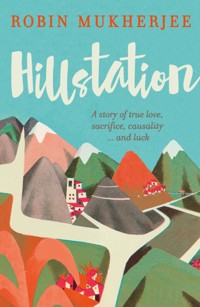
Dreaming of escape from his remote village in the Himalayan foothills, Rabindra entreats the gods to send him an English bride. When a saucy English dance troupe arrives on the run from a Bombay crime boss, Rabindra believes that his prayers have been answered. Except that they have no interest in marrying anyone. As the village begins to unravel in the presence of these scandalous foreigners, surprising secrets emerge from the depths of its past. A story of true love, coincidence, causality and sacrifice. In some ways it is a love-poem to a glorious, intriguing and sometimes frustrating culture still alive in the far corners of a great continent, but slowly fading to the onslaught of the technological age.
Das E-Book können Sie in Legimi-Apps oder einer beliebigen App lesen, die das folgende Format unterstützen:
Seitenzahl: 443
Veröffentlichungsjahr: 2016
Ähnliche



















HILLSTATION
Dreaming of escape from his remote village in the Himalayan foothills, Rabindra entreats the gods to send him an English bride. When a saucy English dance troupe arrives on the run from a Bombay crime boss, Rabindra believes that his prayers have been answered. Except that they have no interest in marrying anyone. As the village begins to unravel in the presence of these scandalous foreigners, surprising secrets emerge from the depths of its past.
A story of true love, coincidence, causality and sacrifice. In some ways it is a love-poem to a glorious, intriguing and sometimes frustrating culture still alive in the far corners of a great continent, but slowly fading to the onslaught of the technological age.
About the Author
Robin Mukherjee was born in London to German-Indian parents. During the 1960s his family home became a meeting place for Indian dancers and musicians performing in the UK, from which he developed a life-long love of the Indian classical arts. Later, he worked for the Sanskritik Festival of Arts of India presenting dance and music at the South Bank, and on tour throughout the country. After forming a theatre company to produce his plays, he received his first commission from the BBC, and has subsequently written extensively for television and radio. His first feature film, set in India, won the Audience Prize at the London Film Festival. His most recent film, Lore, has won numerous awards world-wide. He was nominated for a BAFTA for his original series, Combat Kids, for CBBC. He lives in Winchester with his wife and son.
Thanks are due to many for the genesis and fruition of this book. So, a bow to Ion Mills, Claire Watts and Clare Quinlivan at Oldcastle Books, and to Kesh Naidoo my editor – without you this wouldn’t be. I must also thank Tony Dinner who taught me about writing, and Harry Quinton who taught me about life. Thanks also to Neil Taylor who believed in Hillstation from the start, and to my family here for all their support. Finally, my thanks to all the great souls from Charu Rekha, and their families, who gave me sweets, hugs, and a place to call home. This book is for all of you.
1
In the village where I grew up everybody was either a god or a goddess. Rama, The Omnipotent Face of Cosmic Consciousness, ran the tobacco kiosk. Across the road, Brahma, The Supreme Creator Of All Beings, shoes peppered with crimson spittle, did a roaring trade in betel leaves. Saraswati, The Goddess of Wisdom, swept the dust of our houses from one room to the other, while Divine Lakshmi, Consort of the Heavens, made yak’s wool hats that itched your head and never quite lost the smell of yak however much you beat them. But the greatest of all deities was Mahadev, meaning ‘The Greatest Of All Deities’. He was a Doctor and had been to England. I called him Dev, an omission of syllables for which our father used to clip my ear over supper. Dev himself never seemed to mind. And me? Well, I was Rabindra, the Sun-god. Rabin for short. I blazed in the heavens and did as I was told.
Mahadev was the pride of our family since there’s not a lot in this world to be more proud of than having a son who has been to England and is a Doctor. Although Father never missed an opportunity to mention it, Dev was a little more diffident, shrugging modestly whenever so introduced.Still, he practised his art with an assiduousness that did credit to his training. His white coat, freshly ironed by my sisters at the beginning of each day, would come back crumpled and stained by the end of it, sometimes from the various liquids used for his private research into the application of alcohol for sterilisation purposes, and sometimes by the practice, which he assured me was a peculiarly English affectation, of wiping his nose on his sleeve.
I must admit that sometimes I wished it had been me who’d gone to England and become a Doctor, except that a family like ours could only afford the one ticket, plus I was too stupid. And so, however much I might have dreamed of personal glories in that little bit of the heart where personal glories are dreamed of, Dev was the Number One Son and the Number One Son goes to England. The Number Two Son cleans up after him and speaks when he’s spoken to.
Pol used to laugh at me. Pol was my closest friend in the sense that I didn’t have any others. He’d catch me sometimes wondering how it might have been if I’d been the Number One Son or if Dev had simply never existed.
‘What sort of a universe would it be,’ he’d tease, ‘without The Greatest Of All Gods? A directionless potage of meaningless nonsense jostling about for no good purpose.’
‘But at least I’d have gone to England.’
‘This is mere fancy!’ he’d retort. ‘For the very existence of a universe implies the pre-existence of its impelling cause, in the absence of which there would be no England for you to go to, even if you existed which you wouldn’t, at least in a tangibly manifest form.’
‘Sometimes,’ I said once, ‘we can take our names too seriously.’ And he had stopped laughing for a while.
Pol was among the very few in our village who wasn’t named after a god, the others being his two brothers and four – or was it five? – sisters. Pol’s father was not only low-born but a self-declared atheist, which made him even lower than low-born. He was also the richest man in the village, a fact regarded as further proof, if it were needed, of his spiritual degeneracy.
Sometimes the snow-capped mountains glistening in the afternoon sun felt like a prison. Even their lilting streams trickling down the green foothills seemed to laugh at me as I kicked at their stones. In the winter, with its cold fog seeping through the clammy hollowness of my heart, they felt like a grave.
Pol and I would often sneak up to the pastures after work. We had long agreed that leaving home was the only way to find ultimate happiness if, indeed, it was ultimate happiness that we sought. I thought an aeroplane would do the trick. We could see their silver beads circling the sky above us, a trail of pale feathers thinning in the blue air behind them. And though we knew there was an airstrip somewhere on the plains below, we also knew we could never muster the bus fare, never mind a ticket to England. Pol thought a credible alternative was to spiritually transcend our personal identifications and unite with the Absolute Being that was both nowhere and everywhere. It annoyed me sometimes that he tried to resolve any discomfort, mental or physical, with metaphysics. I kept telling him that as a low-born he had no business with all that. He’d reply that he was making a start and, in a thousand lives or so, would have earned his thread, the sacred symbol of Brahminical purity that tickled my chest, and which I used to get told off for sucking. He’d poke at mine and say if I wasn’t careful, in a thousand lives or so I’d end up like him or worse. ‘What could be worse?’ I’d say. ‘My father,’ he’d answer. And we’d both laugh
On other days those daunting peaks, each a reminder that our little twitch of life was hardly a snow-flake on the timeless folds of their mighty flanks, offered a kind of solace. We’d gaze from scented banks of wild flowers at a sky that could have been anywhere. Then we’d chase each other round the trees, our laughter bouncing across the mountains in fading jolts like the final arguments of a dying advocate. And perhaps that is what Pol meant by transcendence. Forgetting who you are and to whom you belong; a momentary ease of the sweet, sharp ache for a life you would never live.
In winter it was harder to get up there. Even our seasoned wood collectors could stray in the fog, their weeping families waiting for Spring when they could shoo the crows from an eyeless face gazing darkly back at a scuff mark on some precipitous ledge.
So far as my father was concerned, Pol was forbidden company. He would rail over supper sometimes if he suspected I’d met him somehow. I was never sure what gave me away, a smile on my face perhaps. Even Dev, though he was incapable of being cross for very long, felt obliged to chide me when I crept in late.
‘Pol is not of our caste,’ he’d intone, solemnly. ‘And if you consort with him again I shall be obliged to inform our revered Pater.’
To be honest, I quite liked it when Dev told me off, his already-polished accent growing so sharp you could slice a mango with it, while his voice, deepened after the English manner, would plummet another five keys, breathy vowels pouncing softly on the trembling air.
‘Talk to me of England,’ I would say sometimes, lounging on his bed, at the end of a long day, Dev glancing round from the text-books on his desk.
His room, I thought, must be the grandest bedroom in all of Pushkara. Not only was it the largest room in our house but Dev had made it a shrine to all things English, with fabulous posters of red buses, policemen with blue temples on their heads and the secret underground city, connected with coloured tunnels, that lies beneath the London most people know. Sometimes I’d pick through his display of Limited Edition Kings and Queens of England Egg Cups or his Isle of Sheppey Summer Festival Souvenir Mugs. Most striking was the great flag pinned over his door with its dizzy stripes flashing in all directions like an accidental sniff of Entonox. This was the gaudy emblem of the United Kingdom, also known as Great Britain, The British Isles, The Yookay, or simply ‘England, Scotland, Wales and Northern Ireland’. He tried to explain it all to me once but I could never make sense of it.
‘Rabin,’ he’d sigh, ‘have I not already told you all there is to tell?’
‘Tell me again,’ I’d plead, ‘about the University of Oxford Street and the River Thames on foggy mornings, of Sherlock Holmes who knew a Lemon Tree when he saw one, the bridge that splits in half, the market where cockneys flog their petticoats half to death, and the rhyming slang you learnt from an orphaned pick-pocket in the back-alleys of a rat-infested slum.’
And he would smile wistfully, eyes turned to the distant rhapsody of remembered lands.
And once I said, ‘Tell me about English girls.’
Over supper that evening, Father’s mood seemed especially severe. Had I seen Pol that day, yesterday or, for that matter, any other day within the past twelve months? When? Where? And what did we get up to?
I told him we’d met by chance after clinic and wandered up to the hills to chase rabbits.
‘And your chores?’ he demanded. ‘Neglected, obviously, or you wouldn’t have time to associate with untouchables while your sisters toil their finger to its bone and your beloved brother, bless his sacred name, keeps the village alive with unyielding diligence.’
‘They were done,’ I replied.
‘Sloppily, no doubt,’ grunted Father. ‘I know your sort. Idly doing as little as you can, wishing you’d done what you had to do when you had the chance to do it, but too late, you did that which you should not have done and now you pay the price!’
‘Please, Father,’ I said, mopping water from the table where he’d thumped it, ‘I can assure you that everything is clean and tidy for tomorrow.’
Father looked at Dev for confirmation but Dev was picking his teeth, brows furrowed with concentration.
‘I know what is meant by “clean and tidy”,’ Father growled. ‘Everything heaped into drawers after a cursory wipe from some grubby cloth you washed the floors with. Has no instruction dawned in that obstinate darkness you call a brain? Microbes and filth. That is the enemy.’ Father stared at me. ‘Or are you a friend now to microbes and filth? Do you run off to frolic in the hills with microbes and filth? Well?’
My sisters gazed at their plates.
‘Dev has often explained to me the importance of clinical hygiene,’ I said.
‘Mahadev,’ said Father, lifting his hand.
‘If the tools are not properly sterilised…’ I continued.
‘Instruments,’ sighed Dev, looking up now. ‘Really, Rabindra, they are more properly called instruments. Carpenters use tools. Doctors use instruments.’
‘Anyway,’ said Father, impatiently now, ‘never mind tools and instruments. What’s this about girls?’
My sisters gasped.
‘Girls?’ I said.
Father laid his fishbone beside his plate with a deliberation that rarely signalled impending levity. ‘You asked Mahadev about girls,’ he said.
One of my sisters started sobbing so loudly she had to leave the table.
‘Um, I don’t know,’ I said. ‘We were talking about various things, anything really, and the question sort of popped out.’
‘Sort of?’ he spluttered. ‘What is this “sort of”? Is it a word? A phrase? Does it have anything to do with even the minimum standards of linguistic dignity expected in this household? Hnn?’
It was probably something I’d heard Pol use. Pol would have got it from his father who might have heard it on the plains where he went to do business. But you didn’t mention the city on the plains in good company, certainly not over supper and never in the same breath as any reference, whatever the context, to Pol’s father, so I said nothing.
‘If you are interested in girls,’ said Father, ‘we shall find you one. After all, you are twenty now. That’s almost a man.’
‘Twenty two,’ I corrected.
‘It is more than years that maketh us’, he snarled, quoting, I supposed, some ancient phrase the context of which was long forgotten.
Mother didn’t say anything because she was dead. But I wondered what she might have said if she hadn’t been. Once, in her last year, she had gripped my hand, whispering in the breathless voice she had towards the end, ‘Rabin my sweet, if you do one sensible thing in your life, marry the person you love, not some insufferable idiot who farts at night.’ And I’d noticed a tear in her eye, which I brushed away because she no longer had the strength to do it herself.
I don’t know why Dev had told Father that I’d asked about girls. I expect he was just trying to do the right thing, although Father might have instructed him to mention it the moment I gave any indication of a readiness for matrimony. It was village wisdom that marrying too early could result in the failure to procreate while marrying too late bred only resentment. Just a few years ago, one of the Gupta sons had been wedded before he’d properly understood why men and women get together at night. She became a regular visitor to the clinic where Dev performed every test he could think of but still couldn’t fathom why she hadn’t conceived. I personally took her temperature once a week for three months, carefully noting the results which Dev would cross-reference with fluctuations in her blood pressure. Nothing was out of the ordinary. A couple of times he asked me to measure her ankles just in case. I remember the embarrassment as she lifted her sari.
‘I am so sorry,’ I said, trying to apply the tape-measure without touching her, ‘but this is a critical and most instructive test by which, I am sure, my brother will finally establish the cause of your failure to reproduce.’
At which she cried pitifully.
Her husband was furious when he found out that Dev had let me perform the tests, turning up with his mother, father, brother, sisters, uncles, aunts and other assorted members of the family who huffed indignantly behind him on the doorstep while he declared that he’d paid for a Doctor not the Clinic Skivvy and had therefore been swindled. Dev pointed out that under his expert tutelage I was now qualified to carry out a wide variety of examinations and that he alone had been responsible for their interpretation.
In fact Dev was allowing me to do more and more in the clinic these days, my duties extending to lancing boils, ear-examinations, eye-examinations, skin-scrapes and the holding of urine samples up to the light to see if there was anything odd about them. He even allowed me to choose the medication if I thought someone looked pale, sweaty or not quite themselves today. It made me a lot busier but allowed him to use his time more profitably, as he put it, furthering his important research.
In the end, it was that year’s holy man who had sorted the Guptas out. We’d get holy men turning up every few years after a sign-post on the plains had fallen over and been incorrectly resurrected. They’d arrive in search of some hallowed shrine on the other side of the hills, demanding their promised abode by the sacred well. When their mistake was pointed out they usually declared that destiny had led them here until, after a month or so, they’d realise that it hadn’t.
But that year’s holy man had been quite helpful. The young Guptas offered him alms of various kinds before asking if he could bless them with progeny. He recited a few prayers, lit a fire, and sprinkled them with flowers. The results, however, had been disappointing. They offered him sweets, jewels and money. He blessed them, their families, their ancestors and, more to the point, their descendants. But not a sausage emerged from the dubious fertility of their respective loins. At last, the young Mr Gupta marched up to the holy man’s cave and denounced him as a fraud. The holy man took a well-aimed swing at Mr Gupta and knocked him off his feet. Mr Gupta jumped up and threw a punch at the holy man who dodged it nimbly, spinning round to deliver another fearsome thump. Mrs Gupta, shrieking by now, grabbed the holy man’s hair, yanking out a couple of tufts, any attachment to which he promptly renounced. Mr Gupta, bruised and dispirited, sat down to weep. Mrs Gupta, shocked by this display of unmanliness, hit him over the head saying what sort of a husband is it who can’t even get his wife pregnant. Mr Gupta wailed that the gods must have cursed him for some ugly secret in her family undeclared in the matrimonial preliminaries. She said any ugly secrets were more likely to be in his stinking, rotten family than hers. In a moment of divine insight the holy man said do you have sex? They stared at him.
Nine months later she had a baby.
How he knew about sex, being a holy man, is a mystery. But perhaps holy men have knowledge even of things they aren’t allowed to do. At any rate, she was a lot more cheerful after that and so was her husband.
The fact is, even without my prompting, Dev had often raised the subject of English girls, especially on those evenings when the effects of his research were most apparent. He would flick a toy taxi across his desk, rambling variously about the sharp sticks attached to their shoes which made them wobble as they walk, or skirts that come so far above the knee that their knee is no longer the most interesting thing about them. He talked of their soft voices, how they look you in the eyes, and how many of them become educated and even get proper jobs. Above all, he’d say, zooming a little aeroplane around his lampshade, they were ridiculously beautiful with long limbs and pale skin, a bit thin by Indian standards but ravishing nevertheless. And once, after a particularly rigorous research session, he said that English girls didn’t require marriage as a prerequisite for sexual congress.
It might have been this thought which triggered off a seismic shift in my consciousness, or it might have happened anyway. Pol and I could never decide which, but over the span of a single summer, what might have been a blur in the farthest reaches of our peripheral vision suddenly had the effect of jerking our heads round so forcibly that our necks hurt. An afternoon breeze, tugging playfully at the slender hem of an embroidered sari walking in front of us, would become the only visible thing in the universe. Whereas before it might have seemed effortless to nod and say good morning to the baker’s daughter or the weaver’s sister, suddenly it was all we could do to breathe. If any of these feminine apparitions actually spoke to us, the rushing noise in our ears rendered us incapable of hearing, while a gelatinous paralysis of our mouths left any sort of reply out of the question. And even when there wasn’t a girl in sight, idle thoughts that might have wandered aimlessly over any old thing began to swerve violently towards the single, throbbing, oddly uncomfortable and entirely imaginary conjuration, based largely on guess-work with a little help from Dev’s anatomy books, of a girl with no clothes on.
And so our talks, as we strolled up to the meadows or sat in the caves, changed inexorably from the best way to sneak up on a rabbit to whether Jasminda or Chocha provided the greater level of sensory intoxication. Uncomfortable as it was, we accepted the unsolicited arrival of carnal desire as something that eventually happens to everyone, even girls. And it wasn’t too hard to work out that if you had the same effect on a particular girl as she had on you, then you were in trouble. Unless your respective parents approved, in which case it was marigolds all round.
Although I wasn’t entirely ineligible, such prospects as I had were largely derived from my proximity to Dev. As a Doctor who had been to England he was the apogee of matrimonial desirability, the coveted prize of every high-born family, though he had thus far resisted their many propositions. As his brother, I might have satisfied most second sisters, but such were the aspirations of all sisters that I had either to wait until he’d made his decision, or settle for one whose resentments at the implicit failure would tarnish any hope of marital accord. Dev’s argument was that a man of his stature required a properly educated wife, which is to say, from the plains. That no sensible family from the plains would consign their daughter, however ugly, to the hills meant a celibacy for Dev to which he seemed placidly resolved.
Pol stood by the cave-mouth picking stones from the wall. The bats had started to fly in and out, speckling the light with fidgeting silhouettes. For me, the sudden uprush of hormonal disquiet was merely another source of frustration. For Pol it was a catastrophic obstacle to his quest for spiritual perfection.
‘All I wanted,’ he moaned, ‘was to meditate, do my pujas and not become like my father. But now the mind, like a tempestuous horse, races off in all directions to wallow in lascivious images of ankles, bangles and the hair over Kula Nabwar’s shoulders.’
‘Her skin!’ I sighed, imagining its smooth undulations under my fumbling fingers.
Pol looked round, a liquid shape against the sky. ‘It was in some previous life,’ he said, ‘that we turned our thoughts to the transient pleasures of the material world. A moment, that’s all it took. Some footling thing. And now we must pine for liberty while our souls thrash helplessly in lurid chains of insidious discontent.’
‘Yes,’ I said, shifting the moss under my head. ‘I expect that’s it.’
Pol was dark-skinned as befitted his birth. He had a thin moustache which his father would have liked him to grow thicker though I’m not sure that was an option at this time. How can you be taken seriously in business, Malek Bister would say, without a decent moustache? His hair was another battle-ground, Pol preferring it tidy while Malek insisted he tussle it like a movie star. The fact that Pol cared at all about his inner being was a major source of irritation to his father who took great pleasure in declaring, preferably with elders in earshot, that there was no such thing.
Pol slumped back against the wall. ‘We just have to accept,’ he sighed, ‘that we have becomes slaves to lust and the heinous consequences thereof.’
‘Which is quite spiritual, isn’t it?’ I offered.
‘What is?’
‘Accepting the consequences.’
‘If we have the strength,’ he said after a while. ‘Think about it. Marriage, family, the years of unremitting toil. To climb from the stained shame of a conjugal bed, slouching to work for a few meagre rupees, staggering home again to rage at nothing, the supper late, our slippers cold, and then, as night falls, to squirm before our demons, not least among which is the dream of how it might have been. Once a week we shall satisfy our wives. And once a month we shall become so inebriated that she beats us with a broom. And in this manner shall the days of our lives unfold as youth, joy and the tender aspirations of our early years bleed to nothing and we die.’
‘I wouldn’t object to marrying Jasminda Biswas,’ I said, ‘but the only reason her parents even talk to me is because they half-suspect that Dev fancies her so, really, I don’t stand a chance.’
Pol turned slowly back to the sky.
‘And as for you,’ I said. ‘Who’s desperate enough to marry a Bister? You’d be lucky to get the squinty one with bad breath.’
‘Your remarks,’ he said, lifting a spider from the wall, ‘are sometimes less constructive than you think.’ He let the spider crawl back. ‘It is true that our prospects are not high, but don’t you see?’ He looked at me earnestly. ‘The uglier she is, the more stupid and unpleasant, the more useless and ungrateful, the greater our chances of spiritual transcendence. For what do the scriptures, and just about every holy man who ever came here looking for somewhere else, say? Through suffering alone is liberation possible. So let us agree, Rabindra, to find the worst possible wives, to spawn the worst possible children, to live the worst possible lives so that our spirits have no choice but to flap like free birds to the great beyond!’
As I’ve said, in my opinion merely metaphysical solutions are no solutions at all.
‘You suffer if you want to,’ I said, ‘but I’ve got other plans.’ He moved to speak but I carried on. ‘You know Mr Dat? Of course you do. And we all know his wife, Mrs Dat. You can hear them shouting when he gets home at night. And how does he walk? Eyes to the ground. And why’s that? I’ll tell you: suffering. Is that spiritual?’ Pol shook his head. ‘And what about your mother?’ I demanded. ‘Completely mad. Everyone knows that. But why did she go mad? Assuming she wasn’t mad to begin with. Because of your father. Because of her marriage. So how does that help her transcend the world of mortal delusion? She’s more deluded than anyone I know. And what’s the cause of that? I’ll tell you again. Suffering.’
Pol studied his shoes in the half-light, then straightened his back. ‘I shall marry as the gods decree,’ he said. ‘The least appealing she is, the more conducive to my inner calm, for there shall be no danger of me ever enjoying a single moment with her, carnal or otherwise. That is my vow.’ He jutted his chin out like an ascetic deciding on some terrible penance. ‘As the gods will,’ he intoned, ‘so we act. There is no choice in these things.’
‘But are they not,’ I said, ‘open to persuasion?’
He stared at me.
‘And is it not customary,’ I continued, ‘for people with a particular wish to perform such oblations as may be necessary for the gods to grant it?’
Pol looked out again, stroking the frail strands on his upper lip. ‘Only if the wish is lawful,’ he said. ‘But can it ever be lawful to wish for personal happiness at the expense of one’s spiritual prospects?’
‘Maybe,’ I said, ‘maybe not. All I know is that my wish is to marry an English girl.’
He moved his mouth for a moment. ‘A what?’ he said at last.
‘An English girl.’
‘But why?’ he said.
‘Because they are effortlessly beautiful. Because they are elegant, mysterious, and wear peculiar shoes. But most importantly, because they live in England which is where I wish to live, with an English wife, in my English house, doing nothing but English things on a daily English basis.’
‘Your father would never send you to England,’ said Pol.
‘Then she will have to come here. We’ll meet by chance and fall in love. Father will be impressed, my brother delighted. They’ll sit around discussing whether The Charge of the Lightbulb Brigade was heroic disaster or just plain stupid. And then, once the formalities have been completed, she’ll take me home with her.’
He ran his hand through his hair, inadvertently ruffling it. ‘How?’ he said. ‘No English person has ever come here, never mind two English girls looking for husbands. Not in living memory, not in dead memory, never!’
‘Exactly,’ I said.
He stared at me again.
‘Well, think about it. The longer it hasn’t happened, the greater the chance of it happening now.’
‘That is not the proper application of the laws of probability,’ he said, looking at his shoes again. ‘Alright,’ he said after a while. ‘I accept that your wish is an appealing one. But let me tell you, there is no wish less lawful than for what can never be. For if it were the slightest bit lawful the gods would not have made it impossible.’
‘Perhaps it is up to us to make it possible.’
‘How?’ he barked suddenly, his eyes, a little bulgy anyway, threatening to pop out at me.
‘In the traditional manner, through sacrifice and austerities,’ I said calmly. ‘We’ll light fires, burn some butter, recite a few prayers and, if it please the gods, they’ll grant our wish.’
Pol began to walk in circles. ‘And if this desire is not lawful?’ he asked. ‘I mean, inherently sinful, devious or malicious.’
‘Then they won’t grant it.’
‘They will punish us.’
‘What could be worse,’ I said, ‘than staying here for the rest of our lives?’
He twined his fingers nervously. A bird called from outside. Then he took a breath and sat down. ‘No,’ he said. ‘I am resolved. God willing, I shall marry some local harridan nobody else in their right mind could possibly want. If we cannot find one here, then my father will make enquiries in the city on the plains. Those with a shortage of decorative features, brains and modesty are in plentiful supply down there, by all accounts, and generally available. The dowry will not concern us. But if I marry an English girl…’ A vein on his temple began to throb. ‘I shall never be free of the bad Sanskara that has rendered me an outcast. Happy yes, but never free.’ He folded his arms with the finality of one so flattered by the sound of his own argument he no longer cares if it’s right.
‘No-one doubts,’ I said, ‘that you must have done some pretty dreadful things in a previous embodiment to earn such a bad one this time around. But if you really want to make up for it, what greater sacrifice could there be than to imperil your soul for the sake of a friend?’
‘Perhaps,’ he retorted, ‘to imperil a friend for the sake of his soul.’
‘Well, good luck,’ I said a little tartly. ‘No doubt you’ll be happy to come back as a temple monkey.’
‘It was not my intention,’ he answered quietly, ‘to aim so high.’
‘The fact is,’ I said, ‘you’ve read the Vedas, you’ve studied the rites. If I tried reciting prayers, the gods would send me back to school. I’m asking you, for my own personal happiness, even at the expense of my future embodiments, please.’
He remained motionless.
‘I’ll invite you to my wedding,’ I said.
‘I would not be allowed at your wedding,’ he replied
‘The reception?’
‘We’d still need a Brahmin,’ he said, ‘even if I performed the rites.’
‘I’m a Brahmin.’
He stared at the sky, stared at the floor, took a deep breath and said. ‘Very well, if that is your wish.’
And so we began.
Over the next few weeks Pol devoted himself with all the zeal characteristic of those for whom the road to enlightenment runs via discomfort. He took to wearing the itchiest clothes he could find, eating nothing but vegetables and drinking only water. He spent hours at night reciting the Mahabharata, the Ramayana and even verses from the Vivekachumadi. His Father stopped me in the streets one morning.
‘What have you done to my son?’ he said, jabbing at me with a cigar. ‘Poisoning his mind with all this Brahminical shit. I caught him in the bathroom yesterday trying to stick his leg round his neck.’
‘Your shadow is on my foot,’ I said.
‘Huh?’
‘It is not proper for a low-born shadow to cross a high-born foot.’
At which he marched off, muttering.
My contribution was to wash more thoroughly and to bow each morning to the little effigy of Ganesh, the elephant-headed god, on our mantelpiece. It is Ganesh, after all, who imposes and removes obstacles and, since the obstacles to my finding an English wife included, among other things, an eight-hour drive from a city foreigners rarely visit, plus the many thousands of miles she’d have to cross even to get that far, I reckoned he was worth a few nods.
I also refrained from eating meat which worried my father who was of the opinion that red meat enhances virility and if I was to get married it wouldn’t do to be non-virile at the very moment when such things are most called for. He consulted Dev about this. Dev consulted his text-books and, after a few days’ research, advised my father that vegetarianism was not inconsistent with Hindu practice which had done the Indian people well enough over the centuries. Father asked if ‘well enough’ included getting our arses thrashed by the British who ate nothing but meat all day and invented guns. This rather upset Dev who didn’t like to hear ill spoken of the people who’d taught him to be a Doctor. After which Father, feeling contrite, expunged the remainder of his rage in my direction by telling me that every family he’d approached on my behalf had slammed the door in his face.
Each evening, after sweeping the floor and putting the instruments in a tub of hot water to soak, I would close up the large front doors of the clinic and head off towards the mountains. The clinic was at the lowest end of the village, near the bus stop. The mountain road, with its teasing glimpses of a world beyond, ran from the other side, along the high street, past the shops and houses from which people would call me over sometimes, asking for a little more of whatever it was I’d given them last time. Perhaps their rash had returned or their grandmother’s disposition was still cantankerous. More recently some of them had taken to making fatuous remarks along the lines of ‘no daughter of mine would be seen dead marrying a Clinic Skivvy’, and I would make a mental note to give them something for constipation, whether they had it or not. But at last, leaving the houses behind, my breath would catch a little as the road turned sharply upwards, hard stone giving way to dusty dirt, the sides growing precipitous, as the distant slopes across the valley stretched into haze, veiled in the silver shrouds of early evening.
Pol would be waiting for me with a crackling fire and some tasty samosas from his mother’s kitchen. Just as I worked for my brother, as a menial in the clinic, so Pol worked in his father’s various business ventures. Although Malek Bister had started out with a simple scooter repair shop, he had soon expanded to saris, foodstuffs, jewellery and domestic accessories, taking advantage of his frequent visits to the plains to buy in bulk and undercut the competition. The collective fury this provoked in the village was not, however, merely the result of failed shops, bankruptcy and destitution. Although Brahmins are genetically obliged to look down on merchants, it is the privilege of merchants to look down on everyone else. That a low-born outcast should have engaged in commercial activities was seen by many as imperilling the spiritual equilibrium of the entire village. For proof, they pointed to the growing divisions among them since, while many vowed never to buy a single item from the tainted shelves of a Bister retail outlet, others found the prices a bit too tempting.
But what caused the most outrage was his ‘cynical attempt to emulate the natural philanthropy of his betters’, as it was put one evening at an angry village meeting, with the construction of a new village hall, ‘on his own land, from his own design and with his own bloody money’ as he riposted at the very same meeting. Thereafter, The Sri Malek Bister Memorial Hall had continued to be a source of acrimony, particularly between the musicians who would have liked to play there and the elders who forbade it. Eventually after several hikes in the price of petrol that Malek was forced to institute ‘in order to recover the costs of his civic munificence’, it was agreed that a concert would be held. To Malek’s delight, the first recital, a classical performance on the Rudra Veena, had taken place to a sizeable audience though some of the elders refused to turn up and one or two walked out during his opening speech. For various reasons the concert itself had not been a success, and the hall, thereafter, had remained closed. At any rate, Pol was at liberty to exploit the diversity of his father’s enterprise since nobody knew, at any time of day, which of the many premises he was in.
We had decided that, along with Ganesh, the principal deity to whom we should direct our sacrifice was Parvati, whose strenuous efforts to win the heart of a beloved would, we hoped, naturally dispose her towards a couple of mortals struggling to meet theirs. Pol kneaded an effigy from river mud, with a tuft of hair from his own head, a tubby belly and voluptuous breasts, which is how Indians like their goddesses. In the meantime, I made a simple shrine with stones gathered from around the cave on a little plateau by the entrance. Pol doubted that Parvati would be impressed with flowers collected from the meadows but the repetitive purchase of marigolds from the village shops might have aroused suspicions. I hoped that the sincerity of our offerings would compensate for the fact that we hadn’t paid for them. Along with some ghee, rice and the earnestness of Pol’s prayers, we reckoned we had everything necessary for even the most intransigent deity to take pity on us. Personally, I was a bit sceptical in spite of my early assurances. I had no doubt that gods existed, either as abstract representations of natural phenomena or as quasi-tangible beings in some heavenly abode, but either way I feared their reaction to our supplications might fall somewhere between ambivalence and scorn.
Pol’s fervour reached its crescendo on what we had agreed would be the last evening of our penance. He even brought a knife suggesting we add some blood to the fire, but I thought that was going a bit far. His chanting had grown softer but more powerful over the weeks. Sometimes I could almost believe there was a point to all this as I watched him pray, eyes closed, swaying gently, a flare of burning ghee lighting his face with momentary incandescence. Untouchable or not, I thought, there was something about him in that moment that made the moment sacred. We walked home in silence, the first of the stars peeking out through the darkening sky, our rituals complete, penances done, mantras recited. All we could do now was wait.
The next day, a bank of clouds draped the peaks with plumes of ominous purple. Even Mr Dat glanced up briefly and shuddered. As night fell, a thick mist began to finger its way into our houses. Outside, the sky was darker than anyone could remember. Elders muttered. Children hid. And then the mountains flashed with spears of white. A moment later, the sky roared, the valleys shook, dogs barked, ornaments toppled over and people spontaneously expostulated Vedic aphorisms. After which it rained. For three torrential hours the heavens wept their rage over the sodden streets, washing a muddy river into living rooms as distracted wives dashed about their bobbing furniture exhorting husbands to do something about it. Father sloshed around with a bucket saying this was just typical, though of what he wouldn’t elaborate. Dev retreated to his room. My sisters prostrated themselves in front of Ganesh promising to be good. I looked out from my bedroom window and wondered if this was the answer to our prayers or the sound of gods laughing.
By morning it was quiet again. And two days after that our English wives turned up. Which, I suppose, only goes to show.
2
That the bus had been arriving once a month ever since I could remember made its arrival once a month no less exciting. Spluttering up the hill, it would cough to a halt beside the old Bodhi tree, bags and boxes lashed precariously to its roof as chickens and sheep peered from their rickety cages unaware that the man who greeted them so warmly was the restaurateur. Apart from ferrying people around the hamlets that speckled the hills beneath us, it would sometimes bring goods from the city ordered by some of our more enterprising retailers, and carry away small quantities of our village produce. Pushkara was known mainly for its yak’s wool hats, reputedly among the least itchy in all of India, a special concoction of bats’ droppings distributed to herbalists in the South, and a piquant tea, popular with the cognoscenti of the village but spat out, generally, by those who didn’t know any better. More recently, Bister’s Brocades had become a significant export, described by Malek as a speciality re-labelling service by which garments purchased from the city had their labels replaced with odd-sounding alternatives such as ‘Gucci’, ‘Versace’ or ‘Pierre Cardin’, and sold back for six times the original price. In spite of Pol’s repeated attempts to explain it to me, I had concluded that retail would forever remain a pursuit that defied reason.
Once the doors had been wrenched open, visiting uncles would brace themselves for the onrush of elated relatives, while the driver retired with a bidi, leaving the shopkeepers to scramble over his intractable knots. Scrawled across the side of the bus, in blue and yellow letters, was the phrase, which I always thought slightly paradoxical, ‘Long Live Brahman The Immortal!’.
Pol’s father was usually waiting with a clipboard and his clerk, Mr Chatterjee, to find out how much of his cargo had gone missing on the way. Mr Chatterjee enjoyed being out of the office since it gave him a chance to talk to people. In fact, Mr Chatterjee loved talking to anyone whether they were listening or not, the latter being more likely since his universal ex-communication on the grounds of working for Malek. Even at home, simple questions to his wife such as, ‘what about these socks?’ were met with a stony silence. He tried talking to himself for a while, but found the predictability of response frustrating. Now he only talked to himself with others present which was, at least, communication of a kind.
On this occasion he was trying to ascertain why a batch of saris had mysteriously, if not unexpectedly, failed to appear. The more vehement his inquisition, however, the more nonchalantly the driver, puffing on his stick, slipped into that blessed equilibrium wherein no amount of berating from Mr Chatterjee, or anyone else for that matter, held any meaning. Sometimes Malek would jump up and down shouting, ‘I know what you’re up to, you stinking bloody thief.’ Which only made the driver smile more.
I had gone to collect some medicines I’d ordered from the Pharmaceutical Rep who came to the clinic from time to time. We’d run perilously low on fruit pastes after an especially virulent outbreak of foot fungus, while our re-useable mouth swabs had all but lost that essential fluffiness with which they came endowed. I was checking my list when something struck me as odd. Everything had gone suddenly quiet. Even the children, who had scampered through its plumes of blue smoke, stood in mute clusters staring at the bus. Malek Bister, hitherto in mid-tirade against all those thieving bastards along the road who were now the proud owners of premium saris they’d bloody well filched, had stopped abruptly, the cigar falling out of his mouth.
A man was standing by the steps, gazing round with a face like nothing I’d ever seen before. It had two eyes, obviously, and the mouth common to most human beings, and animals too I suppose, but there the similarity ended. His hair, neither black, henna nor any recognisable colour, was an indistinct shade of stale chapatti. His blotchy skin, where it hadn’t peeled, was pink and wet. He was portly like a businessman, his crumpled white suit patched with darker shades under the armpits, a frayed blue shirt open at the collar. He mopped his forehead with a handkerchief, glanced back at the bus and said, ‘Yeah, I think this is it.’
A gasp rippled round as a female face emerged through the doors, though one couldn’t see much of it behind sunglasses so large she resembled a fly. Thick tresses of black hair cascaded over her shoulders, while the long fingers with which she clutched the hand-rail were tipped with nails of brilliant crimson. Her shoes were an ethereal matrix of white straps with, I noticed thrillingly, sticks on the underside, although they made negotiating the steps a careful process. Her dress billowed lightly, muscular calves undulating as her foot touched the dusty ground, so blessing the village, its denizens and the mountains around us for all eternity.
She stared at the first few houses that marked the outer tendrils of the village and pushed her glasses up. Faces flinched from the dazzle of her eyes. ‘Mike?’ she said in a rich, throaty voice.
‘What?’ said the man she’d called Mike.
‘You’ve got to be joking.’
‘Joke? Moi?’ he said, dabbing at his cheeks.
‘So where is this, exactly?’ she asked, pulling a cigarette from her handbag.
‘Push something. I don’t know. Pushmepullyou.’ But his attention had been taken by someone nearby. ‘Hey,’ he said, pointing.
People drew back nervously as his finger lanced a gap through the crowd leaving Malek Bister in the middle. Malek looked helplessly at the retreating villagers and said in a quavering voice, ‘I don’t know. Who is this man? I’ve never seen him before.’
‘Malek,’ said Mike, walking towards him, ‘how are you? What’s going on?’
‘Yes,’ said Malek, creasing his face into the imitation of a grin. ‘Yes indeed. Ha ha.’
‘So where’s the hotel, I mean, you got a car for us? What’s happening?’
‘Ah…’ said Malek, flapping at his pockets for a cigar. ‘Yes. Indeed. Well, that’s… that’s very…’
‘It was a crap drive,’ said Mike. ‘So we’re all a bit knackered. We had people sitting on top of us. Fat gits and everything. Even the girls.’
Malek spotted the cigar he’d dropped and bent to pick it up.
As if to show how it could be done beautifully, the black-haired woman blew a silver stream of smoke into the air. ‘So where’s the rest of it?’ she said.
‘The rest of what?’ said Mike.
‘This place. Pushme whatsit.’
‘Well, it’s a mountain resort, isn’t it?’ said Mike. ‘So I guess it’s over that bit of mountain, round that bit of mountain, over the other side of that bloody great heap of mountains over there. This is the outskirts. Okay? What do you get on the outskirts? The bus station. What do you get in a bus station? Buses.’
‘One bus,’ she said.
‘So they’re out and about,’ said Mike.
‘And who’s this?’ she said, nodding at Malek.
‘He’s the bloke I told you about,’ said Mike.
‘Mr Bister,’ said Malek trying to light his cigar with shaking hands. ‘At your service.’
‘You’re kidding me,’ she said, looking at Mike.
But before I had a chance to ponder why she continued to suppose jocularity in a man whose demeanour suggested anything but, another gasp rippled out from the rapidly gathering crowd of villagers. A second lady had emerged even more startling than the first with hair so fiery red that I wondered, for a moment, if it wasn’t in fact on fire. It was pushed up in ragged tufts through a tattered band of yellow cloth. Large rings of jade and silver undulated from her ears. Her blue jeans were so tight that movement would have seemed impossible had she not descended in slow, graceful steps to the ground where she stood at last, smoothing her white blouse, jaws grinding. Several ladies put their hands over their eyes and some over those of their husbands.
‘I don’t know,’ she said, ‘I think it’s cute.’
At that moment, two leaves, dislodged from the tree by no apparent means, fluttered down to my feet. And suddenly it was clear to me. Two leaves from the same tree. Separate and yet connected. A single being with separate and yet connected aspects of the one tree-ness, as we are all separate and yet connected leaves of the one tree. Actually that part wasn’t entirely clear but what I did understand, with absolute certainty, was that Pol’s wife had arrived with mine. In fact, she was either the flame-headed chewing one in tight trousers or a third lady who had just poked her head out scowling, her strong face wreathed in blonde hair, the wafting gauze of a petticoat shimmering over powerful thighs as she clambered down the steps. Several husbands were now being marched off to their respective homes as yet another pale hand groped its way towards the rail. I didn’t see what apparition this presaged – except that it seemed to be large and hairy – since I was already hurtling up the road to share the news with Pol.
The downside of nobody ever quite knowing where Pol was at any given time was that neither did I. After waking everybody up in the scooter repair centre and bumping into the sales assistant from Bister’s Boutique creeping out the back with a bundle in her hands, I eventually found him at home with his mother.
‘It’s under my bed!’ she screamed as I ran in. ‘Take the money. But leave my last child, I beg of you, that it may comfort me in the twilight of my lonely life. Oh sickness that steals the tender seed of joy leaving only the bitter crusts of desolation for us to weep, to weep!’
‘We all died of cholera,’ sighed Pol.
Vidya Bister was a pretty lady with a graceful face, much admired by the gentlemen of the village, but quite mad. Her family history, in reality perfectly normal, was variously reinvented to include evil step-parents, rapacious husbands and psychotic children. Sometimes Pol had been kidnapped by thieves and sometimes he had just attempted to strangle her, depending on the novel she happened to be reading at the time. Convinced that the nobility of any credible heroine was equivalent only to the depths of her melancholy, she would stroll the streets, sighing forlornly through the sweet delirium of inconsolable distress as she gazed at the mountains that alone held the secrets of her lost love, family tragedy or cruel twist of fate.
‘Murderer!’ she shouted, lunging at Pol. ‘Flesh of my flesh! A dagger to my heart! What do I care of life when my children are dead, dead, dead…?’ Her voice tailed off as she flopped back on the divan.
By this time I’d got my breath back and was able to say a bit more than, ‘Pol! Pol!’ in an over-excited manner. ‘They’re here,’ I gasped.
‘Who?’ he said.
‘Our wives. They came on the bus.’
‘From where?’ he said.




