


2,99 €
Mehr erfahren.
- Herausgeber: Cervantes Digital
- Kategorie: Religion und Spiritualität
- Sprache: Englisch
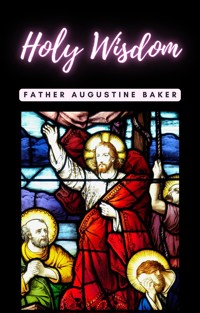
"Holy Wisdom" by Father Augustine Baker is a timeless treasure of Christian spirituality and guidance. In this profound work, Father Augustine Baker imparts his deep wisdom and insights, offering readers a path to a more profound and meaningful relationship with God.
Discover the profound wisdom of this spiritual classic as Father Augustine Baker leads you through a journey of self-discovery, prayer, and contemplation. His teachings on how to cultivate a deeper connection with the divine will resonate with anyone seeking spiritual growth and enlightenment.
If you're on a quest for spiritual growth and desire to enrich your understanding of God and faith, "Holy Wisdom" is a must-read. Father Augustine Baker's timeless words will inspire and guide you on your spiritual journey, helping you attain a deeper sense of wisdom and divine connection.
Das E-Book können Sie in Legimi-Apps oder einer beliebigen App lesen, die das folgende Format unterstützen:
Veröffentlichungsjahr: 2023
Ähnliche









Copyright 2023
Cervantes Digital
All rights reserved
Holy Wisdom
Father Augustine Baker
PREFACE TO THE PRESENT EDITION
AUTHOR´S PREFACE
The First Treatise. Of an Internal Life in General.
FIRST SECTION. OF A CONTEMPLATIVE LIFE IN GENERAL. THE NATURE AND END THEREOF, AND GENERAL DISPOSITION REQUIRED THERETO.
Chapter I. The Nature and End of an Internal Life
Chapter II. Of Natural Propensions to Devotion
Chapter III. Of a State Contemplative and Active
Chapter IV. Of the Necessity of a Strong Resolution
Chapter V. Of the Danger of a Tepid Life
Chapter VI. The Parable of a Pilgrim
SECOND SECTION. IN WHICH IS DECLARED AND PROVED THAT GOD ONLY BY HIS HOLY INSPIRATIONS IS THE GUIDE AND DIRECTOR IN AN INTERNAL CONTEMPLATIVE LIFE.
Chapter I. Two Internal Guides in all Christians
Chapter II. Of an External Director
Chapter III. Of reading Spiritual Books
Chapter IV. Of immediate Divine Inspirations
Chapter V. Impediments to Divine Inspirations
Chapter VI. How God communicates Internal Light
Chapter VII. How to obtain Light in Doubtful Cases
Chapter VIII. What is the certainty of Divine Inspiration?
Chapter IX. Divine Calls do not prejudice Authority
THIRD SECTION. TOUCHING THE SCHOOL OF CONTEMPLATION, VIZ. SOLITUDE AND A RELIGIOUS PROFESSION.
Chapter I. All Conditions capable of Contemplation
Chapter II. These Instructions Profitable to Seculars
Chapter III. The Great Advantages of a Religious State
Chapter IV. A State of Introversion is the end of Religion
Chapter V. How Far Ignorance will excuse Religious Persons
Chapter VI. The Contemplation of the Primitive Monks
Chapter VII. The Special Duties of Religious Persons
Chapter VIII. The Duties of Superiors
Chapter IX. The Duties of Novices
Chapter X. Of the Apostolical Mission into England
THE SECOND TREATISE. OF THE FIRST INSTRUMENT OF PERFECTION, VIZ. MORTIFICATION.
THE FIRST SECTION. OF MORTIFICATION IN GENERAL; AND OF NECESSARY AND VOLUNTARY MORTIFICATIONS.
Chapter I. All duties contained in Mortification and Prayer
Chapter II. Mortification of an Affection to Venial Sins
Chapter III. Absolute Necessity of Mortification
Chapter IV. General Rules of Mortification
Chapter V. Of Mortifications, Voluntary and Necessary
Chapter VI. Of Abstraction of Life, and Solitude
Chapter VII. Of Silence
Chapter VIII. Of Tranquillity of Mind
SECOND SECTION. TOUCHING CERTAIN SPECIAL MORTIFICATIONS OF THE PASSIONS, ETC.
Chapter I. Of Special Mortifications
Chapter II. Of the Mortification of Love
Chapter III. The Nature and Acts of Divine Charity
Chapter IV. Of Purity of Intention
Chapter V. The Order and Degrees of Charity to others
Chapter VI. Of Temperance in Refection
Chapter VII. Of Patience
Chapter VIII. Of Scrupulosity
Chapter IX. Of Scruples arising from Inward Sources
Chapter X. Of Scruples concerning External Duties
Chapter XI. Of Scruples concerning Confession
Chapter XII. Of Scruples concerning Vocation
Chapter XIII. Of Humility
Chapter XIV. Of Obedience
Chapter XV. Of Virtues in General
The Third Treatise. Of Prayer.
FIRST SECTION. OF PRAYER IN GENERAL, AND THE GENERAL DIVISION OF IT.
Chapter I. The Excellency of Prayer in General
Chapter II. Of Vocal Prayer
Chapter III. The Excellency of Internal Affective Prayer
Chapter IV. Of Prayer without Ceasing
Chapter V. Of Sensible Devotion
Chapter VI. Of Distractions
Chapter VII. The Doctrine of Fr. Baltazar Alvarez, S.J. Defended
SECOND SECTION. OF THE FIRST DEGREE OF INTERNAL PRAYER, VIZ. MEDITATION.
Chapter I. The degrees of Prayer
Chapter II. Of Meditation
Chapter III. How Meditation is to be Exercised
Chapter IV. Of set Retirements for Meditation
Chapter V. Signs when a Change of Prayer is Seasonable
THIRD SECTION. OF THE EXERCISES OF IMMEDIATE FORCED ACTS OF THE WILL, BEING THE SECOND DEGREE OF INTERNAL PRAYER.
Chapter I. Of Acts of the Will and Affections
Chapter II. Variety of Acts, how to be exercised
Chapter III. Of the Exercise of Acts of Resignation
Chapter IV. How Prayer is to be Exercised in Distractive Offices
Chapter V. How Prayer is to be Practised in Sickness
Chapter VI. Of Spiritual Discretion
Chapter VII. Of the Prayer of Interior Silence
FOURTH SECTION. OF CONTEMPLATION.
Chapter I. Of Contemplation in General
Chapter II. Of the Prayer of Aspirations
Chapter III. Of Passive Unions
Chapter IV. Of a Passive Union purely Intellectual
Chapter V. OF the Great Desolation
Chapter VI. OF the State of Perfection
ACTS AND AFFECTIONS.
AN ADVERTISEMENT TO THE READER.
A POSTSCRIPT TO THE READER.
A MEMORIAL BY FR. LEANDER
CERTAIN PATTERNS OF DEVOUT EXERCISES OF IMMEDIATE ACTS AND AFFECTIONS OF THE WILL.
TO THE DEVOUT READER.
ACTS UPON THE LIFE AND PASSION OF JESUS CHRIST
PSALMUS DE PASSIONE D. N. JESU CHRISTI.
HOLY EXERCISES OF CONTRITION.
ACTUS CONTRITIONIS, &c.
HOLY EXERCISES OF PURE LOVE TO GOD.
CERTAIN AMOROUS DESIRES, &c.
CERTAIN AMOROUS SPEECHES OF THE SOUL TO HERSELF IN PRAYER.
HOLY EXERCISES OF ACTS OF THE WILL.
HOLY EXERCISES OF RESIGNATION.
A DAILY CONSTANT EXERCISE.
EXERCITIUM QUOTIDIANUM.
Index of Scripture References
PREFACE TO THE PRESENT EDITION
IF it is a duty to apply to holy books the practice which the Following of Christ bids us observe towards holy persons, ‘not to dispute concerning the merits of the saints, as to who is more holy than another, or greater in the kingdom of heaven,’ it will not be right to give the preference to the work which we are now offering in a new form to the public, over the many, spiritual books which have helped on souls in the way of perfection. But it will not be right either to give to other books a preference over this. Certainly Sancta Sophia has been of great service in instructing beginners, in guiding proficients, and in securing those that have arrived at some degree of perfection, in the way along which Almighty God has called and led souls that have been highly privileged; and the Holy Spirit, who breatheth where He will, has through the words of the Venerable Father Baker whispered to these souls, and has drawn them on to a closer and closer union with Himself. Ever since the time that I first became acquainted with the writings of Father Augustine Baker, either in the epitome of them in which Father Serenus Cressy has so successfully presented them in his compilation, to which he gave the appropriate name which this book bears, Sancta Sophia, Holy Wisdom, or in their extended and full form, as they exist in various portions in some of our convents, I felt the desire to enter upon the task, which by God’s blessing I have at last completed, of republishing with necessary annotations this golden treasury. Why should it be kept in the dark when, by being set up aloft, it could shed such light around?
Difficulties, which time has at last removed, have constantly been in my way. Duties of an imperative nature have ever attended me, and in the midst of them—though I have never lost sight of the task I had imposed upon myself—it has not been in my power to do more than a little at a time; and therefore the time has been long in proportion to the importance of the labour. In addition to reprinting the work, I felt that I ought to do two things,—to verify the quotations from the Fathers and spiritual writers, which are interspersed throughout the various treatises; and secondly to call attention to certain passages where explanation or even correction was demanded. The first of these tasks I have been compelled in great measure to abandon; the second, which is of greater importance, I have not neglected. But I must say a word upon both.
The task of verifying quotations from the authors referred to in the writings of Father Baker has been, as is the case with regard to all similar works, an exceedingly difficult and a hopeless labour. I have spent hours upon hours and with very little success. I remember many years ago reading in a note in some edition of the Spiritual Exercises of St. Ignatius,1 that the Scripture quotations of that holy Saint and great Master of the spiritual life are not always strictly correct; because it was evident the Saint quoted from memory, without referring on each occasion to the sacred text. Father Baker, in his reading of the Fathers and of spiritual writers, seems to have noted down at the time passages and words that struck him as bearing upon the subject on which he happened to be then engaged. And Father Cressy, in condensing the good Father’s writings, cited the name, but without any reference to the special treatise; and thus in almost all instances no help is given towards a classical verification of the authority, upon which a truth or principle is confirmed by the writer. To verify passages, therefore, to which no reference whatever is given, is a very laborious task. But in cases in which it is important that the special reference should be pointed out, I have done my best with whatever assistance I have been able to command; and I trust that no question has been left unnoticed in which the authority has been really of importance. To verify every quotation would imply an expenditure of time which I have not, and never can expect to have, at my disposal. This difficulty I have especially felt in the case of the writings of Thaulerus, whose works, as far as I know them, are in very closely-printed volumes, with limited and imperfect indexes. However, I feel that this is not a matter of practical value, as the good persons into whose hands this edition of Sancta Sophia will fall, and who will make the most use of it, will probably have no opportunity or desire of referring to the original, even if every chapter and verse were carefully recorded.
With regard to the second matter of explaining or even correcting certain passages, I hope I have not been negligent. The necessity of such explanations or corrections arises mainly from the circumstances of the period in which Father Baker wrote, and in which his writings were collected, condensed, and printed. Father Baker wrote his treatises and gave his instructions to the religious under his guidance, a short time before the Church was called on to pronounce on the doctrines of Quietism. The same difficulty, therefore, exists in regard to certain expressions of his, as exists with regard to the writings of the Ante-Nicene Fathers. Before the time in which the Church in the Council of Nicaea found it necessary to enter more fully into the definition of the terms of Substance, Nature, and Person, as predicated of the Mysteries of the Blessed Trinity and the Incarnation, expressions may have been sometimes used by perfectly orthodox theological writers, which were capable of a wrong interpretation. But when, under the guidance of the Holy Spirit, the Church defined with careful and logical precision what these sacred Mysteries implied in reference to the various terms used and required, with regard to unity of Substance and plurality of operations, a more exact terminology was strictly observed, in order that orthodoxy might be professed, and that through the sound word that cannot be blamed, he who is on the contrary part might be afraid, having no evil to say (Titus ii.8). If even St. Paul’s own words, notwithstanding the inspiration under which he wrote, were wrested to destruction, no wonder that the words of faithful and wise theologians and martyrs were sometimes misinterpreted and wrenched into a defense of heresy. Father Baker, I have said, lived and wrote just before Quietism was condemned. For it was in the year 1687 that Pope Innocent XI. censured and pronounced sentence against the sixty-eight propositions of Molinos; and in 1699 Innocent XII. condemned the semi-Quietism of Madame Guyon and the illustrious Fénélon. Father Baker had already completed his labours, having gone to his reward in 1641, and Father Cressy in 1674.
Certainly some parts of Sancta Sophia would have been omitted or expressed otherwise, had these two holy Fathers lived to witness the controversy and its issue. Care has been taken to call attention to these points. I hesitated for a time whether I ought not altogether to omit such parts; but upon deliberation and after taking counsel, I thought it better not to interfere with the original, but to make the correction, or give a necessary explanation, in a note. An instance will be found in treat. iii. sect. iii. chap. vii. in reference to the prayer of silence of Don Antonio de Rojas, which has been condemned by the Church; though the censure was not affixed to it during Father Baker’s lifetime. That Father Baker was no Quietist and had no sympathy with Quietism is especially evident from the prayer of Acts, which he so fully explains and so warmly recommends in the third section of the third treatise.2 And the collection of Acts at the end of the work is of itself an evidence how averse he was to the teaching of those, who, after Molinos, considered Contemplation to be a state of perfect inaction, in which the soul exercised none of its powers, and elicited no acts whatever, not even of hope, love, or desire; in other words that it was doing nothing at all, and therefore not praying nor adoring.
Although it may be safely said that there is no fear nowadays from Quietism in any general effect, for the active spirit of the time is so opposed to it, and even the prevalence and increase of vocations to active rather than contemplative orders in the Church render such a danger very unlikely, yet there may be a risk in individual cases of souls being misguided, unless they are on their guard, and receive caution from their directors against this possible evil. I trust that the danger signals which will be erected, where it seems necessary, will remove every objection which has been at any time felt, about allowing the free use in religious communities of this most useful and solid work on Mystical Theology.
A brief biography of the two good Fathers who have been respectively the author and compiler of the work will be appropriate. Some years ago, when I first undertook the task of preparing an edition of Sancta Sophia, I published a Life of Father Baker,3 and appended to it an essay on the Spiritual Life, mainly grounded on the venerable Father’s teaching. As that work is accessible, though I believe it is not very easy to procure, I shall limit myself at present to but a few details.
David, known in religion by the name of Augustine, Baker was born in Abergavenny on the 9th of December 1575, of Protestant parents. He received his early education at Christ’s Hospital in London, and at the age of fifteen went to the University of Oxford, and entered as a commoner at Broadgates’ Hall, now known as Pembroke College. He remained at Oxford but two years, and then returned home to enter upon the study of the law under the instruction of an elder brother. This study he afterwards prosecuted with great attention in London, until upon his brother’s death he once more returned to his native town. Here he worked under his father, who managed the estates of the Earl of Abergavenny. His religious education had not been attended to, and for a long time he seems to have led a thoughtless, though, from his own testimony, not a wicked life. But having been rescued by an extraordinary intervention of Providence from a most perilous position, in which his life was likely to be sacrificed, he entered into himself, and began to think seriously upon the affairs of his soul. He sought instruction at the hands of a Catholic priest, the Rev. Richard Floyd, was received into the Church, and abandoning the law he resolved to devote himself to the sacred ministry. He became acquainted with a Benedictine Father of the Cassinese Congregation, sought and obtained admission into the novitiate, and was clothed in the Abbey of St. Justina at Padua. He went through his year’s probation; but being very much broken down in health he left Padua before taking his vows, and returned to England, where, having recovered his strength, he made his profession at the hands of some Italian Benedictine Fathers of the same Cassinese Congregation. He was then in the thirty-second year of his age.
For some years, before being promoted to the priesthood, he was employed by his superiors in various employments, in which his legal and historical knowledge was of great service. He devoted himself very earnestly also to prayer and the exercises of the spiritual life; and although he made such progress by his earnestness and perseverance—sometimes for six hours at a time in prayer—as to have been rewarded by ecstasies, yet in his case the course even of such love did not run over-smoothly, and from time to time he seemed to fall back again from his advancement. All this was the working of the Divine Spirit, both to ground him more perfectly in humility, and to give him an experience which he was to use afterwards in the guidance of others. After an interval of twelve years he went over to Rheims, where he was ordained priest in the year 1619, in his forty-fifth year; and in the following year he was appointed chaplain to the family of Mr. Philip Fursden, in Devonshire. Here, in a life of great retirement, he pursued with steady constancy the spiritual exercises, and by recommending to all inquirers into the Catholic faith the duty of prayer, in order to obtain light and strength, he succeeded in gaining many converts to the Church.
At this time the venerable Father’s life was so thoroughly one of prayer, that he used sometimes to devote as many as eleven hours in the day to this holy practice. His health, however, was extremely delicate, and as he was threatened with consumption, he was ordered by his superiors to move to London, where it was hoped that occupation of a somewhat more active nature might be of advantage to him. He laboured, conjointly with Father Clement Reyner, in compiling the well known Apostolatus Benedictinorum, and began at that same period to write some of his spiritual treatises. He had to travel about to various parts of England and the Continent to consult documents, and at the same time that this change of occupation benefited his bodily health, it did not in the least interfere with his spiritual progress. He had now so perfectly grounded himself in the ascetical life, that no distractive employments could withdraw him from his habits of recollection. His life was hidden with Christ in God, and was what he himself so aptly calls such a life, ‘a life of introversion.’
In Christmas of the year 1623, Father Rudesind Barlow, President-General of the English Benedictine Congregation, founded a community of Benedictine nuns at Cambray, and in the following summer Father Baker was ordered to go and assist in training the young community in the ways of the spiritual life. Here he was in his true element; and the solid progress made by his disciples was a proof of his skill and success as a guide in these high paths. The two most noted amongst these holy souls were Dames Catherine Gascoigne and Gertrude More. The former of these was the most faithful and constant follower of Father Baker’s instructions, and became herself so skilled in the practice of the duties of the Religious Life, that she was employed for some time by the Archbishop of Cambray in forming a convent in his diocese after the model of her own. She held the office of Abbess of Cambray from the fifth year of her profession, almost uninterruptedly till her death in 1676, two years after her jubilee in Religion. Her letter to Father Cressy prefixed to Sancta Sophia, and his answer prefixed to the third treatise, show what interest she, took and what part she bore in the drawing up of the instructions contained in this work. The other holy nun, Dame Gertrude More, a direct descendant of the martyred Lord Chancellor, was of a character more difficult to bring into that subjection to a spiritual guide, which seemed so natural to Dame Catherine Gascoigne. At first she refused the direction of Father Baker, and pursued a spiritual course of her own. But being one day vividly struck by a passage which he read to her from an ascetical work upon the exceptional guidance of souls in a state of aridity, she placed herself completely under his direction, and quickly advanced so far as to arrive at a very close union with God. Many of the Acts and Affections at the end of Sancta Sophia were found among her writings, gathered, it would appear, from Father Baker’s suggestions. Her little work, called An Idiot’s Devotions by herself, but by Father Baker more properly called Confessiones Amantis, expresses the spirit by which she was animated. She died young, it is said in the odour of sanctity, in the twenty-seventh year of her age in the year 1633.
During the nine years that the venerable Father remained at Cambray, he drew up many of his ascetical treatises at the earnest request of the community, who were anxious to perpetuate instructions which had been of such immense value to themselves. Many of them are lost, but several are preserved, and may be found in manuscript in the libraries of Downside, Ampleforth, Stanbrook, and St. Benedict’s Priory at Colwich. They are best known, however, through the form in which Father Cressy drew them up in the work which is now presented once more to the public. Father Baker remained nine years at Cambray, and then was removed to the Monastery of St. Gregory at Douai, and became a conventual. There he continued his wonted exercises, and devoted himself also to his writings. After about five years’ sojourn he was again sent on the mission into England, being then in the sixty-third year of his age, in the year of our Lord 1638. At that time a summons to the English Mission was a summons to go forth to martyrdom; and notwithstanding his love for conventual life, and his deep sense of the responsibility attending the career of a missioner, he at once set about preparing for his departure. He started—after a painful farewell—from his convent; and, on arriving in England, divided his labours between London and Bedfordshire. He was sought after by the pursuivants who were at that time particularly active in bringing Catholic priests to judgment and to execution; and was obliged, old and feeble as he was, to fly, according to our Divine Lord’s advice, from place to place, in order to avoid the persecution. But nothing interfered with his devotedness to prayer.
The struggle between sickness and persecution, as to which was to conquer in his regard, went on for three years, and at last it was to end in 1641 in favour of sickness. The year 1641 was a fatal one for priests, but a rich one for martyrs. In that year Bishop Challoner enumerates eighteen priests who were condemned to death, and were either savagely executed or harassed to death in prison. Among them were two of Father Baker’s confrères, Fathers Ambrose Barlow and Bartholomew Roe. He himself was on the point of being seized, when he was struck by a contagious fever, which scared away his pursuers. Though he did not actually die upon the scaffold, to which he was on the very point of being led, he may well be considered as a martyr. In concealment, and under the solicitous and affectionate care of a good Catholic matron—Mrs. Watson, mother of one of the nuns of Cambray—in constant prayer and acts of resignation, he resigned his soul unto the hands of his Creator on the 9th of August 1641, in the sixty-sixth year of his age and the thirty-seventh of his religious profession. Defunctus adhuc loquitur. Though dead, he continued to live, and has continued living ever since, in his spiritual writings; and it is to be hoped that his voice will be made to sound again, and be heard by a more numerous circle of hearers, through the means of the work which is now again going forth into the world.
It was in the year 1657, sixteen years after this holy Father’s death, that his friend and disciple, Father Serenus Cressy, published the useful compilation of his writings, under the name of Sancta Sophia. This Father, called in baptism Hugh Paulin, and in religion Serenus, was born at Wakefield, in Yorkshire, in the year 1605, the eventful year of Fawkes’s Gunpowder Plot, and the same year in which Father Baker was clothed in the Abbey of St. Justina in Padua. He went to the University of Oxford at the early age of fourteen, and in the year 1626, at the age of twenty-one, became Fellow of Merton. He received orders in the Church of England, and was appointed chaplain to Lord Wentworth, afterwards Earl of Strafford of noted memory. A little later he was chaplain to Lord Falkland; then he became Canon of Windsor, and afterwards Dean of Leighlin, in Ireland. He travelled as tutor to a young English nobleman, and in the year 1646 became a convert, and was received into the Church in Rome, where he happened to be at the time. Next year, being in Paris, he published his Exomologesis, or Motives of his Conversion, which he dedicated to the Carthusian Fathers of Nieuport in Flanders, whom he at one time thought of joining. However, owing to their very secluded mode of life, he was directed to turn towards an Order in which his literary capacity might be of greater service, and he joined the Benedictine Community of St. Gregory’s at Douai, where he took his vows in April 1649. He remained as a conventual for some eight years, having, however, spent about one year of that time in Paris, with an affiliation community from Cambray. This house in Paris, placed under the protection of our Lady of Good Hope, is now existing in its worthy successors at St. Benedict’s Priory, Colwich, near Stafford. He was afterwards sent out on the mission into the South Province in England; and upon the marriage of Charles II. with the Infanta of Portugal in 1662, he became one of her chaplains, and resided for four years at Somerset House. Here, besides discharging zealously and edifyingly the duties of the sacred ministry, he devoted much time to writing several learned books on controversial subjects.4 During this time he was also engaged upon his great work, the Church History of Britanny, which he published at Rouen in 1668.
Father Cressy was greatly esteemed by his religious brethren, and held among them several offices of trust and responsibility, and was for many years a member of the General Chapter. His last missionary appointment was to the chaplaincy of Richard Caryl, Esq., of East Grinstead, in Sussex, where he died the death of the just on the 10th of August 1674, in the sixty-ninth year of his age. It was towards the end of the time of his residence as a conventual at Douai, that he drew up these instructions from the writings of Father Baker, which in a dedicatory letter to Father Laurence Reyner, President-General of the English Benedictine Congregation, he declares to have drawn up and published in obedience to his command. Not obedience only, however, he adds, but gratitude urged him on in his work of love; for to these instructions he, in that same letter, attributes the hastening of his conversion to the faith, and his call to join the Benedictine Order. May God in His infinite mercy grant that these same words of wisdom and piety may bring grace and inspire resolution into many a hesitating soul, and tend to enlighten those that are sitting in darkness and in the shadow of death! Any one who has had the opportunity of reading any of the Treatises of Father Baker in their original form, will be able to testify to the industry required for compiling them, as Father Cressy has done, and for the fidelity with which the more than forty different Treatises have here been preserved and interpreted.
It remains to make two or three observations in connexion with the teaching conveyed in the treasury of wisdom here laid open. Let me most earnestly recommend the reading of Father Cressy’s Preface to the Reader, herein prefixed to the first Treatise. Possible objections are here anticipated and answered. Also I must invite very particular attention to the case of the holy Jesuit, Father Balthasar Alvarez, recorded in the 7th Chapter of Section 1, Treatise III., where we find a full and striking and most telling apology for the method of prayer, so strongly recommended by Father Baker. One great reason why so many break down in their attempts at arriving at perfection in the spiritual life is, because they are tied down too stiffly to the formal method of Discursive Prayer, and are not allowed free enough scope for the exercise of Acts and Affections. It is quite proper that upon the first entrance into the spiritual life, the soul should be well exercised in the use of the powers of the soul, and that the Understanding especially should be called into play. But to insist upon working the Understanding, even when the Will is ready at once to work, is not unlike insisting on the spelling of every word, or the parsing of every sentence, each time that we read a book or a newspaper. All our proficiency and skill would avail us nothing, if we were to be thus tied down; and the reading of books would indeed be anything but instructive and entertaining. Father Balthasar Alvarez, in the chapter just referred to, will be found to say: ‘All internal discoursing with the understanding was to cease, whensoever God enabled souls to actuate purely by the will. And that to do otherwise would be as if one should be always preparing somewhat to eat, and yet afterwards refuse to taste that which is prepared. By this divine Prayer of the Will, the Holy Spirit of Wisdom with all the excellencies of it described in the Book of Wisdom (chap. viii.) is obtained, and with it perfect liberty.’
Undoubtedly, as we have said, on the first entrance into the spiritual life it is important to attend to the instructions given upon Discursive Prayer, or ordinary Meditation.5 But it is not to be understood that this method is to be rigidly adhered to throughout. When Almighty God calls the soul to the Prayer of Acts, and afterwards of Aspirations, the soul ought to be allowed liberty to obey and follow the call. It is quite true that we should not attempt to run, until we have become steady enough upon our feet to stand or walk. But it is equally true that if we content ourselves with only standing or walking, when there is occasion for greater speed and activity, we shall be outstripped by others, who have learnt that where the Spirit of the Lord is, there is liberty: who have heard the summons to work in the words: Why stand you here all the day idle? and have obeyed the command of the energetic St. Paul: So run that you may receive. For a great truth which Father Baker always keeps before us is, that we are not simply to satisfy ourselves that we devote a certain period each day to our mental prayer, but that we must aim at progress in Prayer, and that by becoming more practised and more perfect in that holy exercise, we may make corresponding progress in holiness of life, and ascending from virtue to virtue, may at last by closer union be allowed to see the God of gods in Sion.
In the same manner as Father Rothaan, S.J., in his most practical and excellent instruction on ‘the Method of Meditation,’ gives an example how to meditate on an eternal truth, and works out the meditation, in order that it may serve as a model on which to work out others, so will I submit an example, how the Prayer of Acts may be exercised, according to the instructions given in Sancta Sophia. We will take the truth suggested by Father Rothaan: What doth it profit a man, if he gain the whole world, and lose his own soul! We must divide our Prayer into the ordinary divisions observed in meditation: 1. the Beginning; 2. the Body; 3. the Conclusion. In the BEGINNING we must, as usual, make our act of recollection of the Presence of God, pray for light, and by an act of sorrow remove sin, which obscures the soul, and then quiet the imagination, by picturing our Divine Lord standing before us, and addressing directly to us those words, which are His own.
Then passing on to the BODY of the Prayer, instead of arguing with myself, I address my words in the form of Acts to Almighty God, or to our Divine Lord; observing, usually, a method in the Acts, beginning with the lower ones grounded on Faith, and progressing towards the higher ones of Confidence and Love. Thus may I pray. Faith. O my God, I believe these words, and I accept in my soul the great truth they express. Thou hast made my soul eternal, and therefore I fully see its immense value. The world may try to convince and persuade me through its false principles to follow it, and forget Thee; but to whom shall I go but to Thee who hast the words of eternal life? &c. Sorrow. O my Divine Jesus, how sorry am I that I have not hitherto felt this truth and acted up to it! Every time I have sinned I have denied this truth by my own willful act and deed. Never let me sin again, &c. Humility. But who am I, that I should pretend to make such a promise? I am weak by nature, and have weakened myself still more by sin. I am Thy child: do Thou save me. Lord, save me, or I perish, and I shall never gain the end for which alone Thou hast made me, &c. Supplication. Give me grace, O my most powerful and generous God, that I may ever live up to what I now feel; and if this day any temptation come upon me, do Thou cry out in my ears, and make me hear Thy words: What doth it profit, &c. Hope. Now I feel that I have more courage, because Thou hast promised to assist me in my struggle. I rely on Thy power and Thy fidelity; and though I have a great work to do in striving to save my soul, Thou canst and wilt help me, and then we shall succeed, &c. Confidence. Nay, O my God, I have more than hope: Certus sum. I am sure that Thou canst conquer all my enemies, and that Thou, in saving my soul, wilt save what is already Thine. Tuus sum ego, salvum me fac, &c. Love and Desire. Since I belong to Thee, O God, I value Thee far beyond all the world, and all that the world can give me. I desire to be dissolved, and to be with Thee, Thou God of my heart and my portion for ever. Woe that my sojourning is prolonged! Draw me to Thee, and help me to run in the way of Thy commandments, &c. Thus, the soul speaks to God, and is continually actuated towards Him. The lower Acts of Faith, Sorrow, &c., will at first be more numerous, and will suggest themselves more readily than the higher ones of Confidence, Love, Resignation, and such like; but after a time these latter ones will prevail. At the end a devout, colloquy or address is made to God, and His blessing is humbly and fervently besought in behalf of all that the soul has been inspired to promise and resolve. A slow and patient perusal of the Exercises appended to this volume will facilitate the making of these Acts. And as the higher Acts become more easy and familiar, the soul will advance further in its union with God, and Prayer will become more affective. I may be allowed to refer the reader to what is said in the short Treatise upon the Spiritual Life, which I have appended to the Life of Father Baker, pp. 141, &c.
I feel that it is not necessary for me to say anything more by way of Preface. But, submitting everything to the judgment of the Holy See, I now commend the work which I have prepared, to the blessing of God; and beg that He, from whom comes down every good and perfect gift, will bestow, in behalf of those who make a good use of these holy instructions, a fresh harvest of the fruit which was gathered in such abundance when Sancta Sophia first made its appearance, and guided so many souls to Perfection.
J. NORBERT SWEENEY, O.S.B.
AUTHOR´S PREFACE
The Sum of the Preface.
1-8. Objections before and since the author’s death made against the publishing of this doctrine.
9-10. The first objection: Because the knowledge and practice of it belongs to few: answered.
11-15. A second objection, viz. Because suspicion may be given to Catholics of pretending to new illuminations, prejudicial to the doctrine of faith and rules of life established in the Church: answered largely, and the contrary demonstrated.
16-20. What illuminations are here meant, and how divine love, above all other things, doth most enlighten the soul.
21-22. A third objection, viz. That sectaries will here take advantage to justify their frenzies and disorders.
23-30. Four preparatory grounds laid for the clearer answering this objection.
31-32. The said objection answered. Where is contrarily proved the necessity of publishing such doctrines, as the only means to discover and disprove the false illumination of sectaries.
33-38. An exhortation to sectaries to observe the strange difference between their spirits and that of Catholics.
39-46. An explanation of certain passages in the following treatises.
47. A just request to the reader.
48. A submission of all to the See Apostolic, &c.
BELOVED CHRISTIAN READER,
1. Before thou proceedest to partake of what is promised thee in the frontispiece of this book, thou art entreated to permit thyself to be detained awhile in the entry. For perhaps a short delay here will make thy progress afterwards both more speedy and profitable.
2. This is to acquaint thee that the immaculate doctrine contained in this book, though it never met with any that opposed, or so much as questioned, the verities thereof, speculatively considered, yet there have not wanted some that have judged them not fit to be thus exposed to thy view, much doubting thou wouldst prove such an one as would make an ill use and perverse advantage from them.
3. Now the principal, yea only, point that gives some this jealousy is that which thou wilt find in the Second Section of the First Treatise, where is treated touching divine illuminations, inspirations, impulses, and other secret operations of God’s Holy Spirit in the hearts of internal lives. Concerning which the constant teaching of our Venerable Author (in brief) is this, viz. ‘That the Divine Spirit, by virtue of the said operations, is to be acknowledged our only secure Guide and Master in these secret paths of divine love, discovered in some measure in the following treatises. And consequently that the most essential, universal duty to be aspired unto by every one that pretends a desire or intention to walk in the same paths is, to give up his soul and all his faculties to God’s internal guidance and direction only, relinquishing and renouncing all other instructors and instructions, as far as they are not subordinately coöperating with this our Divine Master, for the receiving of whose celestial influences, the humble and devout scholar is obliged to prepare and dispose himself by prayer, abstraction of life, &c.; in solitude hearkening to His voice and call, and learning how to distinguish it clearly from the voice and solicitations of human reason or corrupt nature; till that by long familiarity and conversation with God, divine love alone will so clear his spiritual sight, that he will see at last no other light, nor receive motion from any other, but God only; and this in all actions, omissions, and sufferings, though in themselves of the smallest importance.’
4. This is our Venerable Author’s doctrine, everywhere in all his treatises (whatever the subject be) inculcated, and even to the wearying of the readers, continually repeated and asserted. Indeed a doctrine it is so fundamental to all his other instructions concerning prayer and mortification, &c., that the least weakening of its authority renders all the rest unprofitable.
5. But little reason there is to fear that a doctrine, which is the very soul of Christianity, can be shaken by human opposition, or disparaged by jealousy. True it is, notwithstanding, that though this fundamental verity receives testimony abundantly both from Scripture and universal tradition, though it be constantly asserted in the schools, and sprinkled everywhere in almost all mystical writers, yet scarce hath any one since the ancient fathers’ times (especially St. Augustine) so purposely, largely, and earnestly recommended it to practice. And, therefore, no great wonder it is, if such a way of delivering it hath seemed a novelty, even to those that speculatively and in theory acknowledge it to be the established doctrine of the Church; and whilst they willingly, and with applause, hear it asserted daily in the schools, yet meeting with it thus popularly spread, they are offended with it; I mean with the communicating it to the use and practice of the unlearned.
6. Now what it was that troubled them will appear from the only objection in the Author’s lifetime made against it, which was indeed a mere jealousy, lest this doctrine so delivered should prejudice the authority of superiors. The which objection he answered to the full satisfaction of all that were interested in the matter. The sum of which answer follows in the ninth chapter of the second section of the first treatise, and needs not to be here repeated.
7. But since his death, and especially after that, by a general unanimous agreement of all superiors among us, it had been ordained that the sum of the Author’s spiritual doctrine should, for the good of souls aspiring to contemplation, be published; but the same objection hath been renewed, and others moreover added thereto. And all of them have risen from the like ground of jealousy, not so much acknowledged to be rational by the objectors themselves (who readily subscribe to the doctrine as Catholically true and holy) as feared from others; to wit, partly from ordinary not learned Catholics, who, it is suspected, will be suspicious of a doctrine that will seem new and, however, unproper to them; but principally from strangers and enemies to the Church, especially the frantic enthusiasts of this age, who, as is feared, will conceive their frenzies and disorders justified here.
8. These things considered, both zeal to truth, duty to superiors, and charity to thee, beloved reader, obliged me before all other things to beseech thee to abstain from reading the book, unless it can be demonstrated beforehand that it was fit to come into thy hands; that the suspected inconveniences and suspicions are evidently groundless; that it would be a greater frenzy in the enthusiasts of these days, or in any seduced or seducing spirits, to claim any right in this doctrine than that which already possesses them; and, in a word, that no objections, either against the doctrine or publishing of it, either have, or, as we suppose, can rationally be devised, to make us repent the printing, or thee the reading, of the following book.
9. Among the said objections this one is scarce worthy to find place, which yet by some hath been urged against the publishing to all Christians’ view instructions about prayer and mystical practices proper to a few contemplative persons (for whom alone the Author intended them, without the least thought of having them communicated and exposed so generally): especially considering that this treatise discourses of sublime mystic matters, above the reach of vulgar capacities; and also, that whereas to such tender well-minded souls (as those were for whom the said treatises were meant) just liberty and condescendence were allowed in many cases, not to be permitted to others that either in the world, or else in a religious life, do walk in other ways; these, notwithstanding, will be apt to their own prejudice to make use of such liberty.
10. But surely, as it would be most unreasonable to forbid a physician to publish a book of remedies against some special diseases, for fear that some that are untouched of those diseases, or perhaps sick of the contrary, should hurt themselves with making use of medicines improper for them; or Molina the Carthusian to publish his excellent instructions for priests, lest lay persons should assume the privileges belonging to that sublime calling; or Alvarez de Paz to print his volumes about the duties and exercises of religious persons, because they are improper for seculars; so neither upon such grounds ought these instructions be hindered from being public. Neither ought any to fear lest ordinary Christians will foolishly apply to themselves the relaxations about confessions, &c., necessarily allowed to well-minded scrupulous souls that pursue contemplative ways in an abstracted life and solitude. Or that souls that live distracted, solicitous, active lives, as long as they live so, will judge themselves interested in the ways and exercises of internal contemplative livers. Or, in a word, that those who are yet but beginners, or have made but small proficiency in internal ways of the spirit, will be so foolishly presumptuous as to aspire to exercises more sublime than belong to them; the which they cannot do without receiving infinite prejudice by their indiscreet ambition. Add hereto, that on several occasions there have been used and inculcated in this book the best preventions, cautions, and provisions that possibly could be devised, against all misunderstanding and misapplication of any doctrines contained in it. To conclude, it may seem a sufficient safeguard for me to have herein the example of the V. R. F. A. C.,6 a person much esteemed for learning and piety, who hath not only published (in an additional treatise to The Conflict of the Soul) Instructions for Contemplation, but a great part of his Maxims (though brief) are very conformable to what is here expressed more largely.
11. The special feared inconveniences that may arise from the publishing of this doctrine touching divine inspiration, do regard partly some that live in the communion of the Church; but principally such as are strangers and enemies thereto. As for the former, it is suspected, that by urging so seriously the duty of attending to and following divine inspirations, some even of the more sober Catholics will be apt to be jealous, that the teachers and practisers of such a doctrine will seem thereby to exempt themselves in many things from the ordinary jurisdiction of prelates and magistrates, pretending to extraordinary illuminations and commissions, and to walking in mirabilibus super se, &c., by which a prejudice and contempt also may be cast upon the common orders and rules concerning faith and good manners established in the Church.
12. Now not to forestall what is copiously delivered in the second treatise (to wit, that due obedience to all kind of superiors is so far from being prejudiced by this doctrine, that it is only by this doctrine that it is perfectly established, and all possible suspicions, all imaginary cases to the contrary solved): hereto it is answered that, whereas it is said that by a pretending to divine illuminations, &c., a contempt may be cast upon the common doctrines and rules of faith and a good life, there is not the least ground for such an apprehension. For never did any spiritual mystic writer pretend to receive any new or formerly unknown lights or revelations in matters of faith, beyond what have been known and universally received in the Church. The lights which such persons by God’s gracious visits receive being only a clearer sight of ordinary mysteries; the which produces in them a firmer assent unto them, a greater love of them, an abhorring of all novelties of doctrines, and a most fervent zeal to the unity and peace of the Church, and to the reducing of all unbelievers, misbelievers, and schismatics, into its bosom and communion.
13. The like is to be said for the rules of practice, and a holy Christian conversation. They know no other but such as are common to all other Christians, which are revealed in the Gospel, and proposed by the pastors of God’s Church in councils, and in the writings of the holy fathers. The only advantage that in this regard is pretended to, and acquired, by attending to divine inspirations, is a more perfect use and a more faithful application of the ordinary precepts of holiness, or of counsels of perfection, to those who profess the embracing of such counsels: an extending of them further, and to more particulars, than it is possible to be taught by books or attained by study.
14. All Christians know that to blaspheme, to lie, to defraud, to be rebellious, unchaste, revengeful, &c., are sins odious to God; and that the contrary virtues are to be practised. Yea, moreover, they know that we are obliged to love God with all our heart, with all our soul, and with all our strength; that we ought in all things to intend His love and honour, &c. Moreover, all know that besides the essentially necessary Christian duties, there are other counsels of perfection, which belong to those upon whom God hath bestowed an extraordinary vocation and grace, enabling them to cast from them all secular anxieties and other impediments to perfect charity, and to put themselves in a condition of solitude, obedience, &c.; the which affords them the best expedients and helps for the increasing of divine love and conformity to His will, even in the smallest matters. All this in gross is known to all Christians of any reasonable capacity and good education.
15. But yet the wisest, the most subtle and learned Christians will never be able, by any human endeavours of study or meditation, to put in practice even those essential precepts after a perfect manner; that is, with an intention not only right, but also pure and deiform. And much less will they by such weak helps, be enabled to discern in a thousand particular cases and circumstances what is most perfect, most acceptable to God, and conformable to His divine will. As for example: 1. How when two good or indifferent things are proposed, to make choice or preference of that which, in the present disposition of the soul, will prove most advantageous to perfection. 2. How to spiritualise even the ordinary indifferent occurrences of our life, daily and hourly. 3. How to perceive what manner and degree of prayer is most proper and profitable to the soul in her present state. 4. Or what mortifications are in the present circumstances most advantageous. 5. Or how to discern the state, inclinations, and spiritual necessities of other souls committed to our charge. 6. Or lastly, to discover a thousand secret subtleties, close interests, and reservations of our corrupt nature, which mingle themselves, more or less, almost in all our best actions, &c. In these and a thousand like cases, not all the reading or study in the world will enable souls to carry themselves perfectly in the execution of those precepts or counsels, which in gross all know to be necessary, at least to the attaining to perfection. But a distinct actual supernatural light and grace is necessary; and this not to teach us new precepts or furnish us with new counsels, but circumstantially to apply those which are common and universally known. For want of which light it is that the true way to perfection is almost unknown, even to those who profess the seeking of perfection, and fill the world with books and instructions about it.
16. By what other means, then, is such light to be had? Surely by no other but by the exercise of divine love, which is most perfectly performed in internal prayer, in attention to and union with God in spirit. What an expert, persuading, and subtle master love is, beyond study or consideration, we see even in natural and secular businesses. One that is immersed in sensual love to any person, has no need of instructions or books to teach him the art of loving. We see how skilful on a sudden such an one becomes in the ways how to please the person beloved. He loses not, neither out of ignorance nor negligence, the least opportunity to ingratiate himself. He understands the mind and intention of the other by the least signs; the motion of a hand, the cast of an eye is sufficient to inform him, and set him on work to attempt anything, or procure anything that may content the party. The like subtlety and perspicacity we may see in those earthy souls which cleave with an earnest affection unto riches. What subtle ways do they find out to increase their wealth! Such trifling inconsiderable things they make use of for that purpose, as another would not take notice of, or could not see how to make profit by them. They have almost a prophetical spirit to foresee dangers where none are, and advantages probable or possible to happen many years after.
17. Now how comes it to pass that the eyes of love are so quick-sighted? Surely by this: that where love to any particular object is predominant, it subdues all other affections to all other objects, which would distract the thoughts, and seduce the will from contemplating and adhering to the thing so beloved.
18. Upon such grounds, therefore, as these it is, that St. Augustine calls Divine Love (Luminosissimam Charitatem) most full of light, and most enlightening. For a soul that truly loves God with a love worthy of Him, having the mind cleared from all strange images, and the will purified from all strange affections, is thereby enabled purely to contemplate God without any distraction at all. And being desirous in all things to please Him, knows how to make advantage of all occurrences. Light and darkness, consolations and desolations, pains and pleasures, all these contribute to the advancing of this love. Yea, there is nothing so indifferent, or, in its own nature, so inconsiderable, but that such a soul can perceive how use may be made of it to please God thereby.
19. Now since pure love is exercised immediately to God only in pure prayer, by which alone the spirit is united to Him, hence it is that prayer is the only efficacious instrument to obtain supernatural light, according to the saying of David: Accedite ad Deum, et illuminamini: Approach unto God (by prayer), and (ye shall) be enlightened.7 And hence also it is, that the same holy prophet so earnestly and frequently (above twenty times in one Psalm, 118) prays for such light to understand and discover the wonderful things of God’s Law. And what were those wonderful things? Surely not to be informed that murder and adultery were sins; or generally that God was to be loved with the whole soul; for much more knowledge he had than this before he prayed. But being desirous to give himself wholly to God, and to perform His will alone in all things, he so often makes use of prayer for the obtaining an extraordinary light (to be had no other way but by prayer) that he might thereby be enabled to discover and find out the Divine Will in all manner of cases and doubtful circumstances.
20. Now only such inspirations and such illuminations as these do spiritual persons pretend to by the means of prayer and attending to God. And if they do exercise prayer with a due fervour and constancy, these they shall most certainly enjoy, and that in such a measure that whereas the greatest part of ordinary good Christians are so dim-sighted as to see the Divine Will only in circumstances where there is a necessary obligation (so that they spend the far greatest part of their lives in actions that do no way advance them in Divine Love, being wrought chiefly in virtue of the principle of self-love and interests of nature), those that are perfectly internal livers, being clouded by no vain images, and distracted by no inferior affections, do see the Divine Will clearly in the minutest affairs, which they accordingly make advantage of to improve themselves in the love of God. And, according to the degrees of love, so proportionably are the degrees of light. And thus, I suppose, the pretended inconveniences suspected to flow from the publishing of this doctrine will appear to be only pretended and causelessly feared.
21. But the other objection at first sight seems more considerable, as implying a far greater and more certain inconvenience and danger that may ensue upon the publishing of this doctrine concerning divine inspirations, illuminations, and calls. For thus they argue. It is to be feared that the fanatic sectaries which now swarm in England more than ever, will be ready to take advantage from hence to justify all their frenzies and disorders; all which they impute with all confidence to divine inspirations, illuminations, and impulses. For can we forbid them to practise what we ourselves teach to be a Christian duty? And yet it is apparent what fearful and execrable effects the practice of this pretended duty doth produce among them. It was by inspiration, say they, that their progenitors did break out of the Church; and by inspiration they do still introduce endlessly new fancies and practices. It is by inspiration that they endanger the ruin of Christianity itself by infinite schisms and pestilent reformations. It is by inspiration that they employ the Gospel to destroy the Gospel; from thence preaching heresies in churches and chambers, sedition in states, rebellion against princes and prelates; so destroying all order, unity, and peace everywhere. These things considered, what can be more reasonable than that we should take heed how we furnish them thus with arms to maintain themselves, and to fight against God and His Church?
22. This is the objection which, though it have a fearful show, yet, being well examined, it will prove no less weakly grounded than the former. For the demonstrating, therefore, of the inconsequence of it, I will, by way of preparation, lay down these following undeniable principles, briefly mentioned before, viz.




