


9,59 €
Mehr erfahren.
- Herausgeber: Parthian Books
- Kategorie: Gesellschafts- und Liebesromane
- Sprache: Englisch
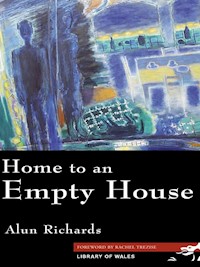
Home To An Empty House tells in Alun Richards' incisive style the story of a marriage that has long since lost its sparkle. Walter, the wisecracking paranoiac and Connie, teacher of the 'backward class', are a couple who know a lot about sex but little about each other.
Das E-Book können Sie in Legimi-Apps oder einer beliebigen App lesen, die das folgende Format unterstützen:
Veröffentlichungsjahr: 2014
Ähnliche



















Contents
About the authorTitle PageFOREWORDHOME TO AN EMPTY HOUSECHAPTER ONE: WALTERCHAPTER TWO: WALTERCHAPTER THREE: CONNIECHAPTER FOUR: CONNIECHAPTER FIVE: WALTERCHAPTER SIX: CONNIECHAPTER SEVEN: IFORCHAPTER EIGHT: RACHELCHAPTER NINE: CONNIECHAPTER TEN: HILDACHAPTER ELEVEN: CONNIECHAPTER TWELVE: WALTERCHAPTER THIRTEEN: CONNIEForeword by Rachel TreziseLIBRARY OF WALESCopyright
Alun Richards wasborn in Pontypridd in 1929. He was educated at Pontypridd Grammar School and then undertook teacher training in Caerleon before spending time as a Lieutenant Instructor in the Royal Navy. After a long period of serious illness as a tubercular patient, he studied at Swansea University and subsequently worked as a Probation Officer in London. Thereafter, although he had periods of employment as a secondary school teacher and, late in life, an enjoyable spell as an Adult Education Tutor in Literature at Swansea University, in essence from the 1960s he was, and successfully so, a full-time writer. He lived with his wife Helen and their four children near the Mumbles, close to the sea which, coupled with the hills of the South Wales Valleys, was the landscape of his fiction.
His output was prodigious. It included six novels between 1962 and 1979, and two collections of short stories,Dai Country(1973) andThe Former Miss Merthyr Tydfil(1976). Plays for stage and radio were complemented by original screenplays and adaptations for television, including BBC’sOnedin Line. As editor, he produced best-selling editions of Welsh short stories and tales of the sea for Penguin. His sensitive biography of his close friend, Carwyn James, appeared in 1984 and his own entrancing memoirDays of Absence in 1986.
Alun Richards died in 2004.
HOME TO AN EMPTY HOUSE
ALUN RICHARDS
LIBRARY OF WALES
FOREWORD
When I first readHome to an Empty Housein autumn 2005, I was living with my fiancé in a basement flat beneath his parents’ house, impatiently awaiting the renovation of our own home. It was a box; one kitchen/lounge, a hotel bathroom with a mini-tub, the plug pulled free of its chain, and a bedroom below the family kitchen. Each morning I was woken by the ceiling creaking; my soon-to-be mother-in-law pounding across it in her relentless quest to prepare a nutritional breakfast and delicately wash everyone’s clothes, and make real tea with a real teapot; a matronal domestic goddess.
Ironic then, that this book is set in a basement flat, that of Walter the wise-cracking paranoiac and Connie, teacher of the ‘backward class’, a couple who know much about sex but little about each other, locked in a marriage doomed to fail. The relative upstairs here is Connie’s Auntie Rachel and they hear her in the mornings too, gargling salt water. I would like to think that is where the similarities of our situations beginandend, but if I’m honest I must admit that I see myself in Connie. By the time I discovered this character, she’d been thirty-two years on the page. It’s not an exceptionally long time really, but sufficient enough for a few changes in the attitudes and expectations of women, given the recent speed of our alleged evolution. In many ways we have surpassed equality – we are chairmen, chief executives, Prime Ministers and mothers. We cherry pick the life experiences that we want: smile genially over our hand-baked flans at the weekend, demand cunnilingus in the bedroom and then on Monday, turn sour-faced in the boardroom. I thought this was a relatively new occurrence but Connie has always been a precocious dominatrix, lacking in sentiment. Why else, while waiting to have sex with Walter for the first time, would she have said this:
What he could never understand was that I wanted it as much as he did. I don’t know where he got his ideas about women from. He professed to be knowledgeable about whores, but that was all. Perhaps he wanted me in a whore’s get up. I didn’t mind if it would help him.
Surely for a woman of the early Seventies (the same age as my mother), she has a particularly modern outlook. Or maybe I’m being naive. It’s the Millennium after all and even reality television allows footage of masturbation with the aid of a wine bottle. It must have started somewhere. Moreover, it’s probably not a question of timing at all. Alun Richards wrote in his 1986 memoirDays of Absenceabout his deep disliking of ‘the exclusivity of the immensely unattractive world of men’. In much of his work, male characters are unreliable, often useless, losers, while females are outstanding truth-tellers: the realists who describe life, as is. Perhaps it’s because Richards’s father abandoned his mother three days after his birth, and never returned. Whatever the reason,Home to an Empty Houseis no exception. Connie is one thing but Auntie Rachel is the keen surveyor who sees through all, including her niece’s extra-marital affair.
It is the oldest story in the world, the older man and younger woman, the one seeking what he has lost, the other finding out what is in front of her… Soft, I call it, like all wishful thinking. They snatch at each other’s bodies in the dark and think it is important.
It was in fact Richards himself who had a particularly modern outlook. He would have grimaced at a suggestion that his work was confined by his being Welsh, although Welsh he was, born and christened Alun in Pontypridd. Richards’ Wales was the South Wales valleys, outward-looking, non-Welsh speaking and already rich with the influence of migrants; a place that bred ‘champions of the world, not bloody Machynlleth’. TheBloomsbury Dictionary of English Literaturerefers to him as a writer who rejected ‘a romanticised Welsh past of myth and anecdote and who was concerned instead with the modern Wales of rugby, beauty queens, television, the language question and the industrial and spiritual decline in the South Wales valleys’. They are subjects that I, a ‘new writer’, am still dealing with today.
In order to faithfully tell of this new world, Richards relied on many of his own experiences. Serious writing, he suggested, should not misrepresent the scenery of its creator’s mind. A writer was at his best when he was ‘up his favourite alley’. In an essay calledThe Art of Narrative, Richards says, ‘It seems to me that there is what an American critic once identified as “a psychological burn” in human lives, a very clumsy expression but one which indicates that the pain of loss, or the intensity of experience can create the most complete revelations’. It is not wayward therefore to suggest Walter’s bout of tuberculosis, the very thing that allows Connie time and privacy to stray, is based on Richards’s own experience of the infection. He spent two years in hospital receiving treatment. This is Walter at the onset of the illness and opening of the work:
You ever been ill? I mean really sick, the sense of rottenness deep down, a feeling of poor quality about every limb you own? Nothing supports you like it should, ashes in the mouth and you haven’t even got the puff to do up a shoe, and there’s this pallor on you, all cheekbones and eyes, the lines where they shouldn’t be, the sweat coming at the wrong times as when you look at an unexpected flight of steps, and you’ve become a right pedlar of sighs.
Richards’s candid approach does not however make his work cold or in any way unattractive. He hated hypocrites, snobs and bullshitters, testimony to which can be found in his 1995 Rhys Davies Memorial Lecture. On the subject of having edited the 1993Penguin Book of Welsh Short Stories, he says, ‘few Welsh writers have a discernable body of work…. With one or two exceptions, you would never think that there is a power structure, wealthy families, groups of persons whose lugubrious self-enhancement as they pass from committee to committee is ripe meat for the discerning eye.’ This nuance influenced him to expose many of these illusions and snobberies in his work but it invariably pushed him, as a person, towards the edges of society. He worked as both a probation officer and a school teacher, jobs which coloured his writing. I’m reminded of one story about his time at Ely Comprehensive. Taking a class largely made up of black thirteen-year-old boys for physical education on a wet Monday morning, he decided to teach them to play rugby. Standing on the running track, the rain misting his thick spectacles (they’d been a necessity since his illness), he held the ball tightly in the crook of his arm, and said, ‘The object of this game is to get the ball, any way you can.’
‘Any way, Sir?’ one of the boys enquired.
‘Yes, any way.’ The boy jumped and spat at the lenses of his glasses, grabbing the ball while Richards was blind. And Richards’s response? ‘I laughed out loud.’
It is this rare warmth of human character that allowed him to writeHome to an Empty House, a frank tragicomedy about ordinary people living against the backdrop of an industrial Wales that is quickly falling away, never getting what they want, but finally realising what it is they need.
Rachel Trezise
HOME TOAN EMPTY HOUSE
CHAPTER ONE
WALTER
The white spot of the ophthalmoscope moved in close, unblinking like a ferret’s eye, an unnatural button brightness moving closer, right in close so I couldn’t blink away the tears, but I saw his jowl then, filmy behind the instrument, his smooth, clean-cut, pretty boy’s jaw, then smelt his lime aftershave sweet to the nostrils against the antiseptic clinical smell, wincing for a moment as he grasped my forehead with his other cold hand and turned me round to get another angle. I was sweating, icicles trickling under my armpits, my good shirt coating and bowels near emptying with fear, but just managing not to get a knee shake which would have been a giveaway because in order to get in close, his knee was between mine, jammed up close to my crutch as he kept looking down that peeper of his.
You ever been ill? I mean really sick, the sense of rottenness deep down, a feeling of poor quality about every limb you own? Nothing supports you like it should, ashes in the mouth and you haven’t even got the puff to do up a shoe, and there’s this pallor on you, all cheek-bones and eyes, the lines where they shouldn’t be, the sweat coming at the wrong times as when you look at an unexpected flight of steps, and you’ve become a right pedlar of sighs.
Ah… you say.Ah…Oh…Aw… And before you know where you are, you’re doing it all the time. Everything about you is paper thin, you feel. You’d bite a nun’s head off for the sake of not shutting a door, and even when you get a grip of the old alk, lifting the top of the bottle doesn’t produce as much as a bubble. A little less of the you-know-what, you say to yourself, whatever your specialwhatis, but in your heart you know you’re beat.
That was me then, only worse than the bilious squidges in front of my eyes, every time I gave the cough an airing, there was this mystery about my left eye.
‘The blip from out there,’ I’d reported to the optician when it first appeared. ‘A little white spot. I can see it there quite clearly, only it’s not there from your point of view if you know what I mean? Left eye, and I can see it with my eye shut if that’s any help? No, not your left, my left.’
The optician was a woman, white coat, letterbox lips, chunky eyebrows, grey hair wrapped in a bun like wire, and a prile of lumpy garnet beads swaddling a prime leather neck like a white Bantu sitting behind a pot. She cooked me all right.
‘Definitely a case of eye strain. I should say reading glasses are a possibility.’
‘Glasses?’
‘Do you do a lot of close work?’ ‘Only when the lights are out.’
‘It won’t be necessary to wear them except for close work.’
‘I’ll remember that,’ I said. ‘But can you hurry it up?’
It was still there, a white blip like an unhatched spider’s egg in front of me. How did I know that tarantulas don’t usually attack in the daylight? They can sit watching their victims for hours until the light goes. And then – bingo! – the shutters are up. I have that kind of melodramatic mind. Which is just as well, the way things turned out.
When I got the reading glasses, it was still there. The lenses didn’t alter it either way.
I said, ‘It’s still there’. ‘What is?’
‘The blip. In the left eye. The glasses don’t make any difference.’
There was only her in the room with me but the blip was like a third presence. It would not go away. I blinked, screwed up my eye, squeezed my eyelids together, then opened them quickly. No difference. It was there in front of me, hanging levelly in limbo like a tiny cocoon. I scowled. If it lived with me much longer, it would require a name. How about Joey, I thought. It was getting like a pet.
‘A further point,’ I reported. ‘The lenses don’t even magnify it.’
I could see her examining my nose for drink signs, and she gave me a mouthful of teeth with a sudden horse smile and a pay-now, complain-later, giggle as if we were all chaps together.
‘I’m sure you’ll find the spectacles a relief, but if you’re still seeing things, I should consult your general practitioner.’ ‘Oh, yes,’ I said. All good advice. But I was scared. I had no idea what it could be, my thing. And I had no energy, no resources. I dragged my feet every day. I’d no appetite either, felt guilty about one or two things. In short, I was a customer for whatever was coming. The low spots in your life always hit you with your trousers down, and with me, it was general nick, and going on down in the medical stakes. And my fear never left me. The white light again. My little blip and his white light.
The GP had sent me to him and now he put the instrument against the other eye, mine.
‘There’s nothing wrong with that one,’ I said.
They don’t have to reply, of course, but I didn’t like his silence. He was young, uppercrust Irish, all shirt cuffs and gold links beneath the white starch, and that impersonal, waxen, SS look that characterises this speciality of medicine. I had this crazy legend in my mind of wayward, drunken, wild-eyed men of brilliance, surgeons who put raw onions in their children’s socks and hated to use the knife. I used to think I was the most naive man I’d ever met, and slightly round the twist, you’ve gathered? I’d believe anything.
Presently, he said, ‘Have you done any heavy manual work lately?’
‘Certainly not.’
‘Tree felling? Using an axe?’ ‘Not on your life.’
‘Jacking up cars?’
‘I couldn’t light a jackie jumper.’
He nodded and began to scribble a note. ‘I want you to get your chest X-rayed.’ ‘Oh, that…’
If it’s easy to guess, your diagnosis and mine, it alters nothing. The moment I started hearing the mumbo jumbo
cavity upper left ventricle, pains in the chest, marked loss of weight – I had that feeling of passing into other hands, a depersonalisation that prisoners get the moment they go through the gates. Still it wasn’t old coffin nails, but pulmonary tuberculosis, such a cliché and so dated. Of course, I was just old enough to remember tales of families going down with it, the street scourge. Galloping consumption, they used to say. I’d met a baker whose girl refused to marry him because of his pallor. He had the sign, her family told her, and for weeks he became a handkerchief watcher, squinting for flecks in the early morning, watching himself for confirmation that flour wasn’t the only ruin of his love life. But this was a decade ago, operatic like then. Or so I thought. And I had this eye too, my little white spider, Joey the One.
Only this was another department.
It was, they said when I got there, to this other department, rare. (Hats off, one and all!) A condition of the vitreous known as Eale’s disease.
‘I don’t see more than six cases in a year,’ the white coat said.
Charming. I never found out who Eale was, but there was no definite prognosis. They couldn’t say, he said. Nobody could say.
‘What d’you mean you can’t say?’ Fear makes you unreasonable and I always sounded anyway like the shop steward the motor companies most wanted to sack. He couldn’t say? What the hell was he there for?
He picked up a pen and began to scribble again. Their MD handwriting… Nothing said and just writing away, squinting at the X-ray plate which was up on his private movie projector, a muscle twitching as he crossed atand the clinical finger writ on. Silence.
There are moments in your life when silence hangs in the air like dust. Nothing moves; you can almost see it, the stillness. All these ophthalmic cookies operate in dingy holes like wizards. You’d swear somebody wanted to hide them away. There were corners in his hole where you had to crouch. It was laced with tomes, bulging out of the fireplace, standing on the gas fire, piled up to the ceiling in two corners and here and there, glinting silver discs dotted about like metal eyes. From his squinting apparatus, they were all laid out with an exquisite studied casualness. Genius at work, I tried to kid myself. Except that green was the universal colour in the decor, county council green.
I took out a cigarette and lit it.
A sigh pursed his lips – what was he writing, a thesis?
he looked up, found a tin lid from under a thatch of files, nudged it forward, then got on with his composition.
I gave the John Player a booster, sucking it right down, and flicked the ash neatly on the floor. What did he mean, he couldn’t say?
I felt that looseness in the bowels again. Try as I would to make jokes, they were growing sour. Joey and me, we’d been together for nearly six weeks now, and he was still sitting there, a blotch on the target area. I could distinguish light and dark, but he was growing. Oh, not shooting up, not anything like that, but bulging so that I couldn’t really see much beyond him. Streamers had appeared, tiny, floating attachments lazily curling and uncurling themselves when I moved my head, at large there in the inner eye like the particles of an amoeba. I kept wanting to rub that eye, had developed a sideways look and a grin like a circus clown’s in the hope of permanently drawing down the lower eyelid so that the streamers floated top left as I tried to get a peep at objects with some definition. While Joey was out of the way, so to speak; around the corner of his lodging. But it didn’t work. I must have looked like a cross between the leader of the peasant’s revolt and a Maltese brothel keeper with a developing hump fattening like a marrow where the shoulder dropped. That smile… My smile… It was the saddest thing you ever saw.
Presently he finished the letter he was writing with a piece of calligraphy like he was Mary Queen of Scots and going down in history. He underlined it too, thick broad strokes of the biro.
‘What is your occupation, Mr Lacey?’
I produced the chamber of horrors smile and gave Joey the blink. I’d been touting a well-known dog food but didn’t like to say so. ‘Market research,’ I lied. ‘A very hard sell.’
‘In that case I shall have to notify your employers. It’s most important that you shouldn’t come into contact with people for some time.’
Then he handed me the medical certificate. Where it said, Duration of Illness, he had written,indefinite.
Oh, the awfulness of awful!
‘You’ll have to prepare yourself for a long period of hospitalisation. It’s all in the letter.’
I gave him the nod, bowed, and beat it down the stairs, heels tapping as I went, stuffing the letter in my suit pocket and bolted for the pub over the road. I went through the traffic, head down, shoulders hunched, hands in pockets, muttering to myself like some screwy academic enraptured with a speciality. Only my speciality was me. A lorry just missed me, an articulated job, air brakes squealing, and out of the corner of my working eye, I saw the driver’s purple face framed in the cab window. His rage worked like a whiplash along his lips.
‘Why bother, pal?’ I said, and wandered on.
I heard him swear but I agreed with him. I could have been under that wheel without thinking of the trouble it would have caused him. I could see his time sheets messed up, his phone call back to wherever he was from, the doubts created in his Governor’s mind. Some nut, he’d say to his wife, the bother of me. It took him a minute to restart and I went into the pub without looking back.
I was gathering regrets with every step I took. You could do nothing without affecting other people, but everything that happened to you, hurt you the most. That was a fact of life for me, but before I got to dwell on it, I ordered a pint and took it over to the corner by the dartboard. The bar was almost empty, an old man and a sad labrador dog on one side, the landlord in his shirt-sleeves looking over horses in the paper, and me in the corner, a shaft of light over my left shoulder cutting the room into halves, the dust hanging in it, and rising and turning over and vanishing as it moved from light to dark into the shadows. Dust always does that in gloomy pubs. Dust and silence… They’ll be the end of me.
But even as I took the head off the pint, I knew I had to snap out of it. I had Connie to tell, thoughts on the wifely score. Then there was Auntie Rachel, our landlord, protector, and old mother earth. She’d got me the job on the dog food and to jack it in, I had to inform her cousin, Iestyn, our Area Manager. There were complications all round. You couldn’t even get ill without Connie’s family rattling the hambones. They were a tribe, and Connie had married outside the tribe, spoiled herself in their book. By marrying the wanderer. Meaning me.
The letter in my pocket for my own doctor was beginning to make me itch so I thought instead of Auntie Rachel. I was there when she phoned Iestyn. I could always tune in on that for a scream. I had plenty of corking memories.
‘Is that you, Iestyn? Yes? Well, I’ve got a favour to ask.
It’s Walter.’
I remember Uncle Iestyn at the wedding, small, gold-toothed, blinking beady eyes rivetted on to Connie’s laced-up navel. He was the sort of man who says, ‘No daughter of mine, etc…’ Somewhere amongst the worshipful masters, the Gods of her tribe, there must have been decent people who were also awful and nice. Like me. But they’d emigrated.
‘Yes, Walter, Walter Lacey, Connie’s Walter. You came to the wedding,’ Auntie Rachel said.
I heard Uncle Iestyn’s epiglottis clicking away in an aria of noncommittal glug-glugs. He never swore, or drank or bet, was the inventor of the early morning salt water gargle, and had never had a cold.
‘Walter? Ah, yes. Yes…’ he sighed, and I sympathised.
We were all packed tight up to the phone, me, Connie and Auntie Rachel, heads together around the earpiece waiting for the signal like Marconi’s dutiful inlaws. I couldn’t resist a crack.
‘Perhaps he’s saluting?’ I said. ‘I mean, as the ship goes down.’
‘What was that?’ Uncle Iestyn said, coming through with his coroner’s voice.
Auntie Rachel flashed me a look. At seventy plus, she ate people. Kindness itself, as she said of herself, she knew when to draw the line. This was the last time, she said. The line was around my neck.
‘He’s having a little bit of difficulty,’ Rachel said.
Connie caught her elbow: ‘Tell him there’s a slump in the second-hand car business.’
‘He wants something better than straight commission,’ Auntie Rachel said grimly. ‘He doesn’t make enough to live on. And he lets her get anaemic.’
That was the family for you. No strangers to disaster, they fed on it like benign sharks with shielded cutting teeth. Bad luck, ill health, a tightening of credit, they had noses like acrobats for the high tensions of overdraft living. And they were medically inclined too. Auntie Rachel reckoned she could spot alcoholics in the pram. By their swallows…
‘I think he’d better come up and see you, Iestyn. There’s things you can’t say over the phone.’ Auntie Rachel put the phone down solemnly as if it were a judge’s gavel and turned to me. ‘You’d better wear your good suit. Take care there’s not a hint of anything about your breath. Not a suspicion, mind! Drink, I mean.’
Connie nodded, took a curler out and looked at it reflectively. We were supposed to have gone out, when I’d come home with two-pound-two and the cards.
‘Thank you, Auntie Rachel,’ Connie said. ‘He ought to be more than grateful.’
Two women looking at you in that way they have, the beachcomber’s last chance. I must have been ill for longer than anybody knew. I finished the pint, went out to a phone box and got through to Uncle Iestyn after a long delay, looking at myself in the mirror the while. ‘He’s worn himself to a shadow;’ I hoped they’d say, the family. ‘Given hisall!’ But I’d been on the pop too. I’d even eaten a tin of the dog food by way of demonstration late one night at The Gutter, our condemned local. Ten pints and through the tin, jelly and all.
‘Uncle Iestyn? Is that you?’ he didn’t like me to call him as family and had pointed it out. ‘It’s Walter this end. I’m down in Ponty.’
‘Is it the car?’ I heard his voice ticking off the likely items of dismay, company car written off, samples gone, and his real worm-tunnelling fear, broken glass in the product. A rival firm had got theirs with this miscomputation, a giant botchery on the assembly line that sent insurance inspectors chalk-faced and funeral-voiced along the entire retail outlet of the area, until there wasn’t a dustbin licker whose owner hadn’t slapped a claim in.Alleluja to the gumless of our four-legged friends! Change to KKK and build yourselves up again!
‘No, it’s not the car, nor the samples, it’s me,’ I said.
I could hear his aria again, the back of his throat tensile with ahh’d alarm. Poor sod. He suffered from every wind that blew, especially when there was a waft of me in it. Taking me on in the first place must have required an act of courage like Woolworth keeping the prices down.
‘My condition is indefinite,’ I said, mixing it up. ‘I don’t know where I got it from, but it’s there, see, a doubler, chest and eye, eye and chest. Interrelated,’ I explained. ‘Eale’s disease. D’you want to hear me cough? I can do a trembler.’
He thought I was having him on.
‘As a matter of fact, it’s dangerous for me to be out at all. They want me to keep away from people. If I do the decent thing, this kiosk will have to be disinfected.’
Did Rachel know?
‘No, nor Connie,’ I said. I had that to come. Was I in a fit state to drive?
‘Listen, I’m not drunk,’ I said. ‘I’m ill. Have you got that? Ill.’
Was it mental?
It soon would be, I thought. But something must have communicated itself to him because he offered to come down and drive me home. There was this niceness to all of them, if they’d just forget how hard they’d worked, and what a low opinion they had of me.
I said, ‘You can pick up the car later. Better let me get home first.’
He said, ‘Look after yourself, Walter, boy. Your health is all you’ve got.’
Now there was a thing to say.
I picked up the car and drove home, just Joey and me. I held him level like the centre spot of a target, holding steady at 4 o’clock, squinting at the cats’ eyes with my other eye as I eased the Mini along. They gave us Minis when we started and worked up to bigger tin from there. I’d offered to do a deal for them, but you can guess the answer to that. I tried to think of something good to tell Connie, but as usual, I had only myself to take home. Got it yet? The universal provider was a tramp.
It was a sunny day, that was the rub, light reflecting along the tarmac surface of the road, beams of light plummeting like silver and reflecting off everything shiny I passed. Ahead of me on the road was a Land Rover and trailer with one of these powder-blue fibreglass speedboats and an eighty-horse Merc engine lumped on the stern, dead sexy. I could see a blazered young burk at the wheel, his bird beside him and water skis sticking out of the back of the Land Rover. Off to the rah-rah-rah. Well, good luck to you, pal. Salt tang and menthol ciggies, sand up your crutch. It occurred to me I hadn’t seen anything as healthy for years. I had this woeful capacity for the tarnished view. There was a nail in our wedding cake, I remembered, one of your actual rusty nails, but it was only this last year that things had gone on the slide. It looked as if I was going to have time to think about it. Prolonged hospitalisation, the quack said. His letter fried in my pocket.
We didn’t live far from the foot of the valleys, a flat on the perimeter of this industrial estate, halfway from nowhere, but high up, overlooking the ribbon development beside the river. We got winter smoke and summer fog, but there were patches of green, sycamore woods and there were one or two sheep farms still left, rambler’s walks if you could ramble, and we had the feeling of being above things. Connie taught backward children in a secondary school on the edge of the estate below, and usually brought home more than me. Whatever happened, she’d manage. It was some consolation.
I stuck close behind this Land Rover and trailer, musing thus. I’d once had to take an advanced course of driving, but now I was back on the slovenly, elbow on the window, a fag on, trying to relax. A power boat for the summer… For some reason, it made me think of professional people. As a group, I mean, the high flyers. Letters after your name, a parchment in the hall, a code to protect you in case anybody split, an assured income, wet or fine. Commission always burned me up. But then I had no skills, no apprenticeship, craft, nothing. It was the penalty for wandering. Always a smart alec, sooner or later I was bound to get mine.
But what the hell? Up off the floor, brother! I thought I’d stop off and take a bottle home and then we could sit around and have our own case conference. Be reasonable, I could hear myself saying. It may not be as bad as we think. What was the word I hated? – Bland! Well, bland we could be. Calm, accepting, the pale figure in the corner, Pelmanised by the trained will. We have to look on the bright side, take stock, just a temporary setback. The trouble was I wanted to scream and scream that age-old cry from the nursery – why me?
You know the feeling? Self pity. It’s what you must exorcise first. Burn it right out!
I had a good go right then. I must have put my foot down on the accelerator with a chronic exercise of the will because I suddenly shot forward and rammed this speedboat with such a clunk the propeller of the Merc shot up in the air, cocking itself like a small cannon. We all ground to a halt, Mini, Land Rover, and trailer locked in a love coupling that would need surgery to break. The propeller shaft was stuck up the Mini’s jaxi so to speak. I began to laugh.
His bird got out of the Land Rover first, high yellow trouser suit, peach colouring, a fuzzy mass of copper hair. You know?Homes and Gardens, swing chairs in the garden, hair done in beer, fragile to the touch.
‘Have you any conception of what you’re doing? Any conceptionat all?’
‘You’re very beautiful,’ I said gravely. ‘If I had to see anything last of all, it’s great that it’s you.’
She stared at me, niffing for drink. He joined her then, blazer buttons flashing, super lilac cravat, the both of them staring in at me through the offside window. I didn’t move. It occurred to me that now the moment had come, my calmness was something out of the regimental annals, the regiments of me.
‘What the hell d’you think you’re playing at?’ he said. For some reason, he was nervous. Why had she got out first? Perhaps he was another one like me, better with the scabbard than the sword.
‘Andrew,’ she said. ‘He may be in a state of shock.’
I tried to open the driving seat door but it was jammed. I eased across to the farside door, feeling the sweat clammy around my thighs. I’d manufactured a pool of it. I got out, drew myself up and blinked in the sunlight. I was taller than them both, six foot, eleven stone and gaunt with the undertaker’s front parlour look, an easy laying-out job. I kept my voice grave and commiserating.
‘I am on my way to hospital ultimately,’ I said. ‘I have a condition of the eye known as Eale’s disease. Round these parts we don’t see more than six a year and the vitreous may haemorrhage at any minute. It’s my fault entirely. I should have insisted on an ambulance.’
‘Oh, my God!’ she said.
He didn’t know what to say.
As I said it, I didn’t believe it myself. That it was true was wicked.
‘If we leave the trailer, can we run you somewhere?’ she said.
He said, ‘Perhaps we’d better ring for an ambulance. I don’t see anything wrong with him.’
‘It’s inside the eye,’ I said. ‘Like a tea bag.’
I could see he didn’t believe me and I was on his side. ‘I’ve got TB as well,’ I said. ‘And I’m very run down.’ ‘I can see that,’ she said.
We stood there in a welter of indecision. A car hooted as it drove past. Out of my good eye, I could see the driver grinning. They’d grin at John Reginald Christie around here. I wouldn’t be surprised if there wasn’t a Necrophiliacs Anonymous.
‘It’s just up the hill there,’ I said. ‘But of course, I could walk.’
That did it.
‘Unshackle the boat,’ she said to him.
‘You’re very kind,’ I said. I followed her to the Land Rover. I could hear him hammering at the speedboat coupling behind us. Finally, he broke it loose and we all three sat in the cab. Then she put her arm around my neck. I was nodding slightly. My good eye was watering as if it had suddenly woken up to the fact that it was working a single shift. I brushed a tear away.
‘How will you manage about the car?’ she said.
‘I’ll ring Uncle Iestyn.’ His suspicions would be confirmed, I thought. It would take the Attorney General to make him believe it didn’t happen before I phoned. But I was too weary to bother.
When we got home, I asked them to stop away from the house.
‘My wife doesn’t know,’ I said.
I could see the reaction in her eyes and I wanted to dwell on it, but I found a company card and gave it to the bloke.
‘All the cars are covered. I’ll get in touch. Sorry about the Merc.’
He nodded, another thing I’d messed up. She said, ‘Well, Good Luck.’ Damn nice.
I gave her the spot-on sign with curled forefinger and thumb, and my crook’s smile again.
‘Don’t forget to write,’ I said. I could see him bristling but I had to say something. I didn’t turn to see them off. I found my key, noticed the shudder of the curtain in Auntie Rachel’s upstairs flat, opened the door and went in. The whole thing was beginning to burst in on me, and now I had to find the guts.
But as soon as I got myself into the kitchen, steadying myself against the ultimate collapse, I saw Connie sitting at the table marking pastel drawings she’d brought home from her backward class. All very wifely. But what got me was that she was nearly starkers with one of these floppy sun hats pulled over her ears. She had the sun lamp beaming on her from the bread board. She was on the complexion kick again, stuck there cooking like a lush.
I stopped dead and stared at her. She didn’t look up. She put a mark on one of the pastels and picked up another, scrutinised it.
I blinked. It could only happen to me, the scene of my life, the realmisère ouvert, flecks in the handkerchief and all, and stripjacknaked, there she was, her cuddly bum spread all over, legs askew, swingers swinging, her country maid face serene except for her tight-drawn valleys’ mouth which had dropped at my entrance as if I were a racial memory of the Great Depression. I say valleys’ mouth, but I don’t mean she’s the sort who reminds you she’d take food off her plate like her father and his father and his father’s father’s – but she can cut when she wants. She’s got the family tongue. Acid is as acid does.
I leaned weakly against the lintel of the door, taking her in, the other threequarters.
At last she looked up, eyes appraising. ‘Don’t tell me, cards?’
‘Worse.’
She nodded quietly to herself. She was born patient. She had this capacity for acceptance that sometimes made me want to cry. I’d seen her with sick deformed kids I couldn’t bear to look at, and she oozed sap like an oak tree. There was something substantial there in that woman. I knew it and loved it and marvelled at it. It was of the earth, earthy, and on the side of the angels, the deep core in her, the strength, the being.
But didn’t I have a chance too? The more I thought about it, the more I felt like the guy Queen Victoria wore out. Who was the player in this lousy drama that gets the real kicks, I asked myself. Wouldn’t I like to be Joan of Arc now and again? You bet. Here I am, I thought, poxed up to the eyebrows, a mass of cavities, haemorrhages, one of six of your actual cases seen in a year, the outpatient of outpatients, king of the ruptured vitreous, and I was even denied my entrance. I wanted to scream, ‘The prognosis is so bad that ophthalmic specialists do not even talk to me!’ ‘But she just went on cooking, turning to brown below the bra-line and surveying me with that Assistance Board appraisal.
‘It’s much worse than cards,’ I said again. ‘The sack is an infinitesimal part of it.’
She must have seen me blinking. ‘Well, glasses won’t hurt your appearance. Especially if you grow a moustache.’ Lunacy reigns. I’d told her about my eye and the ophthalmic visit but not the X-rays. She’d naturally assumed that the slightest suggestion of me wearing spectacles would drive me straight to the glass grinders. I shook my head, went over to the settee, sat, clasped my hands together, adopted the death cell pose.
‘The reprieve has not come through. The Governor has to break the news. Hanging is back.’
‘Pardon?’
I said sombrely, ‘I want you to put some clothes on and listen very carefully.’
She examined her nails. ‘There’s an NUT dance on Thursday. I’m going to wear that see-through dress. I thought I’d brown up a bit.’
I stared at her. She nodded benignly like a total stranger in a railway carriage and went on marking the pastel drawings. Shuttle-shuttle, the seconds were going by like trucks.
‘I am very seriously ill. Eale’s disease,’ I said with emphasis.
‘Eale’s disease? You haven’t got worms?’ ‘Vitreous haemorrhages,’ I clenched my teeth. ‘What’s the vitreous?’
I looked away. I didn’t know. The SS man hadn’t said.
Was it anything to do with china?
‘It’s inside the eye. That spot I told you about.’
‘Drink,’ she said, dismissing it.
‘It’s not drink. It’s in the eye. And it’s bleeding, bleeding all the time.’
It wasn’t. But as I said it, I knew it might. ‘And I’ve got TB as well. I’ve got a letter in my pocket for the quack. They said a long period of hospitalisation. They don’t see more than six cases a year. They can’t even give me a prognosis and they don’t want me to mix with people. I’m poxed.’
There it was at last, the hysteria. I was going to break it gently, the soft voice, whimsical smile, the measured tones of your man in the grey flannel suit, that ordinary dope at the bus stop who measures all things well. But I was near screaming. Under the whip, I always did everything at the top of my voice.
She looked at me steadily for a moment, taking it in. Most of the rubbish I came out with, she could break down sentence by sentence like a trade union negotiator filing away at bullshit clauses. But she didn’t say anything immediately, just looked me over, the lines on my forehead
I’d had them since I was ten – the pallor, the stoop, and a visiting gift, a nervous tic I’d recently acquired, the pressures of being me.
She swallowed, gave the faintest shrug of her shoulders, then smiled.
‘Well, that’s that then.’ ‘Yes,’ I said.
‘I wish we’d had a baby.’ ‘Oh, that.’
‘It would have been something we’ve done.’
‘Yes,’ I said. ‘Something done.’ Doing anything real was what eluded me.
‘Still,’ she said. ‘We’ll manage.’
That was what our kind of people always did, manage.
When you learned to do that, you grew up.
She didn’t say any more, turned the sun lamp off and went into the bedroom to put her clothes on. Not another word.
Would it have been different with a pram in the corner? Not for me. I had nothing to perpetuate. But what the hell? The lowest of low is sorry for yourself. I stumped to the cupboard and found the bacardi. The breeding idea stuck with me as I poured a drink. Of all things, I suddenly remembered a sign from a farm near where I lived once.Nostromo, it said.Prize Arab stud. Enquire within. For a skylark, I did once and you ought to have seen Nostromo. He was so bushed, he would have given the Sheik of Araby rickets, I swear! The only thing to that nag was his sign outside, all done in fine gold script. The farm was mortgaged and they threw it up for appearances or something, or maybe Nostromo’d got the pox too. When I saw him, he couldn’t mount a nosebag. I quite understood. I filled my glass again, recovering slowly now. My attitudes… The trouble I thought, outside of me, was that we knew so much about awful. You turned the telly on, there was a limb in the gutter, somebody’s house gone up in smoke, four-figure numbers of dead every week, towns, villages, homes, lives, all expendable somewhere or other. You couldn’t invent a dirty trick that wasn’t somebody’s policy, all high-level stuff. So what did you do but opt out unless you were some kind of crank? Unless it was bread and butter, ordinary people didn’t bother any more, just escaped, building private forts against the general dismay. With others it was salary gravy, the things people had always done, only more and bigger and better, and kids just went potty and slammed out at the nearest thing. There was this world and that world, and people like me didn’t want to join either. Now why was that, I thought? And why did I feel yet another additional guilt?
I heard the clip of her high-heeled boots on the passage tiles.
‘There’s coke in the fridge,’ she called encouragingly. She stuck her head around the door. ‘What are you doing?’
‘Thinking,’ I said.
That alarmed her. ‘What?’
‘The lewd thoughts of Chairman Mao.’ ‘Hey?’




