


9,95 €
Mehr erfahren.
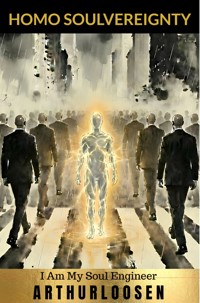
Stop just functioning. Start designing. In a world driven by fear and obedience—a state defined here as Servitus—most people remain passengers in their own lives. We rely on crumbling systems to provide security, trading our freedom for a false sense of safety. But what happens when the walls crack? Homo Soulvereignty is the technical manual for the architecture of your freedom. Arthur Loosen, the Soul Engineer, bridges the gap between rational logic and deep spirituality. He replaces vague esoteric promises with precise static calculations: Your soul is the blueprint, your body is the hardware, and your consciousness is the code. In this manifesto, you will learn how to: Switch from User to Admin: Reclaim full write-access to your life script and rewrite your past in the Akashic records. Correct your Statics: Align Soul, Astral Body, and Physical Body to eliminate burnout and dissonance. Master Frequency: Use the Hawkins Scale and Heart Coherence to rise above the noise of collective fear. End "Anti-Karma": Stop delegating responsibility and start owning your power. Become the Engineer of your soul.
Das E-Book können Sie in Legimi-Apps oder einer beliebigen App lesen, die das folgende Format unterstützen:
Seitenzahl: 141
Veröffentlichungsjahr: 2025
Ähnliche










Homo Soulvereignty
I Am My Soul Engineer
Homo Soulvereignty
I Am My Soul Engineer
Arthur Loosen
Imprint
Copyright: © Arthur Loosen Year: 2025 EBook-ISBN: 978-94-038-5650-6 Editing/Proofreading: Self-edited by the author Images: Author's own illustrations Cover Design: Arthur Loosen Additional Contributors: – Publishing Portal: Published via Bookmundo Print: Printed in Germany
The Deutsche Nationalbibliothek lists this publication in the Deutsche Nationalbibliografie; detailed bibliographic data is available on the Internet.
This work, including all its parts, is protected by copyright. Any use beyond the narrow limits of copyright law without the consent of the author is prohibited.
Responsible for content: Arthur Loosen CH-4500 Solothurn
Acknowledgments
In quiet awe and with an open heart, I thank those who have accompanied me on my path—visible and invisible, near and far.
I thank my adult children for their being—for the light they carry into the world, and for the lessons they have gifted me, consciously or unconsciously. You are part of my inner universe.
To my friends who have held, mirrored, and challenged me in times of change—I thank you for your presence, your patience, and your truthfulness.
To the companions on the soul journey—those who have walked with me through shadow and light, who have reminded me of what lies beyond words—I bow before your wisdom and your courage.
And to all those who have supported my personal development—through conversations, silence, resistance, and trust—I thank you for your traces in my inner space.
This work is also your echo. May it bring healing where it is needed, and clarity where the fog still lingers.
FOREWORD: From Code to State
When you hold this book in your hands, you may be standing at one of two points.
Either you know my work on the "Loosen Code". You have learned how to decipher the deeper scripts of the subconscious, how to read and rewrite the syntax of your own programming.
For you, this book is the logical consequence.
After we have cleaned up the code, we must now learn to run the new operating system in a world that is still running on obsolete servers.
The "Loosen Code" was the tool; the Homo Soulvereignty is the structure we build with it.
Or you are encountering this intellectual edifice for the first time. Then rest assured: You do not need to have read the predecessor to stand your ground here.
This book is a standalone manifesto. It is designed to meet you exactly where you stand—in the midst of the world's noise, in the confines of the office, or in the silence of a crisis of meaning.
While the "Loosen Code" focused heavily on the micro-level (inner programming, dissolving blockages, hypnosis techniques), Homo Soulvereignty zooms out to the macro-level.
We leave the laboratory and enter the construction site of life. We no longer ask just: "How do I delete a fear?" (Code). We ask: "How do I live fearlessly in a society based on fear?" (State).
Homo Soulvereignty is the applied physics of freedom.
He is the human who no longer just tinkers with his code, but who executes it.
He is the engineer who no longer just draws plans, but who stands in the storm and ensures his building holds.
Consider this book the manual for the operational management of your soul within the density of matter.
Everything you need to know—from the historical derivation of your lack of freedom to the concrete tools of frequency modulation—can be found here.
The theory is complete. The practice begins now.
Welcome to Soulvereignty.
PART I: THE DIAGNOSIS OF MATERIAL FATIGUE
Before we can renovate a house in danger of collapse, we must understand why the walls are shaking. Is it the foundation? The wrong mortar? Or the load?
In this first part, we dedicate ourselves to the structural assessment.
We look back into history to understand where we lost our freedom. We analyze the healthcare system that services us as machines, and we observe the cultural fears that paralyze us.
This is the most painful part of the book, for we must admit to ourselves that we are not victims of fate, but inmates of an architecture that we ourselves (or our ancestors) signed off on.
Let us begin with the foundation.
Chapter 1: The Architectonics of Unfreedom – A History of Servitus
1.1 The Feudal Contract: Protection for Obedience
If we want to understand why we today—in the most technologically advanced age of human history—collectively suffer from fear, exhaustion, and disorientation, we must not look only at the symptoms.
We must investigate the foundation upon which our societal building rests.
Modern historiography, shaped by an almost naive optimism, likes to tell us the story of unstoppable liberation: From the Dark Ages through the Enlightenment to modern democracy.
As a Soul Engineer, I must tell you: This structural calculation is flawed.
What we label as "progress" is, in energetic terms, often merely a transformation of the shackles. The chains of iron became shackles of paper (bureaucracy) and finally shackles of data (algorithms).
The fundamental problem, which we hereinafter define as Servitus (servitude/bondage), is not merely a legal status, but an ontological state: It describes the structural refusal of the individual to bear the full static load of their existence themselves.
And this state has a precise historical origin. It begins with a trade-off so fundamental that it echoes to this day in our DNA, in our pension systems, and in our employment contracts: the Feudal Contract.
The Primal Fear of Chaos
Let us transport ourselves into the energetic reality of the European Middle Ages.
For the individual, the world was not a place of opportunity, but a zone of mortal danger. Outside, chaos reigned. Nature was merciless, harvests were uncertain, plagues were omnipresent, and robber barons made the roads perilous.
In this environment, the "Anthropological Hiatus"—that space of freedom in which one can choose—was a life-threatening luxury.
Whoever was "free" was unprotected. Freedom meant being fair game.
The human stood before a binary choice: Either he keeps his autonomy and likely dies by the sword or hunger. Or he surrenders his autonomy and survives in the shadow of a wall.
Here, the primal contract of Servitus was born. The feudal lord offered something the individual could not produce on their own strength: Statics in a chaotic world.
He offered the protective walls of the castle and the sword of the knight for defense. The price for this external statics was high, but rationally calculated: It was total submission.
The Architecture of Delegation
The Feudal Contract was based on a clear energetic transaction: Physical protection for energetic sovereignty.
The serf (Servus) did not just sign away his labor. He signed away responsibility for his destiny.
If we analyze the motives of the ruling class (the "Architects of Order" of that time), we find three pillars that support every form of rule to this day:
Granting Protection:
The nobility legitimized its privileges solely through its ability to fight. "I bleed for you, so you work for me." This was the promise of security.
Allocation of Energy:
Since there were no machines, the human body was the primary energy source. Serfdom was the instrument to bind this energy to the soil in order to skim off surpluses.
Fear of Unrest:
A mass of people not integrated into a hierarchy is unpredictable (high entropy). Servitus ordered the mass and reduced social complexity.
The crucial aspect of this historical moment is psychological in nature: The human accepted bondage not only out of fear of the lord, but out of an even greater fear of the world without the lord.
He delegated his survival to an external authority. He went from being the Operator of his life to being a Passenger.
The Birth of "Anti-Karma"
In this system, a mechanism developed that we must understand for the Homo Soulvereignty: Anti-Karma.
When the serf went to war and killed on the lord's orders, or when he worked to the point of exhaustion, he felt no personal moral or energetic responsibility for it.
The causality was decoupled. "I am not acting; my lord acts through me."
This is the "Anti-Karma Act". It is the illusion that one can delegate the energetic consequences of one's actions (Karma) to the chain of command.
It is the ultimate comfort of immaturity.
One does not have to ask: "Is this right?" One only has to ask: "Is this ordered?"
This closed the Anthropological Hiatus almost completely. The gap between stimulus (command) and reaction (obedience) was cemented shut.
The Persistence of the Solid Fortress
Why is this ancient history relevant to you in 2025?
Because we never canceled the Feudal Contract. We merely changed the contracting partner.
The stone castle wall is today the welfare state (in the DACH region) or the corporate image (in the Anglosphere). The knight who protects us is today the insurance policy or labor law.
We still live by the maxim: Security is more important than sovereignty.
We are still looking for the "good lord" (the government, the CEO) to keep the chaos of the world off our backs. We pay taxes and duties like the tithe back then, in the hope that someone will lift the burden of existence from us.
But here lies the drama of our time: The modern lords of the castle can no longer guarantee protection.
The walls have developed cracks. Globalization, AI, the climate crisis—these are the new "robber barons," and the nation-state (the old castle) has become too small and too weak to fend them off.
Modern man now stands there like a serf whose castle has been razed. He never learned to wield a sword (autonomy), and now finds himself without a wall.
This is the origin of "German Angst": The naked panic of the inmate who suddenly stands in the open.
The Homo Soulvereignty recognizes this historical trap. He understands that the Feudal Contract has become invalid in the 21st century.
There is no lord left to save him. And that is why he begins to be his own castle.
1.2 Clerical Statics: The Installation of Metaphysical Guilt
While the feudal lord controlled the horizontal statics (space, protection, food), the church established a monopoly over the vertical statics (meaning, conscience, eternity).
If we view the history of unfreedom as engineers, we must acknowledge: The construction of the Catholic Church in the Middle Ages was perhaps the most efficient operating system for controlling human energy ever written.
It was not based on walls, but on frequency modulation. The goal was the colonization of the interior: The Anthropological Hiatus was now no longer threatened by the sword but occupied by dogma.
The Ontological Defect: The Engineering Miracle of "Original Sin"
The core of this architecture was the dogma of Original Sin. From the perspective of a Soul Engineer, Original Sin is a brilliant, albeit perfidious, invention for customer acquisition and retention.
The thesis stated: Man does not enter the world as an intact, sovereign being (as the Arcturian Hypothesis and our understanding of the astral body as a perfect blueprint suggest), but as a structurally defective, deficient being.
He is born with a "static debt" that he did not cause himself and—this is the decisive lever—that he cannot clear on his own strength.
This created a permanent, existential dependency.
The human is the patient, the church is the hospital, and the priest is the only doctor who possesses the medication (grace/sacraments).
This mechanism is the precursor to every modern addiction structure:
Convince the user that they are incomplete (sinner / today: consumer).
Offer them an external solution that only works temporarily (confession / today: shopping spree).
Make them dependent on the next dose.
Energetically considered, this led to a compression of the soul. The human learned not to trust their own inner signal. If their own impulse signaled "joy" or "pleasure," but the dogma shouted "sin," the human had to decide against themselves.
They learned self-sabotage as the highest virtue. This is the historical origin of that inner judge who still sits in our heads today as the "critic," telling us we are not good enough.
The Delegation of Conscience: Anti-Karma in a Robe
Clerical Statics also perfected the principle of Anti-Karma.
In a teocratic order, conscience is not an internal instance, but an external regulation. The question "Is this right?" was replaced by the question "Is this allowed?"
This had fatal consequences for personal responsibility. If suffering occurred—wars, burnings, injustice—it was often legitimized by the "Will of God" (Deus vult).
The individual who lit the torch at the stake felt no energetic burden, as they were acting on behalf of a higher authority. They delegated the responsibility upwards.
At the same time, personal suffering (illness, poverty) was reinterpreted. It was not a geometric dissonance (as we understand it today in Homo Soulvereignty), but a "test" or "punishment."
This interpretation made people passive. Instead of fixing the cause of the dissonance (e.g., through rebellion against the feudal lord or energetic healing), they endured it as divine fate.
Theodicy (the justification of God in the face of evil) served as a sedative to keep the masses quiet.
The Transformation of Guilt: From the Confessional to the Bank
Why is this relevant for the secular human of the year 2025?
Many believe that with the decline of church power (secularization), we became free. That is a misconception. We have retained the structure of Original Sin; we have merely filled it with new content.
With the Enlightenment and industrialization, the priest was replaced by the teacher, the banker, and the manager.
"Original Sin" (You are born bad) transformed into "Underperformance" (You are born poor/uneducated). Sacraments were replaced by certificates.
The basic feeling remains identical:
The
Homo Religiosus
felt guilty before God.
The
Homo Oeconomicus
feels guilty before the market (Impostor Syndrome).
We are still trying to "buy our freedom" through external achievements. Previously, we bought indulgences to shorten purgatory. Today, we buy index funds and prestige objects to shorten the fear of insignificance.
The "logic of debt" sits deep in our cultural statics. In German, the word Schuld is ambiguous: It means moral failure (Sin) and financial liability (Debt).
The system keeps us in Servitus by suggesting that we are permanently in the red. We must first "earn" our place on Earth (Meritocracy).
Clerical Statics in the DACH Region vs. Anglosphere
Here we also see the root of the differing pathologies:
DACH Region (The Obedient Sinner):
Here, the clerical structure was transferred almost seamlessly into
bureaucracy
. The state took over the role of the church as the moral authority. One "believes" in regulations as one does in dogmas. The fear of "sin" is today the fear of a formal error or a tax audit.
Anglosphere (The Calvinist Performer):
Here, especially in Protestantism/Calvinism, material success became the sign of being chosen by God. Whoever is poor is not just unlucky, but abandoned by God. This drives the hamster wheel: One
must
be successful to prove one's soul's justification.
The Engineering Insight
We must realize: Our inner insecurity is not a law of nature. It is an installed program.
The church (and its successors) uploaded the "software of inadequacy" to us in order to sell us their "security update."
The Homo Soulvereignty uninstalls this program.
He acknowledges: There is no Original Sin. There is only static integrity or dissonance.
The soul does not enter the world as a debtor, but as an investor.
We do not have to ask anyone for permission to be. The Anthropological Hiatus is the space in which we stop confessing and start constructing.
1.3 The Industrialization of the Spirit: The Factory of Conformity
With the dawn of the modern era, the old yoke seemed to break.
The Enlightenment cried out, "Have the courage to use your own understanding!" Serfdom was abolished.
But as Soul Engineers, we must look at the static load distribution, not the slogans. Servitus did not disappear. It merely changed its state of matter. It shifted from a personal dependency (Serf–Lord) to a systemic dependency (Worker–Machine/Market).
To create modern man—Homo Industrialis—two massive energetic renovations had to be undertaken:
The Mechanization of Time (The Tact).
The Standardization of Thought (The School).
The Loss of the Cycle: How Time Became Currency
In agrarian society, humans lived in cyclical time.
One worked when it was light or the harvest was due. One rested when it was dark or winter. The rhythm was dictated by biology and nature. The body was in resonance with the environment.
With industrialization, time became linear and abstract.
The factory knows no seasons. The machine runs always. To make the human compatible with the machine, he had to break his natural rhythm.
The invention of the time clock was the moment time became money.
The human no longer sold a product (the result of his work), but his pure lifetime (the duration of his presence).
Energetically, this is a catastrophe. It means permanent dissonance.
The body signals: "I am tired, I need rest."
The factory siren (or today, the Outlook calendar) signals: "You must function."




