


9,99 €
Mehr erfahren.
- Herausgeber: Sonicbond Publishing
- Kategorie: Geisteswissenschaft
- Serie: On Track
- Sprache: Englisch
Foreword by Barry Devlin
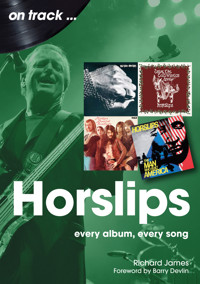
Five-piece Horslips are arguably the greatest band in Irish rock music history, producing truly special, unique music in the 1970s. By joining literary craft and their cultural heritage with a fusion of traditionally inspired music with rock instrumentation, they created a genre of music which became known as ‘Celtic Rock’.
Horslips also pioneered an ‘in-house’ approach to the rock music business, controlling their stage presentation, graphic design, record pressing and concert promotion. Their finest albums – The Tain, and The Book Of Invasions – adapted legendary and historic texts with compelling music. Elsewhere the life and times of Turlough O’Carolan, The Famine and emigration provided a conceptual backdrop to Dancehall Sweethearts, Aliens, and The Man Who Built America.
But the band broke up in 1980. Reconvening in the next century, after the ‘longest tea break in history’, they produced a new ‘acoustic covers’ album, played stadium-filling gigs and television performances, and recorded two live albums. With a foreword by bassist/vocalist Barry Devlin, this book celebrates (and sometimes criticises) the creative waves that Eamon Carr, Barry Devlin, Johnny Fean, Jim Lockhart, and Charles O’Connor gave us.
Richard James immersed himself in music as soon as he got his first real six-string at the age of ten. Previously chained to a desk for a living, he broke free, armed with a music degree from the Open University and a Licentiate Diploma in Classical Guitar from the Royal School of Music, and proceeded to roam the East Midlands as a freelance guitarist and music teacher. He lives with his wife in Leicestershire, UK, and when not involved with music, he enjoys foreign travel and playing chess badly.
Das E-Book können Sie in Legimi-Apps oder einer beliebigen App lesen, die das folgende Format unterstützen:
Seitenzahl: 309
Veröffentlichungsjahr: 2025
Ähnliche














Horslips
Richard James
Contents
Author’s Note
Foreword By Barry Devlin
1. Happy to Meet …
2. Happy to Meet, Sorry to Part (1972)
3. The Táin (1973)
4. Dancehall Sweethearts (1974)
5. The Unfortunate Cup of Tea! (1975)
6. Drive the Cold Winter Away (1975)
7. Live (1976)
8. The Book of Invasions: A Celtic Symphony (1976)
9. Tracks From the Vaults (1977)
10. Aliens (1977)
11. The Man Who Built America (1978)
12. Short Stories, Tall Tales (1979)
13. Roll Back (2004)
14. More Than You Can Chew (2023)
15. Sorry to Part
16. Appendix. An interview with Barry Devlin
Author’s Note
Unless stated to the contrary, all quotations in this book are from Horslips – Tall Tales, The Official Biography by Mark Cunningham, published in 2013 by The O’Brien Press Ltd.
Foreword By Barry Devlin
I’ve never been formally introduced to Richard James but it turns out he knows me (and the rest of the band) really rather well. That’s the power of music, its ability to connect people who’ve never met, but who share a view of what is pleasing in words and cadences, metaphors and inversions.
A few artists over the years have attracted me to the point that I’ve listened to everything they’ve done and tried to figure out why the connection is there. Clive Gregson of Any Trouble; the late Warren Zevon; Lowell George; Colin Harper.
It’s nice to think that Richard has brooded as well and has set down his observations. What shines through his work is a thoroughgoing analysis and descriptive clarity. And though his view of the collected works is not uncritical, it’s not dispassionate either. There’s a genuine liking there for what we did all those years ago.
So let’s take this as our formal introduction.
Hello, Richard. Happy to Meet.
Barry Devlin, June 2023
Happy to Meet …
Horslips are the most important band to come out of Ireland. They never attained the broader ‘Classic Rock’ status of Thin Lizzy, nor became a U2-sized global phenomenon, but it wasn’t for lack of trying. The bands significance derives from their invention of a new genre of popular music: ‘Celtic Rock’.
By taking traditional ‘folk’ melodies and using them as the basis for new rock songs, sometimes with unusual or unexpected instrumentation and arrangements, they pioneered a style which continues and evolves to this day. During the 1970s, Horslips broke new ground, and introduced audiences across Britain, Europe and America to music which sounded simultaneously both familiar and yet innovative, new and spellbinding.
They were also the first successful rock act to base their entire career in Ireland. They controlled every aspect of their being; stage presentation, graphic design, record pressing, and concert promotion, before it became fashionable. Their blend of progressive rock arrangements with sometimes centuries-old melodies on conceptual albums sought to explain Ireland’s past to an audience keen to hear rocked-up versions of ancient narratives that took less than 40 minutes to listen to. Horslips had an impact because, for many Irish people, the band energised them and their sense of identity.
The origins of the band date from 1970 and a Dublin advertising agency called Arks. Devlin, a native of Ardloe, County Tyrone, was a recently arrived copywriter. Eamon Carr, originally from Kells, County Meath, was also a copywriter, and Charles O’Connor, a Middlesborough-born designer all worked there. A forthcoming television advert needed a band to mime along to a pre-recorded song, and the three employees were co-opted into performing for the camera. Realising that another musician was needed, Jim Lockhart, a Dubliner and a friend of Devlin’s, was recruited for ‘The Gig’. ‘The Gentle People’, as they were called, duly acted their way through a song promoting Harp lager. Devlin recalled:
There were free drinks and lots of girls and we thought ‘If this is what it’s like being in a pop band maybe we should look into this.
As a consequence, the pretend group decided to become a real band. The four men bonded over a shared love of traditional music, and the newly emerging rock scene. They were aware that a guitarist would be needed if they were to develop as a rock band. Kieron ‘Spud’ Murphy, a photographer at Arks, was swiftly recruited by Devlin to the still-unnamed group, and he is credited with accidentally coming up with the band’s name. What started out as a play on ‘The Four Horsemen of the Apocalypse’ became, after a less than satisfactory rehearsal and a Chinese meal, ‘The Four Poxmen of the Horslypse’, shortening to ‘Horslypse’, before finally arriving at Horslips. The band attracted some attention in October when Spotlight (Ireland’s top music magazine of the time) described them as a ‘new rock-orientated group’. On the DVD Return of the Dancehall Sweethearts, Carr explained the band’s original inspirations:
A lot of the earlier sort of material we were doing had more in common with what bands were doing in San Francisco in the late Sixties than what was coming out of England, although people would say it’s like Steeleye Span, or whatever. I always thought it was much more like The Grateful Dead, or The Joy Of Cooking, or Jefferson Airplane, the bands who mixed up sort of a psychedelic rock thing with Appalachian music, with country blues, with folk and all of that sort of thing.
The band’s first official gig, at the CYMS Hall, Navan, County Meath in November, was cancelled when the local curate withdrew his permission, fearing that the evening was ‘immoral and designed to seduce the girls of Navan’. Turning disappointment into opportunity, and utilising the skills gained in their day jobs, the band managed to get their name into the press. Fortune smiled on them again when Aine O’Connor (no relation), a friend of Devlin and Carr, offered the band the chance to play on a forthcoming new television series, ‘Fonn’ for RTE, Ireland’s national television station.
By December, Murphy had left to become a photographer with ‘Sounds’, a London-based weekly rock music magazine. His role was taken by Declan Sinnott, who had played in Carr’s previous project, Tara Telephone; a group the drummer described as being ‘an Irish version of Pentangle’ (the British folk-jazz band). Devlin described the band’s vision at this stage:
We purposely didn’t try to emulate what Fairport Convention was doing in the sense that they were English folkies playing rock instruments. We realised that we wanted to do something quite different, which was to deconstruct tunes and use them as the basis for new material.
It is this unique approach to their sources that makes Horslips special.
In January 1971, Gene Mulvaney, also formerly of Tara Telephone, joined the band as bassist. The group became the ‘house band’ for ‘Fonn’, performing regularly on its six week run, which aired in February. Devlin recounted:
We were playing a hybrid of traditional Irish airs and rock’n’roll that was warmly but cautiously received by the audience. No one had ever given Irish music this treatment.
Carr added:
It was exciting because we had to come up with a couple of new tunes for each performance. It gave us something to work towards, and by the end of the series, we had cracked a repertoire of sorts.
O’Connor mused on the power of the small screen:
There wasn’t much money involved, but the promise of appearing on television was staggering. We had made this abrupt move from the shallow end into the deep end. We didn’t want to sing Irish songs but take the melodies that were inherently Irish or Celtic and put them into a different sort of music.
By the time ‘Fonn’ had finished its run of shows, the band had honed plenty of material, including ‘The Clergyman’s Lament’, ‘Johnny’s Wedding’, ‘The Musical Priest’, ‘Flower Amang Them All’, and ‘Comb Your Hail And Curl It’, into a gig ready set-list. Unlike the vast majority of new bands, the ‘Fonn’ appearances gave them a national profile, just like that!
By the end of March, Mulvaney had left the group, and bass duties were taken on by Devlin, who moved over from rhythm guitar. The band finally made their first official live debut at Galerie Langlois, Dublin, on 3 April at the same time as the final ‘Fonn’ programme aired. They played as part of a five-hour ‘extravaganza’, grandly titled ‘Portraits and Anthems’. Such was the response that a second event took place on 1 May. The band then appeared at Sligo Sounds Whit Weekend Festival, where Fairport Convention was headlining. A late addition to the bill was a band called Jeremiah Henry, which featured John Fean on guitar. Horslips and Jeremiah Hardy both appeared at the Clare Festival during the summer.
The Highland Festival in September saw promoter Michael Deeny (who was struck by the band’s totally original sound even at this early stage) offering to become their manager. Deeny booked them into Trend Studios in Dublin to record their first track ‘Motorway Madness’ (which would later resurface on Tracks From The Vaults). In October, the band featured on the front cover of Spotlight magazine for the first time. By now Horslips were attracting some serious record company attention, including attempts by Decca, Polydor, Transatlantic, and Charisma to sign them. These were resisted; the band were determined to do business on their own terms, and not jump at the first offer so early in their career.
In January 1972, the band recorded ‘Johnny’s Wedding’, ‘Flower Amang Them All’, and ‘Knockeen Free’ with Fred Meijer acting as producer. As Deeny was finding it difficult to locate a record company which would be the best fit for his new signing, the band instead formed their own record label, Oats Records. Deeny recollects the freshness and originality of such an approach:
Oats gave us immense satisfaction and Horslips really knew their stuff. When you pooled their experience in advertising and graphics, their appreciation of rhythm and blues, and pop, and their knowledge of traditional music, what you had was a real force to be reckoned with. It meant we could do everything. So all we had to do was hire a pressing plant for the records, a printer for the sleeves, and a distributor.
In February, the band received their first significant publicity outside of Ireland when a feature on them appeared in the ‘Daily Express’. On 17 March (St Patrick’s Day), ‘Johnny’s Wedding’ (with ‘Flower Amang Them All’ as the B-side) was released, and Horslips turned professional. The single spent three weeks on the chart, rising to a highpoint of number ten. Carr recalls:
The release of ‘Johnny’s Wedding was the flashpoint. Until then, we’d been this curious, arty collective that had done some TV and a few interesting gigs. But it started to gain momentum. We had started to pick up a following and were regularly hiring an Avis truck to get us to an increasing amount of gigs.
As the band sharpened their musical senses, they also adopted the ‘glam rock’ look which was popular at the time. This did not impress Sinnott. The final nail in his Horslips career-coffin was another television appearance, where the band again pretended to be a ‘pop group’ in a commercial for a soft drink manufacturer, Miranda. This was shot at a specially organised concert at Ardmore Studios, Bray, in front of an invited, appropriately ‘groovy’ audience, where the band mimed to a pre-recorded jingle. Although they were initially against the idea, a significant amount of money was offered for their services, enough to buy a PA system which was suitable for their music and volume required at the venues where they were performing. Temporary pragmatism won out over artistic integrity.
In May, the band played a headlining gig at the National Stadium and whilst it was a success, tensions within the ranks meant that an unhappy Sinnott left on bad terms.
Devlin commented on the guitarist’s departure:
Declan taught me how to be a bass player, so I owe him that much. I know he doesn’t have many positive things to say about us and, conversely, I wasn’t very enamoured with him as a personality, but I wouldn’t deny him his place in the band’s history. He must have liked the band enough at the start of it to be in it. We wouldn’t have got the band together without Declan, he made a big contribution in that early period, especially as he and Eamon were the two people who had previously been in bands and had an idea of how all that works. He was, and remains, a very good guitar player.
Lockhart was more succinct:
(Sinnott) wasn’t happy being in the band and we weren’t happy with him either. It was a relief when he was gone, but filling the vacant position permanently looked like it was going to be a problem.
Gus Guest was drafted in as a replacement. In June, Horslips returned to Trend Studios. ‘Green Gravel’, ‘The Fairy King’ and ‘Blodau’r Drain’ were recorded, and on 25 August, the band’s second single ‘Green Gravel’ (backed with ‘The Fairy King’) was released.
In July, the band topped the bill at a music festival in Ballyvaughn where, once again, Jeremiah Hardy was performing; Johnny Feans’ guitar playing left an indelible impression on the Horslips collective eye and ear. In August, their second single was released, reaching the top 20 in its first week, and in the autumn, Guest left, but on good terms. Fean was invited to audition for the band, having been head-hunted by O’Connor, who travelled by taxi from Dublin to Shannon to find the guitarist. On 1 October, Fean officially joined the band, playing his first gig with them at the National Stadium later that month. In November, work began on what would become the band’s debut album.
The mixture of Northern and Southern Irish members, together with an import from the northeast of England, meant that Horslips was a band without borders. Their existence challenged the North/South ‘them and us’ attitude; they were playing Irish-flavoured rock music for anybody and everybody who wanted to hear it. Lockhart confirmed this viewpoint in an interview with Ralph McLean on BBC Radio Ulster in March 2022, saying:
Charles had come over from Middlesborough, where he had been playing in the College of Art Ceilidh band. I was playing tin whistles and playing trad stuff. Barry had come down from around Loch Neagh with all these songs from around the loch, Eamon’s grandfather had been in a ceilidh band, I think, or had a ceilidh band, and then later when Johnny came on board, he had been playing banjo around Clare with Ted Furey and mandolin and so there was in parallel with all the rock’n’roll influences there was always these traditional influences coming in that we’d all been intimately involved in.
In broad terms, O’Connor and Fean were the traditional folk players. Lockhart had training in jazz and classical piano arrangements. Devlin and Carr had strong leanings towards the rockier side of things, and all of them loved The Beatles. Lockhart saw that the fusion of traditional Irish melodies within a modern-day rock setting as a major factor in the band’s success:
We had different angles of approach for blending in Irish influences. In some cases, we would take an Irish tune and use it as the main riff so that it made it do something unexpected. The riff would generate a chord structure and then you’d superimpose a song on top of it, making sure that the two elements sat comfortably together. Another approach was to take a tune and use it as a countermelody, as we did in ‘Ghosts’, and ‘Sideways to the Sun’. The tune is set up, and once a chordal framework is set, the tune acts as a counterpoint to the vocal melody, with both starting at different times and forming a complimentary relationship where disparate elements illuminate each other. That was always a very satisfying way of writing.
Happy to Meet, Sorry to Part (1972)
Personnel:
Eamon Carr: drums, bodhran, percussion
Barry Devlin: bass, vocals
Johnny Fean: electric and acoustic guitars
Charles O’Connor: fiddle, mandolin, concertina, vocals
Jim Lockhart: keyboards, generation whistle, concert flute, vocals
All tracks composed and/or arranged by Carr, Devlin, Fean, O’Connor, and Lockhart
Recorded on the Rolling Stones Mobile at Longfield House, County Tipperary, Ireland
Produced and engineered by Alan O’Duffy and Horslips
Mixed at Olympic Studios, London, November 1972
Released on: 4 December 1972
Issued on Oats Records in Ireland (M003), RCA Records in the UK (M003), and Atco SD in USA (7030)
In 1972, no studio in Ireland had the capacity to record 24 separate tracks of sound. Whilst the band could have headed to England to record, Deeny and Carr suggested that they hire the Rolling Stones Mobile, which was duly placed on a ferry and delivered to Longfield House, an eighteenth-century building in County Tipperary. Speaking on the Dancehall Sweethearts, DVD Devlin said:
We were aware of the potential value of being the first people to bring in a 24-track to Ireland. No 24-track existed in Ireland so we trundled it across the Irish Sea. It was actually a great stroke, I mean, the Evening Herald did a series of double-page spreads, everyone came down and we entertained them, and everyone had a great time and they came back and wrote about this extraordinary, funny, and interesting thing that was happening down in Longfield House, County Tip.
Ian Stewart, the manager of the mobile studio, recommended Alan O’Duffy as a producer to Deeny. O’Duffy already had an impressive CV, including two albums for The Rolling Stones, Let It Bleed (1969) and Sticky Fingers (1971).
Rehearsals took place at the Deeny family holiday home in County Donegal. The sessions attracted the attention of both the Irish press (particularly Dublin’s Evening Herald) and the weekly English music newspaper Melody Maker. The album was recorded on a very tight budget, with money being saved as O’Duffy wore the simultaneous hats of engineer and producer. Different rooms of the spacious house were used, including the cellars and the library, and bales of hay were brought in to separate the sounds of the individual instruments.
With recording completed, the tapes were quickly mixed at Olympic Studios in Barnes, London, and the finished album was released in Ireland in time for Christmas. It would be the fastest-selling LP in the country until the commercial juggernaut, which was ABBA reached their peak towards the end of the decade.
The album cover was ambitious, expensive, and difficult to produce. Based upon an eight-sided concertina with the band members visible through the instrument’s keyholes, it was also a gatefold design, with additional pages inserted within. The cost of this presentation was probably more than the budget for the recording, but it was a visual statement of originality to match the musical content, and a testament to the band’s vision.
The album sleeve is an elaborate, impressive affair. The front featured the band posing in front of a damaged Celtic cross in the Irish countryside against a backdrop of a foreboding sky. As if to emphasise the fusion of the old and the new, the band (left to right, it’s O’Connor, Fean, Carr, Devlin, and Lockhart) are all standing, wearing the fashionable clothing of the time – it’s all flares, long hair, and sparkly, garishly coloured ‘glam-rock’ apparel. Inside, the band is pictured individually; Lockhart looks mean and moody, sitting in- between two pianos. Overleaf Fean is pictured lost in thought and sheepskin in a soft focus shot. On the next page, Devlin, sporting a magnificent droopy moustache, is doing his best impression of a bouncer, with arms folded. Carr is seated, reading a book, and drinking a (possibly unfortunate) cup of tea. O’Connor has a pixie-like demeanour as he sits against a wall, surrounded by the instruments he plays on the album. The lyrics to the songs are also included, and the rear page of the sleeve has another view of the cross with the band in the distance, grouped together, looking towards it. At least the weather has improved.
The band logo, always an integral part of a long-term identity, is a curious amalgam of pseudo-Celtic lettering meets Roger Dean’s ‘flow and join’ style used on most of Yes’s album covers of the 1970s. It is again the marriage of traditional and modern looks which adds to the mystique of what this album might actually sound like, as old and new visuals collide.
When Happy to Meet … was released, demand was overwhelming. The first pressing of 35,000 copies sold out very quickly, partly because the fusion of traditional and rock genres was so fresh and compelling, but also because Horslips were the real deal; an Irish band, playing a new type of Irish music, recording and gigging in Ireland. Of course, success breeds criticism. Lockhart remembered:
The album was a fantastic lift-off. However, a lot of the folk purists that had now started to become aware of us were righteously apoplectic. They were fiercely protective of the tradition and viewed what we were doing to ‘their’ music as vandalism like we were drawing a moustache on the ‘Mona Lisa’. But equally, we saw that we were bringing the music to an audience who were never likely to hear it, let alone embrace it.
O’Connor supports this:
There was never any disrespect from our side towards the ‘trad’ brigade. We were like punk folkers without really knowing it, and I think that really appealed to young people who loved seeing all these old-timers getting wound up.
The band’s youth and relative inexperience meant that the music on Happy to Meet is daring and ground-breaking. Being largely new to the concept of being a rock band they believed anything was, and should be, possible. If, as Lockhart puts it, knowledge can be ‘the great inhibitor of creativity’, Horslips’ collective innocence was a consequent and substantial strength. The band received favourable press coverage for their innovative approach and style. A headline typical of the time, in the Evening Herald ran:
Horslips: the band whose blend of space rock and traditional Irish music could make them the new name to watch.
Devlin, talking on the Dancehall Sweethearts DVD, said:
Happy to Meet, Sorry to Part is an odd album in the sense that when we were doing it we already knew that we were going to do The Táin. Jethro Tull’s first album was called This Was (1968) because in a way it encompassed the stuff that they’d been doing for the two years up to that, and the same is true of Happy to Meet, Sorry to Part. It encapsulated what we’d been doing from October 1970.
‘Happy to Meet’ (0.48)
Anyone who’s ever been to a traditional music session will recognise that the mood and instrumentation of this short opening jig which was taken from ‘O’Neill’s The Music of Ireland. Almost certainly the only opening album track ever to be recorded in a library, (‘quiet, please!’), some concertina noodling, interspersed with a bout of coughing, quickly leads into a brisk melody on concertina, joined by banjo, tin whistle and bodhran, which fades quickly away. It sets a scene, but ‘Happy to Meet’ is deceptive; this is not going to be anyone’s usual idea of what a traditional music album would sound like…
‘Hall of Mirrors’ (5.29)
A swirling fairground organ sound plays a suitably cheery melody with touches of psychedelia in 6/8 time which turns into a disturbing diminished arpeggio, replete with distant percussion. This gradually fades to leave a single sustained keyboard note under which the song itself starts proper with an arpeggiated riff. Over this, the guitar and electric mandolin add decorative touches with some subtle, spacious bass before the first verse of Carr’s lyrics: ‘Once you’ve been through the Tunnel Of Love it’s the Hall of Mirrors for you’. The restrained atmosphere is destroyed by the explosive chorus (‘As soon as you’re through the welcome door, it’s much more fun on your own...’) with effective backing vocals and tight drum work.
The second verse sees a return to relative calm, with increased bass and drum contributions. This time, the chorus section is sung without a substantial increase in volume, and this is followed by an instrumental section where guitar feedback sustain blends effectively with electric mandolin to produce an unsettling mood. Surprisingly, the opening keyboard melody returns briefly at 3.15, and the third verse and chorus feature a disappointing repeat of the opening lyrics.
At 4.08, the pace quickens with a rapid-fire semiquaver five-note guitar flurry which climbs in pitch as it is played four times, accompanied by vicious staccato drumming, leading into the final words: ‘Hall of Mirrors, it’s fun inside, Hall of Mirrors, takes you down to size, Hall of Mirrors where you can’t hide from yourself’. The song accelerates into a second instrumental where Fean impresses with his tuneful, overdriven solo (4.25 – 5.09). A reprise of the fast semiquaver sequence leads into a repeat of the final section of lyrics, which builds through a crescendo into a tight ending.
As a statement of intent, ‘Hall Of Mirrors’ lays out Horslips’ early style with conviction and imagination. Yes, the sound is very much ‘of its time,’ but there is plenty of creativity and style in this track to keep ears interested as the album develops…
‘The Clergyman’s Lamentation’ (4.39)
This instrumental starts slowly and calmly with the electric mandolin playing graceful arpeggios, while melodic bass and an expressive, clean electric guitar tone fill the soundscape. In the background, the spooky ‘fairground sound’ from ‘Hall of Mirrors’ swoops and swirls quietly.
After 40 seconds, this is all swept away, replaced by the central melody played slowly on electric mandolin, with acoustic guitar providing chord accompaniment. Bass joins as the tune progresses. At 1.23, the melody gathers pace before being joined by tin whistle and bodhran.
At 2.19, the ghostly organ from ‘Hall of Mirrors’ returns as the pace slows and a new melody harmonised between mandolin, electric guitar and keyboards takes over at 2.39. Triplet-based drums add to the sense of tension and anticipation, and some wah-wah guitar chords (cleverly mixed back and forth into opposing stereo channels) lead to a reprise of the initial tune on mandolin. Carr powers along behind the bass and electric guitar, whilst the organ provides a constant texture in the background. A repeat of the ‘wah- wah’ sequence leads into the coda section which is a mixture of organ, bass meanderings and fading drumming. This gradually fades away, leaving just the organ playing to the close.
Comparing the Horslips arrangement to the original slow air, written by Turlough O’Carolan (1670 – 1738), shows just how far the band were prepared to take Irish music in a new, exciting and, to some, challenging direction. Whilst the central melodies are retained, everything else (tempo, texture, instrumentation, dynamics) undergoes a massive transformation. This ‘Clergyman’s Lamentation’, like so much of the material on the album, is an impressive display of instrumental virtuosity, creative arrangement, and inspired musicianship.
‘An Bratach Ban’ (2.04)
‘An Bratach Ban’ is a Scottish tune introduced to the band by Lockhart, who also sings the Gaelic lyrics. The track incorporates two other melodies: ‘Rolling In The Long Grass’ and ‘Kitty Got A Clinker Coming From The Races’.
The original’s restrained tempo, and occasionally twee interpretation, is given the full Horslips treatment, opening with an unexpected reggae rhythm led by syncopated bass, plus some very quiet organ and guitar. The main melody is played on violin and mandolin before the vocals appear. The second section of words has the accompaniment dropping down to just percussion and mandolin which provides an interesting contrast.
After only 48 seconds, the tune moves up several gears and into double time for very brief diversions into ‘Rolling in the Long Grass’ (0.48 – 1.02), and ‘Kitty Got a Clinker Coming From the Races’ (1.03 – 1.17) with prominent and entertaining contributions on acoustic guitar, fiddle, and finally banjo. The arrangement and feel of these inclusions are those of a riotous ceilidh. The vocals and original feel then return for the balance of the song, with the second lyric section again featuring the ‘drop out’ instrumentation as this rousing number goes into a long fade.
‘The Shamrock Shore’ (4.34)
This evergreen song is given a subtle, gentle reinterpretation with a sustained keyboard tone, concertina and acoustic guitar dominating the first four phrases of the introduction. Fean adds some tasteful slide guitar fills, and bass is added to the texture for the second set of phrases.
Devlin sings with restraint, his vocal melody being hauntingly matched by the uilleann pipes. Harmony vocals join for the second half of the verse with the ensuing instrumental (2.42 – 3.34) featuring subtle melodic slide guitar fills. At times, Fean matches the underlying pipe melody then his playing becomes more bluesy. The effect is evocative, beguiling and hypnotic. It’s like listening to a Celtic version of ‘Albatross’ (Fleetwood Mac), a tranquil, beautiful sound that transports the listener effortlessly to another place.
Halfway through the second verse, the instruments all drop out, leaving just the pipes and highly effective harmonised vocals, the top line of which is sung by producer O’Duffy. The instruments rejoin for the final lyrics, which slow, bringing this island of musical peace to a close.
‘Flower Amang Them All’ (2.04)
The pastoral mood continues. ‘Flower Amang Them All’, originally written by Sir John Fenwick (1645-1697), is a traditional song from the north of England, and was introduced to the band by O’Connor. Originally recorded as the B side of ‘Johnny’s Wedding’ (which would appear later on Tracks From The Vaults), the track was re-recorded for inclusion on the album.
It begins with a melancholy concertina melody which is joined by tin whistle. The texture grows with bass, acoustic guitar, and percussion. The counterpoint and harmonies between the lead instruments are extremely effective, and the tune meanders along pleasantly in a soothing manner. The piece ends on an imperfect cadence, creating an appropriate level of anticipation, given what is about to hit the ears ...
‘Bim Istigh Ag Ol’ (3.38)
In its original instrumental version, this tune is known as ‘Comb Your Hair and Curl It’; the Gaelic title translating as ‘I’m Always Inside Drinking’.
The introduction is atmospheric; harmonised whistles, bass, cymbal swells, gently picked electric mandolin and a tambourine all contribute until, after 36 seconds, the mood changes abruptly with a fast melody on the mandolin, which leads into the rousing vocals sung by Lockhart in Gaelic.
At 1.20, an instrumental section takes over; it’s stirring stuff with a suitably manic rock feel throughout. A bluesy guitar solo and manic triplet-based drumming are the stand-out features of this tightly arranged track, where each instrument has a significant part to play. At 2.09, the music changes again with an electric mandolin solo put through a wah- wah pedal, whilst syncopated power chords smashes provide a heavy backdrop.
The vocals return at 2.39 with some impressive harmonies. Tin whistle, fiddle, banjo, and guitar join in the melody, and the sonic mayhem really kicks in as the track blasts into an accelerating coda, reaching a ‘typical-of- its-time’ heavy rock ending. It’s all tremendous fun, played with passion and precision in equal measure.
‘Furniture’ (5.14)
This is the album’s big rock ballad, one which in a live setting would leave plenty of room for instrumental exploration. The words were written by Lockhart, who said:
The lyrics of ‘Furniture’ started out as a poem that I’d written about my parents, and how tolerant they were about me abandoning my academic career in favour of playing in a band. It’s a very metaphorical song in the vein of ‘Whiter Shade Of Pale’ in the sense that you really need to know the background to understand what the hell it’s about.
The introduction is another excellent blend of flute (playing the melody) with support from acoustic guitar, bass and drums. The lyrics are impressive, if occasionally opaque: ‘Solid as a chair from an older time, you watched me slowly grow away from you, only half understood the things I had to do, but you let me try although it brought the pain to you’ and, for the second verse, ‘Badly beaten by the troubles you’d had to bear, you invested everything you had in me, hoping I would hoist your flag for all to see. But I broke the things you cherished so carefully’. Devlin sings throughout with great sensitivity and phrasing.
The song builds with a sustained organ into the chorus: ‘The best and oldest furniture cannot be rearranged. If it suits the way it is, there is no need to change. The best and straightest arrow is the one that will range, out of the archer’s view’. Fean’s tastefully bluesy fills at the front of the mix add to the mood.
Following the second verse and chorus, the song moves into an instrumental section featuring a new riff-based melody. This is a new interpretation of the traditional tune ‘Oro Se Do Bheatha Bhaile’. It is played in unison four times over, in which Fean introduces a distorted solo with the organ adding moody arpeggios. The riff then mutates, which gradually calms into a repeat of the chorus. The effect of this is heightened by the inclusion of harmony vocals, swirling keyboards, and piano arpeggios.
At 4.14, we’re into a reprise of the instrumental section, where the underlying riff is played simultaneously on uilleann pipes and electric guitar repeatedly until the song comes to a heroic and heavy conclusion.
‘Ace and Deuce’ (3.32)
There’s a complete change of mood here with this brisk acoustic guitar and harpsichord-based tune, also known as ‘The Ace and Deuce of Pipering’. Joined by bass and percussion for the second run-through of the melody, 48 seconds in, the music takes a more reflective turn with some finger-style acoustic guitar playing. Bass, electric guitar, and percussion slide in and out again for a repeat of the section, before the music becomes more brooding and dramatic.
The key shifts from G major to a progression of E major, D major, C major seventh and D major chords, with the melody transferring to the violin as organ, bass, vigorously strummed guitar, and bodhran all add to the atmosphere. The mood brightens at 1.54 with a return to the introductory theme, with bass and percussion as prominent in the mix as the guitar and keyboard.
At 2.20, a new violin-led melody takes centre stage together with some clever counterpoint lines on the electric guitar, bass, and harmony from the keyboards. The tone is celebratory, putting the listener in mind of a wedding, possibly, until the brooding, darker feel returns at 3.02, building and building this intricate instrumental to a dramatic close.
‘Dance to Your Daddy’ (4.37)
O’Connor’s North-East England roots are given full rein on this track, although you would never guess it until the vocals begin as the instrumentation is anything but traditional.
A staccato keyboard refrain is joined by more keyboards playing a counter melody at differing octaves with bass joining, as the song takes familiar form with a violin melody. Sung by O’Connor, the vocals (‘You shall have a fishy on a little dishy...’) sound like the band are trying their best to keep the smile off their faces as they record. While the music may be light-hearted and upbeat in delivery, the arrangement is again razor sharp, with well-placed backing harmonies and precise playing from the rhythm section.
This is nowhere better exemplified than in the instrumental section (1.54 – 3.03) where Fean employs blues, country and even jazz stylings into his lightly overdriven tone against a syncopated and busy backing. At 3.04, the vocals return, with the backing vocals becoming more noticeable. Lockhart throws in brief flute and tin whistle flourishes alongside O’Connor’s violin, as the track sails towards a delightful end, full of melody, brio, and humour. The degree of musical skill and dexterity involved in taking a straightforward folk song and transforming it into a multi-layered arrangement is not to be underestimated.
‘Scallaway Rip-Off’ (1.52)
The opening held chord soon powers into this jaunty instrumental, which is so titled as it incorporates both ‘The Scallaway Lasses’ and ‘The De’els Take the Minister’. Sounding like it belongs in a pub during a busy late- night session, the background noises (shouting, whooping, clapping) were provided by everyone else who was staying at Longfield House during the recording sessions.
Lockhart’s tin whistle is the lead instrument, playing in unison with the fiddle. This is Horslips at their most ‘traditional’, with only the electric guitar and bass hinting at what is to come. Thirty-nine seconds in, energetic drumming soon lifts the music onto a higher level, where it stays for the track’s duration, coming to a predictable conclusion. ‘Scallaway Rip-Off’ is magnificent; good humoured, and, of course, superbly played.
‘The Musical Priest’ (4.31)
A meandering introduction of wah-wah’d electric guitar, mandolin arpeggios and a distant bass is soon being pummelled by relentless drums, which drive the music into a steady 4/4 rhythm, with the organ providing the melody, which again had been sourced from ‘O’ Neills’.
There is a busy electric mandolin solo (1.07–1.52), with Fean adding occasional harmony moments, until the music accelerates rapidly into a much more energetic section. Here, the organ plays a furious new tune with dramatic rhythmic stabs from bass and drums, until a bluesy, phaser-effect heavy guitar solo (2.38 – 3.20). This mixes tasteful phrases with intensity, building the mood into an explosion of melody for mandolin and keyboard.




