


136,99 €
Mehr erfahren.
- Herausgeber: John Wiley & Sons
- Kategorie: Wissenschaft und neue Technologien
- Serie: Advances in Pharmaceutical Technology
- Sprache: Englisch
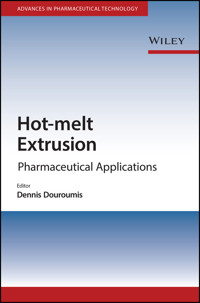
Hot-melt extrusion (HME) - melting a substance and forcing it through an orifice under controlled conditions to form a new material - is an emerging processing technology in the pharmaceutical industry for the preparation of various dosage forms and drug delivery systems, for example granules and sustained release tablets.
Hot-Melt Extrusion: Pharmaceutical Applications covers the main instrumentation, operation principles and theoretical background of HME. It then focuses on HME drug delivery systems, dosage forms and clinical studies (including pharmacokinetics and bioavailability) of HME products. Finally, the book includes some recent and novel HME applications, scale -up considerations and regulatory issues. Topics covered include:
- principles and die design of single screw extrusion
- twin screw extrusion techniques and practices in the laboratory and on production scale
- HME developments for the pharmaceutical industry
- solubility parameters for prediction of drug/polymer miscibility in HME formulations
- the influence of plasticizers in HME
- applications of polymethacrylate polymers in HME
- HME of ethylcellulose, hypromellose, and polyethylene oxide
- bioadhesion properties of polymeric films produced by HME
- taste masking using HME
- clinical studies, bioavailability and pharmacokinetics of HME products
- injection moulding and HME processing for pharmaceutical materials
- laminar dispersive & distributive mixing with dissolution and applications to HME
- technological considerations related to scale-up of HME processes
- devices and implant systems by HME
- an FDA perspective on HME product and process understanding
- improved process understanding and control of an HME process with near-infrared spectroscopy
Hot-Melt Extrusion: Pharmaceutical Applications is an essential multidisciplinary guide to the emerging pharmaceutical uses of this processing technology for researchers in academia and industry working in drug formulation and delivery, pharmaceutical engineering and processing, and polymers and materials science.
This is the first book from our brand new series Advances in Pharmaceutical Technology. Find out more about the series here.
Sie lesen das E-Book in den Legimi-Apps auf:
Seitenzahl: 644
Veröffentlichungsjahr: 2012
Ähnliche



















Contents
Cover
Title Page
Copyright
Dedication
List of Contributors
Preface
1: Single-screw Extrusion: Principles
1.1 Introduction
1.2 Ideal Compounding
1.3 Basics of the Single-screw Extruder
1.4 SSE Elongational Mixers
1.5 Summary
2: Twin-screw Extruders for Pharmaceutical Hot-melt Extrusion: Technology, Techniques and Practices
2.1 Introduction
2.2 Extruder Types and Working Principle
2.3 Individual Parts of a TSE
2.4 Downstreaming
2.5 Individual Processing Sections of the TSE
2.6 Feeding of Solids
2.7 TSE Operating Parameters
2.8 Setting up an HME Process using QbD Principles
2.9 Summary
3: Hot-melt Extrusion Developments in the Pharmaceutical Industry
3.1 Introduction
3.2 Advantages of HME as Drug Delivery Technology
3.3 Formulations used for HME Applications
3.4 Characterization of Extrudates
3.5 Hot-melt Extruded Dosage Forms
3.6 A View to the Future
4: Solubility Parameters for Prediction of Drug/Polymer Miscibility in Hot-melt Extruded Formulations
4.1 Introduction
4.2 Solid Dispersions
4.3 Basic Assumptions for the Drug–polymer Miscibility Prediction
4.4 Solubility and the Flory–Huggins Theory
4.5 Miscibility Estimation of Drug and Monomers
4.6 Summary
5: The Influence of Plasticizers in Hot-melt Extrusion
5.1 Introduction
5.2 Traditional Plasticizers
5.3 Non-traditional Plasticizers
5.4 Specialty Plasticizers
5.5 Conclusions
6: Applications of Poly(meth)acrylate Polymers in Melt Extrusion
6.1 Introduction
6.2 Polymer Characteristics
6.3 Melt Extrusion of Poly(methacrylates) to Design Pharmaceutical Oral Dosage Forms
6.4 Solubility Enhancement
6.5 Bioavailability Enhancement of BCS Class IV Drugs
6.6 Summary
7: Hot-melt Extrusion of Ethylcellulose, Hypromellose and Polyethylene Oxide
7.1 Introduction
7.2 Background
7.3 Thermal Properties
7.4 Processing Aids/Additives
7.5 Unconventional Processing Aids: Drugs, Blends
7.6 Case Studies
7.7 Milling of EC, HPMC and PEO Extrudate
8: Bioadhesion Properties of Polymeric Films Produced by Hot-melt Extrusion
8.1 Introduction
8.2 Anatomy of the Oral Cavity and Modes of Drug Transport
8.3 Mucoadhesive Mechanisms
8.4 Factors Affecting Mucoadhesion in the Oral Cavity
8.5 Determination of Mucoadhesion and Mechanical Properties of Films
8.6 Bioadhesive Films Prepared by HME
8.7 Summary
9: Taste Masking Using Hot-melt Extrusion
9.1 The Need and Challenges for Masking Bitter APIs
9.2 Organization of the Taste System
9.3 Taste Sensing Systems (Electronic Tongues) for Pharmaceutical Dosage Forms
9.4 Hot-melt Extrusion: An Effective Means of Taste Masking
9.5 Summary
10: Clinical and Preclinical Studies, Bioavailability and Pharmacokinetics of Hot-melt Extruded Products
10.1 Introduction to Oral Absorption
10.2 In Vivo Evaluation of Hot-melt Extruded Solid Dispersions
10.3 Conclusion
11: Injection Molding and Hot-melt Extrusion Processing for Pharmaceutical Materials
11.1 Introduction
11.2 Hot-melt Extrusion in Brief
11.3 Injection Molding
11.4 Critical Parameters
11.5 Example: Comparison of Extruded and Injection-molded Material
11.6 Development of Products for Injection Molding
11.7 Properties of Injection-molded Materials
11.8 Concluding Remarks
12: Laminar Dispersive and Distributive Mixing with Dissolution and Applications to Hot-melt Extrusion
12.1 Introduction
12.2 Elementary Steps in HME
12.3 Dispersive and Distributive Mixing
12.4 HME Processes: Cases I and II
12.5 Dissolution of Drug Particulates in Polymeric Melt
12.6 Case Study: Acetaminophen and Poly(ethylene oxide)
12.7 Determination of Solubility of APAP in PEO
13: Technological Considerations Related to Scale-up of Hot-melt Extrusion Processes
13.1 Introduction
13.2 Scale-up Terminology
13.3 Volumetric Scale-up
13.4 Power Scale-up
13.5 Heat Transfer Scale-up
13.6 Die Scale-up
13.7 Conclusion
14: Devices and Implant Systems by Hot-melt Extrusion
14.1 Introduction
14.2 HME in Device Development
14.3 Hot-melt Extruder Types
14.4 Comparison of HME Devices and Oral Dosage Forms
14.5 HME Processes for Device Fabrication
14.6 Devices and Implants
14.7 Release Kinetics
14.8 Conclusions
15: Hot-melt Extrusion: An FDA Perspective on Product and Process Understanding
15.1 Introduction
15.2 Quality by Design
15.3 Utilizing QbD for HME Process Understanding
16: Improved Process Understanding and Control of a Hot-melt Extrusion Process with Near-Infrared Spectroscopy
16.1 Vibrational Spectroscopy Introduction
16.2 Near-infrared Method Development
16.3 Near-infrared Probes and Fiber Optics
16.4 NIR for Monitoring the Start-up of a HME Process
16.5 NIR for Improved Process Understanding and Control
Index
This edition first published 2012 © 2012 John Wiley & Sons Ltd.
Registered officeJohn Wiley & Sons Ltd, The Atrium, Southern Gate, Chichester, West Sussex, PO19 8SQ, United Kingdom
For details of our global editorial offices, for customer services and for information about how to apply for permission to reuse the copyright material in this book please see our website at www.wiley.com.
The right of the author to be identified as the author of this work has been asserted in accordance with the Copyright, Designs and Patents Act 1988.
All rights reserved. No part of this publication may be reproduced, stored in a retrieval system, or transmitted, in any form or by any means, electronic, mechanical, photocopying, recording or otherwise, except as permitted by the UK Copyright, Designs and Patents Act 1988, without the prior permission of the publisher.
Wiley also publishes its books in a variety of electronic formats. Some content that appears in print may not be available in electronic books.
Designations used by companies to distinguish their products are often claimed as trademarks. All brand names and product names used in this book are trade names, service marks, trademarks or registered trademarks of their respective owners. The publisher is not associated with any product or vendor mentioned in this book. This publication is designed to provide accurate and authoritative information in regard to the subject matter covered. It is sold on the understanding that the publisher is not engaged in rendering professional services. If professional advice or other expert assistance is required, the services of a competent professional should be sought.
The publisher and the author make no representations or warranties with respect to the accuracy or completeness of the contents of this work and specifically disclaim all warranties, including without limitation any implied warranties of fitness for a particular purpose. This work is sold with the understanding that the publisher is not engaged in rendering professional services. The advice and strategies contained herein may not be suitable for every situation. In view of ongoing research, equipment modifications, changes in governmental regulations, and the constant flow of information relating to the use of experimental reagents, equipment, and devices, the reader is urged to review and evaluate the information provided in the package insert or instructions for each chemical, piece of equipment, reagent, or device for, among other things, any changes in the instructions or indication of usage and for added warnings and precautions. The fact that an organization or Website is referred to in this work as a citation and/or a potential source of further information does not mean that the author or the publisher endorses the information the organization or Website may provide or recommendations it may make. Further, readers should be aware that Internet Websites listed in this work may have changed or disappeared between when this work was written and when it is read. No warranty may be created or extended by any promotional statements for this work. Neither the publisher nor the author shall be liable for any damages arising herefrom.
Library of Congress Cataloging-in-Publication Data
A catalogue record for this book is available from the British Library.
ISBN: 9780470711187
Dedication
As you set out for Ithaca hope your road is a long one, full of adventure, full of discovery. Laistrygonians, Cyclops, angry Poseidon – don’t be afraid of them: you’ll never find things like that on your way as long as you keep your thoughts raised high, as long as a rare excitement stirs your spirit and your body.
ITHACA (Konstantinos Kavafis, 1911)
This book is dedicated to my wonderful wife Eleni-Angeliki and my lovely son George-Alexander and daughter Eugenia-Erene. I thank them for their continuous support and patience.
List of Contributors
Jessica Albers, Evonik Industries AG, Kirschenallee, 64293 Darmstadt
Ana Almeida, Laboratory of Pharmaceutical Technology, Ghent University, Harelbekestraat 72, B-9000 Gent, Belgium
Joshua Boateng, University of Greenwich, School of Science, Medway Campus, Central Avenue, ME4 4TB, Kent, UK
Bart Claeys, Laboratory of Pharmaceutical Technology, Ghent University, Harelbekestraat 72, B-9000 Gent, Belgium
Dennis Douroumis, University of Greenwich, School of Science, Medway Campus, Central Avenue, ME4 4TB, Kent, UK
Adam Dreiblatt, Century Extrusion, 2412 W. Aero Park Ct., Traverse City, MI 49686 USA
Tom Geilen, Thermo Fisher Scientific, Dieselstrasse 4, 76227 Karlsruhe, Germany
Thobias Geissler, Thermo Fisher Scientific, Dieselstrasse 4, 76227 Karlsruhe, Germany
Costas G. Gogos, Department of Chemical, Biological, and Pharmaceutical Engineering New Jersey Institute of Technology, Newark, NJ, USA
Andreas Gryczke, Ernst-Ludwig-Straße 19a, 64560 Riedstadt, Germany
Sandra Guns, Laboratory of Pharmacotechnology and Biopharmacy, Catholic University of Leuven Campus Gasthuisberg O & N2, Herestraat 49, 3000 Leuven, Belgium
Abhay Gupta, FDA-CDER, Division of Product Quality Research White Oak Life Sciences Building 64, 10903 New Hampshire Ave, Silver Spring, MD 2099, USA
Mark Hall, The Dow Chemical Company, Midland Michigan, US
Chris Heil, Thermo Fisher Scientific, 5225 Verona Rd, Madison, WI 53711 USA
Pernille Høyrup Hemmingsen, Egalet Ltd, DK-3500 Værløse, Denmark
Jeffrey Hirsch, Thermo Fisher Scientific, 5225 Verona Rd, Madison, WI 53711 USA
Masoor A. Khan, FDA-CDER, Division of Product Quality Research White Oak Life Sciences Building 64, 10903 New Hampshire Ave, Silver Spring, MD 2099, USA
Dirk Leister, Thermo Fisher Scientific, Dieselstrasse 4, 76227 Karlsruhe, Germany
Huiju Liu, Department of Chemical, Biological, and Pharmaceutical Engineering New Jersey Institute of Technology, Newark, NJ, USA
Andrew Loxley, Particle Sciences Inc., 3894 Courtney St #180, Bethlehem PA 18017, USA
Keith Luker, Randcastle Extrusion Systems, Inc., 220 Little Falls Rd. Unit 6 Cedar Grove, NJ 07009
Guy Van den Mooter, Laboratory of Pharmacotechnology and Biopharmacy, Catholic University of Leuven Campus Gasthuisberg O & N2, Herestraat 49, 3000 Leuven, Belgium
Kathrin Nollenberger, Evonik Industries AG, Kirschenallee, 64293 Darmstadt
Michael Read, The Dow Chemical Company, Midland Michigan, US
Martin Rex Olsen, Egalet Ltd., DK-3500 Værløse, Denmark
Jean Paul Remon, Laboratory of Pharmaceutical Technology, Ghent University, Harelbekestraat 72, B-9000 Gent, Belgium
Geert Verreck, Janssen Research & Development, Turnhoutseweg 30, 2340 Beerse, Belgium
Chris Vervaet, Laboratory of Pharmaceutical Technology, Ghent University, Harelbekestraat 72, B-9000 Gent, Belgium
Peng Wang, Department of Chemical Engineering University of Rhode Island, Kingston, RI, USA
Preface
Hot-melt Extrusion (HME) is an emerging continuous processing technology for the development of various solid dosage forms and drug delivery systems. In the last 20 years HME has attracted increased attention from both the pharmaceutical industry and academia. The enormous need for new dynamic manufacturing processes to produce robust finished products makes HME an excellent technology. Although there are several publications on HME applications, this is the first attempt to provide a concrete overview of HME pharmaceutical applications.
The aim of this book is to present a comprehensive review of the theory, instrumentation and wide spectrum of applications. The book is targeted at scientists in academia and industry and graduate students in various research-intensive programs in pharmaceutical sciences and medicine who are dealing with many aspects of drug formulation and delivery, pharmaceutical engineering and processing and polymers and materials science.
Chapters 1 and 2 discuss single- and twin-screw extrusion operational principles, design and critical processing parameters. Chapter 3 is an overview of HME developments in pharmaceutics, and discusses a number of drug delivery systems and physicochemical characterization techniques of HME extrudates. Chapters 4 and 5 deal with theoretical approaches of drug–polymer miscibility estimation and discuss the role, influence and selection of plasticizers in the HME process. Chapters 6 and 7 provide in-depth knowledge of drug products extruded by a wide range of polymers and their applications. More detail is provided in Chapter 8 where the application of HME for the manufacture of thin films is discussed. Chapter 9 is dedicated to the employment of HME for the taste-masking of bitter APIs, and discusses the selection of various excipients for these purposes.
Chapter 10 includes a comprehensive discussion of clinical studies performed by various groups, bioavailability and pharmacokinetics of oral immediate release, oral controlled release and implants. The relatively new manufacturing process of injection molding is introduced in Chapter 11, and aspects such as critical process parameters, excipients, new products and their properties are critically analyzed. A comprehensive discussion of dispersive and distributive mixing is included in Chapter 12 and case studies are presented.
The reader can find important information in Chapter 13 about the scale-up of the hot-melt extrusion process from a lab-scale extruder to a commercial-scale extruder, as well as different scale-up scenarios. Novel applications of HME for the manufacturing of devices and implant systems can be found in Chapter 14, including examples of marketed products.
Chapter 15 is an FDA perspective on HME product and process understanding with special attention given to Quality by Design (QbD) as a tool to understanding HME processing. Finally, Chapter 16 introduces a process analytical technology (PAT) approach by using near-infrared spectroscopy for understanding and controlling the hot-melt extrusion process in the pharmaceutical industry.
I would like to acknowledge the valuable support and cooperation of all the contributing authors throughout this process, to whom I offer a most sincere thank you. Without their dedication and timely submission of material, this book would not have been published.
Dennis Douroumis
1
Single-screw Extrusion: Principles
Keith Luker
Randcastle Extrusion Systems, Inc.
1.1 Introduction
Until recently, single-screw extruders (SSE) have little changed in principle since their invention around 1897. They are mechanically simple devices. A one-piece screw, continuously rotated within a barrel, develops a good quality melt and generates high stable pressures for consistent output. These inherent characteristics, combined with low cost and low maintenance, make it the machine of choice for the production of virtually all extruded products.
Historically, the polymers and particulate they carry (including active pharmaceutical ingredients or API) are subjected to compressive shear-dominated deformation. Compression of particulates, such as API, forces the particulate together into agglomerations under very high pressure before and during melting. When this happens, shear deformation is insufficient to break the agglomerations into their constituent parts. Agglomerations within a polymer matrix define a poorly mixed product.
Many ingenious schemes are known to improve the basic screw. Since the 1950s, a variety of mixers have been available. Some of these force material into small spaces for additional shearing. Some divide the flow into many streams so that smaller masses are sheared more effectively. Some make use of pins embedded in the root of the screw and some cut the screw flights. They have one thing in common that limits their effectiveness, however: they are placed after the screw melts the material, and most of a screw is necessarily dedicated to producing a melted polymer. Typically, these mixers are less than four screw diameters long.
Since around the 1970s, various barrier or melt separation screws became widely available. These force material over a barrier flight of reduced dimension (compared to the main flight), preventing unmelted material from moving downstream. As the material moves over the barrier flight, it receives additional shearing and is therefore mixed a little bit better. Some screws force material back and forth across barriers which also slightly improves the SSE mixing.
To some degree, all of these inventions are incrementally successful. However, they do not change the fundamentals of compression and shear dominance in the SSE. Until recently, the SSE was therefore an agglomerating machine.
Meanwhile, the twin-screw extruder (TSE), and in particular the parallel intermeshing co-rotating TSE1, became the dominant continuous compounding mixer for polymers and particulate. This is because it works on a fundamentally different and better principle: It melts prior to the final compression of the melt. This means that it prevents agglomeration of the ingredients and has no need to then break up agglomerates formed by compression. Fundamentally, it is not shear dominated. Instead, material moving through the intersection of the screws is extended. Such deformation is elongational. Elongation, instead of pushing API particles together, pulls them apart. Unlike the SSEs discussed above, the TSE mixers do not start mixing near the end of the screw. They do not dedicate just a few length-over-diameter or L/D ratios to mixing; instead, they combine elongational melting and mixing early in the extruder in a first set of kneaders and then repeat the elongational melt-mixing process with additional kneaders. In this way, a substantial part of the TSE length is dedicated to elongational melt-mixing.
However, the TSE has flaws. Not all the material moves through the intermesh region; some material escapes down the channels without moving through the extensional fields. In addition, some material will see the intermesh many times. The key elongational history of the polymer and API will therefore be uneven. Compared to single screws, the TSE is less pressure stable; compared to singles, the TSE does not generate high pressures. (When a gear pump is used to generate high stable pressures they require a sophisticated algorithm that is sensitive to small changes, especially in the starve feeding system.)
Very recently, significant advances in fundamental SSE technology have changed the landscape. Costeux et al. proved in 2011 [1] that the SSE could have dominant elongational flow where melting occurred before compression. There is therefore no need to break up agglomerates. Unlike the TSE, all the material can consistently pass through the elongational mixers. Melting and mixing are started very near the hopper so that a significant part of the total length of the SSE becomes a mixer. These new SSEs retain their advantages of simplicity and low cost. They can still generate high and stable pressures most suitable for hot-melt extrusion (HME) production, even when starve fed without a complex control system.
Lesen Sie weiter in der vollständigen Ausgabe!
Lesen Sie weiter in der vollständigen Ausgabe!
Lesen Sie weiter in der vollständigen Ausgabe!
Lesen Sie weiter in der vollständigen Ausgabe!
Lesen Sie weiter in der vollständigen Ausgabe!
Lesen Sie weiter in der vollständigen Ausgabe!
Lesen Sie weiter in der vollständigen Ausgabe!
Lesen Sie weiter in der vollständigen Ausgabe!
Lesen Sie weiter in der vollständigen Ausgabe!
Lesen Sie weiter in der vollständigen Ausgabe!
Lesen Sie weiter in der vollständigen Ausgabe!
Lesen Sie weiter in der vollständigen Ausgabe!
Lesen Sie weiter in der vollständigen Ausgabe!
Lesen Sie weiter in der vollständigen Ausgabe!
Lesen Sie weiter in der vollständigen Ausgabe!
Lesen Sie weiter in der vollständigen Ausgabe!




