


Erhalten Sie Zugang zu diesem und mehr als 300000 Büchern ab EUR 5,99 monatlich.
- Herausgeber: Seren
- Kategorie: Poesie und Drama
- Sprache: Englisch
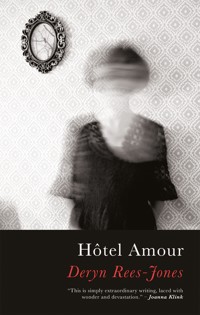
"This is simply extraordinary writing, laced with wonder and devastation…" Joanna Klink A sequel to her T. S. Eliot Prize shortlisted Erato, Deryn Rees-Jones' remarkable new collection sees her returning to ongoing preoccupations: the complexities of memory and memorialisation, desire and the body, and poetry's place in a hostile world. The book begins with a woman checking into Hôtel Amour, a space both real and imagined, in the heart of Paris. This is a hallucinatory city where surreal symbols loom large: the hotel's pink neon sign, elephants, doubles, and lost pairings. A bloody heart lies in the street, books concertina into song, and everywhere is the ever-present noise of birds. Playful, and moving by turn, Hôtel Amour experiments with fragmented narrative and poetic form, creating a breathing space for a multilayered and powerful meditation on illness, love and time. Hôtel Amour's fierce and formidable exploration of 'the now' and its many ghostly literary pasts, is the work of a poet at the height of her powers as she asks us to listen, and explore our human capacity for transformation and for hope.
Sie lesen das E-Book in den Legimi-Apps auf:
Seitenzahl: 73
Veröffentlichungsjahr: 2025
Das E-Book (TTS) können Sie hören im Abo „Legimi Premium” in Legimi-Apps auf:
Ähnliche














3
Hôtel Amour
Deryn Rees-Jones
5
… and the words give out their scent, and ripple like leaves, and chequer us with light and shadow….
– Virginia Woolf
6
7
It was time8
Contents
THE HOTEL10
11
The hotel, which had once been one of the most famous brothels in Paris, occupied a discrete section of the quiet street. Here, if you listened,
you could hear the world in the quality of its movements. You could hear the loops and unravellings of the particular, coming together and then, washing away.
Here,
every wobble of the world in the moments of its creation, paused, and for a moment, she thought, here the sky had managed to
place itself, unknowingly, on a great hinge of between-ness: here was space, time, and, if you, too, paused to look up, here dreaming, here thinking, you could hear the clouds flirting
12across the late summer sky; here you could see, later or earlier, say, the smear of
colour as pinks and oranges bled evening to night, night to dawn, here, &
L I S T E N!
In the nearby cafés, the rustle of pages turning in books and newspapers had become amplified, even the wingflaps of birds,
13of eyelids opening and closing at the start
& end of the day, telescoped their sounds into new meaning.
(Words lifted themselves into the air as if they, too, were
birds wings leaf flutterings.)
SSSSSSSHHHHHHHHHHHH
The sign outside the hotel, up in the 9th, was made from pink neon.
In the boldest letters it spelled out
She had booked the room the previous week, 14
imagining how it would feel at that pinprick moment
in the future
when the afternoon darkened, and she found herself
sitting beside the window, watching the sign bleed its pink light into the room.
Bleedspill, fluorescent. Here. Elsewhere. Perhaps a little hum. She liked to imagine —
she liked to imagine the couples who had been there before her, the temporary residents, ghosting and overwriting themselves in
captions of feeling: the tenderness, the
moments of indulgence, joy, boredom, vulnerability. 15
Here, too, was a history: of sabotage,
harm, violence, fear, all working its way into the fabric of the building, gnawing, biting, sucking, swallowing, settling and edging in, at the door, the window….
Desire.
She flicked at the thought — stretchy, powdery, twitching — alive between her fingers. 16
She thought — imagining that moment now —
of the time in the Orangerie, when she had stood admiring a picture she knew very well, but which was new to her friend, who stood beside her. In it, everything was precise: the women were tending to a man who sat inert on the counterpane. There was a jug in the foreground. The detail at the back of the image on the painted wardrobe was a picture within a picture. It
reminded her of all that had happened. The ravaging, ugly, ordinary, a-synchronicity of illness and of death.
And yet, as the friend pointed out, with great deliberation,
the perspective had been put into the frame all wrong. As space got
unravelled, as the family unravelled, shook themselves into their feelings, actions,
so time 17
shuddered & realigned & shocked.
Narratives, promising all, like lives, snapped off without reason: bud, blossom, branch, were cut down suddenly
(with a pang she remembered the old tree in the garden, how it had fallen in what seemed like slow motion, its roots exposed & naked like a huge —
and now she saw it — a huge lung, upturned before her like a ripped-out diagram from a medical textbook).
When she imagined the room in the hotel, it was like this: 18
it gave her a way of keeping something locked tightly in her mind: a projection of something that had been/not been,
endlessly creating itself
in an imagined future. There, too, everything was not quite in the right place. A mouth
pressed into a shoulder saying quietly, yes, like this, like this?
A hand shifted, weight shifted, cells moved from one body to another.
It was a kind of voyeurism: the spooling out of the strange pattern of two bodies interlinking, a rhythm, a cry
and all the pauses of display and revelation, the realignments of fluids and breath, the animal noises; a glance, a movement of something that was happening.
It was a dreamed space. It was a poem. And, there she was, standing in the crux of a future time, taking the key from the concierge, placing it carefully in the old-fashioned keyhole, pushing open the door. Yes. 19
The virus had blurred her vision, it had made her see things askew or even sometimes in double.
Fragments continued to assemble themselves.
20
She had read, somewhere, of a condition, Paris Syndrome, where visitors came face to face with their fantasy of the city and, disillusioned, became dizzy, or hallucinated, vomited, fell to the floor with rapid heart rates. It was a kind of culture shock.
She imagined it was happening even now as all along the Rue de l’ Hôtel de Ville the sirens from the red and yellow ambulances of the sapeur-pompiers streamed and curled like long blue ribbons.
At night, in her own rented apartment in Saint-Paul, the river traffic lit up her room. She slept with the blinds of the huge windows open, the Panthéon a pale ghost at her feet, and the cranes that flanked the ruined shape of Notre-Dame lifting little blinks of shadow and light into the sky.
There was an order to each morning. Below her, a man camped in a tent beside the road, made coffee on his gas burner, did stretches and press ups, 21 as she herself made coffee and watched the city make its daily commute: bicycles, cars, rollerblades, scooters, everyone’s wheels moving faster and faster to their destinations.
Écoute écoute
Coucou coucou
From her window she could also see a Dutch barge, named Bâteau Ivre, moored up on the quayside on the opposite bank of the river. A poem in the flesh! Behind, in frame,
was Notre-Dame. Up near St Sulpice, Rimbaud’s poem, ‘The Drunken Boat’, was written carefully out, she knew, in precise stanzas on a wall.
Words. Pictures. Things. 22
Now, more than ever, it was easy for her to get lost in the squares and winding streets of the Marais.
And it was tempting, always, to stitch everything together, to make meanings from it all as on the world went, with its particularities and rhythms.
This morning, a serious young priest, in his long, black cassock, played ping-pong patiently with a group of young boys.
Écoute!
Coucou!
Like a lyrebird.
How easily everything suggested itself to her, pinning her to meaning; everything happening in the instant recalled itself via memory. Someone had sprayed in neon, cursive pink
Féminins don’t stop fight nearly the victory
across a stretch of the closed-up booths belonging to the bouquinistes. She wondered, really, what it meant, and let it irritate her, 23
the way it called out for a line break.
Old films
spoke to and through her. But
who was speaking the voice-over to her own
small life?
In Bastille, the angel at the top of the Colonne Juillet towered over the traffic, his golden wings outstretched.
The summer, too, stretched lazily out, but soon
the leaves from the plane trees would kick at her feet. Leaves. Lines. Rhymes.
Napoléon, so the story went, had wanted,
instead of the angel,
a huge bronze elephant.
In Victor Hugo’s Les Misérables the elephant — at that time still only a plaster mock-up that slowly disintegrated and which was populated by rats
— becomes the refuge for a small boy. Now only the stump 24
of the elephant, her plinth, remained.




