


Erhalten Sie Zugang zu diesem und mehr als 300000 Büchern ab EUR 5,99 monatlich.
- Herausgeber: Crown House Publishing
- Kategorie: Bildung
- Sprache: Englisch
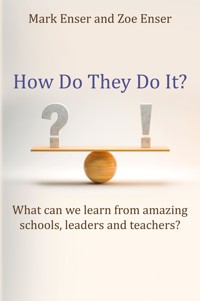
With so many schools doing amazing work, How Do They Do It? What can we learn from amazing schools, leaders and teachers? by Mark and Zoe Enser is a much-needed celebration of successful teachers and school leaders. Drawing on their combined experience as teachers, school leaders and former HMIs and members of Ofsted's Curriculum Unit, they answer one central question: how do amazing schools do it? Using the Ofsted Education Inspection Framework (EIF), they break aspects of school life down into their component parts and identify the best practice of highly successful schools and the not so great practice of less successful ones. Together, Mark and Zoe unpick what we mean by a high quality of education, what matters when it comes to pupil attitudes and the importance of education going beyond the academic and including personal development. Along the way, they bust some common myths about inspections and offer thought-provoking reflective questions which will help school leaders and teachers improve their practice. Ideal for busy teachers and school leaders, this book is broken up into bite-size sections for readers to dip in and out and read the advice they need most. Suitable for teachers of all levels, head teachers, Ofsted inspectors and anyone interested in education today.
Sie lesen das E-Book in den Legimi-Apps auf:
Seitenzahl: 229
Veröffentlichungsjahr: 2025
Das E-Book (TTS) können Sie hören im Abo „Legimi Premium” in Legimi-Apps auf:
Ähnliche













Praise forHow Do They Do It?
What Mark and Zoe have done with this book is to collate hours and hours of listening, seeing and hearing practice from around the country. It is a powerful opportunity to explore the learning that results from two brilliant minds distilling all that lived and learnt experience.
Through every aspect of school life and structure they have unpicked the thinking and reflections of hundreds of different school leaders and teachers. They have been able to triangulate this thinking with what they have seen and synthesised the emerging patterns. This is a powerful body of wisdom to have the luxury to explore.
In every aspect they stress the value of considering our purpose and being deliberate about how we make a path towards it, planning both the potential pitfalls and opportunities that would work best for our students and our staff in our context: where do we want to be? Where are we now? What are the best bets to take us on the path?
It’s not a how-to approach that dictates a set preferred model but an invitation and a scaffold to reflect on this body of learning for the greatest possible outcomes for those that matter most. The most compelling reality exposed is that it is exactly that journey that is the most impactful, the deliberate thought and deliberate action that in the end creates the magic, making something greater than the sum of its parts.
Caroline Barlow, head teacher, Heathfield Community College and co-chair of Headteachers Roundtableii
Written by two heavy-weight thinkers, Zoe and Mark Enser, this book absolutely lives up to its title. Although using a superseded Ofsted framework to support its narrative (which doesn’t matter as it’s a good one), this highly researched and evidenced book lifts the lid on a wide range of aspects of any school’s provision. Tackling topics from curriculum sequencing and pedagogical approaches to the reading curriculum and approaches to disadvantage, this book pulls together the very best theory to create eminently practical suggestions. These are powerfully grouped using a repeated structure that considers why the topic matters, what happens when it goes right and (very helpfully) what happens when it goes wrong. The authors also acknowledge the importance of leadership that creates a culture of openness, trust and supportive challenge, where policy is consulted upon to ensure whole-school processes will work in all contexts within a school. I highly recommend this excellent book.
Andy Buck, founder of Leadership Matters, Cadogan Press and BASIC Coaching
How Do They Do It? explores some of the questions teachers and leaders frequently ask around the EIF and uncovers what high-quality schools have in common. Mark and Zoe provide an insightful look at what matters most and provide concise reflections with approaches that work. Highly recommended.
Michael Chiles, head teacher and best-selling author
How Do They Do It? is the ultimate guide for those walking the winding, often uphill path of school improvement. It feels like travelling alongside expert trail guides; Mark and Zoe Enser draw on their rich, tacit expertise to point out both the hazards and the hidden shortcuts. The book inspires like a breathtaking landscape view yet grounds you with clear, evidence-based steps and sturdy strategies to keep you moving forward. For iiischool leaders and teachers doing the hard miles, this is both a map and a trusted companion, walking every step with you toward excellence.
Haili Hughes, Professor of Teacher Coaching and Mentoring at Academica University of Applied Sciences, Director of PD at All Saints MAT
How Do They Do It? is a timely and valuable book that provides an evidence- and experience-based guide to improving schools, based on insights from highly successful schools and teachers.
The book is structured around Ofsted’s Education Inspection Framework (EIF), which both authors know intimately, with chapters on quality of education, behaviour and attitude, personal development and leadership and management. Each chapter provides a helpful and accessible overview of key areas (for example, assessment or pupil behaviour). They are helpfully structured around what each concept is and why it matters, where things can go wrong and what it looks like when things go right.
This book is fundamentally optimistic. It is a celebration of good schools and of how we can develop all schools by building on the talent of leaders and teachers already working there. As such, it is highly recommended for anyone working in education.
Daniel Muijs, Professor of Education, Queen’s University Belfast
This is a marvellous book. Here we have two educators with a wealth of experience in the classroom and in leadership at all levels, including national roles. Mark and Zoe Enser draw on their experience to provide insights and practical examples of what’s working well in our schools. It’s a celebration of what great schools are doing, how they have clarity of purpose and deliberateness as they work to provide great experiences and outcomes for young people. Balanced by overviews of what ivhappens when things go wrong, there are helpful discussion prompts as an invitation for all of us to consider how to get better. How Do They Do It? is a terrific book and will be immensely helpful for teachers and leaders across the sector.
Mary Myatt, education writer and speaker, Myatt & Co
v
How Do They Do It?
What can we learn from amazing schools, leaders and teachers?
Mark Enser and Zoe Enser
vii
This book is dedicated to the plate spinnersviii
Contents
Introduction
There are three questions that help you to understand almost anything in education. So we will start there.
Why this?
So many schools are amazing. Every day pupils flock through the gates from dozens, sometimes hundreds, of different homes. They bring with them their own stories, hopes and fears. Hundreds of individuals that are warmly welcomed and catered for. Adults move them into classrooms, introduce them to ideas, skills and knowledge that they would never have considered on their own, and they support them to learn it all. To own it. To use it. At the same time, they teach them how to behave in these large, mixed groups and offer them help when they get it wrong, with the promise of a fresh start, over and over again if necessary. These wonderful places, whilst doing all this, also prepare them to go into the world as well-rounded individuals. They provide them with wider opportunities to develop their own interests and become interested in things that they never would have encountered otherwise. At the end of the day, the pupils return home to parents and carers, who are part of that wider school community. And the staff prepare to do it all over again tomorrow. They are amazing. 2
This book is a celebration of the institution of the school and of those who work in schools. It draws on our experience as people who have visited dozens and dozens of schools in one way or another over the years, as well as our experience as teachers and leaders, and evidence into why what works works. We hope that not only will this book be a much-needed celebration of excellent schools, but that it will also be an inspiration. So much happens inside schools that the people in them think is nothing special, but that isn’t happening anywhere else. We want to lift the lid on what schools up and down the country are doing and explore the impact it has on their pupils’ lives.
We also want this book to be useful. One feature of amazing schools is that they are always looking at how to be even better. They are outward-looking and keen to develop. For this reason, there are reflection points throughout the book. Hopefully, these will give an opportunity to consider what you have read in your own context.
We also know that there are pressures in the system. Ofsted and other accountability measures can lead to time-consuming worries for leaders, and that stops schools being able to focus on the business of being schools. We hope to give insights into the inspection process that will help give teachers and leaders clarity on what to expect, and to bust some myths about ‘what Ofsted want’, and this is one reason why we use the Education Inspection Framework (EIF) as a loose structure for the book.1 However, this is certainly not a book about preparing for inspections, or a guide to writing your Self Evaluation Form (don’t bother writing one for inspection– I’m pretty sure that they have little impact. Write one for yourself and your team if you want). 3
There is another, more important reason why the book is structured around the EIF. If we are going to explore what makes amazing schools amazing, we need a criterion. Whatever the flaws with the inspection process, taken in its own right, the EIF provides a well-researched conception of school quality.2 It unpicks what we mean by a high quality of education, what matters when it comes to pupil attitudes, and the importance of education going beyond the academic and including personal development. Look at it away from the desperate attempt to review a school against the EIF in a flurry of activity over two days, and there is a lot to appreciate.
At the time of writing, there is a lot of discussion about likely reforms to the current framework, and to how its outcomes are reported, but this is largely irrelevant to answering the question of what makes amazing schools so amazing. Interestingly, the proposed new toolkit seems to have the same conception of quality that sits underneath the reworked judgement areas. Ofsted’s view of what makes great schools great, whatever term they use to describe them, appears to be unchanged.
Why now?
We are writing this book now because we can. We have both spent more than two years working for Ofsted as His Majesty’s Inspectors (HMIs), out on inspection and within the Curriculum Unit as subject leads for English and geography. Before that we spent a couple of decades working in schools in a wide variety of teaching and leadership roles, as well as carrying out school support work, writing books and working on any number of education projects (from writing and delivering 4National Professional Qualifications to Postgraduate Certificate in Education (PGCE) courses). Our CVs make for interesting and fairly unusual reading.
However, I don’t think this is a book either of us could have written until now. Over the last two years. we have had the opportunity to talk to hundreds of school leaders and teachers about their schools and about their practices. We have had a mandate to ask difficult questions and then to triangulate the answers to them with what we saw on the ground. This has also given us the space to reflect on our own work in school, and outside of them, and to bring that all together to answer the central question of this book: when you look at amazing schools, how do they do it?
What next?
Hopefully, the thing that happens next is you read the book and find it useful. It is broken up into bite-size sections, so if you want to know what we have seen in schools where there is high ambition for pupils, or want to know what pitfalls schools sometimes stumble into over careers, then jump straight there.
However, we also hope that this book tells a story over its pages and that certain commonalities will become apparent. For example, throughout this book we will talk about the importance of having a clear purpose and then putting in place supporting structures to help bring that purpose into fruition.
We have included questions at the end of each section that should help you to reflect on what is happening in your own school or own practice. They might also be useful prompts for group discussions and continuous professional development (CPD).
Whatever happens next with you and this book, do get in touch and let us know.
1 Ofsted, Education Inspection Framework (2019). Available at: https://www.gov.uk/government/publications/education-inspection-framework.
2 Ofsted, Education Inspection Framework: Overview of Research (2019). Available at: https://www.gov.uk/government/publications/education-inspection-framework-overview-of-research.
Chapter One
Quality of Education
What does high-quality education look like? This is not a simple question to answer and debates have raged for centuries. Does high-quality education look like a personalised curriculum, with pupils pursuing their own interests as they arise? Or does it look like a curriculum that sets out the best that has been thought and said that pupils are expected to learn? Does high-quality education have teachers as sages on stages or as guides by the side? Should there be a focus on pupils achieving the best possible exam results or are these a distraction from other, perhaps more holistic, outcomes?
Your answers to such questions will depend in part on your own view on the ultimate aim of education and of schools. Are schools creating a generation of activists who will change the world, hopefully for the better? Or are schools a vehicle for cultural cohesion – passing on a body of agreed knowledge and values from one generation to the next? Or perhaps schools serve a more utilitarian purpose, preparing pupils for the world of work and ensuring that they are economically useful?
However, perhaps more significant is your belief about the best way to achieve these aims. Two leaders may agree on the same aim for their respective schools, perhaps to use education to create a more equal society where everyone can flourish, but have schools that look very different because they have very 6different ideas about how this common aim can be reached. One leader may feel that the best way to achieve a more equitable society is to give everyone access to the same curriculum whilst another feels that it means giving a bespoke curriculum to reflect the background of the individual child or their school’s community.
Your answer to the question may depend on where you fall on the idealist–pragmatist spectrum. You might have a deeply held belief that education should be based on discovery learning or a belief that schools should be based on principles of absolute authority. Either way, you may or may not be led by these beliefs. Some will. Their ideology wins out over pragmatic concerns of whether the approach will lead to exam success or please an inspectorate, but others will be more pragmatic and leave their beliefs to one side.
Where schools are most successful, leaders have considered these questions about purpose and their answers to work out where they want to head. They take deliberate actions to move the school forward towards their desired outcome and regularly stop to check that they are still on course. Throughout this book you will see references to these three things: purpose, deliberate action and checks.
Intent
I remember that when the EIF came out, there was a belief that as part of the Deep Dive process teachers would be gathered together and tested to see if they could repeat their department’s intent statement. Before long, stressed heads of department were being asked to write such statements for their subjects, and sometimes for each individual topic, that teachers were then asked to memorise ready for the inevitable inspection test. These tests never came and school websites became 7littered with well-meaning, yet ultimately meaningless, intent statements.
The problem with such statements is that they tended to be fitted retroactively to an existing curriculum. At best, this misses the benefits of thinking about curriculum intent as part of the curriculum design process. At worst, it creates a tension between what people are saying they want their curriculum to do and what the curriculum actually does. Confusion results.
Where we have seen the strongest schools, the ones with curriculums that delight, excite and have an impact, the intent is not a statement; it was part of the planning for the curriculum at the point of its creation. Leaders, at whole-school and at subject level, had spent time thinking carefully about what they wanted their curriculum to achieve and then they created a curriculum to do just that. Creating a curriculum from the bottom up is a huge undertaking, and this is probably one of the reasons why so many of these strong curriculum designs came from new schools that had started from the beginning, rather than in schools where the curriculum had evolved over decades of shifting priorities and changing demands. Starting with a new curriculum gives more opportunities to ensure that the national curriculum is approached in a thoughtful way (rather than a list of topics to force into existing plans) and there is space to reflect on publications like Ofsted’s subject reviews and subject reports, along with advice from subject associations. Of course, even when a school has been able to create their curriculum from the beginning, this curriculum thinking can never truly be ‘done’ and the most successful schools recognise this. They start with a strong basis for those future discussions and have a clear sense of the direction that guides their decisions over time.
However, there are schools that have successfully reviewed an existing curriculum in light of fresh thinking about their intentions. Where this has been successful, departments or subject 8leads have sat down and spent time considering what it is that they want their curriculum to achieve, looked again at their current curriculum offer and been brutal in pruning out those topics, lessons or activities that don’t fit. They have then turned their attention to what was missing from their curriculum to help make their intentions a reality and added this into the plans.
At other times, schools have realised that what is needed is not new topics, texts or units, but just a change of focus in the ones that already exist – perhaps setting a question that sharpens the lens and means that there is greater clarity about why that thing is being studied at this particular time. This process has been especially helpful in primary schools, particularly in foundation subjects, where time is limited and the curriculum often becomes overstuffed with material that no longer serves any particular aim.
Breadth
What is it?
When we talk about breadth in the curriculum, we can mean a few different things.
Firstly, we might mean the range of subjects that pupils are able to study or that they do study. For example, a broad curriculum might include vocational courses alongside more academic ones, a wide range of different arts subjects, and the option to study single sciences. Within this idea of breadth we might also include the curriculum time that is given to different subjects. A school in which pupils study English and mathematics every morning with all other subjects squeezed in after lunch might be seen as lacking in breadth. It would depend on whether the school managed to compensate for this in some way. 9
Secondly, we might mean the breadth within a subject. For example, do pupils study a broad range of places in geography? A broad range of historical periods and concepts in history? A broad range of texts, genres and forms in English?
Thirdly, breadth might be used to talk about the wider curriculum, beyond the subjects taught in the classroom. A broad curriculum might be defined as one that includes character and career development, work on cultural capital or cultural literacy, and time to explore individual interests.
Through all of this comes a second point, about whether all pupils study a broad curriculum – or whether for some pupils the curriculum has been narrowed? Perhaps some pupils are deemed unsuitable, for whatever reason, to study languages, or perhaps they always miss art to have intervention in reading.
Whichever definition of breadth we are using, what it comes down to is a curriculum that contains more.
Why is it important?
There are several reasons why we might consider a broad curriculum to be an important facet of amazing schools.
Firstly, there is the question of fairness. We might deem it as unfair that the school a child ends up in determines whether or not they are able to study music, or science, or religious education. These are things that society, through their choices at the ballot box, have included in a national curriculum as a basic entitlement for all children in state schools.
Secondly, we can acknowledge that people change. A child at the age of 12 might have decided that they will never be interested in biology, before falling in love with the subject at 15 and going on to study medicine. Someone at the age of 6 might want to give up on music and live to bitterly regret it at the 10age of 76. Whilst at some point people are going to have to specialise further in their studies, we probably don’t want a school deciding for them that their options will be narrowed before they have a clearer sense of their priorities, especially as history has taught us that for some groups, our own inherent biases might be making some of those choices for us.
Thirdly, we can see breadth as important because of the sheer number of things that we want schools to achieve. People will argue that there needs to be breadth in terms of preparing pupils for the world of work, getting them ready for life in modern Britain and ensuring they have resilience and ‘grit’. A broad education is very broad indeed.
When does it go wrong?
At the time of writing, paragraph 237 of the EIF says that the inspectors will focus on those things that research and inspection experience shows are the most important factors in the quality of education, and this includes that the curriculum ‘remains as broad as possible for as long as possible’. This manages to be both vague and harmful. How broad is possible? It is possible to make the curriculum a smorgasbord of different subjects throughout a child’s time in school. They could learn construction first thing on Monday morning, then creative accountancy, followed by water polo. Perhaps on Tuesday they could move on to dry-stone walling and then the history of graffiti art. Is this ‘as broad as possible’? Does this breadth create high-quality education? The problem it creates is an impression that breadth is the goal of curriculum design – and without an infinite supply of time, that inevitably means that depth has to be sacrificed.
This obsession with breadth also filters down from the whole-school curriculum plan into plans for individual subjects. Many primary school curriculums skim past the pre-1066 history 11that is set out in the national curriculum and, in the name of creating a broad curriculum, spend their limited time exploring the Victorian age and World War II – periods covered in depth in secondary schools. Meanwhile, in geography, each geographical term or place listed in the national curriculum is turned into a topic and as much as possible about that topic is then covered. So a topic on rivers tries to include a little on how rivers change as they move downstream, the landforms found there, and something about the issues of flooding and human uses of the river. One of the key criticisms of subjects like PE is that there is a desire to get pupils to encounter as many sports as possible. It is broad but risks being ‘a mile wide, but an inch thick’.1
With this approach it is hardly surprising that people complain the curriculum is overstuffed, but too often these complaints come from those doing the stuffing.
Where does it go right?
Where schools are most successful, they don’t only consider the important question of what to include on a curriculum, they also consider what not to include, and these decisions are guided by that all-important answer to the question of intent. Schools with a very clear sense of what they are trying to achieve find it much easier to remove things from the curriculum when they don’t serve a purpose to give more time to those things that fulfil their goal. If you don’t know what you want, you don’t know what you don’t need. This is true at a subject level and at a whole-school level.
For example, some schools try to offer a carousel of different design technologies, mixed in with visual arts, but with little 12sense of purpose beyond the fact that they have always done it this way, and a vague suggestion of ‘breadth’. Pupils end up experiencing a little bit of everything, but with nothing to draw it together and no sense of progression over time. However, others take a similar carousel approach but are more successful because they ensure that the different elements of design come together to create one product or where common knowledge is revisited in different mediums. They have considered carefully the purpose of what they want to achieve and where the key components and concepts and in one area intersect with another. For example, considering how the properties of materials cuts across different domains or how value judgements are reached when designing a product.
At the level of specific-subject curriculum, some primary schools avoid the desperate rush through thousands of years of human history, and instead focus on pre-1066 history. They made the decision to remove the age-old topic on Victorians because they thought about its underlying purpose, perhaps to consider how developments in technology shape changes to society, and looked at this through the lens of changes to farming over the time period they were studying. Pupils still get a breadth of historical knowledge but with a clearer sense of purpose at its heart.
Reflection points
What subjects could your school offer but doesn’t? What is your rationale?In an ideal world, what subjects, or topics within a subject, would you want to teach? What are the barriers? Can those barriers be overcome?Take a look at your curriculum plans. Be brutal – is there anything you are teaching just because you always have? Does everything serve a purpose? 13Ambition
What is it?
Are you ambitious for your pupils? There are few people working in education who would say that they are not. Even those few people who are still out there saying, ‘This is the best we can expect from these kinds of pupils’ (and, sadly, they are still out there) believe themselves to be ambitious; they just need to recalibrate what their pupils can achieve. And this is the central problem with talking about ambition. We know from our visits to countless schools that ambition is incredibly important, but it is also incredibly difficult to pin down.




