


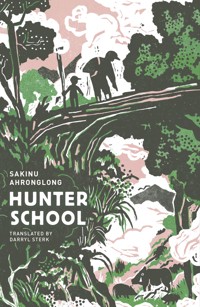
Erhalten Sie Zugang zu diesem und mehr als 300000 Büchern ab EUR 5,99 monatlich.
- Herausgeber: Honford Star
- Kategorie: Gesellschafts- und Liebesromane
- Sprache: Englisch
Hunter School is a work of fiction consisting of recollections, folklore, and autobiographical stories from the perspective of an aboriginal Taiwanese man aiming to reconnect with his lost tribal identity. A common theme running throughout this charming but important book is that of a young man learning about himself and his heritage – from the past, elders, ancestors, and nature itself. This award-winning book is a highly readable and touching work with great insight into the unique aboriginal Taiwanese societies.
Sie lesen das E-Book in den Legimi-Apps auf:
Seitenzahl: 213
Veröffentlichungsjahr: 2020
Das E-Book (TTS) können Sie hören im Abo „Legimi Premium” in Legimi-Apps auf:
Ähnliche




















HUNTERSCHOOL
“In the indigenous literary firmament, Sakinu has always been one of our most important stars. His stories of growing up a Paiwan boy are engaging and environmentally conscious, and his simple wisdom will take your breath away. He may not be known in New York, London, Paris, or Milan, but his generosity, insight, and forgiveness make him one of the most important writers in the world.”
—WITI IHIMAERA
Author of The Whale Rider
“Sakinu’s work shares with the world an aspect of Taiwan that has been overlooked, namely its rich indigenous culture and history as well as the inner world of a charismatic tribal leader and teacher whose deep connection to the primordial source of our consciousness helps bring us back to our natural state of wellbeing.”
—CINDY THEIL
Producer of The Sage Hunter, a film based on Sakinu Ahronglong’s life
“Sakinu’s work does not just make you smile – in it you can also perceive the allure of the alpine wilderness and the responses the Paiwan people have evolved in this wilderness.”
—WU MING-YI
Author of The Stolen Bicycle, listed for the 2018 Man Booker International Prize
“Hunter School is an important addition to the still small but growing corpus of Taiwan’s indigeous writing in English translation. Ably and lovingly translated by Darryl Sterk, the collection of tales, in which the author assays what it means to be Paiwan in contemporary Taiwan, is now available to the English-speaking reader and should not be missed.”
—JOHN BALCOM
Award-winning translator of Chinese literature, philosophy, and children’s books
HUNTERSCHOOL
Sakinu Ahronglong
Translated from Mandarin byDarryl Sterk
This translation first published by Honford Star 2020
honfordstar.com
© Sakinu Ahronglong 1998
Translation copyright © Darryl Sterk 2020
All rights reserved
The moral right of the translator and editors has been asserted.
ISBN (paperback): 978-1-9997912-8-5
ISBN (ebook): 978-1-9997912-9-2
A catalogue record for this book is available from the British Library.
Cover illustration by Chia-Chi Yu
Sponsored by the Ministry of Culture, Republic of China (Taiwan)
CONTENTS
Introduction
Translator’s Note
A PAIWAN BOYHOOD
The Flying Squirrel College
The Mountain Boar School
The Monkey King
Grandpa’s Millet Field
Grandma’s Millet Plot
Wine Can Sing
Smoke Can Speak
Hawk Master
INDIGENOUS TRAJECTORIES
Hawk Man
The Fisherman’s Lament
The Warrior Who Crossed the Sea
The Hunter Who Crossed a Continent
Seeking a Son
Finding a Father
RECLAIMING WHAT WAS LOST
My Encounter With Destiny
The Harvest Festival
My Name is Paiwan
My Wife is Pingpu
Introduction
Ever since I was a boy, I’ve seen my Paiwan tribespeople inundated by society, carried away in the flood. Growing up, I witnessed members of my tribe getting eaten away by reality, even swallowed whole. Reality’s pursuit is relentless, while tradition has receded from us, leaving us helpless and indecisive, leaving wounds in our hearts – in our innermost worlds. The reality is that our villages have been invaded by foreign culture, which has fragmented the tribal social structure and deprived us of the totemic tattoos that adorned the bodies of our ancestors. Without the tattoos, many of us try to pass as Han Chinese. Unable to recognize us, our ancestral spirits have not been able to give us their blessings or offer us comfort.
I have dedicated my life to the reconstruction of traditional Paiwan culture, to show the ancestors that we know who we are. We may not tattoo our bodies, but we can consolidate our village communities, speak our language, and follow our own way of life.
I have faced a lot of opposition. In my mind, I can hear my father, a devout Christian, cursing me when I announced that my wife and I were going to get married in a traditional wedding ceremony. But even when my father called me Satan for reconstructing the culture of our tribe, I did not waver. Never have I wavered since I made my choice. I have never complained nor regretted a thing.
For I am Paiwan! This is an unalterable fact. The beauty of Paiwan culture attracts me profoundly. In fact, it has become my faith and my identity.
There are moments of clarity in everyone’s life, and for me the moment of greatest clarity came when I stood on the top of the Ta-she Mountain in Pingtung County, south-western Taiwan and looked down at the old tribal village in the valley.
In that moment, I finally realized what it means to be Paiwan! I perceived the Paiwan-ness in our traditional slate houses and in our stunning totemic carvings of the hundred pacer snake. My tears gently fell. I stood there all emotional for the longest time. It was as if I were an orphan boy finally learning his parentage.
In the tribal village where I grew up, it was once hard to find traces of traditional Paiwan culture because of the severity of Sinification.
Everything Paiwan was a distant blur for me, until I met my mentors – the Paiwan sculptors Sakuliu and Vatsuku. From them I learned many precious things. From Sakuliu I learned the practicality of a Paiwan person’s wisdom, while Vatsuku shared with me the Paiwan manual creativity.
Sakuliu and Vatsuku initiated me into Paiwan culture, but I would never have been receptive to it if it weren’t for my father and my grandfather.
My father hasn’t always supported my decision, but it was in observing him and his father that I first saw beauty in the traditional relationship with nature. When I was a child, nature was my classroom. Everything in the mountains was my textbook. My grandfather was the headmaster of the school, my father the teacher. It is there that I learned the wisdom of my tribe, passed down from generation to generation.
I’m still celebrating my luck in having an amazingly wise grandfather and a hunter for a father. In my father, I saw the principle of coexistence between man and animal. In my grandfather, I realized the truth of coexistence of man and nature, the truth of sharing and mutual benefit.
One day, Grandpa said, “I’m old. There are not many days left for me to see the sun rise and set. The millet in my field is now ripening for the very last time. My legs no longer have the strength to kiss the land I know so well, nor my fingers the force to pull the trigger of my hunting gun. I am old. I’m old.
“Last night I had that dream again,” he said. “The ancestral spirits were calling me, asking me to go with them. I asked them to give me a bit more time and let me tell all the stories I have to tell, before my life ends. In these eighty years I’ve lived, I’ve lived enough. But before I leave, I want to pass on the glory and dignity of the past to the next generation.
“The words that I’ve uttered, you must record with pen and paper.” Grandpa’s helpless eyes, which had borne witness to the ravages of time, and the wrinkles on his face, which was inscribed with the runes of history, obliged me to comply with his request. Before he passed away, I had to transcribe his wisdom in a book for everyone to read, hopefully to understand. The hard part was that I had to do it in my own words.
“I’m dumb,” I told an editor to whom I had shown an essay. “I haven’t read much, and the things I write nobody reads. I can’t write essays like the other people.”
“Sakinu, why would you want to be like anyone else?” she said. “Everything in you is literature, things other people don’t have and can’t imitate. Sakinu, let everyone know all the things you keep hidden, let your life story, and Paiwan history, come flowing out of your pen.” That was a revelation. I thought it over. I should be proud because I’m indigenous – I’m Paiwan! Now I am proud to tell everyone my only faith is Paiwan, from beginning to end, never to change.
In the past six years I’ve written a lot of things. My objective at the beginning was to make an account of what had happened to me, what I had realized, and what I had heard of the oral accounts of the village elders and their life histories. I wanted to tell the next generation how we once lived in this space.
I dedicate this book, such as it is, to my mentors, my father and grandfather, to the next generation, and to the beautiful woman by my side who has supported me the most, my beloved wife A-chen. A Siraya princess from Tainan County, she has chosen to make a life with me in New Fragrant Or-chid, Lalaoran in Paiwan, between sea and sky on the southeast coast.
Which is where, if you will allow me, I will guide you in this book.
Sakinu Ahronglong
Translator’s Note
“My name is Paiwan!” Sakinu proudly declares. “This is a fact that will not change!” But what does it mean to be Paiwan? Sakinu speaks an Austronesian language that is now called Paiwanese, but it is unclear exactly what paiwan itself means. It might have been a village name – it might have been the name of a plant. It has only become the name of a language in modern times. According to the “Out of Taiwan” hypothesis, Taiwan is the original homeland of the Austronesian language family, meaning that Paiwanese as it is spoken today shares a common ancestor with Polynesian languages and Indonesian, not to mention Tagalog, Malay, Hawaiian, and Maori. Austronesian is a cultural category, too, and Paiwan practices like headhunting and millet cultivation spread from Taiwan through the Austronesian sphere thousands of years ago.
In pre-modern times, Paiwanese was linguistically and culturally unstandardized and therefore highly variable from village to village. In modern times, Japanese scholars from 1895 to 1945 and Chinese and Taiwanese scholars since 1945 have studied the Paiwan and their language. Their studies are written representations of the Paiwanese language and Paiwan culture. These written representations have, in turn, become the basis for written standards. There are now written standards for different dialects of Paiwanese, which are used in teaching materials designed to save the language. Sadly, Paiwanese is now only spoken by people of Sakinu’s age – he was born in 1972 – or older. It really is a mother tongue, and it will soon be a grandmother tongue if attempts to rejuvenate it are not successful.
In supporting the compilation and use of these teaching materials, the Taiwanese government is trying to undo decades of efforts to suppress the language and the culture. Taiwan was officially Chinese until martial law was lifted in 1987, and has only belatedly embraced multiculturalism, particularly with regard to ethnic minorities like the Paiwan who were once called savages. Taiwan has recognized peoples like the Paiwan as indigenous since the mid-1990s based on a simple principle: they were living on the island of Taiwan for thousands of years before the ethnically Han Chinese settlers arrived in southwestern Taiwan in the seventeenth century, and they remain distinct. Official recognition of indigenous peoples is just one of the reasons why Taiwan is now one of the most progressive places in East Asia. Today, Taiwan is the East Asian country that has tried to do the most to make its original residents feel at home in their own homeland.
Sakinu feels at home in his village in southeastern Taiwan and is playing a role he has cast himself for. That role is to be a cultural ambassador for the Paiwan people, where “culture” can be understood in two ways, as identity and as adaptation. As an identity, Sakinu’s culture is distinct practices, including the festivals his village holds and the styles of clothes he wears. To some extent, Sakinu understands these practices according to standards based on research by Japanese and Chinese scholars, but he also understands them based on his own village community experience and oral history research. As you will notice as you read, Sakinu has a very strong sense of local identity, of being a Paqaluqalu – east coast Paiwan – from Lalaoran, a village with its own distinctive practices.
As an adaptation, Sakinu’s culture is an approach to survival in premodern times, when if you wanted dinner you had to hunt it or grow it yourself. Is hunting your own meat and growing your own millet still adaptive when you can now drive to the supermarket and get everything you need? Sakinu thinks so. He thinks that there’s something missing in the modern or postmodern lifestyle, which has alienated many of us from nature and stranded us in screen-based media. That’s why, in 2006, in his mid-thirties, a half a dozen years after publishing the Mandarin edition of the collection you hold in your hands, Sakinu founded the Hunter School. You can understand the Hunter School in terms of ethnic or eco-tourism, but if you talk to Sakinu you’d realize how sincere he is about helping young people reconnect with their original home, which remains the source of anything they could buy in the store or see on the Internet. Tragically, the Hunter School burned down in May, 2019, but then the school is a state of mind, and will, I am sure, get rebuilt.
I first met Sakinu in the summer of 2010 when a friend of mine, Professor Terry Russell, and I were doing some research on how indigenous writers write about the topic of home in their works. We wanted to interview Sakinu because in a way he doesn’t do anything but write about his home. We were very grateful to him for showing us the Hunter School, introducing us to his father, who as a construction worker has visited more countries than Terry and I had combined, and for showing us his millet field and hunting ground. This visit helped me imagine the places in Sakinu’s stories as I was reading and translating them. It’s an honour for me to finally give Sakinu a gift in return by translating his stories.
This collection was published as Shanzhu, Feishu, Sakinu in Mandarin. As you can tell, the three words in the title rhyme. Sakinu rhymes with shanzhu, meaning “mountain boar”, and feishu meaning “flying squirrel”. As you can also tell, the English title wouldn’t rhyme.
I considered calling the collection The Sage Hunter, the title of a 2005 feature film based on Sakinu’s stories. But in the end, I went with Hunter School, in honour of the actual school that Sakinu built and will rebuild.
I’ve reordered the stories in the collection to tell the story of Sakinu’s life and the lives of his fellow villagers: from an idyllic childhood to an adolescence in which Paiwan people get buffeted by socioeconomic forces beyond their control, to a maturity in which they are finally able to reorient themselves and choose their own path.
Sakinu’s path is a hunter’s path. As someone who as a child used to read The Call of the Wild by the light of the moon, I wanted to follow Sakinu down this path, only to discover that to Sakinu it’s not the call of the wild, it’s the call of his Paiwan ancestors. To Sakinu, there is nothing wild about a Paiwan hunter, who is every bit as civilized as you and me, if not more so. In these stories, Sakinu translates the call of his Paiwan ancestors into terms that modern Mandarin readers can understand, and I’ve done my best to relay-translate that call into English.
Darryl Sterk
PART ONE
A Paiwan Boyhood
The Flying Squirrel College
With the approach of spring, flying squirrels used to go in search of nubile mates, hoping to fall in love. At night you once heard flying squirrels wooing each other. Sometimes the entire valley resounded with the rhythms of squirrel courtship, when there were a half dozen flying squirrels singing the song of love on each and every tree. What a magnificent sight! What an amazing sound!
Alas, the last time I heard the flying squirrels sing their songs of squirrel love was when I was in secondary school. I didn’t immediately notice when they stopped, or rather when they failed to sing one spring, perhaps because I had never fallen in love myself, either with a girl or with the mountain forest. But I knew someone who had not only fallen in love but had a lover’s intimate knowledge of the object of his love.
“Hey Dad! What happened to the flying squirrels?” I asked him one day. “Where have they all gone?”
“Sakinu, I thought you’d never ask,” he replied. “It’s not just the flying squirrels that have disappeared. What about the mountain eagle that used to soar over the peaks hunting for prey? I didn’t need to notice the silence of the squirrels. The quiet eagle told me all I needed to know, that the animals of the forest had started to migrate further afield.
“As for why, you can blame it on the destruction of habitat due to development and on the overuse of the crossbow by unscrupulous hunters. No matter how many flying squirrels there were, hunting them night and day with advanced technology could only end in the local extinction of the species. But you can’t lay all the blame on people, you know. Partly the squirrels themselves are to blame.
“The flying squirrel,” he said, “is the dumbest animal in the world. A flying squirrel is so dumb it will stand there waiting for you to catch it. Maybe dumb isn’t the right word. Maybe I should say stupidly curious. At night the flying squirrel finds nothing more fascinating than a bright object. All you do is shine your flashlight at one, and it will stand there transfixed, not moving an inch.
“Flying squirrels hide in their dens in the daytime. A flying squirrel may have dens in two or three trees, but it usually chooses one to make its bed in. Unless a human comes or its tree den is forcibly occupied by some stronger squirrel, it won’t leave or move into another one.”
I always looked up and tried to spot the entrances to flying squirrel dens in trees when I hunted with my father as a boy. It’s all down to experience: as long as a person learns to see the world through flying squirrel eyes, Father said, he’ll be able to find one.
For example, if you see a hole in a tree that looks damp, especially one that is funnel-shaped, you know there’s no way you’ll find a squirrel inside. Who would want to live in a place that makes your skin itch or turns into a swimming pool every time it rains?
But flying squirrels are still the stupidest. Every time Father discovered a likely hole, he covered it with a hand-woven net he’d tied to a bamboo pole. Then he knocked the tree trunk with his machete. Knock knock. At that, the flying squirrel inside instinctively flew towards the entrance into the trap Father had set. Trapped in the net, the flying squirrel struggled, making the net even smaller until it couldn’t move. In the end, all we would see was a tightly wrapped grey-brown ball.
Flying squirrels may be thicker than bricks, but they are also the most hygienic animal. A flying squirrel is so clean almost every part of it can be eaten or otherwise used.
Even undigested food in the intestines can be squeezed out and enjoyed with millet wine. Old folks say this is the most nutritious part. In the village, I often see elderly hunters washing back bites of the undigested stuff from the guts of a flying squirrel with swigs of millet wine as they reminisce about all the battles they fought and won when they were young.
One time on a hunt for flying squirrels, my father said, “Son, flying squirrels are divided into ‘lowlanders’ and ‘highlanders’, just like people in Taiwan. The flying squirrels we normally see with ash-brown fur are lowlanders, while flying squirrels with dark-gray fur and white spots on their heads live higher up.
“In winter, when food is scarce in the mountains, we can see the highlanders below the ridgeline. The highlanders are even stupider than the lowlanders, which have had to learn how to hide from hunters and to avoid people in general, in order to reproduce and survive.”
Once I followed my father to the hunting grounds around Pine Brook, a model alpine village belonging to the forest bureau, to hunt for wild bees. As we walked, suddenly I threw back my head and called, “Dad, do you think there’s a flying squirrel in that there tree hole?”
Father looked up and smiled with pride. Softly, he told me, “Watch and learn!”
He tiptoed up and knocked lightly on the trunk. A flying squirrel popped its head out and looked around with a suspicious look on its face. It was trying to find out who had woken it up. Its vigilant eyes took in the surroundings.
I eased myself behind a tree, but by the time I had found myself a hiding place, the squirrel had disappeared into its hiding place. By then, Father had managed to find a branch with an offshoot. He took off his pants – no need to be shy! – tied the pantlegs together, and fitted the branch through the belt loops. If you haven’t brought a net with you, you can make one. I was impressed.
I was also amused: there was Father in his old yellow rubber boots and shabby underpants. He looked so comical.
But he was deadly serious. He moved slowly and softly. It seemed like the whole forest was watching Father’s every move. He approached the hole in the tree and covered it with the opening of his makeshift net, hit the trunk with his machete, and waited. And waited. But after the longest time, no flying squirrel had come flying out. Father asked me to hit the trunk hard with the axe. Still no response. All we could hear was the echo of the axe in the valley. Then he said, “Oh! This flying squirrel has definitely gone to school. He probably finished elementary.”
No sooner had he finished speaking, the flying squirrel found another way out of the tree. It flew across a ravine, settling itself in a tree on the other side. We realized we had been tricked by the thickest animal in the forest. Father climbed the tree and found that the flying squirrel was so incredibly smart it had installed a back door, an escape route in the event of attack.
Father shook his head and said, “This squirrel didn’t just graduate from elementary. I think it finished secondary school and has gone on to college. Otherwise how could it be so clever?” Father untied his trouser trap.
“Next time, I will catch it, somehow,” Father vowed before blocking the back door with underbrush and hiding the branch to use when we returned.
“Dad, is there really a college for flying squirrels?”
“Yes, there sure is. They all attend their classes at night.” I didn’t get it, so Father went on to explain, “They go to night school because they’re nocturnal. They often get together for midnight cram sessions on the principles of survival. Fleeing and hiding from eagles are compulsory credits. Outwitting hunters is an advanced elective.”
The next time Father asked if I wanted to go hunting with him, I immediately agreed. Of course I wanted to go! Father had prepared the hunting implements. This time we were ready for that sneaky flying squirrel. This time we’d get him.
We walked a long time, so long that it was after noon before we returned to where we’d faced off with the squirrel who had lived to fight another day. We moved slowly, stepping so softly it seemed the flying squirrel had not noticed our arrival. Father told me to keep an eye on the squirrel, tracking where it went, while he found the stick. When he did, he made the same rough and ready trouser net, stood under the tree hole, and, slowly and softly, held the opening of the net over the hole. Whereupon I walloped the trunk with the axe. But no flying squirrel came flying out.
“Dad, hasn’t the flying squirrel come back yet?” I asked.
“It’s possible!” Father told me to knock harder. Still nothing.
Father had me hold the net while he climbed up the tree with kindling and grass in hand. “If we can’t scare it out, we’ll smoke it out.”
He crammed the cracks in the underbrush with which he had blocked the back door with the kindling and grass, lit it and blew hard to waft the heavy smoke into the hole. Soon it was coming out of the other hole, the front door. But still the squirrel – a true squatter – refused to budge!
Father was truly flummoxed. Then he discovered that it had already found another hiding place, even higher up, another hollow in the same tree with another opening to the outside. It was curled up inside this hollow with its nose poking out, so that it wouldn’t inhale any of the smoke from Father’s fire. The only way Father knew was because he saw its nose.




