


6,99 €
Mehr erfahren.
- Herausgeber: Open Book Publishers
- Kategorie: Gesellschafts- und Liebesromane
- Sprache: Englisch
Friedrich Hölderlin’s only novel, Hyperion (1797–99), is a fictional epistolary autobiography that juxtaposes narration with critical reflection. Returning to Greece after German exile, following his part in the abortive uprising against the occupying Turks (1770), and his failure as both a lover and a revolutionary, Hyperion assumes a hermitic existence, during which he writes his letters. Confronting and commenting on his own past, with all its joy and grief, the narrator undergoes a transformation that culminates in the realisation of his true vocation.
Though Hölderlin is now established as a great lyric poet, recognition of his novel as a supreme achievement of European Romanticism has been belated in the Anglophone world. Incorporating the aesthetic evangelism that is a characteristic feature of the age, Hyperion preaches a message of redemption through beauty. The resolution of the contradictions and antinomies raised in the novel is found in the act of articulation itself. To a degree remarkable in a prose work of any length, what it means is inseparable from how it means. In this skilful translation, Gaskill conveys the beautiful music and rhythms of Hölderlin’s language to an English-speaking reader.
Das E-Book können Sie in Legimi-Apps oder einer beliebigen App lesen, die das folgende Format unterstützen:
Veröffentlichungsjahr: 2019
Ähnliche




















HYPERION, or the Hermit in Greece
Hyperion, or the Hermit in Greece
By Friedrich Hölderlin
Translated and with an Afterword by Howard Gaskill
https://www.openbookpublishers.com
Translation and Afterword © 2019 Howard Gaskill
This work is licensed under a Creative Commons Attribution 4.0 International license (CC BY 4.0). This license allows you to share, copy, distribute and transmit the text; to adapt the text and to make commercial use of the text providing attribution is made to the authors (but not in any way that suggests that they endorse you or your use of the work). Attribution should include the following information:
Friedrich Hölderlin Hyperion, or the Hermit in Greece. Translated and with an Afterword byHoward Gaskill. Cambridge, UK: Open Book Publishers, 2019, https://doi.org/10.11647/OBP.0160
In order to access detailed and updated information on the license, please visit, https://www.openbookpublishers.com/product/941#copyright
Further details about CC BY licenses are available at, https://creativecommons.org/licenses/by/4.0/
All external links were active at the time of publication unless otherwise stated and have been archived via the Internet Archive Wayback Machine at, https://archive.org/web
Updated digital material and resources associated with this volume are available at, https://www.openbookpublishers.com/product/941#resources
Every effort has been made to identify and contact copyright holders and any omission or error will be corrected if notification is made to the publisher.
Open Book Classics Series, vol. 10 | ISSN: 2054-216X (Print); 2054-2178 (Online)
ISBN Paperback: 978-1-78374-655-2
ISBN Hardback: 978-1-78374-656-9
ISBN Digital (PDF): 978-1-78374-657-6
ISBN Digital ebook (epub): 978-1-78374-658-3
ISBN Digital ebook (mobi): 978-1-78374-659-0
ISBN Digital (XML): 978-1-78374-667-5
DOI: 10.11647/OBP.0160
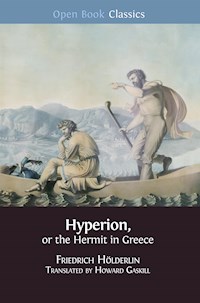
Cover image: Rudolf Lohbauer, ‘Hyperions Fahrt nach Kalaurea’ [Hyperion’s voyage to Calauria] (1824), reproduced by kind permission of the owner. See Walter Ludwig, ‘Rudolf Lohbauers Bild “Hyperions Fahrt nach Kalaurea”’, Hölderlin-Jahrbuch 30 (1996–1997), pp. 359–80.
Cover design: Francesca Alabaster.
All paper used by Open Book Publishers is SFI (Sustainable Forestry Initiative), PEFC (Programme for the Endorsement of Forest Certification Schemes) and Forest Stewardship Council® (FSC® certified).
Contents
Hyperion, or the Hermit in Greece
1
Volume One
3
Foreword
5
Book One
7
Hyperion to Bellarmin [I]
7
Hyperion to Bellarmin [II]
8
Hyperion to Bellarmin [III]
9
Hyperion to Bellarmin [IV]
11
Hyperion to Bellarmin [V]
16
Hyperion to Bellarmin [VI]
17
Hyperion to Bellarmin [VII]
21
Hyperion to Bellarmin [VIII]
34
Hyperion to Bellarmin [IX]
36
Hyperion to Bellarmin [X]
37
Hyperion to Bellarmin [XI]
38
Book Two
41
Hyperion to Bellarmin [XII]
41
Hyperion to Bellarmin [XIII]
42
Hyperion to Bellarmin [XIV]
45
Hyperion to Bellarmin [XV]
46
Hyperion to Bellarmin [XVI]
47
Hyperion to Bellarmin [XVII]
48
Hyperion to Bellarmin [XVIII]
49
Hyperion to Bellarmin [XIX]
49
Hyperion to Bellarmin [XX]
49
Hyperion to Bellarmin [XXI]
50
Hyperion to Bellarmin [XXII]
51
Hyperion to Bellarmin [XXIII]
52
Hyperion to Bellarmin [XXIV]
52
Hyperion to Bellarmin [XXV]
53
Hyperion to Bellarmin [XXVI]
54
Hyperion to Bellarmin [XXVII]
55
Hyperion to Bellarmin [XXVIII]
59
Hyperion to Bellarmin [XXIX]
64
Hyperion to Bellarmin [XXX]
65
Volume Two
79
Book One
81
Hyperion to Bellarmin [XXXI]
81
Hyperion to Bellarmin [XXXII]
82
Hyperion to Bellarmin [XXXIII]
83
Hyperion to Bellarmin [XXXIV]
84
Hyperion to Bellarmin [XXXV]
85
Hyperion to Bellarmin [XXXVI]
86
Hyperion to Bellarmin [XXXVII]
89
Hyperion to Diotima [XXXVIII]
90
Hyperion to Diotima [XXXIX]
90
Hyperion to Diotima [XL]
91
Hyperion to Diotima [XLI]
91
Hyperion to Diotima [XLII]
94
Diotima to Hyperion [XLIII]
94
Hyperion to Diotima [XLIV]
96
Hyperion to Diotima [XLV]
96
Hyperion to Diotima [XLVI]
98
Diotima to Hyperion [XLVII]
99
Hyperion to Diotima [XLVIII]
100
Hyperion to Diotima [XLIX]
101
Hyperion to Diotima [L]
102
Hyperion to Diotima [LI]
102
Hyperion to Diotima [LII]
104
Book Two
107
Hyperion to Bellarmin [LIII]
107
Hyperion to Bellarmin [LIV]
108
Hyperion to Bellarmin [LV]
109
Hyperion to Bellarmin [LVI]
111
Hyperion to Bellarmin [LVII]
116
Hyperion to Bellarmin [LVIII]
123
Continued
124
Continued
125
Continued
126
Continued
126
Hyperion to Bellarmin [LIX]
131
Hyperion to Bellarmin [LX]
134
Afterword
139
A Novel in Letters
141
The Foreword
151
‘Not to be constrained by the greatest …’
155
‘… return whence he came’
171
Englishing Hyperion
188
Acknowledgments
207
Appendix A
209
Editions consulted
209
Appendix B
211
Translations
211
English
211
Other translations consulted
211
Appendix C
213
Select bibliography in English
213
Index of Proper Names
215
Map of Greece and Asia Minor, with locations mentioned in Hyperion, CC BY 4.0.
Hyperion, or the Hermit in Greece
© 2019 Howard Gaskill, CC BY 4.0 https://doi.org/10.11647/OBP.0160.01
Volume One
Non coerceri maximo, contineri minimo, divinum est.
[Not to be constrained by the greatest, to be contained by the smallest,is divine.]
Foreword
I’d happily promise this book the love of the Germans. But I fear some will read it like a compendium and be overly concerned with the fabula docet,1 whilst others will take it too lightly, and neither party will understand it.
Those who merely sniff my flower mistake its nature, and so do those who pluck it merely for instruction.
The resolution of the dissonances in a particular character is neither for mere reflection nor empty pleasure.
The setting for what follows is not new, and I confess that I was once childish enough to try changing the book in this respect. But I became convinced that this setting was the only appropriate one for Hyperion’s elegiac character, and was ashamed at my weakness in having been unduly swayed by the probable verdict of the public.
I regret that for now it is not yet possible for everyone to judge the design of the work. But the second volume is to follow as soon as possible.
Book One
Hyperion to Bellarmin [I]
The beloved soil of my fatherland gives me joy and grief once more.
I’m up now every morning on the heights of the Isthmus of Corinth, and often, like the bee from flower to flower, my spirit flits back and forth between the seas to right and left that cool the feet of my glowing mountains.
One of those two gulfs would specially have delighted me, had I stood here some thousand years ago.
Then, like a conquering demi-god between the glorious wilderness of Helicon and Parnassus, where the rosy light of dawn plays on a hundred snow-covered peaks, and the paradisal plain of Sicyon, the shining gulf surged in towards the city of joy, youthful Corinth, pouring forth before its favourite the accumulated bounty from all corners of the earth.
But what is that to me? The howl of the jackal, singing its wild dirge amidst the rubble of antiquity, jolts me from my dreams.
Happy the man for whom a flourishing fatherland gladdens and fortifies the heart! Being reminded of mine is like being pitched into the mire, like having the coffin lid slammed shut over me, and whenever anyone calls me Greek, I always feel I’m being throttled with a dog collar.
And see, my Bellarmin! whenever I’d burst out with such remarks, as often as not with tears of anger in my eyes, along came the wise gentlemen who so delight in gibbering among you Germans, those wretches for whom a grieving disposition is such a welcome opportunity to unload their maxims; they were in their element, and made so bold to tell me: ‘Don’t moan, act!’
Oh, that I had never acted! how many hopes I’d now be richer by! —
Yes, just forget that men exist, starving, vexed and deeply harassed heart! and return whence you came, into the arms of nature, never-changing, beautiful and tranquil.
Hyperion to Bellarmin [II]
I have nothing I might truly call my own.
Far away and dead are those I loved, and through no voice I hear from them, nothing ever more.
My business on earth is done. I set about my work with a will, bled over it, and made the world not a penny richer.
I return alone and unrenowned and wander through my fatherland, stretching about me like a vast graveyard, and it may be that what awaits me is the knife of the hunter who keeps us Greeks for sport like forest game.
But you still shine, sun of heaven! You still green, holy earth! Still the rivers rush into the sea, and shady trees whisper in the height of day. Spring’s blissful song sings my mortal thoughts to sleep. The plenitude of the all-living world nourishes and fills with drunkenness my starving spirit.
O blissful nature! I can’t tell what comes over me when I lift up my eyes before your beauty, but all the joy of heaven is in the tears I weep before you, the lover before the beloved.
My whole being stills and listens when the gentle ripple of the breeze plays about my breast. Often, lost in the immensity of blue, I look up into the aether and out into the hallowed sea, and it’s as if a kindred spirit opened its arms to me, as if the pain of isolation were dissolved in the life of the godhead.
To be one with everything, that is the life of the godhead, that is the heaven of man.
To be one with everything that lives, to return in blissful self-oblivion into the all of nature, that is the summit of thoughts and joys, that is the holy mountain pinnacle, the place of eternal peace where noon loses its sultriness and the thunder its voice and the boiling sea becomes like a waving corn-field.
To be one with everything that lives! At these words virtue lays aside its wrathful harness, the mind of man its sceptre, and all thoughts melt away before the vision of the world’s eternal oneness like the toiling artist’s rules before his heavenly Urania, and iron fate renounces its dominion, and from the covenant of beings death disappears, and indivisibility and eternal youth blesses, makes beautiful the world.
On this height I often stand, my Bellarmin! But a moment of reflection casts me down. I begin to think, and find myself as I was before, alone, with all the pains of mortality, and my heart’s sanctuary, the world’s eternal oneness, is no more; nature’s arms are closed, and I stand before her like a stranger and cannot comprehend her.
Oh! had I never gone into your schools. It’s learning that lured me down into the pit, in my youthful folly I thought to find in it the proof of my pure joy, and it has ruined everything for me.
Amongst you I became so very rational, learnt to distinguish myself perfectly from what is around me, and now I’m set apart in the beautiful world, expelled from the garden of nature in which I grew and bloomed, and shrivel under the noonday sun.
Oh, man is a god when he dreams, a beggar when he thinks, and when inspiration’s gone he’s left standing there like a delinquent son, cast out of the house by his father, staring at the pitiful pennies given as alms to help him on his way.
Hyperion to Bellarmin [III]
I thank you for asking me to tell you about myself, for making me remember former times.
That’s what really drove me back to Greece, wanting to live nearer to the playground of my youth.
As into quickening sleep the labourer, so my beleaguered being often sinks into the arms of the innocent past.
Peace of childhood! heavenly peace! how often do I stilly stand before you in loving contemplation, and think to grasp you! Yet we can only conceive of that which once was bad and has been made good again; of childhood, innocence we can have no conception.
When I was still a tranquil child, knowing nought of all that is around us, was I not then more than I am now, after all the heart’s travail and all the mind’s toiling and striving?
Yes! a divine being is the child as long as it’s not been dipped in the chameleon colours of men.
It’s wholly what it is and that’s why it’s so beautiful.
The force of law and fate can’t touch it; in the child alone is freedom.
In the child is peace; it’s not yet at variance with itself. Richness is in the child; it’s still to know its heart, the penury of life. It is immortal, for it knows nothing of death.
But this men cannot bear. That which is divine must become like one of them, must learn that they too are there, and before nature expels the child from its paradise, men cajole and drag it out onto the ground of the curse, that it may, like them, grind away its life in the sweat of its face.
But the time of awakening is beautiful too, if only we’re not woken out of season.
Oh, they are hallowed days in which our heart first tests its wings, when full of quick and fervent growth we stand there in the glorious world, like the young plant when it unfolds to the morning sun and stretches up its slender arms towards the endless heaven.
How I felt impelled to roam amongst the mountains and along the shore! oh, how I often sat with throbbing heart upon the heights of Tinos, and gazed after the falcons and the cranes, and the doughty sprightly ships as they shrank below the horizon! ‘Down there!’ I thought, ‘down there you too one day will wander,’ and I felt like one who, parched with heat, plunges into the cooling pool and splashes the spumy waters on his brow.
Sighing I’d then turn back towards my home. ‘If only my school years were over,’ I often thought.
Dear boy! They’re far from over yet.
That in man’s youth he thinks the goal so near! That is the most beautiful of all illusions with which nature helps our weakness.
And often when I lay amongst the flowers and basked in the soft spring sunlight, and looked up into the bright blue that embraced the warm earth, when I sat under the elms and willows, in the womb of the mountain, after a quickening shower, when the branches still quivered from the caresses of heaven and golden clouds moved above the dripping woods, or when full of peaceful spirit the evening star rose with those ancient youths, the other heroes of the heavens, and I watched as the life within them propelled itself through the aether in eternal effortless order, and the peace of the world enfolded and elated me, so that I roused and listened, not knowing what came over me — ‘do you love me, good father in heaven!’ I’d then silently ask, and felt so blissful and sure his answer in my heart.
O you whom I’d invoke as if you were above the stars, whom I called creator of heaven and earth, amiable idol of my childhood, you won’t be angry I’ve forgotten you! — Why is the world not so wanting as to make one seek an entity outside it?2
Oh, if she’s the daughter of a father, glorious nature, is the daughter’s heart not his heart? her inmost self, is it not He? But do I possess it then? do I know it then?
It’s as if I saw, but then again I take fright, as if it were my own image I’d seen, it’s as if I felt him, the spirit of the world, like the warm hand of a friend, but I awake and think it’s my own fingers I’ve been holding.
Hyperion to Bellarmin [IV]
Do you know how Plato and his Stella loved each other?
That’s how I loved, how I was loved. Oh, I was a lucky lad!
It’s a joy when like and like are joined, but when a great man raises lesser to his level, it’s divine.
A kindly word from a brave man’s heart, a smile that conceals the consuming glory of the spirit, is little and much, like a magical password hiding life and death in its innocent syllable, like living water welling up from deep inside the mountains and conveying to us in each crystal drop the secret energy of the earth.
But how I hate all the barbarians who think themselves wise because they no longer have a heart, all the vulgar brutes who find a thousand different ways to kill and destroy youth’s beauty with their stupid petty principles of manhood!
Good God! This is the owl wanting to drive from the nest the young eagles, wanting to show them the way to the sun!
Forgive me, spirit of my Adamas! for recalling these people before you. That’s what we gain from experience that we can imagine nothing excellent without its malformed opposite.
Oh, would that you were ever present to me, with all that is akin to you, grieving demi-god I cherish! Those you enfold with your tranquillity and strength, conqueror and warrior, those you confront with your love and wisdom, let them flee or become like you! What’s ignoble and weak stands no chance beside you.
How often you were near to me when you were long since far away from me, you glorified me with your light, warmed me that my frigid heart began to stir again, like a frozen stream when it’s touched by the ray of heaven! Then I felt like fleeing to the stars with my bliss, so that it not be debased by the world around me.
I’d grown up like an unpropped vine, and the wild tendrils spread aimlessly across the ground. As you well know, there’s many a noble energy that perishes with us because it isn’t used. I flitted about like a will-o’-the-wisp, grasped at everything, was gripped by everything, but then only for the moment, and my clumsy energies exhausted themselves to no purpose. Everywhere I felt wanting, and still couldn’t find my goal. So he found me.
For long enough he’d practised patience and art on his material, the so-called cultivated world, but his material had been and stayed stone and wood; it might, when occasion demanded, outwardly assume the noble human form, but that’s not what my Adamas was about; he wanted human beings, and to create them he’d found his art too poor. That those he sought had once existed, those his art was too poor to create, this he clearly saw. Where they’d existed, he also knew. That’s where he wished to go, to probe beneath the rubble for their genius and with it while away his lonely days. He came to Greece. So I found him.
I still see him approaching me in smiling contemplation, I still hear his greeting and his questions.
Like a plant when its peace soothes the striving spirit and simple contentment returns to the soul — so he stood before me.
And I, was I not the echo of his quiet inspiration? did the melodies of his being not reverberate in me? What I saw I became, and it was divine what I saw.
How feeble is even the most honest human industry compared with the sheer power of unbroken inspiration.
This doesn’t linger on the surface, doesn’t merely touch us here or there, has no need of time or means; nor does it need command, compulsion and conviction; it takes hold of us in one moment on all sides and on all levels, low and high, and before we know it’s there, before we can wonder what is coming over us, it turns us through and through into its blissfulness and beauty.
Happy the man whose path has thus been crossed in early youth by a noble spirit!
Oh, these are golden unforgettable days, full of the joys of love and sweet activity!
Adamas led me now into the world of Plutarch’s heroes, now into the magical land of the Greek gods, now he used number and measure to bring to my youthful impetuousness order and composure, now he took me up into the mountains: by day to see the flowers of field and forest and the wild mosses of the rocks, by night to see the holy stars above us, and understand them after the manner of men.
There is a luscious feeling of well-being within us when our inner self can thus draw strength from its material, separating from it to bond with it more faithfully, and step by step the spirit becomes empowered.
But with threefold force I felt him and myself when, like shades from the past, in pride and joy, in anger and grief, we journeyed up as far as Athos and from there shipped eastwards to the Hellespont, then down to the shores of Rhodes and Taenarum’s mountain chasms, through the silent islands all; when longing drove us inland from the coasts, into the sombre heart of ancient Peloponnese, to the lonely banks of the Eurotas, oh! the desolate valleys of Elis and Nemea and Olympia; when leaning against a pillar of one of forgotten Jupiter’s temples, hugged by laurel roses and evergreens, we gazed into the wild riverbed, and the vibrance of spring and the ever youthful sun reminded us that man too had once been there and now is gone, that the glorious nature of humanity is barely there any more, like the fragment of a temple, or in memory as the image of one dead — then I sat playing sadly beside him, plucking the moss from a demi-god’s pedestal, digging some hero’s marble shoulder out of the rubble, and cutting away the brambles and the heather from the half-buried architraves, whilst my Adamas sketched the landscape that fondly held the ruins in its comforting embrace, the corn-covered hill, the olives, the herd of goats clinging to the mountain crag, the forest of elms sweeping down from the peaks to the valley; and the lizard frisked at our feet, and the flies buzzed about us in the stillness of noon — Dear Bellarmin! I’d love to give a point-by-point account in Nestor’s manner; I range through the past like a gleaner through a field of stubble, when the lord of the land has reaped; one picks up every piece of straw. And the time I stood beside him on the heights of Delos, what a day it was that dawned for me as I climbed with him the ancient marble steps up Cynthus’ granite face. Here once dwelt the sun-god, amidst the heavenly festivals where, like golden clouds, assembled Greece glowed all around him. It’s here the youths of Greece immersed themselves in floods of joy and inspiration, like Achilles in the Styx, and like the demi-god emerged invincible. In the groves, in the temples their souls awoke, each sounding in the other, and all faithfully preserving the rapturous chords.
But why am I speaking of this? As if we still had an inkling of those days! Oh! not even a beautiful dream can thrive under the curse that weighs upon us. Like a howling north wind the present blasts the blossoms of our spirit and sears them in their bloom. And yet it was a golden day that enfolded me on Cynthus! We reached the summit with dawn still breaking. Now he rose in his eternal youth, the ancient sun-god; serene and effortless as ever, the immortal titan with a thousand joys of his own soared upward, smiling down on his wasted land, on his temples, his pillars that fate had tossed before him like withered rose petals, mindlessly ripped from the bush by a passing child and scattered over the earth.
‘Be like him!’ Adamas cried out to me, grasped my hand and held it out towards the god, and I felt as if the morning winds were carrying us away, bringing us into the train of the holy being that now rose up to the summit of heaven, kindly and grand, and wonderfully infused the world and us with his spirit and his power.
Still my inmost self grieves and rejoices over every word Adamas spoke to me then, and I can’t understand my privation when often I feel as he must have then. What is loss when man thus finds himself in a world which is his own? In us is everything. If a hair should fall from his head, what is it to him? Why does man so strive for bondage when he could be a god! ‘You will be lonely, my dearest!’ Adamas also said to me then, ‘you will be like a crane, left behind by his kin in the harsh season whilst they seek out the spring in distant lands.’




