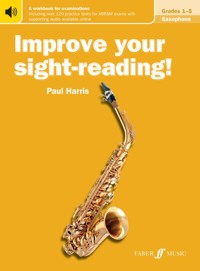
Improve your sight-reading! Saxophone Grades 1-5 - Paul Harris - E-Book

Improve your sight-reading! Saxophone Grades 1-5 E-Book

Paul Harris

0,0

Beschreibung

The full eBook version of Improve your sight-reading! Saxophone Grades 1-5 in fixed-layout format. Paul Harris' brilliant series of workbooks contains not only the complete scales and arpeggios for the current ABRSM Initial and Grade 1 syllabuses but also uses finger fitness exercises, scale and arpeggio studies, key pieces and simple improvisations to help you play scales and arpeggios with real confidence. An invaluable resource for students, Improve your scales! Violin Initial and Grade 1 covers all the keys and ranges required for the ABRSM syllabuses, helping you pick up valuable extra marks in exams.

Sie lesen das E-Book in den Legimi-Apps auf:

Android
iOS
von Legimi
zertifizierten E-Readern

Seitenzahl: 24

Veröffentlichungsjahr: 2025

Das E-Book (TTS) können Sie hören im Abo „Legimi Premium” in Legimi-Apps auf:

Android
iOS
Bewertungen
0,0
0
0
0
0
0
Mehr Informationen
Mehr Informationen
Legimi prüft nicht, ob Rezensionen von Nutzern stammen, die den betreffenden Titel tatsächlich gekauft oder gelesen/gehört haben. Wir entfernen aber gefälschte Rezensionen.


Paul Harris
Grades 1–5
Saxophone
Introduction
2
Grade 1
Stage 1
q
Î
2
4
3
Stage 2
F major
Small leaps
4
4
h
6
Stage 3
G major
Slurs
3
4
h.
iq
9
Grade 2
Stage 1
C major
iiiq
Ties
12
Stage 2
D minor
q
.
e
<
15
Stage 3
Staccato
Revision
18
Grade 3
Stage 1
jjjq
ijq
4-note slurs
>
p
21
Stage 2
A minor
œ
œ
24
Stage 3
Rhythms in
3
8
Revision
27
Grade 4
Stage 1
D major
Up-beats
30
Stage 2
Rhythms in
8
6
q jq
33
Stage 3
B minor
jiq
q
.
jq
Revision
37
Grade 5
Stage 1
B
b
major
G minor
Syncopation
40
Stage 2
A major
E
b
major
pp
and
ff
43
Stage 3
E minor
Revision
46
Improve your
Improve your
sight-reading!
sight-reading!
2
Introduction
Being a good sight-reader is so important and it’s not difficult at
all! If you work through this book carefully – always making sure
that you really understand each exercise before you play it – you’ll
never have problems learning new pieces or doing well at sight-
reading in exams!
Using the workbook
1 Rhythmic exercises
Make sure you have grasped these fully before you go on to the
melodic exercises: it is vital that you really know how the rhythms
work. There are a number of ways to do the exercises, several of
which are outlined in Stage 1. Try them all out. Can you think of
more ways to do them?
2 Melodic exercises
These exercises use just the notes (and rhythms) for the Stage,
and progress gradually. If you want to sight-read fluently and
accurately, get into the simple habit of working through each
exercise in the following ways before you begin to play it:
• Make sure you understand the rhythm and counting. Clap the
exercise through.
• Know what notes you are going to play and the fingering you
are going to use.
• Try to hear the piece through in your head. Always play the
first note to help.
3 Prepared pieces
Work your way through the questions first, as these will help you
to think about, or ‘prepare’ the piece. Don’t begin playing until you
are pretty sure you know exactly how the piece goes.
4 Going solo!
It is now up to you to discover the clues in this series of practice
pieces. Give yourself about a minute and do your best to
understand the piece before you play. Check the rhythms and
fingering, and try to hear the piece in your head. Always remember