


10,79 €
Mehr erfahren.
- Herausgeber: Faber Music Limited
- Kategorie: Geisteswissenschaft
- Sprache: Englisch
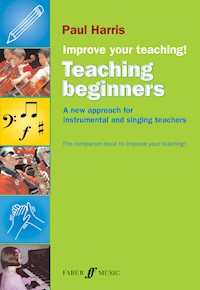
Teaching beginners is a huge responsibility and a challenge, but also reaps enormous rewards. Today there are a host of colourful tutors to choose from, but none tells us how to teach beginners. It can be a hit and miss affair! Energising and inspirational, Improve your teaching! Teaching Beginners is a must-have resource for all instrumental and singing teachers. Written by the UK's leading music educationalist Paul Harris, it is packed full of comprehensive advice and practical strategies, it offers creative yet accessible solutions to the challenges faced in music education. Written in an approachable style and distilled from years of personal experience and research Paul Harris looks at the issues concerning the teaching of beginners, outlining a series of principals, advice and strategies, discussing: How to approach the first lesson, Practice ideas for beginners, Introducing the tutor book and notation, Taking stock and moving forward, Inheriting pupils, Improvisation and Composition for beginners. A companion to the best-selling Improve your teaching!, this book is guaranteed to challenge, affirm and energise your teaching! This is the full eBook version of the original edition.
Das E-Book können Sie in Legimi-Apps oder einer beliebigen App lesen, die das folgende Format unterstützen:
Veröffentlichungsjahr: 2017
Ähnliche









Paul Harris
Improve your teaching!
Teachingbeginners
A new approach forinstrumental and singing teachers
The companion book to Improve your teaching!
© 2008 by Faber Music Ltd
This edition first published in 2008
Bloomsbury House 74–77 Great Russell Street London WC1B 3DA
Music processed by Jeanne Roberts
Design by Susan Clarke
Printed in England by Caligraving Ltd
All rights reserved
ISBN10: 0-571-53175-X
EAN13: 978-0-571-53175-2
To buy Faber Music publications or to find out about the full range of titlesavailable please contact your local music retailer or Faber Music sales enquiries:
Faber Music Ltd, Burnt Mill, Elizabeth Way, Harlow CM20 2HX
Tel: +44 (0) 1279 82 89 82 Fax: +44 (0) 1279 82 89 83
[email protected] fabermusic.com
UK/USA terminology
bar
crotchet
minim
quaver
semibreve
= measure
= quarter note
= half note
= eighth note
= whole note
Contents
Foreword by Jonathan Freeman-Attwood 4
The way in … 5
1 Entering our world 7
2 The initial stage: teaching the first lessons 16
3 The next stage: beyond the first lessons 24
4 Introducing the tutor book 28
5 Taking stock and moving forward 33
6 Inheriting a pupil 39
7 Improvisation – it’s easy! 42
8 … and so is composing! 47
9 Making assumptions 51
10 Affirming our musical beliefs 56
Coda: ‘Them’ on us! 62
3
Foreword
Paul Harris, as teacher and writer, always asks perceptive questions which revise and refine our view of what it takes to be a good teacher. In his last book, Improve your teaching!, Paul proposes a way forward that he terms ‘Simultaneous Learning’, where both the student and teacher perceive that the lesson is a journey that involves two (or more) people imaginatively investigating the ways of technical, musical and human insight. The benefits are likely to be manifold. Not least, the teacher’s own sense of pride in their privileged position percolates through to their students and the learning experience is lifted onto a new plane of potential accomplishment and meaning.
This principle also lies at the core of Teaching Beginners and perhaps requires an even greater sense of self-awareness from the teacher of what it really feels like to be a beginner and how fine are the lines between perceived success and failure by the pupil. How many profoundly musical people have unnecessarily lost confidence in their ability to learn to play or sing because of unmotivated and unimaginative teaching in the first few weeks?
This book openly challenges teachers in the way Paul Harris has challenged himself, constructively analysing the satisfaction to be had in trying out new ideas to instil both pleasure and achievement in learning at the most formative stage. Paul’s approach gives teachers and pupils’ proper ‘confidence tricks’ (in the best sense), which build self-assurance and develop a vocabulary of discovery.
I know a lot of people find the prospect of teaching people from scratch about as enticing as climbing Everest without oxygen or boots. I for one now feel compelled to try it as a profoundly vibrant activity. Not least, one is reminded that if we were not to recognise the special challenges of this seminal part of musical life – passing on the benefits of our musical experience to brave beginners (in the most thought-provoking and responsible way possible) – the future would indeed be bleak. As an educator, par excellence, Paul Harris has no intention of letting that happen. Quite the opposite. Under his guidance, the currency of teaching is justly elevated.
Professor Jonathan Freeman-Attwood
Principal, Royal Academy of Music
4
The way in …
‘ The real voyage of discovery consists not in seeking new lands,but in seeing with new eyes. ’Marcel Proust
A colleague once said to me that teaching beginners was real drudgery. How wrong he was. Teaching beginners is certainly a huge challenge; it is also a huge responsibility, but one that reaps enormous rewards. Above all it is a real joy.
The way we learn to play a musical instrument has changed very much over the last hundred years or so. Look at an old orchestral instrumental tutor and you will notice that by the bottom of the first page beginners were expected (somehow) to have instantaneously absorbed quite advanced rhythmic and technical skills! Things were a little different in piano tutors – young ladies were expected to play the piano as part of their social education, so learning methods were geared more to the younger beginner – but they weren’t much fun. Today we have a host of colourful tutors to choose from – but none of these tells us much about how to teach beginners. It is very much a hit-and-miss affair.
I was very lucky with my first instrumental teacher. He was inspiring and fun and certainly the reason why I became a musician. Perhaps the same is true for you. Those first few lessons are crucial to the way a young musician will develop.
This book looks at all the issues concerning the teaching of beginners. And by beginners I mean the average beginner. One of my pupils (who was already a good reader) came back at the end of the second week’s practice having polished off an entire tutor book. This is unusual! All pupils will move forward at their own particular pace – but whether they are, on the surface, slow or fast learners, whether they come with or without previous musical experience, all the suggestions made in this book can be applied. In general the strategies introduced in the four ‘stages’ (discussed in chapters two to five) will probably fill the first term. But it may fill more or less time. It doesn’t matter. Go at your own pace and that of your pupils.
There are many ideas and strategies in this book. Don’t feel that you have to absorb them all. Just pick and choose those which you think would be most helpful to your teaching. Some of the ideas in the following pages will challenge, some will affirm, but whichever, I hope you will emerge energised and full of (renewed) enthusiasm for your teaching.
5




