


10,79 €
Mehr erfahren.
- Herausgeber: Faber Music Limited
- Kategorie: Geisteswissenschaft
- Sprache: Englisch
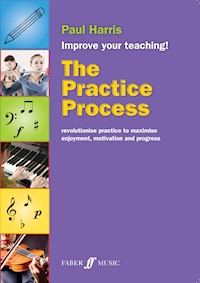
The Practice Process is an inspiring and empowering look at the crucial topic of practice. Paul Harris explores the key role the teacher plays in developing a psychological and holistic approach for pupils. Packed with clear advice, innovative ideas and principles such as the Integration-Representation-Connection cycle and the Simultaneous Practice Map, this book is firmly rooted in Paul Harris's highly successful Simultaneous Learning approach. This is the full eBook version of the original edition.
Das E-Book können Sie in Legimi-Apps oder einer beliebigen App lesen, die das folgende Format unterstützen:
Veröffentlichungsjahr: 2017
Ähnliche








Revolutionise practice to maximiseenjoyment, motivation and progress
Paul Harris
© 2014 by Paul Harris
First published in 2014 by Faber Music Ltd
All rights administered worldwide by Faber Music Ltd
Bloomsbury House
74–77 Great Russell Street
London WC1B 3DA
Text and cover design by Susan Clarke
Printed in England by Caligraving Ltd
All rights reserved
ISBN10: 0-571-53833-9
EAN13: 978-0-571-53833-1
To buy Faber Music publications or to find out about the full range of titles availableplease contact your local music retailer or Faber Music sales enquiries:
Faber Music Ltd, Burnt Mill, Elizabeth Way, Harlow CM20 2HX
Tel: +44 (0) 1279 82 89 82 Fax: +44 (0) 1279 82 89 83
[email protected] fabermusic.com
Contents
Forewords 5
1 ‘My tortoise had a headache …’ 7
2 The revolution starts here! 9
3 The Simultaneous Learning Practice Map 16
4 The problem with practice 24
5 ‘Do I have to practise?’ 30
6 What we actually do during that time we call practice 35
7 Making practice a snug and comfortable place to be 46
8 What drives and motivates pupils to practise? 52
9 The parent factor 56
10 Different goals, different practice? 62
11 Do teachers need to practise? 67
12 Practice: the future 70
3
Acknowledgments
I would like to dedicate this book to the memory of a truly great teacher: Professor John Davies, who taught me to play and practise from the age of nine and ever after remained a mentor, continually supporting and challenging my thinking. For all his many students – among whom number principals of music colleges, world-renowned conductors and many world-class teachers and players – his most enduring ability was to instil a sense of self-belief, a humble confidence and a gentle dignity. These are the qualities we need to instil in our pupils as we take them into a very new age of practice.
I’ve also been very fortunate to have studied with other inspirational teachers and to know and work with many wonderful teachers too. Many have read this manuscript and shared their thoughts on this highly fascinating and emotive subject. Here they are, and to all, huge thanks.
Sally Adams, Catherine Black, Liz Childs, Jean Cockburn, Richard Crozier, Sezil Güler, Pat Hayler, Diana Jackson, Brian Ley, Helen Leek, Isabel Matson, Julia Middleton, Leonie Minty, Ann Priestley, Francesca Rogers, Alan Taylor, Robert Tucker, Simon Walker and Hector Wells. Many thanks also to the superb team at Faber Music: Richard King, Kathryn Knight, Phil Jarvis and my exceptional editor, Lesley Rutherford, whose support and unfailing positivity has made it all possible.
Who the book is for
Although written primarily for teachers, both parents and pupils will learn a lot from it too.
A few words about practice (or practise)
In this instance, I mean the word: how do you spell it? In the USA they have solved the problem and spell both the noun and the verb in the same way. How very sensible! Here in the UK we insist on maintaining different spellings for noun and verb. If, like me, you don’t always get it right, may I suggest the trick of simply replacing it (temporarily that is) with either advice (the noun) or advise (the verb) to see if you have made the appropriate choice.
4
Forewords
‘I find this an inspiring and, may I say, revolutionary approach to this tricky subject. Practice is such an important topic and you have drilled it to the core. Your approach is revolutionary but also a natural progression from your previous work and philosophy: your suggestions for practice really are innovative though in many ways quite obvious. Empowerment, motivation and independent learning are key principles – all of which provide a foundation for meaningful and profitable practice during the time each week that pupils are not with us. This book provides so many answers and gives so many ideas: you have not only introduced a new approach to practice but you have also shared so many tips and ideas to help teachers put practice into practice!’
Brian Ley, former music adviser, inspector and consultant
‘It is so refreshing to read your books – I do so with a smile on my face as you just hit the spot. I do believe that your books should be compulsory reading for all those downtrodden teachers who don’t have any connection with their peers or find any joy in their teaching.’
Diane Widdison, Musicians’ Union National Organiser, Education and Training
‘As a music teacher, The Practise Process has rejuvenated my teaching. My students have embraced the opportunity to be empowered to practise rather than pressed to do so. The ‘to do’ list is no more, replaced by a collaborative process, resulting in many students starting journeys of independent learning, creativity and critical thinking. It has been a joy to watch children blossom and develop in their musical learning with wonderful compositions written, improvisations played, composers discovered and scales actually learnt! The benefits are two way, I have learnt from my students. The 21st century child is more autonomous than ever, embracing the opportunity to be a ‘partner’ in their practice programmes. Bravo Paul: as always, you show us a way to walk around the side of the mountain instead of having to go over the top of it. My students and their parents are very grateful, as am I: you have expanded my thinking yet again!’
Karen Marshall, teacher
‘…In The Practice Process you are right in the stream of research and thinking about effective formative assessment, next-step marking and enabling the child to own their learning journey – all disciplines from the classroom which you are translating, applying and extending into music teaching and learning. You do this in a way that feels intuitive rather than artificial and theoretical: ‘Ah yes, of course, why aren’t I doing that already?’ In particular I love the practice map (visual!), the integration with life, the way you integrate the psychological with the technical and social, and the many ideas and suggestions you
5
generate. You, like me, believe in the power of pupil self-assessment, pupil’s metacognitive development and teacher-pupil dialogue. Thanks again for allowing me to read your book.’
Simon Walker, Director, Human Ecology Education
‘The Practice Process combines real insight, understanding and experience with humour and sympathy. This book has encouraged me to question and reassess my values, judgements and motivations in relation to practice, which will contribute to my personal development as both a player and a teacher.’
Leonie Minty, student and teacher
6




