


5,99 €
Mehr erfahren.
- Herausgeber: Grosvenor House Publishing
- Kategorie: Bildung
- Sprache: Englisch
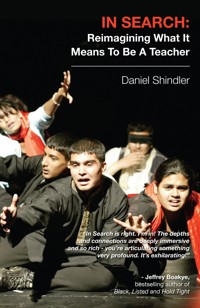
Teachers want more. Daniel Shindler's In Search: Reimagining What it Means to be a Teacher, is an optimistic, necessary book that invites us to identify our core values as teachers, school leaders, and policy-makers. With those values, we journey with him through a series of fundamental requisites that we can apply and nurture in our lives and places of work. Using his teaching experiences, practical examples, and storytelling, Daniel illustrates the requisites we should strive for - honing our expertise, creating powerful and memorable teaching experiences, enquiring with honesty about ourselves and those we teach, building meaningful one-to-one conversations, fostering curiosity and resilience, and building a wider school culture of community and pastoral care. By asking the biggest questions of what it means to be an educator and not seeking simple answers, the book is saying here is what is possible. For Daniel, teaching is alchemy and craft that goes beyond career, intertwining our personal and professional lives. Only a holistic approach will do, if we are to create longevity, which is why Daniel is asking us to reimagine what it means to be a teacher by placing it in the intersection of the private and public self. Why else teach, if not to live? How many of us live in our careers but not our craft? In short, it speaks to the complexity of the human condition of teaching. Our journey is enhanced by Daniel's extensive experience as a teacher of drama, wellbeing and project–based learning within inner cities and internationally, and as lead architect of School21's ground-breaking oracy curriculum. The book includes a compelling foreword by Jeffrey Boakye, teacher and bestselling author of Black, Listed and Hold Tight. In a world of constant change and shifting priorities, never has the search for craft and meaning been more necessary. 'Teaching is a search. It's the effort to walk towards, not forward, or upwards, but inwards towards the self and outwards towards others, at the same time. We've all got a search in us and trust me, In Searchis 100% a jumping off point for your own journey, whatever that may be.' Jeffrey Boakye – Bestselling author of Black, Listed and Hold Tight I loved its scope, the depth of thinking, the range of references, the way public and private, school and life, cross over. It got me thinking differently about things. It's also the perfect antidote to all the books around that reduce teaching to chunks, or a series of moves and techniques. Peter Hyman, Co-Director of Big Education, Co-founder of School 21
Das E-Book können Sie in Legimi-Apps oder einer beliebigen App lesen, die das folgende Format unterstützen:
Seitenzahl: 662
Veröffentlichungsjahr: 2020
Ähnliche












IN SEARCH: REIMAGINING WHAT IT MEANS TO BE A TEACHER
‘In Search is right. I’m in! I’ve been swimming in the best possible sense. Swimming is the word – there are tides and pulls and undercurrents to the writing, and depths in which I find myself swimming. It’s exhilarating, I mean that. Daniel Shindler is defying form, too (like water), and it requires focus and energy to engage in. The depths and connections are deeply immersive and so rich – Daniel is articulating something very profound.’
Jeffrey Boakye, bestselling author of Black, Listed and Hold Tight
‘Daniel Shindler’s very frank, and personal, growth and development shows the reader he’s not asking anything of them (or his students or his colleagues) he hasn’t asked of himself, too. What Daniel’s offering is a master showing the way and a kalyana mitra (noble friend) walking the path alongside him, offering support, provocation, perspective, and inspiration. A big part of what makes it such an enjoyable encounter is the clarity of Daniel’s voice. For someone who doesn’t know him will read it and will feel like they’ve made a new friend or acquired a mentor by the time they finish reading it. I do feel what Daniel is offering is a friendship of sorts, and the use of the invitation to play away and conversational tone amplifies this.’
Dr Ehpriya Matharu, writer/artist
‘I loved its scope, the depth of thinking, the range of references, the way public and private, school and life, cross over. It got me thinking differently about things. It’s also the perfect antidote to all the books around that reduce teaching to chunks, or a series of moves and techniques.’
Peter Hyman, Co-Director of Big Education, Co-founder of School 21
‘Shindler’s aim as a teacher is to help students live in the present in a way which is informed by the future they want, rather than the difficulties of their past. I thought this was a very powerful idea and definitely one that is relevant beyond the classroom.’
Clare Carson, novelist
‘It’s a truly generous outpouring of knowledge and learning gathered over years from teaching and from life. It’s amazing how Shindler has managed to bring together and curate ideas of his own, and of such a diverse range of sources to really provide a book that both stands alone, and a reference that can be used as a base for much more exploration.’
Rayne Wiselman, Senior Content Developer, Microsoft
‘Rich, multi-layered, erudite, personal; it’s like a manual, a memoir, and educational philosophy, as well as a commentary on how to live a rich life.’
Simon Misso-Veness, Deputy Principal, German Swiss International School, Hong Kong
To my angels, Jo, Ellie and Rosa
‘Most people come to know only one corner of their room, one spot near the window, one narrow strip on which they keep walking back and forth’
Rainer Maria Rilke
‘I go out into the world in order to come back with a self’
Mikhaïl Bakhtin
‘Let the beauty of what you love be what you do’
Rumi
CONTENTS
In Search: Reimagining What it Means to be a Teacher
Dedication
Foreword Jeffrey Boakye
Introduction
Chapter 1 The Requisites
Chapter 2 The Four Circles
Chapter 3 One-to-One Conversations: Creating meaningful one-to-one conversations using a common language
Chapter 4 The Wider School Culture: Building a broader culture that champions and enacts its virtues and values
Chapter 5 The Wraparound Services of Pastoral Care: Establishing a framework that envelops and nurtures the school culture
Chapter 6 The Inquiring Classroom: Creating an environment in which the craft of teaching and learning can flourish
Chapter 7 The Process of Resilience: Creating social contexts in which the attributes that make someone resilient can show up
Chapter 8 Knowing Oneself; Knowing the Child: Using unexpected tools to explore, know and accept ourselves and others
Chapter 9 Building Community: Making community a sustainable place for transformation to occur
Chapter 10 Expertise and Empowerment: Merging craft and curiosity
Chapter 11 Creating Experiences: Creating experiences together that add up to more than a sum of their parts
Copyright
*All names of the students have been changed as have some, but not all, of the adults mentioned
FOREWORD
Before I get into it, here’s something that nobody ever said to a new teacher:
You’ll never be a great teacher.
They never say it because of how brutal and cruel it would be; to whip away the belief that there is some kind of bulletproof level of competence you can reach as an educator, a skill threshold beyond which you will never feel that knot of anxiety again.
Next, here’s something that nobody ever said to a retired teacher:
You were never a great teacher.
Because it’s a devastating thought; that you might have spent a lifetime in the classroom trying to perfect the unperfectable craft. That you never got to that place of expertise you thought you were always striving towards.
And finally, here are two things I’m telling you now:
1) There’s no such thing as a new teacher.
2) There’s no such thing as a retired teacher.
Let me explain.
I know this somewhat cryptic opening is suspiciously wise-sounding, with its Yoda-like rejection of linear thinking. I can only apologise if I’ve put a whiff of arrogance in the air. It isn’t like that. See, when I first met Daniel, I was very close to being a ‘new’ teacher (having only really worked at the one school I qualified at) and I think it’s fair to say he was very close to being a ‘retired’ teacher (entering the school at which he would draw his career to a close).
So, there we were, two ends of the teaching spectrum, horseshoed into collaboration in the mission to create something new in East London. I had no idea at the time I was entering into a phase of my career, and a relationship, that would have a profound impact on my whole outlook on life. If I’d known, I might have marked the occasion with some kind of farewell party, saying goodbye to all those weird myths you get fed as a young teacher about becoming ‘outstanding’ and not having to plan lessons anymore.
In Search. The title says it all. Teaching isn’t a ladder, or a series of challenges, or a pro forma, or ‘continued professional development’, whatever that’s supposed to mean. It’s an act of curiosity. What will connect? What’s the context? What’s the subtext? What’s the matter? What’s the text? What’s next? Who are you, who are we, who am I? It’s a search. It’s the effort to walk towards, not forward, or upwards, but inwards towards the self and outwards towards others, at the same time.
The more I got to know Daniel, working with him, problem solving, exploring new ideas and sharing our experiences, the more I realised that this is the space in which a teacher lives, ice on the hotplate, living, being, in the truest sense of the word. It’s a mindset that comes with its own set of physics. It’s the venn diagram of deep craft, human engagement and the expressive arts. It’s relational and its relationships and it’s as messy and fluid and challenging and ultimately as rewarding as life itself. Big words I know, but why else teach, if not to live? Believe me, with In Search, you’re about to connect with a mind that fully appreciates how to live in teaching.
The book you’re holding in your hands is not a how to, or even a why do. It’s a dip in the waves that makes you come up for air. Which is exactly what any teacher, new, retired, or anywhere in between, will tell you teaching is like. Hence those first two things I said nobody ever said at the start of this foreword. You’ll find yourself in these pages. It’s a rich tapestry woven thick with experiences, episodes of a life lived in teaching.
Whether we realise it or not, teachers draw from this palimpsest with every interaction, every decision, every scheme of work, every curriculum unit, every triumph, every failure or frustration, because these are the embers that spark. It’s a journey that came to life all over again as I read this book. We’ve all got a search in us and trust me, In Search is 100% a jumping off point for your own journey, whatever that may be.
Get ready.
Jeffrey Boakye
INTRODUCTION
Play away; techniques; strategies; concepts in this chapter that can be used in different contexts:
Ikigai
The never –ending dialogue
The walk toward
The public and the private self
Starting out as a 23-year-old, I really was the teacher in Roger McGough’s poem where, ‘Chaos ruled OK in the classroom As bravely the teacher walked in’.(1) 33 years later, having stepped into some of the most challenging environments, this embattled approach is still in me. Above my desk hangs a huge poster with Taylor Mali’s What Teachers Make colourfully emboldened on it.(2) A lawyer at a dinner party famously asked Mali, a teacher and a poet, ‘What’s a kid going to learn from someone who decided his best option in life was to become a teacher?’ I won’t spoil the fun, watch Taylor’s reply on YouTube and yell as you applaud his ‘kick-arse’ reply. But perhaps the lawyer did ask the right question. What does it mean to be an educator? Of course, such a question inevitably leads a good Jewish boy like me to the world of clinical practice. The Hungarian-born physician, Gabor Mate might have turned to Mali’s dinner guest and explained teaching is, ‘Not only so that others might hear me but so that I could hear myself’.(3) Vonnegut would have joined in,
‘If you want to really hurt your parents, and you don’t have the nerve to be gay, the least you can do is go into the arts. I’m not kidding. The arts are not a way to make a living. They are a very human way of making life more bearable. Practicing an art, no matter how well or badly, is a way to make your soul grow, for heaven’s sake. Sing in the shower. Dance to the radio. Tell stories. Write a poem to a friend, even a lousy poem. Do it as well as you possibly can. You will get an enormous reward. You will have created something.’(4)
That’s what I did, probably first to hurt my parents but then, once I got (or didn’t get) over that, I tried to practice my craft well. In doing so, I’ve created a life in which the private and public self become inseparable. It’s in the intersection of the private and public that this book lives. We will dance around many private and historical figures who will give us a context in which we can examine the deepest encounters I experienced with my students, the heartbeat of the search. It’s an optimistic approach. At its core has been finding a way of creating infinite contexts that have allowed both my students and me to live in a present informed by the future rather than the past.
Of course, this kind of reimagining takes us beyond the classroom, so allow a small digression. Like others, I dream of cooking for a living. I’m not sure why. I hope it isn’t as Houellebecq’s narrator cruelly tells his reader, ‘Gourmandise entered their lives as a new interest, brought on by their growing indifference to the flesh, like the passion of priests who, deprived of carnal joys, quiver before delicate viands and old wines.’(5); Or even worse, ‘You have to take an interest in something in life, I told myself. I wondered what could interest me, now that I was finished with love. I could take a course in wine tasting, maybe, or start collecting model aeroplanes.’(6) However, I spend a considerable amount of my time watching cooking programmes, or when I travel, hunting down places where the late Anthony Bourdain had eaten. Not because I particularly like what he himself once described on his Twitter feed as, ‘the meathead culture’(7) but I do like the food he ate. When asked where he’d eat his last meal on earth, Bourdain replied in a way that drew me to him, ‘I think I’d prefer to die like an old lion—to crawl away into the bushes where no-one can see me draw my last breath. But in this case, I’d crawl away to a seat in front of this beautiful hinoki wood sushi bar, where three-Michelin starred Jiro Ono would make me a 22- or 23-course omakase tasting menu.’(8) Tragically it wasn’t to be.(9) In death as in life, Bourdain’s search led me to the lifelong craft of Jiro Ono. Ono is often credited as ‘the greatest sushi craftsman alive’.(10) He started working in a kitchen at the age of 7, and is still cooking in his 90s in the tiny basement of his three-Michelin-starred Tokyo restaurant. In the beautiful film, Jiro Dreams of Sushi, Ono articulates what I have felt about the art of teaching, ‘Once you decide on your occupation… you must immerse yourself in your work. You have to fall in love with your work. Never complain about your job. You must dedicate your life to mastering your skill. That’s the secret of success... and is the key to being regarded honourably.’(11) There are key themes here in the search for a life worth living. It’s getting close to the Bakhtinian notion of the ‘never-ending’ dialogue. In such a dialogue there’s no distinction between work and what you do outside, as ‘everything feeds the work’.(12) In Japan they call this straddling of the private and the public, ‘ikigai’. ‘Ikigai’ has no literal translation. ‘Iki’ means ‘life’ and ‘gai’ is often used to describe value or worth. It’s the joining of what you love + what you are good at + what you feel the world needs + what you can get paid for. There’s challenge and growth in these overlapping circles as you commit to learning a craft over a long period of time, forming your physical and emotional wellbeing. This notion of self-worth is close to the ‘never-ending’ dialogue to which Ono alludes. It’s the lifelong search to ‘become what one is’.(13)
But I digress. For me, the deepest, most immersive, educational experience is to take a cohort of students through from Year 7 to Year 11. Apologies to the post-16 teachers, but I never learnt the craft needed at this level. The ‘never-ending’ dialogue, the search to ‘become what one is’, starts when the eleven-year-old child enters my drama studio, often uncertain and apprehensive, often excited and expectant. Here’s another core theme we will unpack. For this kind of dialogue will need to nurture, ‘A spirit in which we are certain by not being certain of our certainties. To the extent that we are not quite sure about our certainties, we begin to “walk toward” certainties.’(14) We often like to talk about experiences as a journey. The sign, ‘Life is a journey not a destination’, stands proudly above the desk in my drama studio. However, dig deeper. There’s something that resonates if we redefine the journey as a search, viewing the process as a ‘walk toward’. For the students and me, it’s been a social process over an extended period of time in which we have learnt to let go notions of certainty in order to discover anything long-lasting. The point where I have to jump off is when at 16, the young adult has just finished the drama practical exam, always jubilant and smiling, always deeply satisfied and proud. Listen to some testimony, not as an exercise in ego but rather to hear the ‘honour’ to which Ono is perhaps alluding to. Both student and teacher are honouring the craft that has allowed them, ‘to become what one is’. For the students the public life of school and their private selves become indistinguishable. They have been encouraged to step out of the ‘corner of their room, one spot near the window, one narrow strip on which they keep walking back and forth’(15) to discover something bigger than themselves. Previous certainties have been undone. Their reflections suggest the ‘walk toward’ will continue as they move to the next the stage of their young lives,
• ‘You taught me discipline. You taught me dignity. Much more than drama, which you were supposedly teaching me, you taught me that I could achieve more than what I or other people thought I was capable of. Thank you for being genuine. Thank you for seeing me as a partner in learning and sharing. Thank you for being you’ (Student)
• ‘The journey that I have been on for the past five years has not only made me question the world but it has been the reason that I have taught myself never to diminish what I have and can do. I will forever hold it in my heart’ (Student)
• ‘A perfect example why the profession needs to respect more, those that keep teaching at the heart of their role for so many years. Where you’ve got those kids to, from where they were, says it all about your career and craft’ (Teacher)
• ‘When you know the students, it is impossible not to be moved by the progress and development of each student. I don’t mean that in an educational sense, I mean that they have grown as human beings and will leave this school much more ‘well-rounded’ people than they would have without you. I was reminded of my priorities on Friday. But it was also inspiring - you reminded me what can be achieved when you have ferociously high expectations of students’ (Teacher)
The process of transformation being reflected upon here in which both student and I have become ‘someone else that you were not in the beginning’(16) happens when a series of requisites are in play. Pause for a moment; it’s important to understand what one might mean by a requisite. Then a deep dive into each of the requisites in the context of both our private and public lives will require the reader to constantly ‘play away’ to find new contexts for further exploration once the book has been read. Hopefully it will bring its reward. From my extensive practice as a teacher of drama, wellbeing, oracy and project-based learning, there are many ideas that can be put into practice in both private and public spheres. Each chapter is based on a pedagogy that includes academics from the world of education, theatre, film, psychology, sociology and philosophy. Our search introduces the reader to these thinkers, and to others encountered in the ‘never-ending’ dialogue ‘to be more fully human’.(17) Some may be familiar, some unfamiliar. You may feel overwhelmed by the extensive range of references, but it’s all designed to provoke curiosity, taking the reader to new places. It’s exactly this process over the last 33 years that has informed the art of my teaching. If it’s leaving you feeling somewhat uncertain, scratching your head, but you still haven’t thrown down the book, salute, your ‘walk toward’ finding new ways of thinking and seeing has begun.
1-McGough, R. 2003: The Lesson from Collected Poems: Penguin Books
2-Mali, T.2014: What Teachers Make: TED Bowery Poetry Club: https://www.ted.com/talks/taylor_mali_what_teachers_make
3-Mate, G. 2009: In the Realm of Hungry Ghosts: Vintage Canada
4-Vonnegut, K. 2006: A Man Without a Country : Bloomsbury
5-Houellebecq, M. Translated by Stein, L. 2015: Submission: Farrar, Straus & Giroux
6-Ibid
7-Maclean, D. 2017: Anthony Bourdain condemns restaurant industry’s meathead culture after Harvey Weinstein sex assault scandal: The Independent
8-Bourdain, A. 2016: ‘So long, and thanks for all the fish’: Anthony Bourdain’s final meal: The Guardian
9-Bourdain committed suicide at the age of 61, alone in a French hotel room while working on his CNN series, ‘Parts Unknown’. As the title of the TV show suggests, we will never fully know what caused him to take his life.
10-Gordinier, J. 2013:“Sushi’s New Vanguard”: New York Times
11-Jiro Dreams of Sushi: 2011, directed by Gelb, D., Magnolia Pictures
12-Brook quoted in Roose-Evans, J. 1970: Experimental Theatre-from Stanislavsky to Peter Brooke: Routledge
13-Kierkegaard, S. 1992 [1846]: Concluding Unscientific Postscript toPhilosophical Fragments, Vol. 1: Princeton: Princeton University Press
14-Freire, P.1985: Reading the World and Reading the Word: An Interview with Paulo Freire: Language Arts, Vol. 62, No. 1, Making Meaning, Learning Language: Published by: National Council of Teachers of English
15-Rilke, R. 2011: Letters to a Young Poet: Penguin Classics
16-Foucault, M. 1982: Truth, Power, Self: An Interview with Michel Foucault - October 25th, 1982. From: Martin, L.H. et al 1988: Technologies of the Self: A Seminar with Michel Foucault: London: Tavistock
17-Freire, P.1970: Pedagogy of the Oppressed: Continuum
CHAPTER 1: THE REQUISITES
Play away; techniques; strategies; concepts in this chapter that can be used in different contexts:
Requisites
Play away
Authenticity
Steadiness
A while back, the educationalist Guy Claxton talked to a small group of teachers in a fascinating, free-flowing, 90-minute conversation. He stressed the intentionality of the designed classroom. He’s written extensively about this: ‘It is about creating a culture in classrooms – and in the school more widely – that systematically cultivates habits and attitudes that enable young people to become better learners; face difficulty and uncertainty calmly, confidently and creatively.’(1) The capacity to ‘walk toward’ uncertainty, we can agree on. However, I may be doing Claxton a disservice, but when asked how one ‘systematically cultivates habits and attitudes’, he was reluctant to be tied down to any unchanging fundamentals. This troubled me. I’ve often been asked, ‘How do you do it?’ and have been similarly evasive, as I’d never been able to articulate a satisfying answer. I hadn’t learnt my craft. However, watch Ono’s film to see how he cultivates his own children and apprentices – all men, I’m afraid, for which not only Ono and particularly his son have been criticised, but for which the whole sushi industry is now rightly under scrutiny.(2) In the film, the Japanese food writer Masuhiro Yamamoto tried to capture how Ono does it. He came up with the notion of attributes,
‘A great chef has the following 5 attributes: First, they take their work very seriously and consistently perform on the highest level. Second, they aspire to improve their skills. Third is cleanliness. If the restaurant doesn’t feel clean, the food isn’t going to taste good. The fourth attribute is impatience. They are not prone to collaboration. They’re stubborn and insist on having things their own way. What ties these attributes together is passion. That’s what makes a great chef.’
Instead of attributes, I’d like to call them requisites. By articulating what I do, I offer a series of requisites that, if nurtured over time, will make for those deeply satisfying experiences we strive for in our private and public lives.
The Requisites
1. The four circles:
o One-to-one conversations: Creating meaningful one-to one conversations using a common language
o The wider school culture:Building a broader culture that champions and enacts its virtues and values
o The wraparound services of pastoral care:Establishing a framework that envelops and nurtures the school culture
o The inquiring classroom:Creating an environment in which the craft of teaching and learning can flourish
2. The process of resilience:Creating social contexts in which the attributes that make someone resilient can show up
3. Knowing oneself; knowing the child:Using unexpected tools to explore, know, and accept ourselves and others
4. Building community:Making community a sustainable place for transformation to occur
5. Expertise and empowerment:Merging craft and curiosity
6. Creating experiences:Creating experiences together that add up to more than a sum of their parts
These requisites are not new; they’re present in our everyday interactions. We are being invited to look at them with fresh eyes. Read what Rashid, a 16-year-old who grew up above his family’s curry house in London’s East End and went to Oxford(3), has to say about creativity. How many of the requisites mined over 5 years can you hear echoed in his writing?
‘Well, the “correct” definition for this term is “involving the use of the imagination or original ideas in order to create something” (Oxford Dictionary). However, for me the definition for creativity is infinite. As a drama student, creativity is more than imagination; it’s a frame of mind and a way of thinking. It’s more than just merely adjusting something with imagination; it’s creating and solving problems which never existed; it’s adding your own touch to the world through your own means, whether it be art, or music or sports; it’s taking a challenge, dissecting it, and putting it back in a way that has never even been thought of. With the fear of sounding like a cliché, creativity is thinking outside the box, and what is to stop one from changing the box into an oval or triangle?
Being creative is not just making something new, it can also be taking an old idea and simply bringing it back to life. Creativity is one of life’s themes and undercurrents prevalent from the womb to old age. We all are creative in our own ways, from creative work to fashion sense to humour. Although, in my mind, it has strong connotations with art, but artistic creativity is not bound down to art studios or in the flick of a paintbrush. For example, the creativity present in our drama class is nearly as strong as the testosterone and it embodies every single member of our class. Those who may be shy or lack in confidence, their creativity throws them forward and forces them to contribute. However, the greatest advantage of creativity for me is it provides a change to the daily, monotonous life and literally blows fresh air into this materialistic world. Without it, life would be the same day in, day out. We as a society can also appreciate creativity from The Gherkin, to The London Eye, to knives and forks. Creativity is embedded into life and work and play. It’s also very prevalent in religion, as God must have been creative when creating the world and all in it. To conclude, creativity, its uses, and presence in life is undeniable. It’s the seed of all intellect and imagination. It both entertains and amuses us. It’s a device used by all, and the only requirement to use it is a little imagination.’
No drafting went into this. Off the bat, he was asked to describe what creativity meant to him. But a response such as this arises out of a rich process that lies in the intersection where the private and public meet. It’s what gives his writing edge. He has begun the ‘walk toward’ ideas, feelings, and experiences which can offer life, both private and public, meaning beyond the superficial.
Like Rashid, the Italian psychologist Loris Malaguzzi, founder of the education philosophy ‘Reggio Emilia Approach’, understands the need to avoid limiting ourselves but rather to give ‘value to the potentials, the resources, and many intelligences of all children’.(4) His has been a lifelong search to liberate what he beautifully calls, ‘the hundred languages of children’:
The child
is made of one hundred.
The child has
a hundred languages
a hundred hands
a hundred thoughts
a hundred ways of thinking
of playing, of speaking.
A hundred always a hundred
ways of listening
of marvelling, of loving
a hundred joys
for singing and understanding
a hundred worlds
to discover
a hundred worlds
to invent
a hundred worlds.(5)
Malaguzzi has created schools based on requisites that serve to empower children’s ‘surprising and extraordinary strengths and capabilities linked with an inexhaustible need for expression and realisation’.(6) If anyone, child and adult, is willing to engage in this kind of dialogue, Malaguzzi believes it has ‘infinite potential for transformation’.(7) It’s transformation this book wants to explore. It will become clear that these requisites, which have such transformative power, exist in all meaningful relationships, in high functioning families, organisations, dressing rooms, as well as in the alive classroom. As we look closely, we find them. Or to turn it on its head, see what you find, for example, where the search for Malaguzzi’s ‘Hundred languages of children’ doesn’t exist. It’s highly likely you’ll discover fear, anger, shame, shielding, lethargy, fragility, failure, resignation, and dysfunction.
But to be able to do this, it’s worth considering a phrase used by Claxton in our conversation that stuck with me. He talked about ‘playing away’ in relation to transference and connections. We ‘play away’ all the time. It’s part of the human psyche, what Freud called ‘a universal phenomenon of the human mind’ that ‘in fact dominates the whole of each person’s relations to his human environment’.(8)
So, play away for a moment; what might we call a search that transcends both the private and the public? A search for what? In learning their craft, what is it teachers are searching for? What are students in search of? If you happen not to be a teacher, what is it you are in search of?
A friend suggested ‘wisdom’: ‘To me, wisdom always implies a life lived and reflected upon – it’s experiential and implies self analysis and discovery and some notion of timeless truths.’ Play away and follow her trail, it takes us close. Read this description of wisdom; it could be straight out of a school handbook. You’d want to send your child there: ‘Being wise is about knowing what’s important; having sufficient insight into how we and others tick; having a handle on negative moods and emotions instead of being controlled by them; having an attitude of curiosity and a love of learning; understanding we’re all in the same boat and therefore being compassionate towards ourselves and others.’(9)
However, it’s not only educationalists who talk of such things. Psychologists also discuss what Freire alludes to when discussing life as a ‘walk toward’ certainty: ‘An integration of knowledge, experience, and deep understanding that incorporates tolerance for the uncertainties of life as well as its ups and downs. There’s an awareness of how things play out over time, and it confers a sense of balance.’ However, psychologists also warn us, ‘It can be acquired only through experience, but by itself, experience does not automatically confer wisdom.’(10) So, who am I to talk about ‘wisdom’? Perhaps, like Socrates, we should avoid the word, leaving true wisdom to the gods. While I’m not quite prepared to go all the way with Plato’s Socrates, ‘I know only one thing – that I know nothing’, I have more sympathy with the declaration he made at his trial, ‘The unexamined life is not worth living.’(11) However, ‘wisdom’ comes from the Greek for the love of wisdom, pulling us into the realm of philosophy. Let’s not go there. So, if not wisdom, then how about a search for ‘authenticity’?
Play away once more; ignore what I just said about philosophical discourse, read this passage about existence and then place it in a context. Who is talking? To whom? Where? Have you ever felt like this? Do you know anyone who has felt like this?
‘The fundamental question, therefore, is not what is but that I am. ‘My life has been brought to an impasse, I loathe existence, it is without savor, lacking salt and sense. ... One sticks one’s finger into the soil to tell by the smell in what land one is: I stick my finger into existence – it smells of nothing. Where am I? Who am I? How came I here? What is this thing called the world? What does this world mean? Who is it that has lured me into the thing, and now leaves me there? Who am I? How did I come into the world? Why was I not consulted, why not made acquainted with its manners and customs? How did I obtain an interest in this big enterprise they call reality? Why should I have an interest in it? Is it not a voluntary concern? And if I am to be compelled to take part in it, where is the director? I should like to make a remark to him.’’(12)
In the pub with the slightly drunk, frustrated, work colleague in crisis? In a room with an angry, confused adolescent? It was, in fact, the writing of the Danish intellectual Kierkegaard, whose answer to sticking one’s finger into existence finding it smells of nothing, is to create an ‘authentic’ relationship with something outside oneself that, for him, was God. That won’t do for me. Then there’s Heidegger and his word, ‘eigentlichkeit’ – a neologism for ‘authenticity’. It translates as ‘being one’s own’. Heidegger links it closely to ‘verstehen’ which means ‘understanding’. The etymological root, ‘taking a stand’, is a key concept in this book as we search for new stories about ourselves. Indeed, his concept of ‘dasein’ centres on who one is in the moment and what one can be in the future. It’s clear that Heidegger believed life is a search, a ‘happening’ or ‘movement’. Our being is at stake, we’re always ‘in question’ with ourselves in a process of ‘storyization’. So far so good; but Heidegger joined the Nazi Party, refusing to repudiate the Holocaust, and allowed publication of his Black Notebooks which have too many anti-Semitic references to ignore. We won’t debate whether his Nazism negates his philosophy. However, if you insist, then by all means play away; there are numerous articles on the subject; my refugee parents played Wagner endlessly.
So, if not Heidegger, then there are plenty of others to turn to. The French philosopher, Foucault, believed life was a search: ‘To become someone else that you were not in the beginning.’ In a rhetorical flourish, he asks why couldn’t ‘everyone’s life become a work of art? Why should the lamp or the house be an art object, but not our life?’(13). I wish I had shown this to Rashid, his life as a work of art. He would have liked it. But an ‘authenticity’ that focuses on preoccupation with the inner may fall foul of what Lasch defines as ‘Narcissistic Personality Disorder’.(14) Bloom goes further and blames this self-absorption on neglect of the public and political self.(15) Indeed, in his aptly titled, Jargon of Authenticity,(16) one of Adorno’s main objections to Heidegger is he sees it all as merely a ‘grinding of teeth which says nothing but I, I, I’ (time to get rid of the irritating ‘it’s all about you’, this will pierce the most thick-skinned friend or colleague; try it, I have).
In his book, Truth and Truthfulness: An Essay in Genealogy,(17) the philosopher Bernard Williams is having none of it: ‘The search for an authentic life is always questionable, and it is not a secret that it can lead to ethical and social disaster.’ It’s worth considering his ideas on ‘steadiness’ instead. In what can feel like a senseless world, in both the private and public lives we live, full of ‘episodic feelings and thoughts’, it then becomes a search ‘of stabilising the self into a form’. In doing so, we can ‘create a life that presents itself to a reflective individual as worth living’. After all, ‘If I am around in the world at all, then I am in it as a human being.’
Play away; read that again. Is education about stabilising the self into a form in order to help students and teachers create a life that’s worth living? Is it essentially to bring us all to an understanding of what it means to be human? Go beyond teaching into how we live our lives. Are we all in search of this kind of steadiness?
In search of steadiness, it has been that for sure. It has been all of these things and more. The best I can come up with is, ‘In Search…’ because no singular word covers it. It’s the search that’s thrown up a series of requisites for authenticity, steadiness, wisdom, realness, whatever you prefer to call it. However, it’s a search resting on the premise that these requisites can be applied and nurtured over time, both inside and outside the school environment, to make for more deeply satisfying experiences and connections in our public and private lives. It’s a search that has created longevity.
1-Claxton, G. 2002: Building Learning Power: Helping Young People Become Better Learners: TLO
2-Fifield, A. 2016: Roll over male sushi chefs. In Japan women challenge tradition: Washington Post
3-Akram Khan, the wonderful dancer, in his film, The Curry House Kid (Channel 4, first shown 29.4.19), explores the kind of environment Rashid grew up in
4-Malaguzzi, L. As quoted on the website Reggio Children: http://www.reggiochildren.it/identita/loris-malaguzzi/?lang=en
5-Malaguzzi, L. Translated by Gandini, L. from the poem, The Hundred Languages of Children: as quoted on the website: https://reggioemilia 2015.weebly.com/the-100-languages.html
6-Edward, C. 2012: The Hundred Languages of Children: The Reggio Emilia Experience in Transformation: Praeger
7-Malaguzzi, L. 1998: History, Ideas and Basic Philosophy, in Edwards, C., Gandini, L. & G.E. Forman, G. (Eds) The Hundred Languages of Children: the Reggio Emilia approach, advanced reflections: 2nd edn. Greenwich, CT: Ablex
8-Freud, S. 2010: An Autobiographical Study: Martino Publishing
9-Baggini, J and Macaro, A. 2014: What is wisdom? : Financial Times
10-Psychology Today:Wisdom, https://www.psychologytoday.com/us/basics/wisdom
11-Plato. 2015: Apology: Xist Publishing
12-Kierkegaard, S. 1941: Repetition: Princeton
13-Foucault, M. 2000: Ethics: Subjectivity and Truth, Volume 1: Penguin
14-Lasch, C. 1979: The Culture of Narcissism: American Life in an Age of Diminishing Expectations, New York: Norton
15-Bloom, A. 1987: The Closing of the American Mind: New York, Simon and Schuster
16-Adorno, T. 1973: The Jargon of Authenticity: London, Routledge and Kegan Paul
17-Williams, B. 2002: Truth and Truthfulness: An Essay in Genealogy: Princetown University Press
CHAPTER 2: THE FOUR CIRCLES
Play away; techniques; strategies; concepts in this chapter that can be used in different contexts:
The four circles:
o One-to-one conversations
o The wider school culture
o The wraparound services of pastoral care
o The inquiring classroom
Habitual leanings
Many of us work in isolation. We plough our narrow field without imagining how our work can be placed in a richer, broader landscape. It doesn’t stop us from succeeding, but it’s a limitation. ‘We don’t have to do all of it alone. We were never meant to.’(1) Once we see this, and what might be getting in our way, we begin to create infinite contexts where anything is possible. Peter Hyman, one of the founders of School21 – a school situated in the East End of London – uses the metaphor of the jigsaw to demonstrate school design is an organic structure which grows as the school evolves. I like the concept of a jigsaw very much. It’s limitless; it can be moved around, pieces added and taken away. It encourages threads and connections which aren’t obvious; what you do on a micro level is framed by the bigger picture. As you immerse yourself in the pieces, you create possibilities.
I believe the jigsaw contains four circles. The idea of circles comes from the American system where they’re familiar with the idea of distinct academic, sporting, and arts circles that rarely cross over.(2) In our model, the circles richly impact each other, with wider significance beyond an educational setting.
o One-to-one conversations: Creating meaningful one-to one conversations using a common language
o The wider school culture:Building a broader culture that champions and enacts its virtues and values
o The wraparound services of pastoral care:Establishing a framework that envelops and nurtures the school culture
o The inquiring classroom:Creating an environment in which the craft of teaching and learning can flourish
In my setting, with my students, these circles were developed and woven into a common thread, giving students a coherence into which they could lean; ‘habitual leanings,’ a colleague called it (much more of him later). It’s a sophisticated process, as we shall see. But first, take a moment to play away: how might these four circles play out elsewhere?
I’m a proud Crystal Palace supporter, taken to my first game as far back as 1968. Indulge me a little. I’m not exaggerating when I say I have ‘measured out my life’ in Crystal Palace fixtures. Ask my loved ones. Indeed, I’d claim ‘any event of any significance has a footballing shadow’. Sadly, it’s also becoming true that ‘as I get older, the tyranny that football exerts over my life, and therefore over the lives of people around me, is less reasonable and less attractive’. I can hear you snigger but it doesn’t bother me. You see, I know all the jokes. I’m resigned. The natural state for a Crystal Palace fan is one of ‘bitter disappointment, no matter what the score’.(3) I’ll prove it to you. One of the most painful periods, and there have been many, was the short time the famous former Dutch international Frank De Boer spent at the club. 77 days, played 5, no goals, no points; a Premier League record for being totally hopeless. I was in the perfect position to explain why, except no-one was listening. I tried calling into the radio, but to no avail.
Hattie likes to describe the act of teaching as gently closing ‘the classroom door’ and performing ‘the teaching act’.(4) If Hattie was a Palace fan, which I doubt (he’s from New Zealand), he might have said De Boer finally resorted to slamming the door and rudely performed whatever it was he thought he was doing. ‘It has not helped De Boer’s standing in the dressing room that he suggested the Palace players lacked courage following the Swansea defeat which he had said, pre-match, was a “must-win” game’.(5) De Boer failed because none of the four circles were in place. He was unable to talk to the players. ‘Difficult to get along with,’ said one Crystal Palace source. ‘A bit of a weirdo,’ said another. A tad harsh, perhaps. How well can you know someone in 77 days? Nevertheless, his personality – or lack of it – is said to have played a role in his sacking’.(6) As the players’ wellbeing fell away, they were obviously working in an environment with no ‘security and clarity of expectations’.(7) The ‘habitual leanings’ had disappeared. The players lost any inquisitiveness for the growth mindset needed to learn a new way of playing, the so-called ‘Dutch Way’. I’m sure there are other well-documented stories of failed organisations that suffered in the same way. Thankfully, we now play ‘The Purley Way’ under Roy Hodgson, the son of a Croydon bus driver. If this was a sports book – luckily for some of you, it’s not – it would be interesting to show how Hodgson established the four circles with the same group of players, resulting in an upturn in club fortunes and Premier League survival.
Before we move on, we ought to mention Gareth Southgate, the England manager and former Crystal Palace player (of course he was) and his experiences at the World Cup in 2018. After years of trauma and failure, he knew change wasn’t enough. Perhaps he didn’t see things in the same way my colleague Jeffrey (as I said, more of him later) expressed it on his Twitter feed: ‘Time to consider the tricky relationship with post-Empire nationalism and failure-trauma that I was born into as the son of colonial immigrants. It’s a miracle I made it 36 years without developing a twitch. #football’(8) However, Southgate knew it had to be about transformation. To help him, a psychologist, Dr Pippa Grange, was employed to transform the culture in this male-driven world. She was asking something huge of these men: to reimagine their own masculinity. As a woman, this wasn’t an easy task for her either. As Grange explains, when talking about her experiences with the New Zealand rugby team,
‘Being a woman in a professional male team sports environment is a constant navigation, for everyone. I have no interest in being one of the lads and I don’t quite fit in the ‘nurturing mother figure’ category in terms of the leadership work I do. I would be professionally ineffective if I remained in the background, psychologically safe with minimal voice, and I am not here to be the centre of attention as some form of entertainment. I don’t want to be completely separate because that would make me inaccessible and probably be a lonely place to operate from. I don’t want to fit in completely because frankly hanging out with a squad of 35 blokes has its limits. However, there are very few women role-models who I can look to as examples when it comes to getting this “fitting in” balance right.’(9)
Grange set out establishing the four circles by creating an environment in which Freire’s ‘walk toward’ could begin. Like Freire, Grange is interested in uncertainty: ‘I notice that the players are initially a little less certain, less relaxed, and more aware of themselves and their behaviours. They approach with caution until a relationship has well and truly been built, and they still apologise after swearing almost two years on. It is simply less comfortable, because no-one is quite sure “how to be”.’(10)
As we examine each circle in detail, we’ll see that these requisites nurture a vulnerability in which people can drop their shields and start to show up. In this context, these young men begin to create new conversations with themselves and with each other. ‘This has reportedly included getting the players to sit down together in small groups to share their life experiences and anxieties, and to reveal intimate truths about their character and what drives them.’(11) Of course, England lost, standard, but Grange had established a set of values in a secure environment with a clear and different set of expectations. Winning and losing was now placed in the context of a growth mindset: ‘Every day in our general lives and our sporting lives we will win some and lose some; it’s just part of the way life should be. It could be missing out on a promotion, being pipped at the line in a running race, or bombing out in an exam – it doesn’t matter – the important lesson is to learn from our failures, reassess, rethink, move forward (sometimes in a different direction), and keep those dreams and goals alive.’(12) Listening to Southgate explain his methodology, it’s striking how it meets many of the requisites this book is exploring.
Play away; in what environment outside of sport would you welcome someone talking in these terms? Have you ever spoken like this? What was the context?
• ‘We’ve spoken to the players about writing their own stories.’(13)
• ‘We always have to believe in what is possible in life.’(14)
• ‘I think if the players have some ownership of what’s going on then that’s going to help them make better decisions on the field and also buy into the way that we are trying to progress.’(15)
• ‘As a coach, you always have to be there to support the person – improving them as a player becomes secondary to a degree.’(16)
Where the four circles exist, transformation is possible. In 2008, Iceland’s three main banks imploded, leaving behind $85 billion worth of debt. Icelanders were among the heaviest drinkers in Europe and had no national football team to speak of. Today, Iceland is very different. Women make up 38.6% of the governing body; at the time of writing their prime minister, Katrín Jakobsdóttir, is from the Left Green movement; for the ninth time in 2016, Iceland was ranked the most gender equal country in the world by the World Economic Forum; in 2018 it became the first country in the world to make it illegal to pay men more than women; the Economist has named it the world’s best place for working women(17); what’s more, their national football team has now risen 100 places in Fifa’s world ranking, if you care about such things. Something has happened.
Back in 1980, Iceland elected the world’s first democratically-elected female head of state, Vigdís Finnbogadottir – a single mother and breast cancer survivor, who spoke openly about her mastectomy. When one of the male contenders said she couldn’t become president because she was only half a woman, Finnbogadóttir put him firmly back into his box: ‘Well, I’m actually not going to breastfeed the Icelandic nation; I’m going to lead it.’(18) For a drama teacher, it’s poignant this leader was a theatre director in her previous life. In all I’ve read, she was committed to the kind of conversations she used when practising her art. The ‘never-ending’ search ‘to become what one is’ is beautifully articulated in an interview she gave, in which she threads together an argument that brings her to the very essence of who she ‘be’:
‘Women tend to have a greater understanding of the human being. I think being a theatre director was very good preparation, that and having studied the humanities and being a literary person. From morning when the rehearsals start, until night when the curtain falls, theatre involves analysing humanity – the human being versus society, society versus the human being, love and jealousy, how people manage to live together – all the aspects of life. This leads me to the question: What is a presidency about? …It’s about human beings. It’s about understanding and being sensitive to how people think and feel.’(19)
She understands a wider culture wanting to create a country, not a school, that ‘functions, day in, day out, as an effective incubator of its chosen virtues’(20); to design a country, not a school, where ‘the espoused values do gradually become enacted values’.(21) She knew to build a broader culture ‘takes thought, solidarity and determination’.(22) Read another answer she gave in the same interview. It’s imbued with the Freirean ‘spirit’ in which ‘we are certain by not being certain of our certainties’. It’s the question she almost asks herself at the end which suggests she isn’t quite sure:
‘I understand my people – I understand the Icelanders, their way of thinking… The Icelandic way of thinking is very linked to nature. Icelanders have to get the hay into the barn before it starts to rain. They have to catch the cod before it swims past the coast. So they have to get things done and they are impatient and they are stubborn and stick very stubbornly to what they think is the truth. Icelanders are not trained in the art of discussion because they don’t have philosophy in their heritage. The Nordics – except for the Danes who have Kierkegaard – don’t have philosophers. Say you’re with six French friends and nobody agrees – the arguments are very intellectual: ‘Remember what Pascal said,’ someone will say. ‘No, you can’t say that because Schopenhauer…’ another will say. They can always refer to ideas. We don’t refer to ideas, and so our discourse can become very harsh. Do you think there is truth in that?’
Finnbogadottir laughs. She realises a lack of inquiry is a limitation; the infinite contexts are not there. Transformation is needed. ‘This is a shortcoming that can harm us as an entity – because we are so few it is extremely important that we stand together and that we do not have feuds in our society.’ So, she set about making the country inquisitive, asking them to consider what’s important: ‘I would always encourage the nation to concentrate on what is worth safeguarding in this country: identity, language – memories that are stored in the language – and not least, nature. I think that we have to take great care of the real treasure that is our nature. Safeguarding Icelandic nature is a huge responsibility.’ However, the actor/theatre director in her, allowed her to realise herself, ‘to become what one is’, but carried out with a spirit of ‘playfulness, inquisitiveness and self-reliance’.(23) You can hear it in her answer: ‘I think those were good years for the Icelanders. I promoted the country. I was the first president to adopt that role because I became so well known after being elected. It was extraordinary. I was invited all over the world because – I would joke about it– the world wanted to see what kind of phenomenon this was: a woman president. It was so alien. I was like an alien.’ Like Claxton and Lucas, Finnbogadóttir was aware the ‘walk toward’ needs to be set in a culture of ‘security and clarity of expectations’. She leaves Michael Moore in no doubt of this: ‘If the world can be saved, it will be women that do that. And they do not do it with war, they do it with words.’(24) In Moore’s film, Where to Invade Next, there’s a memorable moment in which the women tell Moore how they structure themselves with ‘we’, not ‘me’: ‘We are like a big group and we try to take care of each other within that group.’ As Moore flounders, they tell him, ‘It’s women, it’s in our DNA.’ It’s the four circles. They’re there when Brynhildur Heiðar, executive manager of the Icelandic Women’s Rights Association, states: ‘There is absolutely no doubt that there is an equivalency between more gender-balanced political representation and better policies for women. Parental leave, day care, the gender pay gap – none of these were seen as major issues before women ran for parliament.’(25)
Try and find the four circles in Trump’s presidency. Topping reports depressingly, after the 2016 election, the US dropped from 52nd to 104th in the world for women’s political representation. However, liberal female legislators co-sponsored an average of 10.6 bills related to women’s health – an average of 5.3 more than their liberal male colleagues. A Stanford University study also showed female Congress members simply get more done, passing on average twice as many bills as male legislators in one analysed session of Congress. Finish the book and you’ll see why that is. The requisites for transformation are certainly there.(26)
1-Brown, B. 2015: Rising Strong: Vermilion
2-Read Michael Sokolove’s riveting book, Drama High (2013: Riverhead books) about Lou Volpe’s four decades of teaching drama in an American blue-collar town. Volpe manages to break into the three circles; the sporting ‘jocks’ became some of his most successful performers. Apart from the extraordinary relationship Volpe forms with Cameron Mackintosh and the success of his former students, it’s a wonderful chronicle of a great teacher who transformed lives. In wanting so much more for his students, the requisites shine through.
3-Hornby, N. 1992: Fever Pitch: Victor Gollancz Ltd
4-Hattie, J. 2003: Teachers make a difference: What is the research evidence?: Research conference of the Australian Council for Educational Research – Building teacher quality: What does the research tell us? Melbourne: Australian Council for Educational Research
5-Burt, J. 2017: Crystal Palace players already questioning Frank De Boer’s management: The Daily Telegraph
6-Mokbel, S. 2017: The players were baffled… and called him a weirdo: The inside story on Frank de Boer’s calamitous 77-day reign as Crystal Palace manager: The Daily Mail
7- Claxton. G. And Lucas. B. 2013: What Kind of Teaching For What Kind Of Learning: SSAT
8- Jeffrey Boakye @unseenflirt Jul 7/ Twitter
9-Grange, P. 2013: Women in sport – fitting in: Bluestone Edge: http://bluestoneedge.com/2013/11/03/women-in-sport-fitting-in/
10- Ibid
11-Saner, E. 2018: How the psychology of the England football team could change your life: The Guardian
12-Ibid
13-Ibid
14-Ibid
15-The Boot Room: Southgate: “If a player feels you respect them, they are more likely to follow you”: The FA: http://www.thefa.com/get-involved/coach/the-boot-room/issue-26/gareth-southgate-coaching-approach-060617
16-Ibid
17-Topping, A. 2017: There’s proof: electing women radically improves life for mothers and families: The Guardian
18- Koon, N. 2012:One woman’s take on ‘the high bridge’: The Rocket: https://www.therocket.com.my/en/one-womans-take-on-the-high-bridge/
19-Andersen, A.2014: Madam President, Vigdís Finnbogadóttir on fashion and the times: The Reykjavik Grapevine: https://grapevine.is/mag/feature/2014/03/24/madam-president/
20- Claxton. G. And Lucas. B. 2013: What Kind of Teaching For What Kind Of Learning: SSAT
21-Ibid
22-Ibid
23-Ibid
24-Moore, M. 2015: Where to Invade Next: IMG Films
25-Topping, A. 2017: There’s proof: electing women radically improves life for mothers and families: The Guardian
26-The fight back has begun. In the 2018 American congressional elections, women from an array of diverse backgrounds now make up nearly a quarter of its voting membership, the highest percentage in U.S. history. I recommend the Netflix film, Knock Down The House, which follows four women’s attempts to break the male monopoly of power in their fight to be elected. Analyse Alexandria Ocasio-Cortez’s personal and public transformation through the lens I’m proposing, and see where it takes you.
CHAPTER 3: ONE-TO-ONE CONVERSATIONS
Play away; techniques; strategies; concepts in this chapter that can be used in different contexts:
Distinctions:
• Transformation (we don’t know what we don’t know) v Change (we know what we know; we know what we don’t know)
• Fact v Opinion
• Respond v React
• Showing up v Shielding
The Universal Human Paradigm –‘should/should not/ it is what it is’
TheWinning Strategy
Already always listening
Infinite contexts
Vulnerability
Being Present
The Stand
A fundamental question is whether we are willing. My mentor once challenged me, ‘When you can really get that, and I mean really get that, you will begin a new conversation, to discover what you don’t know you don’t know.’ Most of the time we know what we know; we know what we do not know. For example, though we don’t know what will happen tonight or tomorrow morning, we kind of do. However, the moment when we discover ‘what you don’t know what you don’t know’, is transformative. Run with it; you’ll get it, I promise. For now, just note our first distinction, ‘Change versus Transformation’.
In her book, The Last Word on Power, Tracy Goss defines this distinction: ‘Change provides an improvement in the existing way of doing… Transformation provides the creation of that which does not yet exist…a new realm of possibility.’(1) We can use these distinctions in creating a common language that empowers two people in meaningful conversation. This isn’t exclusive to a school context. Tracy Goss works in the realm of business. It can operate on a deeply personal level, too. It will be clearer if I share a meaningful conversation that extended over five years. As you can imagine, it’s a long conversation, but hopefully will offer insight into what one means when we talk about a meaningful conversation informed by a common language.




