


Erhalten Sie Zugang zu diesem und mehr als 300000 Büchern ab EUR 5,99 monatlich.
- Herausgeber: Arc Publications
- Kategorie: Poesie und Drama
- Sprache: Englisch
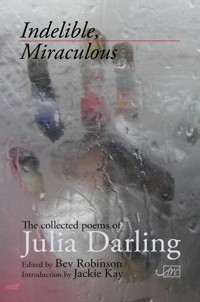
This collected edition commemorates the 10th anniversary of Julia Darling's death, and includes a substantial selection of unpublished work. Jackie Kay writes: "The poems are funny, irreverent, moving and never sentimental. You can recognise yourself in them, recognise your family. They are warm, full of compassion; [...] a shining bright light."
Sie lesen das E-Book in den Legimi-Apps auf:
Seitenzahl: 89
Veröffentlichungsjahr: 2015
Das E-Book (TTS) können Sie hören im Abo „Legimi Premium” in Legimi-Apps auf:
Ähnliche

















INDELIBLE, MIRACULOUS
Published by Arc Publications
Nanholme Mill, Shaw Wood Road
Todmorden OL14 6DA, UK
www.arcpublications.co.uk
Copyright in the poems © Estate of Julia Darling, 2015
Introduction copyright © Jackie Kay, 2015
Copyright in the present edition © Arc Publications, 2015
Design by Tony Ward
Printed by Lightning Source
978 1910345 30 6 (pbk)
978 1910345 31 3 (hbk)
978 1910345 29 0 (ebk)
ACKNOWLEDGEMENTS
Sudden Collapses in Public Places and Apology for Absence were first published by Arc Publications in 2003 and 2004 respectively. The early poems first appeared in the following publications: ‘Small Beauties’ in Small Beauties (Newcastle-upon-Tyne City Libraries, 1988); ‘Reminiscence’ & ‘Gladys’ Last Attack’ in Modern Goddess (Diamond Twig, 1992); ‘Forecasting’ & ‘Buying Cars’ in both Modern Goddess and Sauce (Bloodaxe & Diamond Twig, 1994); and ‘Men on Trains’, ‘Good Taste’, ‘Playing Pool’, ‘World Cup Summer’, ‘Be Kind’, ‘Coming Out 1, 2 & 3’, ‘Newcastle is Lesbos’ & ‘Journey with a Golden Lady’ in Sauce.
The Editor would like to thank Colette Bryce, Linda France and Ellen Phethean for their invaluable help with putting this volume together.
Cover photograph: © Sharon Bailey, 2015
Cover design: Tony Ward & Ben Styles
This book is in copyright. Subject to statutory exception and to provision of relevant collective licensing agreements, no reproduction of any part of this book may take place without the written permission of Arc Publications.
Editor for the UK and Ireland:
John W. Clarke
Julia Darling
Indelible,
Miraculous
Edited by Bev Robinson
Introduced by Jackie Kay
2015
CONTENTS
Editor’s Preface
Introduction
SUDDEN COLLAPSES IN PUBLIC PLACES
High Maintenance
Impersonation
A Comforting Car Park
Waiting Room in August
Too Heavy
Things That Should Never Have Happened
Satsumas
Insomnia
Healer
Square Dancing
Waiting Room
Don’t Worry
Living in the New Extension
Water Power
Vanity
Dental Attention
Where the Living Meet the Dead
Things I Have Lost
The Boy’s Room
Macaroon
Facial
Afternoon Films
Doing the Crossword
The Grove
Out of Here
Hospital Geography
The Mill
Wooden Spoon
Turkish Bath
Virginia
Ward Thirty-Six
Chemotherapy
Sudden Collapses in Public Places
Ancestry
Convalescence
End
FIRST AID KIT FOR THE MIND
How to Behave with the Ill
How to Deal with Terrible News
Recipe for a Curative Soup
How to Negotiate Hospital Corridors
How to Frighten Cancer
How to Paint your Self-portrait
How to Speak to Tired People When You Visit Them in Hospital
APOLOGY FOR ABSENCE
Visualisation
Ways of Discussing My Body
Living in the Moment
This is a Day of Soup
Injection
The Water Extractor
Getting There
Probably Sunday
Salsa Dancing Class, Heaton
Large Old Men
Phone Call from the Hospice
When I was Healthy Things Were Often Yellow
Parenting
Turn Off the Lights When You Go to Bed
Impossible
Apology for Absence
After All That
My Daughters Reading in May
Satisfactory
Days of Terrible Tiredness
Sleeping in March
September Poem
Night Sweat
My Complicated Daughter
Listening to Jack Listening to Music
Nurses
Weight
Two Lighthouses
Rendezvous Café: Whitley Bay
Old Jezzy
A Short Manifesto for My City
My Thumb in Leeds
Moving to the Country
Coat
Hollow
The Recovery Bed
My Old Friend Hospital
It’s Nearly Time
Hearing Things
It’s Not Over
Indelible, Miraculous
EARLY WORK PUBLISHED 1988–1994
Small Beauties
Forecasting
Reminiscence
Buying a Brassiere
Buying Cars
Gladys’ Last Attack
Good Taste
Playing Pool
World Cup Summer
Men on Trains
Be Kind
Coming Out
Newcastle is Lesbos
Journey with a Golden Lady
UNCOLLECTED POEMS
A Happy Childhood
Bad Parent
Small Things in the Cupboards of Long Relationships
Recovery
Supermarket Shopping
Advice for My Daughters
Storyline
Sheep Pretend to Be Happy
Geraniums
Above Me
Operating Theatre
Festival Mass
Night Moment
A Night Off
Dark and Light
Vanities
It Might Work
Travellers
The Radio in the Morning
I Don’t Want Anything
Things That I Have Used Up
Entreaty
Biographical Notes
EDITOR’S PREFACE
Compiling this collection of Julia’s poetry has taken me on a journey through our lives, the places we visited, the girls growing up, the years living with cancer and facing death. The poems span from the title poem of Julia’s first pamphlet Small Beauties, which was published in 1988, to those she wrote in 2005 before she died. Her two books published by Arc, Apology For Absence (2004) and Sudden Collapses in Public Places (2003) form the backbone of this collection. Prior to these, Julia had published poems in two Poetry Virgins’ anthologies, Modern Goddess (1992) and Sauce (1994). The Poetry Virgins were a performance group that Julia formed with writer Ellen Phethean and actors Charlie Hardwick, Fiona McPherson and Kay Hepplewhite. When I was selecting from these anthologies, I could almost hear the poems being performed and was transported back to rooms full of laughter. Subsequently, some of the poems chosen are those I remember audiences enjoying the most, like ‘Buying Bras’, ‘Newcastle is Lesbos’ and ‘Forecasting’.
Poems from First Aid Kit for the Mind were originally printed on postcards as part of a collaboration between Julia and artist Emma Holliday. They were included within individual boxes that also contained special and unique objects, like a miniature painting set, worry dolls, and a rubber stamp for your medical notes saying ‘I know my body better than you do’. The poems were about living in the ‘land of illness’ and some had appeared earlier in Apology for Absence. This collection has brought together the remaining poems from the postcards and includes ‘How to Behave With the Ill’ which appeared in the Bloodaxe anthology The Poetry Cure that Julia edited with Cynthia Fuller in 2004.
Selecting the unpublished poems was like piecing together a jigsaw puzzle. I read hundreds of poems. Some were early drafts under different titles. A particular line or an image might appear in different poems and I wasn’t sure which was the final version. I began to worry whether poems where finished or not, if they were work in progress, and if Julia be would happy about publishing them as they stood. One day I went back to the archive of boxes that contain Julia’s work for one last check to see if I had missed any other poetry files. I found a black folder of more poems! Flicking through it, I saw that some were copies of poems already published but at the front of the file it said: ‘This file is filled with poems that don’t work, or need something! (not all, there are some good ones too)’. There was a list of around 70 poems and in orange ink Julia had marked those that needed work, those she liked, those that had become songs and those that didn’t work. This was the guidance I’d been looking for.
Bev Robinson
INTRODUCTION
To say that the poetry of Julia Darling is of great comfort – to anybody who has ever been ill, or had a loved one ill, who has had their lives dictated and controlled by a series of appointments for first one department and then another; for anyone who has ever had to await the results of tests, who has had to juggle the paradoxes of complicated symptoms and side effects, who has had their body altered by operations, their face or hair changed, who is no longer confident about putting dates in a diary, who cannot now think of a holiday anywhere anymore; for anyone who has had to suffer the length and the length of the hospital corridor, the patronizing attitude of some doctors and nurses; who has had to eat and drink things they don’t like and give up practically everything they do; who knows too well the blood test or the blood transfusion, knows too well the colour of their own blood; who has had to strike up a relationship with their illness, personify it, bargain with it, who has lost days, weeks, years – is an understatement. Yet what is striking about the poetry of Julia Darling, collected all together for the first time here, is how, far from being a bleak and depressing read, these poems charm, disarm, disrupt, uplift, and surprise the reader.
They are the work of a quirky and original mind, a charismatic and generous writer and an inquisitive and enquiring human being who can manage to make the difficult subject of death entertaining and even ordinary. There’s a sharp wit to be found in these poems alongside a tender wisdom, and there’s a mind that is unafraid to take the unexpected turn. These poems invite the reader in; encourage us to embrace the unexpected, the surprising, the – perhaps – disappointing. It’s as if Julia, in the driver’s seat, takes off at speed, taking the reader on an at times hairy journey full of hairpin bends and sudden steep hills, laughing, sometimes wildly, then slowing down suddenly to a leisurely country pace. The reader willingly goes along, because driving with Ms Darling is such fun. That she can move you to tears one minute and the next to laughter is par for the course, and her great strength. You find yourself constantly being caught unawares. You find yourself spotting something you hadn’t noticed before.
Then too, there’s a great wisdom to be found in the work of Julia Darling. There’s common sense advice on how to behave with the very ill, on how to appreciate and live in the moment, in how not to waste time worrying, how to take delight in the simplest of things, how to live your life with as much unexpected elegance as you can muster, how to be defiant and yet glamorous. The poems are jam-packed with a kind of Julia Darling way of seeing the world. They offer up her homegrown philosophy; not only does everything begin with the chopping of an onion, there’s no point in worrying about how things are going to end. There is no point in worrying – full stop. ‘Beneath your feet the worms aren’t worrying.’ So these poems, many of them about death, conversely end up turning to life, to life’s wonders and conundrums. We end up marvelling at Julia Darling’s ability to pull this feat off – to remind the reader how richly rewarding life is, without ever seeming to be judgmental or didactic, to make us want to relish life at the same time as confront the inevitability of death. And life is bustlingly here: cities, civic spaces, lighthouses, families, and holidays. Julia’s accurate, beady eye zooms in and picks out details that are fresh, frank and true. The tone of the poems is candid, unfussy, and unpretentious.




