


14,39 €
Mehr erfahren.
- Herausgeber: Independent Thinking Press
- Kategorie: Bildung
- Sprache: Englisch
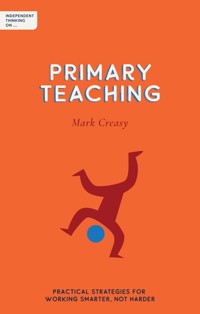
Foreword by Ian Gilbert.Primary school teachers are working harder than ever, and have more and more to do in the finite time they have with their pupils, but Mark Creasy believes it doesn't need to be like this. With rare experience in both primary and secondary phases and at leadership as well as classroom levels, Mark is ideally placed to comment on what works and what doesn't - and in this book he urges teachers to recognise that there is another way.In Independent Thinking on Primary Teaching, Mark encourages teachers to stop and consider the things they do daily in the classroom and presents a series of prompts, nudges and suggestions to help them achieve the same (or even better) results by working smarter, not harder. In so doing he shares a wealth of practical and easily transferable tips for immediate use in the classroom, all designed to streamline teachers' schedules and lighten their workload while enlivening children's learning.These are in no way doctrines, or silver bullets for success, and nothing that Mark advocates requires further investment of either time or money; rather, these 'working smarter' tips are geared to win teachers their evenings and weekends back, something that many more teachers need than is healthy for the profession.Essential reading for primary school teachers.Independent Thinking on Primary Teaching is one of a number of books in the Independent Thinking On ... series from the award-winning Independent Thinking Press.
Das E-Book können Sie in Legimi-Apps oder einer beliebigen App lesen, die das folgende Format unterstützen:
Veröffentlichungsjahr: 2022
Ähnliche












A
Independent Thinking on Primary Teaching is the book I wish I had early on in my teaching career. As Mark points out, actions become habits; and if you develop the most effective habits early on in your career, you will be set up for life. This book is full of accessible, practical ideas and neat ‘hacks’ to save time, such as sharing powerful and engaging morning routines and simple ways to hand over more responsibility to the children. A great guide to developing an effective, efficient classroom.
BECKY CARLZON, CLASSROOM PRACTITIONER AND CREATOR OF THE LEARNING PIONEERS COMMUNITY
It would appear that Mr Creasy is an incredibly real and down-to-earth guy, and that’s exactly what the frantic world of education needs. Frankly, I wish I’d been armed with this book in my induction year – because I’d have been on top of the world on a daily basis! His advice, tips and strategies aren’t fluffed up with a mountain of psychology; they just work. They ‘do what they say on the tin’. And if that makes your life easier, then what’s not to love?
STUART SPENDLOW, DEPUTY HEAD TEACHER AND CO-AUTHOR OF THE ART OF BEING A BRILLIANT PRIMARY TEACHER
This book is easy to read and is jam-packed with years and years’ worth of wisdom from an experienced teacher. Mark’s insights will generate thinking, reflection and action in teachers at every stage of their career. Early career teachers will pick up tons of strategies they can implement easily, while more experienced teachers will reflect on their own practice and consider how they can make it even better – and all will smile at Mark’s understanding of how schools, their staff, their pupils and their parents work and behave.
Reading Independent Thinking on Primary Teaching is akin to having the privilege of being present in Mark’s Bclassroom, in planning meetings with him, reflecting with him in the staffroom after a day’s teaching, and observing his interactions with parents, colleagues and children, with the added benefit of a running commentary about his decision-making at every turn. And throughout the book, Mark’s passion for teaching and love for the children he teaches is writ large.
RACHEL TOMLINSON, HEAD TEACHER, BARROWFORD PRIMARY SCHOOL
How I wish Independent Thinking on Primary Teaching had been on my shelf when I first started teaching. It would by now be falling apart due to constant use. Full of wisdom and common sense, this is a book of hope and possibilities in which Mark asks questions designed to help teachers consider the ways we work.
Each chapter encourages us to reflect positively on what we already know and do, and provokes us to examine this with optimism – enabling us to see there is always another way to look at things, and offering alternative strategies that may just make our lives easier and our environments for learning more effective. Mark is the kind of coach we all need in our classrooms: authentic, values-led and focused on creating the very best environments for learning – enabling us to work smarter, not harder.
JULIA HANCOCK, DIRECTOR, BOUNDLESS LEARNING, AND LEADERSHIP, LEARNING AND WELL-BEING COACH
Independent Thinking on Primary Teaching is an early career teacher’s dream come true, and will also be useful for teachers at any stage in their career who may want some practical tips and suggestions to reduce their everyday workload, in a smart way!
The author’s practical advice builds upon best practices that teachers may already apply in their classrooms, or Cthose that they simply need to refocus upon and adapt what they currently do. It is most definitely a teacher-friendly book that offers concrete strategies to help in everyday practice. It is an easy read that will also serve as a reference point for specific areas, such as marking and feedback, in which teachers may want to make changes.
DONNA MARTIN, HEAD TEACHER, ST MARY’S RC SCHOOL, ISLE OF MAN
Independent Thinking on Primary Teaching is undoubtably essential reading for all early career teachers, but is equally useful for more experienced teachers who wish to reflect on their habits and discover new ways of working smarter, not harder.
The book is a really accessible read which is jam-packed with tips, advice and practical ideas in terms of establishing effective systems and routines, building strong relationships and focusing on what really matters in the classroom (and outside). Always keeping the child at the centre, Mark encourages readers to reflect and question why we do things the way we do – and reveals alternatives and suggests small changes to help us see that ‘there is always another way’.
Each chapter focuses on a key area of primary practice and offers clear, structured and practical advice to support teachers to reflect and make considered changes in order to not only have a greater impact on outcomes for children, but also on their own workload and well-being. Mark’s warmth and humour runs throughout the book, and the strategies and ideas suggested come from a real understanding of the pressures and rewards of teaching in the primary classroom.
HELEN MARTIN, EXECUTIVE DIRECTOR, GATEWAY ALLIANCE
DHow rare to read a book on primary education quite so packed full of common sense and practical tips. Mark Creasy shines a spotlight not only on the nuts and bolts of learning, but also into the cracks of – or places between – those important aspects of school life that are rarely spoken of, or are swept under the carpet, but can eat up time.
And this book won’t eat up your time; I read it cover to cover in a sitting (but with copious sticky notes on the pages I wanted to return to). I can see myself recommending it to teachers of all levels of experience. The provocative questions in each chapter will help any teacher or leader to anchor themselves back in the ‘why’ of daily practice, while the ‘working smarter tips’ are brilliant for dipping into, with lots of practical ideas to try.
Mark shares some inspired ideas about how to make ‘learning breaks’ multipurpose, but equally he is uncompromising in the expectation that teachers should know their children and their curriculum inside out, and tailor it to the needs of every individual.
SARAH LEWIS, HEAD TEACHER, ST MARY’S C OF E PRIMARY SCHOOL, OXTED
E
INDEPENDENT THINKING ON …
PRIMARY TEACHING
Mark Creasy
PRACTICAL STRATEGIES FOR WORKING SMARTER, NOT HARDER
G
For Jessica. You inspired everything in this book; now I hope it inspires you in your career.
FOREWORD
As someone who spent much of his early life determined never to be a teacher, upon realising that it might be a career worth considering after all, I realised that I had a question to answer: primary or secondary?
My limited knowledge of either phase – that and forgetting what being a teenager entailed – meant I opted for secondary. I felt, naively, that I could have conversations with older children that I couldn’t have with younger ones, and I wanted to be able to talk as well as teach, to connect and not just wipe noses. I have since learned, of course, that you can often have a better conversation with an excitable five-year-old than you can with a grumpy adolescent, and that a teenage boy can produce far worse than anything a Year 5 can, and so I often wonder what would have happened if I had gone down the primary route instead.
If I had seen Mark Creasy in action at that point in my dubious career planning – and he is one of those rare creatures who has successfully pursued both the secondary and the primary route – I might have been swayed to throw my PGCE hat into the primary ring. What I have observed in his work – which is also the reason why he is such an important part of the Independent Thinking family – is his ability to stretch children’s thinking, learning and subsequent achievements far more than I would have thought possible. He gives children of all ages choices, options, freedoms, responsibilities, independence and the opportunity to shine on their terms, without ever letting go of what might be seen as the traditional values of standards, behaviour and high expectations for every child.ii
Mark’s first book, Unhomework, is all about how you can make that whole homework situation so much better by not setting any. Not in the conventional ‘Go and read this, write that, colour this in and memorise that for the test on Friday’ way at least. The unhomework approach is about helping pupils create meaningful, personal, high-quality (‘I know you’re Year 5s but I want Year 6 level work from you’) longer-term projects that are motivating and enjoyable for the children, comparatively painless for their parents and carers, and that hit all the necessary curriculum targets. In this way, Mark’s approach has transformed primary life for so many children and their families. And if there was any test of the effectiveness of this approach, it was during the COVID-19 pandemic, with schools locked down but Mark’s pupils easily making the shift to online and independent learning. After all, taking responsibility and learning independently is what they’ve always known with Mr Creasy.
It is this combination of standards, rigour, expectations and professionalism – combined with his creativity, risk taking, humour, love of children and willingness to do the groundwork necessary to then fully trust his pupils – that comes across loud and clear in this book too.
With the sort of practical common-sense suggestions that make you kick yourself and ask, ‘Why didn’t I think of that?!’, Mark shares his proven strategies, tips and approaches to help busy teachers save time, energy, paper and ink, and enjoy a classroom full of motivated, happy, learning children. He even gives tips on how to get the best out of parents and colleagues too.
I don’t regret my decision to opt for secondary rather than primary. Indeed, Independent Thinking came about thanks to the connections I made in my secondary school on the edge of Northampton all those years ago. I do know, however, that thinking about primary education as iiia one-way street that is all about the teaching rather than the interactions with the children was a rather shaky premise for making such a decision. Done well, as Mark Creasy shows, teaching primary-aged children is a wonderful two-way relationship, full of joy and surprises (and, admittedly, some dribbling), that doesn’t have to rob you of your evenings and weekends either. If only I had known back then that there is always another way.
IAN GILBERT ROTTERDAM
ACKNOWLEDGEMENTS
This book has been produced thanks to a cast of thousands – literally – as it derives from the support, encouragement and understanding of friends, family, colleagues and head teachers.
First, a huge thank you to my wife, Deryn, whose constant, unwavering support is my rock. She is the first port of call for many of the ideas in this book, which I then enact in every class, or the sounding board and critical ear for those moments of spontaneity I have had during the day when I’ve gone off-piste! Increasingly, over recent years, she has been joined by our daughter, Jessica, who gives me, sometimes unrequested, the pupils’ view – something I’m used to, having taught her at the start of my primary teaching journey. However, I hope she realises that she has taught me far, far more than I think I’ve ever taught her and together with her mum they are my world.
Second, to my mum and dad, who sparked my interest in learning and thirst for ‘being better’ when I was a boy. It’s never left me. You filled our house with books and inspiration that have served me a lifetime and I use this as the basis for my interactions every day. You’re always there to listen to what I’m doing.
I also want to say a huge thank you to Andy Willis, someone whose friendship and sage advice I value immensely. Although not a teacher, as we coach swimming together, we get to spend hours at galas talking about learning and pedagogy, as well as solving all of the world’s problems! This is invaluable to me. He is a sounding board and someone I respect and trust without equivocation, plus he provides something that every teacher needs: he gives me something outside of teaching to focus on – our swimmers! viNext, to my Independent Thinking and Crown House families, who have, again, made me believe that I have something worthwhile to say about education – particularly Ian Gilbert, who always makes me think anything is possible and has been taking a chance on me since 2013! Also, to Dave, Nina and Hywel, who always look out for me, and are always there to support me when I need it. And, at Crown House, to David, Beverley and Louise for making this book a reality.
To everyone in primary schools with whom I have worked, thanks for all the times you have ‘gone with it’ and those when you’ve just asked ‘why?’ I can’t name everyone, but to those of you who know that there is another way and embody this daily in your actions, not just through platitudes and soundbites, I am so grateful that you have supported me – you know who you are!
And last, but most certainly not least, I cannot fail to acknowledge all the input of the children whom I have taught, and their parents. You are the reason why I do this job, why I still love my job after more than 25 years, and why every day I get up to see what exciting learning there is to be had. If it wasn’t for all of you, this book wouldn’t be possible, so a huge thank you to you for taking a risk daily and to your parents for giving me their trust in doing so.
CONTENTS
FIRST THOUGHTS
I don’t think that staff in schools, anywhere, have ever had to work harder or had more expected of them than they do now. Pre-pandemic, during the pandemic, and now, post-pandemic, the pressure keeps stacking up. This is a situation not helped by the fact that education is – as it has always been – a political football, which might explain why teachers so often feel as though they’ve been kicked around the park on a daily basis.
We’re not going to change that, which means if we are looking to improve the way we work in the classroom to ease our workload, free up our evenings, improve the quality of pupils’ outcomes for all the time and effort we put in and, who knows, even see something of a Sunday afternoon once in a while, we need to look to ourselves for help. And what better place to start than with a simple but very powerful question: why are you doing that?
Seriously, have you ever stopped and thought about that question? Just pause now and think about some of the things you do on a daily basis, the things that seem to define your working life. The things that mean that you spend most of your working week on the perennial hamster’s wheel. Where did those practices come from? Why are things done that way and not another? Why are they even done at all?
Maybe you work the way you do because that is how it was demonstrated to you during your teacher training? Perhaps you picked up your methods during your first year as a teacher or from a mentor, if you were lucky enough to have one. Your methods worked that year, so why not continue? Or, alternatively, you could work the way you do because you have been told ‘That’s the way 2things are done around here.’ Perhaps no one even said those words to you explicitly, but that was the message you picked up. Who knows, maybe you’re even doing things the way you do because that’s what you remember from when you were at primary school?
Actions become habits, and habits become reality if you don’t question them. You lose the ability to even recognise that you have a choice in how things are done if you’re not careful. Or, just maybe, you have never really reflected on why you work the way you do. But, as is becoming increasingly important in our high-pressure, high-stakes, top-down model of education, there is always another way.
That is what I am attempting to highlight in this book: to reveal alternatives, to show how things can be done differently in primary classrooms everywhere. Not a massive revolution, but so many little changes that add up to something better. Everything you read is based on my experience in the classroom – having taught across the primary age range in a wide variety of settings from tough estate schools to the independent sector – and I aim to highlight what you really can achieve when you tackle everyday matters with an ‘other way’ mindset.
I have tried to address what I see as the key elements for working in primary schools today, whatever your setting. Admittedly, I may have missed a few. It’s a big job we do, after all. However, I have examined everyday practices and how the same – or even better – results can be achieved, not by working harder, as if that were possible, but by following the old adage of working smarter. To this end, throughout the book, I have included sets of working smarter tips which will act as a guide and a prompt to different ways of working. Alongside these, I have also included some questions, provocations and points of reflection. After all, I don’t have all the answers and you will 3create even more alternative possibilities by thinking for yourself and reflecting on your own working practices.
Nothing I advocate here requires huge investments of time or money. Everything is also designed to help you reclaim your evenings and weekends, something more teachers need to do than is healthy for any profession. Too many teachers are way too close to breaking point, as evidenced by the perennial problems of recruitment and retention. If we take it on ourselves to revaluate our work and learn to be a whole lot smarter about it, this will surely help.
CHAPTER 1
DAILY ROUTINES
This is the first chapter, not only because for many of us routines are the first part of the day, but also because I believe that from these small acorns, great oaks really can grow. By ‘routine’ I am referring to all of the things that primary school teachers do on a daily basis that have little, or no, relation to teaching and learning: the administrative, bureaucratic, often whole-school elements of the day that no one ever seems to talk about during teacher training.
Why are routines important?
Simply put, they provide structure and regularity for the teacher and the learners. Well-considered, organised and structured routines offer huge benefits to everyone as they provide certainty and clarity. The teacher and the learner can be certain that there are things that have to be done and that there are ways in which they have to be done.
When routines are flawed and haven’t been properly considered, they become burdensome and time-consuming, getting in the way of learning. Any lack of clarity and consistency from the teacher leads to confusion for the learners, plus, for some, the opportunity to exploit the cracks for mischief and misdemeanours of their own.
If you want to see with your own eyes the power of effectively crafted routines, simply spend some time with your 6early years and foundation stage (EYFS) colleagues, especially during the self-directed learning elements of the children’s day. Thanks to providing clear routines and responsibilities for the children, and having high expectations of them, the potential for chaos is averted and the room is, in fact, more akin to an orchestra playing a well-composed symphony or a ballet company performing a beautifully choreographed dance than the mad supermarket trolley dash many would envisage.
To achieve this carefully crafted performance there will have been thought, consideration and plenty of training, plus more than a few missteps along the way. However, in a short space of time, the EYFS teacher has the classroom working how they want it to. Ask yourself, if it can be done with the youngest members of the school, why not with the older ones?
Throughout this chapter I will explore those things that everyone has to navigate every day, including:
The start of the day.How the children enter your classroom.How you meet and greet them and how they are settled.Taking the register and lunch orders.Getting to and from – and running – assemblies.Seating and groups.Getting your class’ attention.The end of the school day.These are activities that are usually part of your whole-school responsibilities or are determined by the head teacher. However, I will ask you to reconsider how you 7organise them in order to take ownership. Before I go through these daily routines, I think it is important to start with another set of behaviours which are common to every classroom; the benefits of getting them right are huge, but so many of us slip up when it comes to applying and sticking to them. Of course, I am talking about …
Classroom expectations/non-negotiables
Unlike in secondary schools – where there’s usually a set of predetermined school rules, often individually interpreted by each teacher a child meets on their timetable – primary schools do try to involve the children in the process of rule creation. We frequently see this as an exercise in democracy – I’ll come back to this important notion later – and an opportunity to engage with the children so that we can refer back to the expectations, often with a flourish, as we remonstrate with the class, ‘Come on, 3B – what did we all agree about this six months ago?’
These classroom expectations are usually created at the start of the year, including expectations for written and numerical work too, frequently in conversation with the children, and then printed, laminated and put up on the wall for all to see. I have even seen some teachers who get all the children to sign the list of agreed expectations, as some sort of contract. However, this in itself creates a problem, which I’ll address shortly.
Ideally, when crafting this list, the children will come up with the ideas that you already had in your head and life will move on swimmingly. Unfortunately, this doesn’t always happen. For example, in stating writing expectations, too many children in Key Stage 2 will still talk about 8capital letters and full stops, which is a Key Stage 1 expectation. It may well be OK to include this as an expectation in the initial stages of their transition from Key Stage 1 into Key Stage 2 but it should certainly not be an expectation beyond this point. I would even advocate revisiting Year 3 expectations in January to remove that element and look ahead, rather than backwards. Another example is when crafting the expectations for working in maths. Teachers will be told that one digit per square should be an expectation in Key Stage 2, even though that’s been in place ever since the children started working in books and shouldn’t need restating.
When considering how you and your class create your shared expectations, what about …
Not starting with the expectations on the first day?
Instead, you could wait a week and then review what you have seen and discuss with the children what has worked and what has not. This will also allow the children to get a feel for how you want to run your classroom – never forget that it is your classroom. You are the adult, paid to lead it. I have always found that it helps to consider the classroom as more of a benevolent dictatorship than a democracy; the children have the power, as long as you let them.
Providing the children with a list of your options?
Rather than simply let the children choose their list, offer them a longlist first. This then can be whittled down to what all teachers have, which is an optimum number of rules expectations (for me it’s seven).
Alternatively, you could use a ‘self-pair-square’ or ‘snowball’ idea to develop the expectations. This means that the 9children individually select their own preferences from the list, then agree these with a partner, before establishing the final selection in a group, after which you take responses from the groups. Or simply provide the children with the list and have a straightforward vote – this also involves less of a sense of personal defeat for the children as it is the teacher’s ideas being voted on, not theirs.
I would also suggest that this approach works really well when used at the end of the first week. This way you get to highlight all of the positives that you have seen, and note the things that the children do automatically, so you don’t need to waste time restating them.
Start with the expectations from the previous year?
During your handover, why not carry over the expectations from the previous year and apply them from day one in your class? This brings with it familiarity for the children and it’s hard to imagine any teacher will have previously established anything drastically different. Then, at some point within the first half term – personally I’d wait no more than a fortnight – review, edit and adapt them. Phrasing this exercise along the lines of, ‘We’ve worked really well with these expectations, but they were for Year X; you’re now Year Y, so are there any that you think we should change?’ will help. Again, providing your own list of options to choose from, including the current expectations, will aid the process.
The bigger challenge, though, isn’t so much how you come to a list of classroom expectations, it’s sticking to them. These are, after all, your non-negotiables. And they are for everybody. For example, a common one, on every class’ list up and down the country, would be along the lines of: ‘We take it in turns to speak and listen to each 10other.’ Which is all well and good in theory, but is it applied in practice? Moreover, is it applied rigorously and judiciously? Or, as is often the case, is this expectation referred to simply:
When a discussion has got out of hand?When people have started shouting?When you’re not being listened to?When it’s ‘that child’?When you’ve had enough of ‘that child’, but instead pick on someone else who is far easier to deal with?Working smarter tips
Make everyone accountable
If you’re going to have a list of expectations for your class, ensure that everyone, including the adults, is responsible for themselves, all of the time. That way everyone is held to account. Once you have created your expectations, it is everyone’s job to adhere to them. True, early on in your relationships with a class there may need to be more frequent reminders, but within a short period of time everyone knows that these really are expectations and that they are to be maintained. Examples include:
An expectation of not talking over each other. Challenge it every time.One digit per square. Get work rewritten to follow what’s been agreed.11Sentences need to start with a capital letter. Send away any child who hasn’t done this so they can correct it for themselves. Do not do it for them. Do not even signpost it to them by indicating the error.You have agreed the 5Bs for thinking for themselves when they get stuck – book, brain, board, buddy, boss. Insist that the children follow it, and don’t respond to questions until they do, especially when the task has been modelled or the answer is clearly displayed.




