


14,39 €
Mehr erfahren.
- Herausgeber: Independent Thinking Press
- Kategorie: Bildung
- Sprache: Englisch
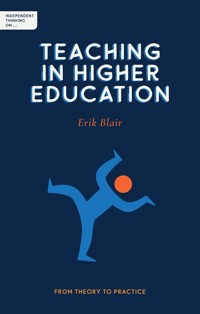
A refreshing and invigorating exploration of what really matters and what really works in higher education teaching. Dr Erik Blair's Independent Thinking on Teaching in Higher Education: From theory to practice is a refreshing and invigorating exploration of what really matters and what really works in higher education teaching. This book offers an insight into an area of higher education that has become more significant of late: the art of teaching. It focuses on the actual work of teaching and gives thought-provoking and perceptive guidance on how to teach in a meaningful and engaging manner.Independent Thinking on Teaching in Higher Education doesn't bamboozle with abstract terminology. Instead, Erik guides readers through topic-driven chapters that offer practical answers supported by rationales drawn from everyday experience. Alongside the core themes, he also provides bite-sized 'nuggets of wisdom' that prompt readers to implement flexible and effective strategies as part of their daily practice. The book offers a deeper understanding of the roles and responsibilities of those who teach in higher education, and also covers the three areas measured in the Teaching Excellence Framework (TEF): teaching quality, the learning environment, and the educational and professional outcomes achieved by students. Furthermore, Erik goes beyond the lecture theatre and seminar room by including a section dedicated to teaching online - that is, how to get the best out of delivering content to students remotely via the virtual learning environment. Ideal for those new to teaching in higher education as well as more experienced practitioners who want to continue honing their craft, Independent Thinking on Teaching in Higher Education embraces teaching and learning as a personal and human activity - and encourages educators to reflect on how the suggested approaches can be applied in their particular teaching environment. Suitable for all educators working in higher education.
Das E-Book können Sie in Legimi-Apps oder einer beliebigen App lesen, die das folgende Format unterstützen:
Veröffentlichungsjahr: 2020
Ähnliche











A
I would recommend this book to anyone thinking about beginning a teaching career in higher education. It provides a highly engaging and accessible style of writing throughout, as Erik communicates how his pedagogical approach places student engagement at the heart of meaningful thinking and learning through collaboration and critical thinking. The chapters explore pedagogy and teaching in a meaningful way, clearly explaining key terms, while the ‘little nuggets of wisdom’ offer an excellent conduit towards putting these ideas into practice. A great resource to help educators navigate the experiences of working in higher education.
LISA STEPHENSON, COURSE LEADER - MA DRAMA AND CREATIVE WRITING IN EDUCATION, CARNEGIE SCHOOL OF EDUCATION, LEEDS BECKETT UNIVERSITY
Independent Thinking on Teaching in Higher Education is an authoritative book that will be of much value to both new and experienced teachers in higher education, sharing theoretically informed and practically rooted advice on how to plan for better student learning. It offers outstanding accessible guidance for good teaching by drawing on ideas and empirical evidence from practice, and provides thoughtful and wide-ranging analysis of the multiple aspects informing good teaching practice.
Essential reading for anyone concerned with, and committed to, offering high-quality learning experiences to their students.
DR NAMRATA RAO, PRINCIPAL LECTURER IN EDUCATION, LIVERPOOL HOPE UNIVERSITY B
This book offers what teachers in higher education want and need: practical support in how to improve their everyday practice. Blair’s ‘little nuggets of wisdom’ give useful tips that can serve as a reminder to those who have been teaching for some time and as a confidence-builder for those who are new to the profession.
Supported by an easy-to-read narrative style, Independent Thinking on Teaching in Higher Education is a must for those wishing to give more to their students.
OLIVIA FLEMING, CO-FOUNDER OF OneHE
Independent Thinking on Teaching in Higher Education is both philosophical and practical and Erik’s voice of experience comes through in a reassuring manner. Also provided is a selection of useful teaching tools for those who are new to teaching in higher education and as well as those who offer training and CPD within higher education institutions.
The author understands very well that the key to successful encounters in education at any level is engagement: getting students involved and interested. Erik employs many useful analogies and metaphors in this regard that I imagine will be used again and again as the book comes into common usage.
Ultimately, Independent Thinking on Teaching in Higher Education offers a very reassuring guide to the important things to consider as one develops their craft as a teacher in higher education.
DR REBECCA PATTERSON, SENIOR LECTURER - EDUCATION (DRAMA), FACULTY OF EDUCATION, MANCHESTER METROPOLITAN UNIVERSITY
C
INDEPENDENT THINKING ON ...
TEACHING IN HIGHER EDUCATION
Erik Blair
FROM THEORY TO PRACTICE
E
For my mum – who would have probably preferred that I had written a nice storybook!F
FOREWORD
The schoolteacher who simply lectures is someone we have all experienced in our school careers. It’s easy to challenge – and improve – a teacher who thinks their job starts and ends with the delivery of the facts. As for the subsequent learning of what they’ve delivered? Well, that’s a job for the students. Fortunately, good teachers know these days that their job isn’t to teach; it’s to ensure that their students learn.
But what about the lecturer who simply lectures? All those of us who have been to university know what that is like too. A large lecture hall. A chalkboard/whiteboard/screen at the front (depending on how old we are). A mass of young faces, pens or keyboards poised, a sense of hush when the main attraction shuffles in and takes his or her place at the front, and off we go. After around an hour of delivery, the clockwork mechanism powering the academic runs down until there’s barely enough remaining to get out of the lecture hall before the students come back to life. Repeat.
Now, admittedly, I did go to a traditional Russell Group university in the north-east of England which didn’t really have to try that hard. Not only that, this was before the ‘bums on seats’, free market, pay-as-you-go approach took over the world of higher education, not to mention the transformation of so many old caterpillar colleges into new butterfly universities. Maybe the shift from lecturing to genuine teaching owes its roots to such changes, or maybe it’s because there is a new generation of lecturers, teachers, tutors and educators who genuinely like young people and want to be part of an institution that sees them grow and develop as independent thinking adults? iiWhich is where Independent Thinking on Teaching in Higher Education comes in.
With so much known these days about the great teaching that makes for great learning, there is no reason why the lecture theatre, tutor room, seminar group or any variation on a theme in the modern higher education pantheon cannot enjoy the best in teaching and learning as well as the best which has been thought or said.
Of course, the limits of a university’s teaching are not limited to its walls these days either. Even before the coronavirus pandemic-induced mega-shift to online learning, many of the world’s leading institutions were already making their teaching available everywhere to anyone and for free. Which does tend to rather up the ante when you are competing not just for bums on seats but eyeballs on screens with the very best teaching and the very best universities in the world.
Such a world was brought home to me recently when a head teacher told me of a working-class student from his school who had made it to a university in London. Bumping into him not long into his first year as an undergraduate, the head asked how the young man’s lectures were.
‘I don’t go to them,’ was the surprising reply.
Fearing the worst (students from poorer backgrounds, although going to university in greater numbers in England in recent years at least, are also the ones more likely to drop out according to the most recent figures1), the head teacher asked why that was the case.
iii‘Well, I just find out what the lecture is going to be on and then I find the best person in the world who has lectured on that and watch that recording instead. Why would I get out of bed to attend something that wasn’t as good as what I could watch on my laptop?’
Well, duh, indeed.
The quality of your teaching counts – whether that’s at school or at university, in a lecture hall of a thousand students, in a smaller classroom or online – for perpetuity. It can mean all the difference between pass or fail, between a poor grade or a great grade, between a lifelong love of your subject or a grudging hoop-jumping, between setting a young person up for life or giving them yet another experience that shouts ‘this world is not for me’.
With Erik Blair’s book as your guide, you can ensure that your teaching will connect with even more students, influence even more academic careers and transform many, many more young lives.
But you don’t need me to lecture you on that.
IAN GILBERT ROTTERDAMiv
1 E. Busby, Poorer Students Now Even More Likely to Drop Out of University Than Richer Peers, The Independent (7 March 2019). Available at: https://www.independent.co.uk/news/education/education-news/university-dropout-rates-students-rich-poor-education-a8812526.html.
ACKNOWLEDGEMENTS
I would like to thank everyone who helped bring this book to fruition. Various ideas that make up parts of the book have been shared with, commented on and improved by many colleagues and students. There are too many individuals to name personally, but if you have ever been taught by me or if we have ever worked together, then it is highly likely that you have been part of the development of this book.
I am deeply grateful to all at Crown House Publishing for their support and guidance – particularly Beverley, Louise and Emma, who have impressed me with their thorough, professional insights and eye for detail. Every piece of advice they have given has been valuable and is greatly appreciated.
Teaching in higher education is an iterative process that is improved through enactment, feedback and revision. The same is true of writing. Parts of Chapters 1 and 3 have been reworked from some of my earlier blogs and articles, and I would like to thank the University of West London1, London School of Economics and Political Science2 and Optimus Education3 for their kind permission to reuse this work.
There are two individuals who have been a great influence on me and who, without knowing, are always in the background as I write. I would like to thank Don Smith, who is the constant voice of good conscience at my shoulder – vireminding me about the power of being positive in the teaching environment. And, most importantly, I would like to thank Angela Francis, who keeps me grounded while simultaneously pushing me to be better.
1 E. Blair, What is a Lecturer? New Vistas, 5(1) (2019): 38–42.
2 E. Blair, Mapping the Teaching Environment. LSE Education Blog (28 April 2019). Available at: https://blogs.lse.ac.uk/highereducation/2019/04/28/mapping-the-teaching-environment.
3 E. Blair, Different Hefts, Different Expectations. Learning and Teaching Update, 39 (2010): 4–6.
CONTENTS
FIRST THOUGHTS
QUESTION EVERYTHING
One of the many mantras in the teaching world is, ‘You shouldn’t have to reinvent the wheel’, but my favourite is, ‘Adopt, adapt, reject’. When reading through this book, feel free to steal ideas that might work for you or tweak things to fit your students – and also feel free to reject anything that doesn’t work for you. Conversely, don’t be so closed-minded that you instantly dismiss new ideas. One of the most common retorts that teachers make when faced with new material is, ‘Yeah, that’s fine in theory but it wouldn’t work with my class.’ Try to open up and give it a go – apply the concept to your group and then make a value assessment.
This book is structured around five chapters which explore specific aspects of teaching in higher education. Collectively, these chapters conveniently cover the three areas measured in the Teaching Excellence Framework (TEF): teaching quality, the learning environment, and the educational and professional outcomes achieved by students.1 The first chapter investigates the nature of higher education – focusing on what we might consider to be the role and function of higher education and the task of teaching within such an environment. Chapter 2 examines the structure of higher education – particularly the structure of teaching within higher education – and highlights the benefit of having a structured approach to planning and practice. Chapter 3 offers insight into the various ways 2that information flows around the teaching environment and how we can map this flow to better support student engagement and interaction. Chapter 4 focuses on using observation as a tool for teaching enhancement and emphasises that this can be done in a collegial and developmental way. Finally, Chapter 5 highlights the role of reflection and reflective practice – exploring how this is best done in a balanced and structured manner.
At the end of each chapter there are some ‘little nuggets of wisdom’. These nuggets cover a wide variety of topics – some are presented as ideas that you can quickly implement in your teaching practice and some are there to stimulate your thinking. There is no one answer presented here; instead, the emphasis is on engagement and reflection. But remember: don’t accept what I say just because I have written it down. Please don’t hesitate to question my suggestions, but also aim to be open to new ideas.
You may already be asking questions about the word ‘teaching’ itself. In this book, I have been quite deliberate in discussing teaching in higher education rather than the range of higher education activities undertaken by academic staff. There are many student-facing, educational roles in higher education. Some colleagues are employed as professors, some are tutors, some are readers, some are fellows, some have titles as long as their arm and many have titles that don’t really explain what they do at all. This book is aimed at all those who teach in higher education. Recognising that this is a long (and ever growing) list of professionals, and because of the nature of this book, I have preferred to concentrate on what people do rather than their job titles.
For example, many people employed in higher education are employed as a lecturer and this can lead to some 3confusion, especially for novice lecturers. The word suggests that what you will be doing is lecturing, but that is a rather old-fashioned perspective because to deliver a lecture is a rather specific activity. You may be employed as a lecturer, but try to think about that as your job title rather than as a description of what you do. Individuals who are employed as lecturers undertake many different tasks (as discussed in Chapter 1), but I have focused on one particular task – teaching. Consequently, ‘lecturer’ is a description of what someone is employed to be, but ‘teaching’ is what they are employed to do.
For this reason, in this book I refer to the individual doing this teaching as a ‘teacher’, in order to place the concept of teaching front and centre where I feel it belongs. Some colleagues might be irked by this and regard the term a slight to their academic status; however, that is not my intention. I recognise that all those who teach in higher education have to juggle many different responsibilities. I am simply drawing out one of those roles, teaching, in an effort to shine a light on something that is central to the student learning experience.
It is this emphasis on teaching as an act of doing that is at the heart of this book. The focus is on how we take complicated ideas, theories and concepts and organise them in such a way that they are accessible (and useful) to students – that is, teaching in higher education as a fundamentally person-centred activity. 4
1 See https://www.thecompleteuniversityguide.co.uk/student-advice/where-to-study/teaching-excellence-framework-tef.




