


9,99 €
Mehr erfahren.
- Herausgeber: Daniel Zaborowski
- Sprache: Englisch
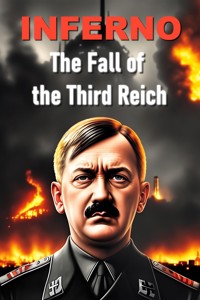
From the charred remnants of World War I, a sinister force emerged, reshaping the world in its dark image. 'Inferno: The Fall of the Third Reich' chronicles the chilling rise of Adolf Hitler and the Nazi Party, their iron grip on Germany, and the cataclysmic events that led to their ultimate downfall.
In gripping detail, this captivating account unveils the twisted ideology that drove Hitler's pursuit of supremacy, his ruthless ascent from Chancellor to Führer, and the erosion of democracy under the ominous shadow of the Enabling Act. Witness the lightning strikes of Blitzkrieg, the conquest of Europe, and Hitler's fatal mistake in Operation Barbarossa.
But amidst the horrors, a flicker of hope emerges. Explore the heroic resistance, the formation of the Grand Alliance, and the audacious D-Day invasion that turned the tides of war. Confront the chilling reality of the Holocaust, the liberation of concentration camps, and the pursuit of justice at the Nuremberg trials.
As the Third Reich crumbles, the book peels back the layers of darkness to reveal the psychological scars and the enduring legacy of a shattered Germany. Delve into the rebirth from the ashes, the economic recovery, and the quest for reconciliation and remembrance.
"Inferno: The Fall of the Third Reich" is a poignant testament to the triumph of humanity over unspeakable evil. Explore the depths of a nation consumed by darkness, and discover the lessons that resonate across generations. A gripping and enlightening journey that will leave an indelible mark on your soul.
Das E-Book können Sie in Legimi-Apps oder einer beliebigen App lesen, die das folgende Format unterstützen:
Veröffentlichungsjahr: 2023
Ähnliche




















Inferno: The Fall of the Third Reich
Daniel Zaborowski
Published by Daniel Zaborowski, 2023.
While every precaution has been taken in the preparation of this book, the publisher assumes no responsibility for errors or omissions, or for damages resulting from the use of the information contained herein.
INFERNO: THE FALL OF THE THIRD REICH
First edition. June 18, 2023.
Copyright © 2023 Daniel Zaborowski.
Written by Daniel Zaborowski.
10 9 8 7 6 5 4 3 2 1
Table of Contents
Title Page
Copyright Page
Introduction
Chapter 1: The Gathering Storm
Chapter 2: Blitzkrieg and Conquest
Chapter 3: Darkening Horizons
Chapter 4: Turning Tides
Chapter 5: Holocaust and Horrors
Chapter 6: The Road to Defeat
Chapter 7: Unveiling the Horror
Chapter 8: Legacy of Darkness
Conclusion
Introduction
In the smoldering aftermath of World War I, a tempest brewed in the heart of Europe, ready to unleash an inferno that would consume nations and redefine history. It was a time of turmoil, despair, and shattered dreams, where the seeds of a malevolent force took root and grew with insidious vigor. This force would emerge as the Third Reich, an embodiment of evil that would plunge the world into darkness.
Welcome to "Inferno: The Fall of the Third Reich," an extraordinary journey that will transport you back to a time when the fate of humanity hung in the balance. Prepare to be captivated by the pages that lay ahead, as we traverse the treacherous path of one of the most cataclysmic eras in human history.
Step into the tumultuous Germany of the 1920s, scarred by the wounds of the Great War. Feel the palpable sense of desperation that permeates the air, a breeding ground for the rise of an enigmatic leader: Adolf Hitler. Together, we shall explore the roots of his fanatical ideology and the twisted vision that drove the Nazi Party to unspeakable atrocities.
Join us as we witness Hitler's ascent to power, from his early days as a fiery orator to his transformation into the Führer, a title that would command unwavering loyalty from his followers. Uncover the insidious erosion of democracy, as the Nazis employed propaganda, persecution, and militarization to cement their grip on German society.
As the world teetered on the brink of war, tensions mounted, and ominous storm clouds gathered on the horizon. Through vivid prose, we shall recount the prelude to war, when the world held its breath, knowing that the flames of conflict were imminent. The stage was set for an inferno that would engulf the globe.
With each turn of the page, be prepared to witness lightning strikes of Blitzkrieg, as Germany's war machine unleashed its fury upon Poland, France, and the lands beyond. Experience the darkness of the Holocaust, the systematic genocide that scarred the collective conscience of humanity. Encounter stories of resistance, resilience, and the courageous souls who defied the Nazi regime, lighting a flicker of hope amidst the darkest of times.
Our journey will take us from the battle-scarred skies over Britain, where the indomitable spirit of a nation stood firm against the Nazi war machine, to the frozen landscapes of the Eastern Front, where the Soviet Union bore the brunt of Hitler's wrath. We shall bear witness to the Pacific Theater, where Japan's expansionist ambitions clashed with the resolve of the Allied forces.
In "Inferno: The Fall of the Third Reich," no stone shall remain unturned. Together, we shall confront the horrors of concentration camps, delve into the pursuit of justice at the Nuremberg trials, and grapple with the moral boundaries shattered by Nazi experiments.
But amidst the devastation and darkness, glimmers of light will emerge. We shall rejoice in the triumph of the Allied forces as they turn the tide of war, leading to the liberation of Europe and the ultimate defeat of Hitler's regime. We shall examine the lasting impact of the Third Reich, from the division of Germany to the rise of neo-Nazism, and explore the lessons learned to ensure that such a cataclysm may never be repeated.
Dear reader, fasten your seatbelt and brace yourself for an extraordinary expedition through history's most harrowing chapter. Through the power of words, we shall bear witness to the fall of the Third Reich, and in doing so, we honor the memory of those who suffered, persevered, and triumphed. May their stories ignite our resolve to cherish the light, preserve democracy, and ensure that the inferno of tyranny never engulfs humanity again.
Setting the stage: Germany in the aftermath of World War I
The ravages of World War I had left Germany in a state of profound despair and disillusionment. The once-mighty nation, known for its rich cultural heritage and industrious spirit, now lay in ruins—both physically and emotionally. As the dust settled on the battlefield, a bitter legacy of loss, resentment, and shattered dreams gripped the hearts of its people.
To truly understand the genesis of the Third Reich and the tumultuous era that followed, we must journey back to the aftermath of the Great War—a time when Germany stood at the precipice of societal upheaval and political turmoil.
The Treaty of Versailles, signed on June 28, 1919, imposed severe terms of surrender upon Germany. The nation was burdened with crippling reparations, territorial losses, and military restrictions that not only humiliated the German people but also plunged their economy into a deep abyss. The war had exacted a heavy toll, both in human lives and in the fabric of society.
In the war's aftermath, Germany faced an unprecedented wave of challenges. The returning soldiers, scarred by the horrors they had witnessed on the front lines, struggled to reintegrate into civilian life. Economic hardship gripped the nation, as hyperinflation ran rampant and left families destitute. The middle class, once a pillar of stability, faced bankruptcy and poverty.
In this climate of desperation, resentment, and disillusionment, a fertile ground emerged for radical ideologies to take root. Amid the chaos, a young veteran named Adolf Hitler began to gain prominence as a charismatic speaker and fervent nationalist. His ability to tap into the collective frustration and anger resonated with the disenchanted masses, and he quickly rose to prominence within the burgeoning far-right political circles.
The fragile Weimar Republic, established in the wake of the abdication of Kaiser Wilhelm II, faced an uphill battle in its quest to establish stability and democracy. Political divisions ran deep, with extremist factions on both the left and the right vying for power. In this fragmented landscape, Hitler's National Socialist German Workers' Party, commonly known as the Nazi Party, found fertile ground to sow the seeds of its poisonous ideology.
Drawing upon nationalistic sentiments, anti-Semitic rhetoric, and a promise of a glorious resurrection for Germany, Hitler's party gained traction. The Nazi Party's propaganda machine, led by Joseph Goebbels, skillfully exploited the discontent and painted a bleak picture of a nation betrayed by external forces and internal enemies. The myth of a "stab in the back" by perceived traitors became a rallying cry for those seeking revenge and a return to former glory.
Simultaneously, the cultural landscape of Germany underwent a radical transformation. Artists, writers, and intellectuals, disillusioned by the perceived failures of the old order, began to question societal norms and explore avant-garde expressions. The Weimar Republic became a hotbed of cultural experimentation, with Berlin at its epicenter. It was a time of contradictions, where social progressiveness coexisted with political unrest, and artistic freedom clashed with rising extremism.
The economic struggles of the post-war years further fueled societal unrest. Germany's dependence on foreign loans and reparations strained its fragile economy, resulting in a cycle of inflation and poverty. As the value of the German mark plummeted, the middle class bore the brunt of the crisis, while wealthy industrialists and landowners managed to navigate the turbulent waters.
This growing discontent and economic disparity set the stage for the rise of radical ideologies. The sense of betrayal and humiliation at the hands of the Treaty of Versailles created a breeding ground for extremist political movements that promised to restore Germany's former greatness and cleanse the nation of perceived enemies.
The scars of war were not only physical but also psychological. The trauma endured by soldiers on the front lines, witnessing the horrors of trench warfare and the loss of comrades, left an indelible mark on the collective psyche of the German people. This shared trauma, combined with the economic hardships and political instability, created a perfect storm that would shape the trajectory of Germany's future.
The rise of Adolf Hitler and the Nazi Party
In the smoldering ashes of post-war Germany, a man would emerge who would wield an unparalleled influence over the course of history. His name was Adolf Hitler, and he would become the catalyst for one of the darkest chapters in human civilization. To understand the rise of Hitler and the Nazi Party, we must delve into the complexities of his life, the political climate of the time, and the factors that propelled him to power.
Adolf Hitler was born on April 20, 1889, in Braunau am Inn, Austria-Hungary. From a young age, he displayed an insatiable appetite for power, coupled with an unyielding determination to leave an indelible mark on the world. His early years were marked by hardship, as he struggled to find his place in society and faced numerous rejections in his pursuit of a career in the arts.
It was during his time in Vienna that Hitler developed his fervent nationalist beliefs and anti-Semitic views. Influenced by the prevailing ideologies of the time, he immersed himself in the writings of nationalist thinkers and embraced a distorted vision of racial superiority. The seeds of his toxic ideology were sown, and he would go on to cultivate them with unrelenting zeal.
In the aftermath of World War I, Germany found itself in a state of chaos and disillusionment. The Treaty of Versailles had imposed harsh terms of surrender, exacerbating the economic hardships and fueling a sense of national humiliation. It was within this climate of discontent that Hitler found his opportunity to seize power.
In 1919, he joined the German Workers' Party, which would later be renamed the National Socialist German Workers' Party, or the Nazi Party. Hitler's charismatic personality and powerful oratory skills quickly elevated him within the ranks of the party. His ability to captivate audiences and tap into their deepest fears and frustrations propelled him to the forefront of German politics.
As Hitler rose in prominence, he utilized propaganda as a powerful tool to shape public opinion and cultivate a sense of fervent nationalism. Joseph Goebbels, a master propagandist, became an instrumental figure in disseminating Hitler's message of hate, blame, and promises of a glorious German future. The Nazi Party's propaganda machine permeated every aspect of German society, manipulating public perception and instilling a sense of loyalty to Hitler and his cause.
Hitler's political ambitions were further solidified in 1923 when he led the failed Beer Hall Putsch in Munich. The attempted coup d'état aimed to overthrow the Bavarian government and seize control of Germany. Although the coup was swiftly suppressed, Hitler used the subsequent trial to garner national attention and portray himself as a martyr for the nationalist cause.
During his brief imprisonment, Hitler penned his infamous manifesto, Mein Kampf (My Struggle), in which he laid out his radical vision for Germany's future. This autobiography-cum-political treatise outlined his anti-Semitic beliefs, his plans for territorial expansion, and his warped theories of racial purity. Mein Kampf became a blueprint for Hitler's political agenda and a rallying cry for his followers.
Upon his release from prison, Hitler embarked on a path of political reorganization and consolidation of power. He transformed the Nazi Party into a formidable political force, appealing to a broad spectrum of disillusioned Germans. By exploiting economic insecurities, fanning the flames of nationalist pride, and capitalizing on anti-Semitic sentiment, Hitler gained widespread support.
In the early 1930s, the Great Depression struck with devastating force, plunging Germany into even deeper economic turmoil. As unemployment soared and poverty became widespread, Hitler positioned himself as a beacon of hope for those struggling to make ends meet. His promises of economic revival, coupled with his ability to channel public anger and frustration, resonated with a population desperate for change.
In 1933, Hitler's relentless pursuit of power reached its zenith when he was appointed Chancellor of Germany. Leveraging his position and capitalizing on political maneuvers, he swiftly dismantled democratic institutions and consolidated power in his hands. The Enabling Act of 1933 effectively granted Hitler dictatorial powers, eroding the foundations of democracy and paving the way for the establishment of a totalitarian regime.
Under Hitler's leadership, Germany underwent a radical transformation. The Nazi regime implemented a series of measures aimed at centralizing power, suppressing dissent, and persecuting those deemed enemies of the state. Propaganda, censorship, and the brutal suppression of political opponents became the norm, as Hitler tightened his grip on every aspect of German society.
With each passing year, Hitler's influence grew, and his dreams of a racially pure, expansionist Germany became a chilling reality. His aggressive foreign policies, coupled with a rearmament program, posed a growing threat to peace in Europe. The world looked on in a mixture of alarm and disbelief as Hitler's ambitions ignited the flames of war once again.
As we peer into this turbulent period of history, it becomes apparent that Hitler's ascent to power was not a result of a single factor but a convergence of circumstances—a perfect storm of economic strife, political instability, and the manipulative genius of a demagogue. The rise of Adolf Hitler and the Nazi Party stands as a cautionary tale, reminding us of the dangers of unchecked hatred, the erosion of democratic values, and the catastrophic consequences that can arise from the darkest recesses of human nature.
The consolidation of power: Propaganda, persecution, and militarization
With Adolf Hitler firmly at the helm of Germany, the Nazi regime wasted no time in implementing a comprehensive strategy to consolidate power. Through a combination of propaganda, persecution, and militarization, Hitler sought to mold German society into a unified, obedient force, loyal to his totalitarian vision. This section delves into the methods employed by the Nazis to solidify their control and indoctrinate the masses.
Propaganda became the lifeblood of Hitler's regime, permeating every facet of German society. Joseph Goebbels, the Minister of Propaganda and Public Enlightenment, played a central role in shaping public opinion and molding the collective psyche of the nation. Through the manipulation of media, arts, and education, the Nazis sought to control the narrative, craft a distorted reality, and build unwavering support for Hitler and his ideology.
The Nazi propaganda machine harnessed the power of mass communication, employing radio broadcasts, newspapers, posters, and rallies to disseminate their message. They skillfully exploited people's fears, frustrations, and desires, weaving a narrative of national rebirth, racial superiority, and a grand vision of German destiny. By employing simple slogans, appealing to emotions, and employing sophisticated techniques of persuasion, the Nazis were able to sway public opinion and maintain a grip on the collective consciousness of the German people.
At the heart of Nazi propaganda was the promotion of racial purity and the demonization of those deemed "undesirable" or "enemies of the state." Anti-Semitism became a cornerstone of their ideology, and Jews were portrayed as the scapegoats for Germany's perceived woes. The infamous propaganda film "The Eternal Jew" depicted Jews as subhuman and sinister, perpetuating harmful stereotypes and fueling a climate of hatred and persecution.
The implementation of anti-Semitic policies was accompanied by a broader campaign of persecution targeting various groups deemed incompatible with Nazi ideals. Homosexuals, Romani people, disabled individuals, political dissidents, and Jehovah's Witnesses were subjected to systemic discrimination, persecution, and, ultimately, annihilation. The Nuremberg Laws of 1935 stripped Jews of their citizenship and basic rights, while the establishment of concentration camps served as the brutal machinery of oppression.
The regime's militarization efforts were also central to their consolidation of power. Hitler rapidly expanded Germany's armed forces, in direct violation of the Treaty of Versailles. By rebuilding the military, he aimed to assert Germany's dominance and facilitate the realization of his territorial ambitions. Propaganda glorified military service and instilled a sense of duty and honor in the German populace, fostering a culture of unquestioning loyalty to the state and its leaders.
The Hitler Youth, the Nazi Party's youth organization, played a crucial role in indoctrinating the younger generation with Nazi ideology. Through a combination of military training, ideological education, and propaganda, young Germans were groomed to become loyal soldiers and future bearers of the Nazi cause. By instilling their beliefs in the minds of the youth, the Nazis sought to ensure the longevity and continuity of their totalitarian regime.




