


139,99 €
Mehr erfahren.
- Herausgeber: John Wiley & Sons
- Kategorie: Wissenschaft und neue Technologien
- Sprache: Englisch
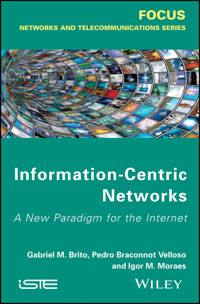
Since its inception, the Internet has evolved from a textual information system towards a multimedia information system, in which data, services and applications are consumed as content. Today, however, the main problem faced is that applications are now content-oriented but the protocol stack remains the same, based on the content location. Thus, it is clear that the Internet’s current architecture must change. This new architecture should take into account aspects to improve content location and delivery efficiency and also content availability. Fulfilling these requirements is the main goal of information-centric networks (ICNs).
ICN is a new communication paradigm to increase the efficiency of content delivery and also content availability. In this new concept, the network infrastructure actively contributes to content caching and distribution. This book presents the basic concepts of ICNs, describes the main architecture proposals for these networks, and discusses the main challenges to their development. Information Centric-Networks looks at the current challenges for this concept, including: naming, routing and caching on the network-core elements, several aspects of content security, user privacy, and practical issues in implementing ICNs.
Contents
1. Content Distribution on the Internet.
2. Information-Centric Networks.
3. Main ICN Architectures.
4. Challenges.
5. Practical Issues.
About the Authors
Gabriel M. Brito is an Engineer at Petrobras in Brazil and studying for a Master’s degree at the Universidade Federal Fluminense in Brazil.
Pedro Braconnot Velloso is an Associate Professor in the Department of Computer Science at the Universidade Federal Fluminense (UFF), Brazil. He worked for Bell Labs France as a research engineer from 2009 to 2011.
Igor M. Moraes is an Associate Professor at the Universidade Federal Fluminense in Brazil.
Sie lesen das E-Book in den Legimi-Apps auf:
Seitenzahl: 166
Veröffentlichungsjahr: 2013
Ähnliche



















Contents
Introduction
Chapter 1 Content Distribution on the Internet
1.1. End-to-end concept and limitations
1.2. Multicast communication
1.3. Peer-to-peer systems
1.4. Content distribution networks
1.5. Publish/subscribe systems
Chapter 2 Information-Centric Networks
2.1. Content naming
2.2. Content or name-based routing
2.3. Content caching
Chapter 3 Main ICN Architectures
3.1. Content-based networking/combined broadcast and content-based
3.2. Data-oriented network architecture
3.3. Content-centric networking/named-data networking
3.4. Publish-subscribe Internet routing paradigm/publish-subscribe Internet technologies
3.5. Content-centric inter-network architecture
3.6. Other architectures
3.7. General comparison
Chapter 4 Challenges
4.1. Naming
4.2. Routing
4.3. Caching
4.4. Security
4.5. Mobility support in ICN
4.6. Applications
Chapter 5 Practical Issues
5.1. Economic models
5.2. Content routers
Conclusion
Acknowledgment
Bibliography
Index
First published 2013 in Great Britain and the United States by ISTE Ltd and John Wiley & Sons, Inc.
Apart from any fair dealing for the purposes of research or private study, or criticism or review, as permitted under the Copyright, Designs and Patents Act 1988, this publication may only be reproduced, stored or transmitted, in any form or by any means, with the prior permission in writing of the publishers, or in the case of reprographic reproduction in accordance with the terms and licenses issued by the CLA. Enquiries concerning reproduction outside these terms should be sent to the publishers at the undermentioned address:
ISTE Ltd
27-37 St George’s Road
London SW19 4EU
UK
www.iste.co.uk
John Wiley & Sons, Inc.
111 River Street
Hoboken, NJ 07030
USA
www.wiley.com
© ISTE Ltd 2013The rights of Gabriel M. Brito, Pedro Braconnot Velloso and Igor M. Moraes to be identified as the authors of this work have been asserted by them in accordance with the Copyright, Designs and Patents Act 1988.
Library of Congress Control Number: 2013932267
British Library Cataloguing-in-Publication DataA CIP record for this book is available from the British LibraryISSN: 2051-2481 (Print)ISSN: 2051-249X (Online)ISBN: 978-1-84821-449-1
Printed and bound in Great Britain by CPI Group (UK) Ltd., Croydon, Surrey CR0 4YY
Introduction
At the beginning of the Internet, users were academic in nature, mainly interested in mail exchange and file transfers. Furthermore, resource sharing was an important issue that imposed major challenges with regard to communication among end systems [JAC 09a, JAC 12, KUR 12]. Interconnected hosts should exchange data, such as files and database registers, and users had to access remote devices, such as printers and file servers. Thus, the improvement in communication efficiency among hosts was the main goal in this context.
Today, new technologies used by the network core and also by access networks has increased bandwidth availability, at the same time reducing users’ access cost. The bandwidth increase has allowed developing a whole new set of applications, especially multimedia applications. The advent of these applications associated with the cost reduction has brought millions of new users to the Internet. Video-sharing Websites and file-sharing peer-to-peer (P2P) systems [MOR 08] are good examples of these new applications that are quite different from the first Internet applications. Both applications clearly indicate that the content distribution on the Internet has evolved from a textual information system towards a multimedia information system, in which data, services and applications are consumed as contents [PLA 05]. Currently, users are more interested in the content itself regardless of who sends it or its location. Documents, videos, audio, images, Web pages and metadata, for example, are “contents” [PLA 05]. This new scenario calls for the development of a network infrastructure that locally enables efficient and secure content distribution with high availability. The main problem faced today, however, is that applications are now content-oriented but the protocol stack remains the same, based on the content location.
There is no unique solution that addresses all the requirements of content distribution today. Basically, there are techniques that partially satisfy these requirements and overcome a few limitations of the current Internet architecture. P2P networks and content distribution networks (CDNs) are widely adopted solutions for distributing content, as indicated by the success of applications such as BitTorrent and CDN providers such as Akamai. Nevertheless, P2P systems and CDNs operate as overlays and, in general, do not take into account the underlying network topology to increase the efficiency of content distribution applications. In addition, the current Internet architecture experiences problems of content persistence, availability and security because the proposed solutions are very specific for a given problem and/or rely on proprietary mechanisms. Hypertext Transfer Protocol (HTTP) and Domain Name System (DNS) dynamic redirection, for example, are used by CDNs but do not guarantee content persistence. Queries to centralized structures are also needed in order to change content location, which increases the content delivery time [KOP 07]. Thus, it is clear that the current Internet architecture must change. This new architecture should take into account aspects to improve content location and delivery efficiency and also content availability. Fulfilling these requirements is the main goal of information-centric networks (ICNs).
ICNs introduce a new communication paradigm for the Internet. ICNs emphasize access to content regardless of its location. This is different from the traditional approach of the Internet, which is focused on the identification and location of end systems. The key idea of ICNs lies in using names to address content and to forward content on the network. Therefore, ICNs are based on novel concepts such as named content, name-based routing, security directly applied to contents and in-network caching [JAC 09a, KOP 07, VIS 09]. These concepts allow ICNs to deploy a more efficient architecture for content distribution, thus avoiding all the “patches” needed by the current Internet architecture such as IP Multicast, DNS and IPSec. ICNs natively provide new functionalities such as mechanisms to increase content availability, content security support and mobility support.
This book presents the main motivations for the ICN approach. First, the main problems related to content distribution in the current Internet are discussed in Chapter 1. The main techniques used to circumvent these limitations, such as multicast communication, P2P networks, publish/subscribe systems and content distribution networks (CDNs), are briefly described. Although these techniques provide a solution for content distribution, in general, they add much complexity to fix specific problems of the current Internet. The authors identify for each technique its main advantage and drawback, justifying the adoption of a new paradigm for the Internet.
Chapter 2 introduces the new ICN paradigm and presents fundamental aspects related to naming, routing and caching in ICN. The authors also discuss different approaches to these three aspects, showing the main characteristics and implications for the ICN. One important aspect is the use of content cache in the network core in order to decrease packet delay and load on servers.
Chapter 3 describes some of the main architectures currently proposed for ICNs. This chapter covers seminal proposals such as combined broadcast and content-based (CBCB) and state-of-the-art architectures such as content-centric networking (CCN), data-oriented network architecture (DONA), the publish/subscribe Internet routing paradigm (PSIRP) and content-centric inter-network architecture (CONET). Differences of naming, routing and caching approaches adopted by the different architectures are emphasized and so are the security aspects. Research projects under development to experimentally evaluate ICN architectures are also mentioned.
Chapter 4 discusses the challenges to distribute content in an efficient and scalable way and with high availability. The development of scalable naming and routing schemes, for example, is a great challenge. Routing decisions are made on the basis of content names and, thus, the way the names are defined impacts the routing efficiency. In-network caching also imposes new challenges to ICNs. Cache sizing, cache replacement policies, content placement and cooperative caching are a few open questions. This chapter also discusses security challenges, such as content authentication and privacy issues, requirements to adopt ICNs in wireless and mobile environments, and presents several applications that can benefit from adopting the ICN paradigm.
Practical issues are also fundamental to deploying ICN architectures on a large scale. In Chapter 5, the authors first present business models proposed for ICNs and then analyze hardware and software requirements to implement practical content routers. The main studies addressing practical issues are presented and discussed.
Finally, Chapter 6 points out new research topics and open questions related to the development of ICN architectures. These topics include inter-domain routing, interoperability between ICN architectures, standardization, peering agreements between service providers, content accounting, etc. These huge economic-financial challenges make the development of ICNs one of the most promising research areas and may potentially result in a radical change of the Internet communication paradigm.
1
Content Distribution on the Internet
In the beginning, Internet applications were based on textual information. Users were used to exchange email messages, transfer files via File Transfer Protocol (FTP) and access remote servers. Today, the Internet is a complex multimedia-information system based on content distribution. Documents, videos, audio, images, Web pages, for example, are “contents” [PLA 05]. Metadata used to find, understand and manage contents are also considered “contents”. However, in order to enable users to request and receive contents efficiently, several basic requirements must be satisfied. First, content persistence must be assured. Persistence means that content identifiers should be unique and valid during the lifetime of the associated content. Recently, with the advent of Web 2.0, the number of content publishers has hugely increased. Today, even users with low technical knowledge are able to publish content on the Internet easily. Thus, it is quite hard to assure content persistence in the current Internet. The second requirement is scalability. Content-search and forwarding mechanisms should be efficient regardless of the number of users and contents offered. Both must be able to operate at Internet scale. Finally, the secure access to contents is an important requirement to provide authentication and access control mechanisms to available contents. Currently, there is no solution that satisfies all these three requirements at the same time. Several techniques try to partially satisfy them and thus make the current Internet architecture more suitable to content distribution. In this chapter, a few of these techniques are briefly presented.
Lesen Sie weiter in der vollständigen Ausgabe!
Lesen Sie weiter in der vollständigen Ausgabe!
Lesen Sie weiter in der vollständigen Ausgabe!
Lesen Sie weiter in der vollständigen Ausgabe!
Lesen Sie weiter in der vollständigen Ausgabe!
Lesen Sie weiter in der vollständigen Ausgabe!
Lesen Sie weiter in der vollständigen Ausgabe!
Lesen Sie weiter in der vollständigen Ausgabe!




