


9,59 €
Mehr erfahren.
- Herausgeber: Seren
- Kategorie: Gesellschafts- und Liebesromane
- Sprache: Englisch
Perceptive, persuasive and intricately made, the poems of Kate Bingham's third collection, Infragreen, take the reader on a startling and unfamiliar journey through everyday experiences and phenomena. Her keen eye, reflectiveness and quiet wit endow her subjects with a shimmering freshness. Set within the four walls of home, on the streets of north London and in the Yorkshire countryside, the poems build out from mundane activities such as taking the pill, traveling a daily bus route and scything thistles. In Bingham's hands, the familiar sights and hypnotic routines that normally lull the brain into unthinking acquiescence are the starting points for finding new richness in the world around us and our participation in it. The book contains three sections, each infused by a different season and place, but a spirit of serious play presides throughout. Contemporary versions of Hardy and Frost, a collage cut from old favourite Christmas carols, and a refleshing of some of English poetry's oldest clichés are part of it, but so too is Bingham's fascination with pattern: the patterning required by some of poetry's stricter traditional forms, and pattern as content, a subject in itself. Those who know Bingham's earlier work will recognize in this collection her playful, often darkly comic, appreciation of the surreal, which features hearts and hands, feet, and even a pair of shoes with minds and agenda of their own. Elsewhere, a milk-bottle breathes, a pocket of air turns into a winged creature, flies serenade the poet whose mortal scent has drawn them into her room. A ballad at the start of the final section tells the story of an artisan paper-maker whose origami creation is so perfect it comes to life, only to be destroyed again by its maker. But beneath the gently cynical, almost self-deprecating tone lie Infragreen's darker themes: a base note of environmental and existential anxiety in which teasing self-deprecation can mutate into a desire for disembodiment, and a ruthless wishing away of consciousness and self.
Das E-Book können Sie in Legimi-Apps oder einer beliebigen App lesen, die das folgende Format unterstützen:
Seitenzahl: 34
Veröffentlichungsjahr: 2016
Ähnliche




















Seren is the book imprint of Poetry Wales Press Ltd. 57 Nolton Street, Bridgend, Wales, CF31 3AEwww.serenbooks.comfacebook.com/SerenBookstwitter@SerenBooks
The right of Kate Bingham to be identified as the author of this work has been asserted in accordance with the Copyright, Designs and Patents Act, 1988.
© Kate Bingham 2015 ISBN: 978-1-78172-243-5 e-book: 978-1-78172-245-9 Kindle: 978-1-78172-244-2
A CIP record for this title is available from the British Library.
All rights reserved. No part of this publication may be reproduced, stored in a retrieval system, or transmitted at any time or by any means, electronic, mechanical, photocopying, recording or otherwise without the prior permission of the copyright holder.
The publisher acknowledges the financial assistance of the Welsh Books Council.
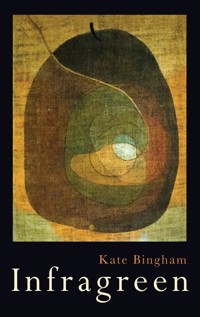
Cover Image: ‘The Fruit’ by Paul Klee, 1932.
Printed in Bembo by Bell & Bain Ltd, Glasgow
Author website: http://www.katebingham.com
Contents
I
Ultragreen
Infragreen
Spring
look at the rain…
On Highgate Hill
Silt
The World at One
Heels
Tulips
Arrangements
Rosa Wedding Day
At Night
Questions
Midnight
two of us awake…
II
Open
The Children’s Room
String
Strip
Ten O’Clock
To
Cows
Thistles
August
Tapetum Lucidum
Cull
The Wood
Blackberries
Down
III
By the River Lau
My Hand
no handkerchief...
Between Our Feet
Look
One
My Heart
Between
Two
Next Door
Cento
call it what you…
Acknowledgements and Notes
Ultragreen
A water drop turns in its skin at the end of the garden and opens one eye to the sun.
Unsteadily, at the speed of light, its plain no-coloured heart breaks into such a green I can hear it loud and bright and green to distraction.
It turns its eye in my brain, looks out and sees what I have seen. Something like photosynthesis begins.
Infragreen
Something the sun and I see eye to eye in winks in the crux of a leaf.
For every turn of the turning earth it makes a tiny correction
half letting go of itself half hanging on.
Spring
You know what the sun is like it has a way of looking at us from side to side
of rising above its various nationalities and making things grow
as if that’s what a life-form has to do to get more attention.
Up come snow drops pushing and shoving and putting on weight
daffodil nubs break out all at once where the grass is thin
and even the weak municipal crocuses divide and multiply, insisting they matter.
An empty plastic milk container left on the kitchen table
takes a breath, increasing in volume filling with light.
look at the rain it always seems to know what to do coming down clear and direct silver and fearless many too many to count in one quick freshwater shoal no thought no thought at all for what happens next
shaped by the air it runs through going its absolute fastest round at one end sharp at the other in and out of control it manages somehow to look its best its every last drop clean and true and hurrying to put its foot in its footstep
falling over itself into earth’s cracked bowl it disappears as it collects vanishing from the pavement up grounding the sky and lifting filthy waters falling into itself in the street as if only falling matters
On Highgate Hill
How it rained; we caught the bus up Highgate Hill past Whittington’s cat and the hospital. The driver insisted he was full – twenty wet children, pleading, shrill,
how it rained.
How it snowed; the bus got stuck on Highgate Hill and we stood on the pavement in pumps and heels, children pelted the windows and wheels, their walk to school a wild white thrill,
how it snowed.
How it shone; we held our breath down Highgate Hill through stinking heat. A teenage girl chucked study guides across the aisle, a boy spat on Swiss Army steel
and it shone,
how it shone; the children kicked their seats until the driver came roaring up out of his stall.




