


123,99 €
Mehr erfahren.
- Herausgeber: John Wiley & Sons
- Kategorie: Wissenschaft und neue Technologien
- Serie: Wiley - IEEE
- Sprache: Englisch
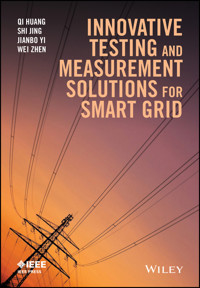
Focuses on sensor applications and smart meters in the newly developing interconnected smart grid * Focuses on sensor applications and smart meters in the newly developing interconnected smart grid * Presents the most updated technological developments in the measurement and testing of power systems within the smart grid environment * Reflects the modernization of electric utility power systems with the extensive use of computer, sensor, and data communications technologies, providing benefits to energy consumers and utility companies alike * The leading author heads a group of researchers focusing on the construction of smart grid and smart substation for Sichuan Power Grid, one of the largest in China's power system
Sie lesen das E-Book in den Legimi-Apps auf:
Seitenzahl: 570
Veröffentlichungsjahr: 2015
Ähnliche



















CONTENTS
Cover
Title page
About the Authors
Foreword
Preface
Acknowledgments
1 Introduction
1.1 The Concept and Worldwide Development of Smart Grid
1.2 Importance and Necessity of Measurement and Test in Smart Grid
1.3 State of Art in Measurement and Test of Smart Grid
1.4 Outline of the Book
References
Part One: Sensor, Measurement and Data Management
2 New Types of Sensors for Smart Grid
2.1 Introduction
2.2 Application of Advanced Magnetic Sensor in Smart Grid
2.3 Application of Fiber Optic Sensor in Smart Grid
References
3 Synchronized Wide Area Measurement for Smart Grid
3.1 Introduction
3.2 Time Synchronization in Substation
3.3 Dynamic Visualization of Power System Synchronphasor
3.4 On-line Measurement of Low Frequency Oscillation Based on WAMS
3.5 Wide Area Situational Awareness
References
4 Measurement of Energy, Power Quality and Efficiency in Smart Grid
4.1 Smart Meter and AMI for Smart Grid
4.2 Measurement for Power Quality in Smart Grid
4.3 Measurement for Integration of Distributed Generation
References
5 Data Management in Smart Grid
5.1 Introduction
5.2 Data and Data Processing in Smart Grid
5.3 Sensor Network for Integration of Smart Grid Data
5.4 Introduction to Smart Grid Data Cloud
References
Part Two: Advanced Test Technologies for Smart Grid
6 Test of Secondary Systems in Smart Substation
6.1 Introduction – Smart Substation
6.2 Whole-view Test of Secondary System in Smart Substation
6.3 Development of Real-time Test Technology
References
7 Test of Auxiliary Monitoring System in Smart Substation
7.1 Introduction – Auxiliary Monitoring and Control System in Smart Substation
7.2 Test of Video Surveillance System in Smart Substation
7.3 Test of the Video Linkage System
References
8 Test on Dynamic Performance of Electronic Instrument Transformers
8.1 Introduction
8.2 Detailed Modeling of Rogowski Coil and Numerical Analysis
8.3 Test System Design and Implementation
References
9 Future Vision
9.1 Summary of the Results
9.2 Future Vision
Index
End User License Agreement
List of Tables
Chapter 01
Table 1.1 Measurement for smart grid
Chapter 02
Table 2.1 The parameters of the transmission line under test
Table 2.2 Identification of the fault type with magnetic field measurement
Table 2.3 Evaluation of the sag effect on the calculation of magnetic field
Table 2.4 Comparison of available fault location approaches
Table 2.5 Sensitivity of FBG for measurement of different parameters
Table 2.6 LGJ-400/35 specifications for evaluation of sag and tension distribution
Table 2.7 The relationship between tension and ice thickness in LGJ-400/35 conductor
Table 2.8 FBG temperature sensor calibration test
Table 2.9 FBG tension sensor calibration test
Table 2.10 Field test results
Chapter 03
Table 3.1 Requirement of time synchronization in power system
Table 3.2 Requirement of time synchronization in substation
Table 3.3 Similarities and differences between IEEE 1588 and NTP
Table 3.4 The low frequency mode information of simulation system
Table 3.5 The comparison result between improved HHT method and Prony method
Table 3.6 The low frequency mode information of EPRI-36
Table 3.7 The identification result of LFO mode
Table 3.8 The information of dominant oscillation modes
Table 3.9 Identification results of the measured complex LFO signal
Chapter 04
Table 4.1 Difference between AMR and AMI
Table 4.2 Energy sources and consumption
Table 4.3 Coefficients in Equation (4.17)
Chapter 05
Table 5.1 Three primary domains of big data and data analytics in smart grid
Table 5.2 Possible use of cloud computing in power system analysis
Lesen Sie weiter in der vollständigen Ausgabe!
Lesen Sie weiter in der vollständigen Ausgabe!
Lesen Sie weiter in der vollständigen Ausgabe!
Lesen Sie weiter in der vollständigen Ausgabe!
Lesen Sie weiter in der vollständigen Ausgabe!
Lesen Sie weiter in der vollständigen Ausgabe!
Lesen Sie weiter in der vollständigen Ausgabe!
Lesen Sie weiter in der vollständigen Ausgabe!
Lesen Sie weiter in der vollständigen Ausgabe!
Lesen Sie weiter in der vollständigen Ausgabe!
Lesen Sie weiter in der vollständigen Ausgabe!
Lesen Sie weiter in der vollständigen Ausgabe!
Lesen Sie weiter in der vollständigen Ausgabe!
Lesen Sie weiter in der vollständigen Ausgabe!
Lesen Sie weiter in der vollständigen Ausgabe!
Lesen Sie weiter in der vollständigen Ausgabe!
Lesen Sie weiter in der vollständigen Ausgabe!
Lesen Sie weiter in der vollständigen Ausgabe!
Lesen Sie weiter in der vollständigen Ausgabe!
Lesen Sie weiter in der vollständigen Ausgabe!




