


0,00 €
Mehr erfahren.
- Herausgeber: Solart Books
- Kategorie: Bildung
- Sprache: Englisch
Open your mind to oratorical art at its finest and digest the wisest sayings and philosophies from some of the world's most distinguished people…
It's fascinating how one word, one sentence, or one phrase can be the propelling factor to altering your way of thinking or even your life. As such, being receptive to the wisdom of others can give us a different perspective on life and subsequently open our minds to new possibilities.
This book is packed with quotes and insights from famous people around the world in the fields of art, literature, poetry, music, and more, creating an all-rounded haven of inspiration.
In it, you will find:
- Quotes and wisdom nuggets from 10 famous people
- A short biography of each person featured to understand your orator better
- Motivation and inspiration straight from the horse's mouth
Das E-Book können Sie in Legimi-Apps oder einer beliebigen App lesen, die das folgende Format unterstützen:
Veröffentlichungsjahr: 2023
Ähnliche

















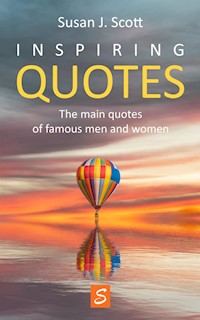
INSPIRING QUOTES
The main quotes of famous men and women
Susan J. Scott
Table of Contents
Title Page
INSPIRING QUOTES: The main quotes of famous men and women
ALESSANDRO MANZONI
ELEANOR ANNA ROOSEVELT
ALBERT EINSTEIN
RITA LEVI MONTALCINI
OMERO
COCO CHANEL
FRIDA KAHLO
RICHARD BACH
© Copyright 2023 - All rights reserved.
Solart Books
Foreword
––––––––
I HAVE TRIED TO INSERT inside of a single rac-colta the phrases that more have motivated me and motivate me in my life.
I was able, in some cases even with particular difficulty, to retrieve the references of many quotations.
On other phrases and aphorisms has not been possible but are universally recognized phrases to the authors indicated.
I hope you can be inspired too, as I have been. Good thinking.
––––––––
Susan J. Scott
ALESSANDRO MANZONI
Alessandro Manzoni is one of the most famous writers of Italian literature and one of the most representative personalities of the Italian national consciousness. He was one of the first to undertake an organizational structure of history in a new literary genre: the novel. His most famous novel is: The Betrothed. On one occasion, Manzoni spoke of this masterpiece and said: "When I write, I always feel bad". His spiritual journeys offer a Tuscan aestheticism able to create lightness and transport readers to other realities. In summary, the work of Alessandro Manzoni is considered an Italian historical classic.
The author describes the pre-universal period in the spirit of a prophet. Observe the evil interests of society without hiding the disinterest for the suffering of the plebeians. It dwells on the human aspects of the discomfort of the lower classes who suffer the weight of capitalist corruption and oppression. The literary style of prefiguration imposes itself masterfully to describe these scenes of collective misery. Manzoni presents the problem from a sophisticated point of view and, thanks to the use of metaphors, he does so with the simplicity of his dialect tuscan. The metaphorical image he uses to describe the reactions of the upper classes to the financial crisis is very eloquent: "The young donkey who ran away, withdraws all contrite". The implications are immediately clear: "The nobles were like donkeys", while "the plebeians were like small cows to which the motherland is removed".
Manzoni outlines the situation as if it were pre-sent; his writing ability opens his eyes to distant but not distant times in terms of substance.
In addition to describing the socialist struggles of the fifties of the seventeenth century in Italy, Manzoni also describes the consequences of the plot that saw him as an occult protagonist. The revelation published after the author’s death confirmed that he would have liked the books to go on without his earthly life ever disturbed by patrician oppression.
"You should think more about doing well, that to be well: and so you would also end up feeling better "
"What comes next is not always progress"
"Words have an effect in the mouth, and another in the ears"
"Common sense was there; but he hid himself, for fear of common sense"
"Turning off the light is an opportunity to not see the thing you do not like, but not to see the one you want "
"Do not dredge up what can only serve to worry you unnecessarily"
"To the man in the poke, almost everything is a new mess!"




