


128,99 €
Mehr erfahren.
- Herausgeber: John Wiley & Sons
- Kategorie: Wissenschaft und neue Technologien
- Sprache: Englisch
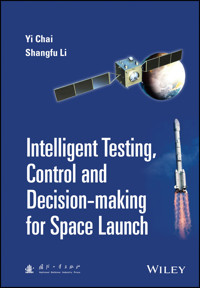
A comprehensive exposition of the theory and techniques of fault identification and decision theory when applied to complex systems
- shows how modern computer analysis and diagnostic methods might be applied to launch vehicle design, checkout, and launch
- the space checkout system is a specialized area which is rarely explored in terms of the intelligent techniques and approaches involved
- an original view combining modern theory with well-established research material, inviting a contemporary approach to launch dynamics
- highlights the advanced research works in the field of testing, control and decision-making for space launch
- presented in a very well organized way and the technical level is very high
Sie lesen das E-Book in den Legimi-Apps auf:
Seitenzahl: 466
Veröffentlichungsjahr: 2016
Ähnliche



















Table of Contents
Cover
Title page
Preface
Introduction
1 Overview of Testing and Control for Space Launch
1.1 Survey of Space Launch Engineering
1.2 Testing and Control System for Space Launch
1.3 Application of Intelligent Techniques for Space Launch Testing and Control
2 Networks of Testing and Control for Space Launch
2.1 Overview of Testing and Control for Space Launch
2.2 Bus Network Architecture of Testing, Launching, and Control
2.3 Key Techniques of Bus Networks for Testing, Launching, and Control
2.4 Examples of Bus Network Construction for Testing, Launching, and Control
2.5 Transmission Networks of Command Systems for Spacecraft Testing, Launching, and Control
3 Intelligent Analysis and Processing for Testing Data
3.1 Contents in Space Launch Testing
3.2 Data Preprocessing
3.3 Data Consistency Analysis
3.4 Analysis of Data Singular Points
3.5 Key Parameter Analysis in Testing
3.6 Data Correlation Analysis
4 Intelligent Fault Diagnosis for Space Launch and Testing
4.1 Overview of Fault Diagnosis for Space Launch and Testing
4.2 Fault Diagnosis Methods
4.3 Multiscale Fault Detection Algorithms Based on Kernel PCA
4.4 Fault Tree Analysis Based on Ant Colony Algorithm
4.5 Analysis of Intelligent Sneak Circuit
4.6 Malfunction Diagnosis Based on Recurrent Neural Network
5 Safety Control of Space Launch and Flight—Modeling and Intelligence Decision
5.1 Overview of Space Launch and Flight Safety Control
5.2 Model of Space Launch and Flight Safety Control Parameter Calculation
5.3 Intelligent Decision of Space Flight and Safety Control
5.4 Intelligent Decision-Making Method for Space Launch and Flight Safety Control
5.5 Safety Emergency Response Decision of Space Launch and Flight
6 Development Tendency of Space Launch Test and Control
6.1 Technique and Methods of Space Launch Test and Control
6.2 Informatization and Intellectualization of Space Launch Test and Control System
Bibliography
Index
End User License Agreement
List of Tables
Chapter 03
Table 3.1 Attribute values after discretization.
Table 3.2 Attribute parameters after getting rid of duplicate values.
Table 3.3 Importance of parameters.
Table 3.4 Correlation coefficient matrix.
Chapter 04
Table 4.1 The contribution rate of the SKPCA model.
Table 4.2 Performance comparison between different PCA approaches on the basis of SPE statistics.
Table 4.3 Time of different PCA approaches.
Table 4.4 Comparison of algorithm accuracy.
Table 4.5 Firing circuit design matrix of the Redstone rocket.
Table 4.6 Training sample.
Table 4.7 Energy values of Sallen–Key bass-band filter.
Table 4.8 Results of Sallen–Key filter multi-malfunctions diagnosis.
Chapter 05
Table 5.1 Safety estimation table.
List of Illustrations
Chapter 01
Figure 1.1 Testing and control system of space launch.
Figure 1.2 The testing, control, and launch process.
Figure 1.3 Structural evolution of carrier rockets. (a) Simple rockets, (b) relatively complicated rockets, and (c) complicated rockets.
Figure 1.4 Manual testing system of carrier rockets.
Figure 1.5 System of testing and control for space launch.
Figure 1.6 System structure of intelligent testing, control, and decision-making.
Chapter 02
Figure 2.1 Transmission Internet work of testing, control, and command system for space launch.
Figure 2.2 Architecture of on-board and ground simultaneous testing system.
Figure 2.3 Remote control network of space launch.
Figure 2.4 1553B bus interface and terminal structure.
Figure 2.5 Module of the on-board bus control system.
Figure 2.6 Comprehensive ground bus testing system.
Figure 2.7 Module of ground system for testing, control, and launch.
Figure 2.8 Principle scheme for structure of traditional on-board testing system.
Figure 2.9 Principle scheme of LXI bus-based testing network.
Figure 2.10 Structure of network message trigger system.
Figure 2.11 Structure of IEEE-1558 network clock synchronization.
Figure 2.12 Principle scheme of 1588 clock synchronization.
Figure 2.13 Application method of LXI trigger bus.
Figure 2.14 Structure of telecontrol system in the launch area with telediagnosis function.
Figure 2.15 Network topology structure.
Figure 2.16 Overall architecture of transmission network.
Figure 2.17 Transmission network architecture of testing, control, and command system for space launch.
Figure 2.18 Universal transmission network architecture of testing, control, and command system for space launch.
Figure 2.19 Principle of master control backup.
Figure 2.20 Example diagram of Eethernet port trunking.
Figure 2.21 Security protection of transmission network of the testing, control, and command system for space launch.
Figure 2.22 Security protection system structure of transmission network of the testing, control, and command system for space launch.
Chapter 03
Figure 3.1 (a) The original “blocks” signal and (b) the noisy “blocks” signal.
Figure 3.2 “Blocks” signal denoising under four threshold rules: (a) Minimaxi, (b) Rigrsure, (c) Sqtwolog, and (d) Heursure.
Figure 3.3 OLMS sliding window.
Figure 3.4 Similarity analysis on measurement parameter curves.
Figure 3.5 Changing curve of a certain parameter.
Figure 3.6 Clustering results for normal data.
Figure 3.7 Comparison between normal data and clustering trend.
Figure 3.8 Comparison between abnormal data and clustering trend.
Figure 3.9 Relational figure for
f
(
x
),
f
*
θ
(
x
),
W
1
f
(
s
,
x
), and
W
2
f
(
s
,
x
).
Figure 3.10 An transient signal and its detail signal waveform after wavelet decomposition. (a) Transient signal and (b) detail high-frequency wave after wavelet decomposition.
Figure 3.11 A signal carrying high-frequency message locally and its layers of high-frequency message after wavelet decomposition. (a) Waveform of the signal carrying high-frequency message locally and (b) detail high-frequency wave after wavelet decomposition.
Figure 3.12 A slowly changing signal and its layers of high-frequency message after wavelet decomposition. (a) Waveform of the slowly changing signal and (b) detail high-frequency message after wavelet decomposition.
Figure 3.13 A mixed signal carrying Gaussian noises and its detail signals of each layer after five layers of wavelet decomposition. (a) A mixed signal carrying Gaussian noises and (b) detail high-frequency message after wavelet decomposition.
Figure 3.14 Analysis result of test signal A6 and its singular points. (a) Test signal A6, (b) analysis result of singular points of A6, (c) local amplification of singular points from 29.2485s to 29.2505s, (d) local amplification of singular points from 29.2542s to 29.2546s, (e) local amplification of singular points from 29.5025s to 29.5045s, and (f) local amplification of singular points from 29.97s to 30.01s.
Figure 3.15 Positive domain, negative domain, and boundary domain.
Figure 3.16 From linearly inseparable to linearly sortable.
Figure 3.17 Testing signals. The data curve of the signal A1 (a), A2 (b), A3 (c), A4 (d), A5 (e), A6 (f), A7 (g), A8 (h), A9 (i), and A10 (j).
Figure 3.18 Correlation between variables.
Figure 3.19 Load of principal components. The load of the (a) first principal component and (b) the second principal component.
Figure 3.20 Principal component distribution. Output of the (a) first principal component and (b) second principal component.
Chapter 04
Figure 4.1 Original signals: (a)
x
1
, (b)
x
2
, (c)
x
3
, and (d)
x
4
.
Figure 4.2 Fault signals: (a)
x
1
, (b)
x
2
, (c)
x
3
, and (d)
x
4
.
Figure 4.3 The accumulation interpretation degree of principal components on original data.
Figure 4.4 Location of principal components in the principal component space.
Figure 4.5 Projections of vectors in the principal component space.
Figure 4.6
T
2
monitoring diagram of (PCA).
Figure 4.7 SPE monitoring diagram of (PCA).
Figure 4.8 The distribution of the first two principal components according to KPCA.
Figure 4.9 The distribution of the first two principal components according to SKPCA.
Figure 4.10 KPCA eigenvalue contribution.
Figure 4.11 SKPCA eigenvalue contribution.
Figure 4.12 Analytical procedures of MSKPCA.
Figure 4.13 Noisy fitting fault signal.
Figure 4.14 Discrete wavelet decomposition of fitting signals.
Figure 4.15 The principle diagram of MSKPCA.
Figure 4.16 The cumulative explain degree of principal component models with different number of principal components.
Figure 4.17
T
2
and SPE monitoring diagrams. (a) and (b) donate
T
2
monitoring and SPE monitoring by KPCA, (c) and (d) donate
T
2
monitoring and SPE monitoring by MSKPCA, (e) and (f) donate
T
2
monitoring and SPE monitoring by improved MSKPC.
Figure 4.18 The sliding window.
Figure 4.19 The original signal.
Figure 4.20 SPE statistic monitoring diagram. (a) Conventional PCA, (b) conventional KPCA, (c) SKPCA, (d) MSKPCA, and (e) MW-MSKPCA.
Figure 4.21
T
2
statistics of empirical data. (a) Conventional PCA, (b) conventional KPCA, (c) SKPCA, (d) MSKPCA, and (e) MW-MSKPCA.
Figure 4.22 Tridimensional contribution of empirical data. (a) Traditional PCA, (b) traditional KPCA, (c) SKPCA, (d) MSKPCA, and (e) MW-MSKPCA.
Figure 4.23 Hierarchical model of M1 electric leakage troubleshooting.
Figure 4.24 Equivalent network map of power supply I negative bus.
Figure 4.25 Single network diagram.
Figure 4.26 Five basic topology graphics.
Figure 4.27 Interface between system A and system B on the ground.
Figure 4.28 Circuit diagram of secondary truncation.
Figure 4.29 Network tree diagram.
Figure 4.30 Structural diagram of neural network.
Figure 4.31 Simplified circuit of redstone rocket firing.
Figure 4.32 Firing network model of redstone rocket.
Figure 4.33 Network attractors. (a) Fixed point attractor and (b) limit cycle attractor.
Figure 4.34 Coding/decoding by Hopfield neural network.
Figure 4.35 Discrete Hopfield neural network model.
Figure 4.36 Quantum Hopfield neural network model.
Figure 4.37 Architecture of fault diagnosis.
Figure 4.38 Wavelet packet analysis.
Figure 4.39 Hopfield coding flowchart.
Figure 4.40 Sallen–Key band-pass filter.
Figure 4.41 Output response of Sallen–Key bass-band filter. (a) SPICE simulated output response, (b) actual output response, and (c) partial enlarged view of diagram (a).
Figure 4.42 Malfunction feature subspace of Sallen–Key bass-band filter. (a) Standard malfunction feature sub-space and (b) actual malfunction feature sub-space.
Figure 4.43 Actual fault feature codes of Sallen–Key bass-band filter. (a) C1⇓, (b) C2⇓, (c) R2⇓, (d) R3⇓, (e) C1⇑, (f) C2⇑, (g) R2⇑, and (h) R3⇑.
Figure 4.44 Fault categories of Sallen–Key band-pass filter. (a) C1⇓, (b) C2⇓, (c) R2⇓, (d) R3⇓, (e) C1⇑, (f) C2⇑, (g) R2⇑, and (h) R3⇑.
Figure 4.45 Multi-malfunctions output response and malfunction feature of Sallen–Key band-bass filter. (a) Output response of multi-malfunction SPICE simulation, (b) actual output response of multi-malfunctions, (c) standard fault feature sub-space of multi-fault, and (d) actual malfunction feature sub-space of multi-malfunctions.
Figure 4.46 Probability distribution of Sallen–Key bass-band filter multi-malfunction diagnosis.
Chapter 05
Figure 5.1 Information processing flowchart of safety control system.
Figure 5.2 Lateral deviation Z safety channel.
Figure 5.3 Safety channel calculation flowchart.
Figure 5.4 Model of dynamic distributed multilevel data fusion structure.
Figure 5.5 External measurement, remote measurement
x
,
y
,
z
, and the final fusion result: (a) integrated
x
by external and remote measurement, (b) Integrated
y
by external and remote measurement, and (c) Integrated
z
by external and remote measurement.
Figure 5.6 External measurement, remote measurement of the change rate of
x
,
y
,
z
, and the final fusion result: (a) fusion result of
x
change rate by external and remote measurement, (b) fusion result of
y
change rate by external and remote measurement, and (c) fusion result of
z
change rate by external and remote measurement.
Figure 5.7 Comparison of
x
,
y
,
z
accumulative error quadratic sum: (a)
x
accumulative error quadratic sum, (b)
y
accumulative error quadratic sum, and (c)
z
accumulative error quadratic sum.
Figure 5.8 Comparison of
x
,
y
,
z
change rate accumulative error quadratic sum: (a)
x
change rate accumulative error quadratic sum, (b)
y
change rate accumulative error quadratic sum, and (c)
z
change rate accumulative error quadratic sum.
Figure 5.9 Impact point calculation flowchart.
Figure 5.10 The calculation flowchart of explosion debris spreading area of the carrier launch.
Figure 5.11 Poison gas leakage calculation model.
Figure 5.12 The integrated structure of GIS and IDSS.
Figure 5.13 Flowchart of space intelligent decision support system of space flight safety control.
Figure 5.14 Systematic structure.
Figure 5.15 Space launch and flight safety control decision flowchart.
Figure 5.16 Safety control decision.
Figure 5.17 Relation schema of each data table in safety inference knowledge library.
Figure 5.18 “General alarm” decision-making network.
Figure 5.19 Reasoning procedures.
Figure 5.20 System structure.
Figure 5.21 Functional modules of the system.
Figure 5.22 Emergency response based on spatial information.
Figure 5.23 Flowchart of search and matching.
Figure 5.24 Simulation of shrapnel dispersion location and dispersion area.
Figure 5.25 Simulation of fuel leakage and diffusion concentration contour.
Figure 5.26 Simulation of impact point location prediction and affected area.
Guide
Cover
Table of Contents
Begin Reading
Pages
iii
iv
ix
xi
xii
xiii
1
2
3
4
5
6
7
8
9
10
11
12
13
14
15
16
17
18
19
20
21
22
23
24
25
26
27
28
29
30
31
32
33
34
35
36
37
38
39
40
41
42
43
44
45
46
47
48
49
50
51
52
53
54
55
56
57
58
59
60
61
62
63
65
66
67
68
69
70
71
72
73
74
75
76
77
78
79
80
81
82
83
84
85
86
87
88
89
90
91
92
93
94
95
96
97
98
99
100
101
102
103
104
105
106
107
108
109
110
111
113
114
115
116
117
118
119
120
121
122
123
124
125
126
127
128
129
130
131
132
133
134
135
136
137
138
139
140
141
142
143
144
145
146
147
148
149
150
151
152
153
154
155
156
157
158
159
160
161
162
163
164
165
166
167
168
169
170
171
172
173
174
175
176
177
178
179
180
181
182
183
184
185
186
187
188
189
190
191
192
193
195
196
197
198
199
200
201
202
203
204
205
206
207
208
209
210
211
212
213
214
215
216
217
218
219
220
221
222
223
224
225
226
227
228
229
230
231
232
233
234
235
236
237
238
239
240
241
242
243
244
245
246
247
248
249
250
251
252
253
254
255
257
258
259
260
261
262
263
264
265
266
267
268
269
270
271
INTELLIGENT TESTING, CONTROL AND DECISION-MAKING FOR SPACE LAUNCH
Yi Chai
Shangfu Li
This edition first published 2015© 2015 National Defense Industry Press. All rights reserved.
Published by John Wiley & Sons Singapore Pte Ltd, 1 Fusionopolis Walk, #07-01 Solaris South Tower, Singapore 138628, under exclusive license granted by National Defense Industry Press for all media and languages excluding Chinese and throughout the world excluding Mainland China, and with non-exclusive license for electronic versions in Mainland China.
Registered OfficeJohn Wiley & Sons Singapore Pte Ltd, 1 Fusionopolis Walk, #07-01 Solaris South Tower, Singapore 138628
For details of our global editorial offices, for customer services and for information about how to apply for permission to reuse the copyright material in this book please see our website at www.wiley.com.
The right of the author to be identified as the author of this work has been asserted in accordance with the Copyright, Designs and Patents Act 1988.
All rights reserved. No part of this publication may be reproduced, stored in a retrieval system, or transmitted, in any form or by any means, electronic, mechanical, photocopying, recording or otherwise, except as permitted by the UK Copyright, Designs and Patents Act 1988, without the prior permission of the publisher.
Wiley also publishes its books in a variety of electronic formats. Some content that appears in print may not be available in electronic books.
Designations used by companies to distinguish their products are often claimed as trademarks. All brand names and product names used in this book are trade names, service marks, trademarks or registered trademarks of their respective owners. The publisher is not associated with any product or vendor mentioned in this book. This publication is designed to provide accurate and authoritative information in regard to the subject matter covered. It is sold on the understanding that the publisher is not engaged in rendering professional services. If professional advice or other expert assistance is required, the services of a competent professional should be sought.
Library of Congress Cataloging-in-Publication data applied for.
ISBN: 9781118889985
A catalogue record for this book is available from the British Library.
Preface
As an important part in astronautical engineering, testing and control for space launch comprises several systems, such as testing, tracking, telemetry, and command (TT&C), communication, meteorology, and service support, and is used for testing, launching, tracking measurement, and safety control of spacecrafts and launch vehicles. In terms of the practical problems in space testing and launch application, this book has a deep insight into theoretical research and technology application.
With a focus on informationalization, automation, and intelligentization, this book discusses the newest technologies of testing and control for space launch; it elaborates the development history and technological features of space testing and control systems and also makes a detailed analysis and summary on data processing, fault diagnosis, safety control, and decision-making. Book contents include networks of testing and control, intelligent analysis on testing parameters, intelligent fault diagnosis, safety control modeling, intelligent decision-making, and the application in space launch. On the aspect of space testing and data processing, the book describes network architecture featured by information sharing and interaction, studies the intelligent analysis and processing of testing data, and researches intelligent fault diagnosis of launch system. On the safety control of space launch and flight, the book studies safety control modeling based on telemetry and tracking data fusion, fault diagnosis, and safety assessment, which includes dropping point calculation of launch vehicles, debris spreading area, and poison gas leak model and provides support for analysis and decision-making of safety control.
Being theoretical and practical, the book can be regarded as a valuable reference for scientists and engineers in space testing and launch field. On the basis of networking and intelligentization, the book focuses on improving key technologies and theories on testing and control, fault diagnosis, and decision-making. In conclusion, the book plays a significant and positive role in space launch.
Sun JiadongAcademician of Chinese Academy of SciencesChief designer of China’s Lunar Exploration Project
Introduction
Testing and control for space launch is always an important part in aerospace studies and is one of the most fundamental and imperative parts in astronautic engineering. The aim of the subject is to fulfill optimal control and decision-making during the space launch by analyzing key statistics in the process of space launch and combining systematic information of testing, tracking, telemetery and command (TT&C), communication, meteorology, and service support.
Testing and control technology for space launch was initially originated from guided missile science. Without an independent testing and control system, early launch technology of guided missiles was very basic and relied mainly on manual testing. With the development of space technology and carrier rockets, launch testing techniques experienced great progress. All advanced countries in space studies, including the United States and the Soviet Union as two pioneers, spared no efforts in the study of testing and control technology for space launch. Gradually, the testing and control system for space launch became a complicated system composed of several subsystems such as testing, TT&C, communication, meteorology, and service support.
It was in 1956 when China began developing its own space programs. Similar to other countries, China also experienced three stages in the development of its testing and control system: manual testing, electromechanical testing, and computer automatic testing and control.
The development of information technology and high-tech applications in the twenty-first century played a significant role in expanding the database and multiplying data types for space launch. All the data obtained should be analyzed both in a separate and comprehensive way, thus adding to the complexity of system diagnosis; all types of data should be optimized and integrated, thus adding to the complexity of comprehensive assessment. Accordingly, a higher standard was set for launch testing and control system. It is required to collect data in real-time and display data in multiple ways, to assess and optimize data in a comprehensive manner, to make accurate judgments, and to achieve intelligent decision-making.
That said, computer testing and control systems for space launch cannot meet every aforementioned requirement, which shows that integration technology and intelligent technology must be an inevitable trends in future studies of testing and control systems for space launch.
Intelligent testing, control, and decision-making technology imply obtaining all information automatically and realizing testing, control, diagnosis, monitoring, and decision-making during space launch on the basis of computer science, communication, control, operational research, real-time modeling, artificial intelligence, and expert systems. Just as the name indicates, the significant feature of the technology is “intelligent,” meaning that it possesses the analytic and decision-making ability to solve specific problems. The whole system consists of parameter testing, network transmission and control, comprehensive data possessing and analysis, condition monitoring and trend analysis, fault diagnosis, and intelligent decision-making.
Intelligent testing, control, and decision-making for space launch are challenging domains that hold great significance for applying intelligence theories and technology to space launch testing and control. They have played an important part in boosting the space sector and increasing launch efficiency and success rate. Making great progress in these domains is a common goal for launch centers all over the world.
The main purpose of this book is testing, control, and decision-making for space launch on the basis of computer science, communication and control technology, artificial intelligence, intelligent information processing technology, intelligent fault diagnosis, and data fusion. Having considered the demand of testing and control for space launch and studied the practical situation in launch centers, the authors make a systematic analysis and illustration of intelligent testing, control, and decision-making techniques and technology for space launch. This book consists of six chapters.
Chapter 1 is an overview of current status, characteristics, and existing problems in the present space testing and control system. It also introduces the historical development of this system and elaborates its related concepts, system components, and key technology.
Then Chapter 2 introduces the bus network and overall command network for testing, launching, and control. It covers the network architecture for automatic testing and launching as well as long-distance control network architecture for space launch. In addition, this chapter also discusses the key techniques of bus networks and presents cases and examples of network construction respectively based on 1553B, LXI, and field bus, ending up with the overall architecture and design of networks of command systems for space testing, launching, and control.
Chapter 3 investigates the intelligent analysis and processing for testing data. Focusing on the features of time varying, multiscale, nonlinearity, and dynamic that testing data possess, this chapter introduces the intelligent analysis and processing methods for testing data on the basis of wavelet, cluster, rough set, and principal component analysis. Also, this chapter discusses anti-noise measures, singular point detection, consistency analysis, simplification, and correlation analysis for testing data in collection and transmission.
Chapter 4 is about intelligent fault diagnosis for space testing and launching. The method of multidimensional scaling principal component analysis (MSPCA) based on data driving is applied in fault diagnosis from the angle of feature sample extraction. On the basis of graph theory models, the ant colony algorithm, and neural networks, the author discusses electric leakage of rockets, the intelligent diagnosis model for sneak path faults, and fault diagnosis for simulation circuits.
Chapter 5 proposes the space launch flight safety control model and intelligent decision; discusses the intelligent decision of safety control; points out the effects of flight trajectory, speed, attitude, and other key factors of safety control; establishes calculation models for safety control parameters like flight trajectory fusion, dropping point calculation, and safety channel calculation; and states the rocket explosion mode by liquid propellant fault under fault state, shrapnel spreading model, poison gas leak model, and the knowledge representation model of safety control. It also simulates safe rocket flight, analyzes the site situation, and introduces intelligent control decisions and emergency responses based on the dropping point, the debris dispersion of an exploded rocket, and concentration of toxic gas leaks.
Chapter 6 draws a vision of future aerospace technologies and methods of flight test, launch, and control; discusses the demands for research on new types of testing techniques and theories, fault diagnosis and forecast, real-time control and decision-making in the development of aerospace; and predicts the trends of informatization, intellectualization, and integration of the aerospace test, and launch and control system.
Yi ChaiShangfu Li
1Overview of Testing and Control for Space Launch
Astronautical engineering is recognized as a scientific domain that exerted great impact on human society in the twentieth century. Human space activities have stimulated human imagination and innovation. Space launch is, without any doubt, a systematic engineering because of its difficulty, complexity, high reliability, and high risk. With further human exploration of space resource in the twenty-first century, space entry and research are supposed to be more economic, safe, and fast, which requires space launch to be featured by high reliability and accuracy.
Lesen Sie weiter in der vollständigen Ausgabe!
Lesen Sie weiter in der vollständigen Ausgabe!
Lesen Sie weiter in der vollständigen Ausgabe!
Lesen Sie weiter in der vollständigen Ausgabe!
Lesen Sie weiter in der vollständigen Ausgabe!
Lesen Sie weiter in der vollständigen Ausgabe!
Lesen Sie weiter in der vollständigen Ausgabe!
Lesen Sie weiter in der vollständigen Ausgabe!




