



1,99 €
Mehr erfahren.
- Herausgeber: Quickie Classics
- Kategorie: Religion und Spiritualität
- Sprache: Englisch
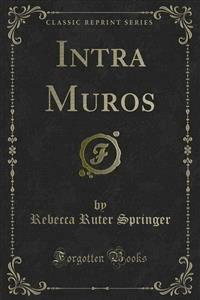
Intra Muros is Rebecca Ruter Springer's luminous first-person testament of a convalescent soul ushered beyond death's threshold. Framed as a vision rather than allegory, the narrative guides readers through gardens, homes of rest, halls of learning, and waters of life where love, growth, and service continue. Its devotional prose blends Victorian domestic realism with eschatological speculation, offering concrete textures: music, companionship, purposeful labor, without polemics. Set within a lineage from Dante to Bunyan and, nearer her day, Elizabeth Stuart Phelps's The Gates Ajar, the book domesticates heaven while resisting rigid dogma. Springer, an American Christian writer of the late nineteenth century, composed the work after a debilitating illness, treating the experience not as sensational memoir but as pastoral consolation. Immersion in evangelical piety, bereavement culture, and women's domestic writing shapes the vision's emphasis on kinship, healing, and moral continuance, yielding a theologically modest yet imaginatively confident picture of perfected life. Readers seeking a consoling portrait of heaven - students of Christian spirituality, pastors, grief counselors, and scholars of Victorian religion alike - will find Intra Muros both tender and probing. It rewards slow reading and conversation, not for dogmatic certainty, but for its humane imagination of love's work continuing "within the gates". Quickie Classics summarizes timeless works with precision, preserving the author's voice and keeping the prose clear, fast, and readable—distilled, never diluted. Enriched Edition extras: Introduction · Synopsis · Historical Context · Brief Analysis · 4 Reflection Q&As · Editorial Footnotes.
Das E-Book können Sie in Legimi-Apps oder einer beliebigen App lesen, die das folgende Format unterstützen:
Veröffentlichungsjahr: 2026
Ähnliche
















Intra Muros (Summarized Edition)
Table of Contents
Introduction
Between the ache of separation and the hope of reunion, Intra Muros imagines the soul’s passage into a home both tenderly familiar and transformatively new. Rebecca Ruter Springer’s beloved work gathers the longings and consolations of faith into a serene vision of the life to come, one that speaks not in argument but in invitation. Without arguing doctrine or chronology, the narrative lingers on textures of belonging—garden paths, quiet rooms, purposeful companionship—so that the afterlife feels less remote and more relational. Its enduring power comes from this intimate scale: the grand question of eternity approached through the steady rhythms of care, rest, and love.
First published in the late nineteenth century and often reissued under the titles Within the Gates or Within Heaven’s Gates, Intra Muros stands within the tradition of Christian visionary literature. Written by the American author Rebecca Ruter Springer, it offers a sustained, first-person portrayal of the afterlife framed as an experiential account rather than a theological treatise. The setting is a heavenly country rendered with domestic warmth and civic breadth, a place of welcome rather than spectacle. Its publication history in devotional circles helped it reach readers seeking comfort and guidance, and its plainspoken style positioned it as a companionable book for private contemplation.
At its simplest, the premise follows a traveler who awakens beyond earthly life and receives a gentle orientation to that realm. The voice is reflective and observant, balancing wonder with humility, and the pacing is unhurried, allowing the reader to dwell alongside the narrator in spaces of rest, learning, and service. Springer’s prose favors concrete, homely details over abstraction, so the reading experience feels like being led by the hand through rooms and gardens rather than surveying a map. The tone is consoling, often tender, and the scenes unfold with a quiet confidence that invites meditation more than analysis.
Among the book’s central themes are homecoming, the continuity of personal identity, and the shaping power of love. The afterlife appears as a community ordered toward growth, where rest and purpose are held in creative balance. The narrative emphasizes healing—of memory, desire, and relationship—without resorting to sensationalism or fear. It suggests that maturity is not halted by death but clarified, and that companionship and service retain dignity in new forms. While the story is resolutely Christian, its stress on hospitality, learning, and mutual care broadens its appeal, foregrounding virtues that resonate across traditions and invite readers into hopeful reflection.
Springer’s choices of image and cadence reveal the sensibilities of her era while remaining surprisingly supple today. Domestic motifs—houses, meals, music, walks—carry moral weight, reflecting a nineteenth-century conviction that holiness is cultivated in ordinary patterns of attention. Yet the book avoids rigid systems, preferring the patience of scene over the pressure of argument. This allows readers to inhabit a vision rather than debate a program. The narrative’s guided movement through a city-like environment keeps the focus on relationship and vocation, suggesting that fulfillment lies not in escape from creaturely life but in its transfigured continuities.
For contemporary readers navigating grief, caregiving, or the uncertainties of illness, Intra Muros offers a vocabulary of consolation that is neither sentimental nor severe. Its images of welcome, meaningful activity, and ongoing learning counter both nihilism and shallow optimism, presenting hope as practiced attention to goodness. The book also models how spiritual imagination can shape ethical life in the present, encouraging gentleness, patience, and service. Readers interested in afterlife narratives, religious memoir, or the history of devotional literature will find here an accessible entry point that respects complexity while remaining pastorally wise and emotionally steady.
Approached without haste, this narrative yields layers of comfort and challenge, inviting readers to inhabit a future shaped by love in order to live more faithfully now. Let its measured descriptions and humane tone set the pace, and allow the scenes to work as parables of presence rather than puzzles to be solved. Intra Muros does not attempt to close the mysteries it opens; it offers companionship at the threshold and a reminder that hope moves by small steps. In returning to its pages, many discover not new information about heaven, but a deepened capacity for attention, gratitude, and peace.
Synopsis
Intra Muros, by Rebecca Ruter Springer, is a late nineteenth-century devotional narrative presented as a vivid vision experienced during grave illness. Framed in the first person, it unfolds not as doctrine but as a consoling account of a soul's entrance into the life to come. Springer's narrator records scenes of welcome, rest, and ordered beauty intended to comfort the living rather than to argue theology. The work proceeds quietly, with descriptive episodes that build a coherent picture of a compassionate heaven. Often republished and cherished in pastoral settings, it guides readers step by step through impressions of peace, belonging, and purposeful growth.
The narrative opens with the narrator awakening beyond death in a landscape of light, water, and tender care. A trusted guide receives her with calm assurance and leads her to a dwelling that feels both new and familiar, set near a shining river and sheltered gardens. Physical weakness falls away, replaced by repose that is neither sleep nor oblivion but restorative stillness. The emphasis is on welcome within well-ordered boundaries, evoked by the book's title, as if entering a protected city. Early scenes establish a mood of gratitude and quiet awe, easing the transition from earthly struggle to unhurried recovery.
As strength returns, the narrator visits places devoted to healing, instruction, and the cultivation of gifts. She observes that spiritual growth continues, not as a sudden transformation but as patient refinement guided by wise attendants. Those wearied by pain or fear find gentle treatment; young ones receive education suited to their promise; lovers of art and music discover ways to practice their callings without rivalry. The scenes linger on kind discipline and mutual encouragement, suggesting a heaven where character is completed through learning. This sustained attention to restoration gives the book its central rhythm of movement from sorrow to wholeness.
Reunion is portrayed as deepened relationship rather than mere recognition. Family and friends appear, converse, and help the narrator understand what endures from earthly life. Differences of background or denomination recede before shared affection and common pursuit of goodness. Conversations recall events on earth without bitterness, interpreting them in a more generous light while keeping personal responsibility intact. The community's harmony is practical, shown in everyday companionship, hospitality, and cooperative tasks. The narrator's identity clarifies through these bonds, as she discovers how love matures when freed from anxiety. The interpersonal focus anchors grand scenery in lived, relational experience.




