


139,99 €
Mehr erfahren.
- Herausgeber: John Wiley & Sons
- Kategorie: Wissenschaft und neue Technologien
- Sprache: Englisch
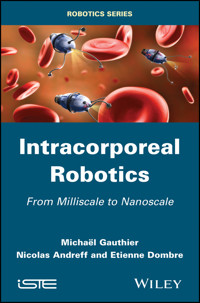
A promising long-term evolution of surgery relies on intracorporeal microrobotics. This book reviews the physical and methodological principles, and the scientific challenges to be tackled to design and control such robots. Three orders of magnitude will be considered, justified by the class of problems encountered and solutions implemented to manipulate objects and reach targets within the body: millimetric, sub-millimetric in the 10- 100 micrometer range, then in the 1-10 micrometer range. The most prominent devices and prototypes of the state of the art will be described to illustrate the benefit that can be expected for surgeons and patients. Future developments nanorobotics will also be discussed.
Sie lesen das E-Book in den Legimi-Apps auf:
Seitenzahl: 271
Veröffentlichungsjahr: 2014
Ähnliche



















Table of Contents
Introduction
Chapter 1. Intracorporeal Millirobotics
1.1. Introduction
1.2. Principles
1.3. Scientific issues
1.4. Examples of devices
1.5. Conclusion
Chapter 2. Intracorporeal Microrobotics
2.1. Introduction
2.2. Novel paradigms for intracorporeal robotics
2.3. Methods
2.4. Devices
2.5. Conclusion
Chapter 3. In vitro Non-Contact Mesorobotics
3.1. Introduction
3.2. Principles
3.3. Scientific challenges
3.4. Experimental devices
3.5. Conclusion
Chapter 4. Toward Biomedical Nanorobotics
4.1. Applicative challenges
4.2. Scientific challenges
Bibliography
Index
First published 2014 in Great Britain and the United States by ISTE Ltd and John Wiley & Sons, Inc.
Apart from any fair dealing for the purposes of research or private study, or criticism or review, as permitted under the Copyright, Designs and Patents Act 1988, this publication may only be reproduced, stored or transmitted, in any form or by any means, with the prior permission in writing of the publishers, or in the case of reprographic reproduction in accordance with the terms and licenses issued by the CLA. Enquiries concerning reproduction outside these terms should be sent to the publishers at the undermentioned address:
ISTE Ltd27-37 St George’s RoadLondon SW19 4EUUK
www.iste.co.uk
John Wiley & Sons, Inc.111 River StreetHoboken, NJ 07030USA
www.wiley.com
© ISTE Ltd 2014The rights of Michaël Gauthier, Nicolas Andreff and Etienne Dombre to be identified as the author of this work have been asserted by them in accordance with the Copyright, Designs and Patents Act 1988.
Library of Congress Control Number: 2013957115
British Library Cataloguing-in-Publication DataA CIP record for this book is available from the British LibraryISBN 978-1-84821-371-5
Introduction
For almost 30 years, research in medical robotics has led to many prototypes that have been validated technically, and some clinically. There are many specialties in this regard. Orthopedics, neurosurgery, endoscopic microsurgery (mainly gynecology, urology, fetal surgery, etc.), cardiac, thoracic and vascular surgery, ear, nose and throat (ENT) surgery, etc., are a few among others.
It is clear that robotics may facilitate surgical approaches such as minimally invasive surgery (MIS), natural orifice transluminal endoscopic surgery (NOTES), single port access (SPA) surgery and interventional radiology, and it is very promising in microsurgery. We list in Table I.1 some benefits for the patient and the surgeon of robots in the operating room (OR). To summarize, surgical robotics may contribute to less invasive and more accurate surgical gestures. It may also be useful in transcending human limitations.
Considering the benefits, it is surprising that only a few prototypes have managed to find their way into OR or medical offices. Several reasons are generally raised of which a few of the most important are given below:
– The cost issue: the cost effectiveness of robotic systems has not yet been proved. Several factors worked against it: the cost of the OR is increased; a technical team is required; the surgical team has to be trained; the setup and ‘skin-to-skin’ times are longer than conventional procedure. The compatibility with the cluttered environment of the OR should also be improved: the robots are still too bulky; quite often, the weight, dimension and footprint of the robot are out of proportion with respect to the force it has to exert and the workspace it has to cover during an operation.
– The clinical added value: as noted in the report of the IARP Workshop on Medical Robotics1, the medical added value has to be improved: Medical robotics suffers from a “chicken and egg” phenomenon in the sense that systems need to be developed before they can be tested clinically, but only through the latter will their true effectiveness and utility be proven […].
– Safety issues: a medical robot is a complex system that consists of (1) an articulated and motorized mechanical structure, (2) a human–machine interface, (3) electronic components and (4) a software controller. These components are used to perform operations in a constrained and not fully structured environment, inside and/or outside of the patient’s body, in cooperation with the surgeon, and in the presence of the medical staff. Thus, it is easy to understand that a system failure or dysfunction can be extremely critical [SAN 13b].
This analysis pushes for the development of a new generation of robotic systems along three major challenges [DOM 12b]:
– Cost: they will be less bulky and less expensive than the current systems.
– Ergonomics: they will be of plug and play-type like most tools and equipment in the OR in order to minimize the installation time. They will also be easy to use in order not to require special technical skills of the staff. Moreover, the sensors will be sterilizable, otherwise disposable, and highly integrated into the architecture of these systems.
– Safety and medical added value: they will be increasingly less invasive and will not significantly extend the duration of the intervention. Moreover, the doctor/robot interfaces will be specifically designed to facilitate the implementation while ensuring that the level of operational safety is as high as possible.
Table I.1.Medical robots: benefits for the surgeons and patients
Fields of application
Potential benefits to the surgeon
Potential benefits to the patient
– Orthopedic surgery
– Precision– Possibility of carrying out complex cutting, drilling, milling– Integration of multimodal preoperative and intraoperative information (vision, force)– safety (virtual fixture)
– Less revision surgery– Expected longer lifetime of prostheses
– Minimally invasive endoscopic surgery
– 3rd hand– Greater comfort– Elimination of the fulcrum effect– Additional internal mobilities– Compensation of physiological movements
– Toward an increasingly less invasive surgery and without visible scars
– Neurosurgery– Interventional radiology– Radiotherapy
– Precision– Safety (avoidance of vital structures)– Compensation of physiological movements– Exposure to radiations– Precise spatial tracking of the dosimetric planning
– Invasiveness– Early treatment of increasingly smaller tumors– Exposure to radiations of healthy tissues
– Microsurgery
– Downscaling of the forces and displacements– Surgeon’s tremor filtering
– Development of innovative procedures beyond the accuracy limits of the surgeon
The above specifications (cost, ergonomics and safety) imply that the future surgical robots should be smaller and dedicated to a limited number of functionalities with a certain level of autonomy appropriate for the complexity of the task they are supposed to achieve. In any case, the surgeon must maintain control of the gesture no matter what, at any time of the operative or exploratory procedure. From this observation, we understand that for many surgical applications, it makes sense to integrate the mobilities and the sensors inside the body rather than outside. In other words, rather than manipulating a multimillennial rigid instrument (like scissors or clamps) with an extracorporeal robot, the idea is to develop intracorporeal robots, offering at least the same performance of movement quality, safety and interaction with the doctor.
Surgical robotics raises several ethical issues that should be addressed very early in the design process. Some of them are covered by regulations already applicable in the pharmaceutical and medical equipment industry. For intracorporeal robotics, specific issues arising from miniaturization should also be addressed, but they have not yet received the attention they require. The IEEE Robotics and Automation Society2 has launched a Technical Committee on Roboethics3 to provide a “framework for taking care of ethical implications of robotics research”. A biannual workshop dedicated to the subject has been organized in conjunction with the IEEE International Conference on Robotics and Automation (ICRA) from 2005 to 2011. A Workshop on Legal, Economic and Socio-Ethical Implications for the Next Generation of Robots4 was held at ICRA 2013. It was organized by the partners of the FP7 project RoboLaw5. One can also refer to the pioneering initiative of G. Veruggio6 in the framework of the European Robotics Research Network (EURON) and the work of R.C. Arkin7 at Georgia Tech as other entry points to the subject.
Crossing the border of the skin opens up new clinical horizons but requires overcoming several technical barriers. These barriers depend on the size of the biological objects to be manipulated: organs, tissues, cells and internal components of cells. The latter are at nanoscale while the cell size is mostly below 100 μm and usually around 5 to 10 μm. The physical principles that describe the behavior of the objects are different according to their size: the dynamics of large micro-objects (e.g. 100 μm) is limited by inertia while the dynamics of smaller objects (e.g. 1 μm) is limited by viscosity. It is then convenient to divide the world into the following groups:
– The macroworld is dominated by volume effects (inertia and weight).
– In the microworld, volume effects (dielectrophoresis and magnetophoresis), surface effects (van der Waals’ force) and linear effects (viscous force) are balanced.
– The nanoworld is dominated by surface effects and linear effects.
In this book, we will consider four scales of object sizes, which are justified by the class of problems encountered and the solutions implemented to manipulate objects and reach targets within the body (note that the size of the object has no evident relation to the size of the device that manipulates it):
– At milliscale (Chapter 1), the dimensions of the objects range from a few millimeters to a few centimeters, and the forces required to manipulate tissues range from a few millinewtons to several newtons. Most of the robotic systems at this scale use the manipulation principles of the macroworld.
– At microscale (Chapter 2), comprising objects below 1 mm up to 10 μm, the forces are in the order of tens of nanonewtons up to a few millinewtons. Original manipulation principles under magnetic field or by swimming in a liquid media have been validated.
– At mesoscale (Chapter 3), between 100 nm and 10 μm, the forces range from piconewtons to tens of nanonewtons. We have introduced this term to designate a scale where the contact with any tool could destroy the object, which requires implementing non-contact manipulation principles.
– At nanoscale (Chapter 4), between 1 nm and 100 nm, the manipulation of objects is still a challenge that will require a paradigm change. As will be discussed, progress will depend on multidisciplinary research bringing together biology, chemistry, robotics and, more widely, engineering sciences.
The book reviews the physical principles as well as the scientific and methodological challenges that have to be tackled to design and control intracorporeal robotic systems at each of the above-mentioned scales. The most prominent devices and prototypes of the state of the art are described in the first three chapters to illustrate the benefit that can be expected for surgeons and patients. In Chapter 4, we will discuss perspectives on nanorobotics.
To conclude this Introduction, let us recall that a robot is defined as “an actuated mechanism programmable in two or more axes with a degree of autonomy, moving within its environment, to perform intended tasks” (ISO 8373:2012 document). Devices that use robotic or mechatronic technologies or components found in robots but unable to carry out autonomous motion should be referred to differently (e.g. robotic system, robotic manipulator and robotic positioner). For the sake of simplicity, the term “robot” will be used more widely for any programmed, teleoperated or comanipulated device.
1http://www.nsf.gov/eng/roboticsorg/IARPMedicalRoboticsWorkshop Report.htm.
2http://www.ieee-ras.org/.
3http://www.ieee-ras.org/robot-ethics.
4http://www.robolaw.eu/ws_icra2013.htm.
5http://www.robolaw.eu/index.htm.
6http://www.veruggio.it/.
7http://www.cc.gatech.edu/aimosaic/faculty/arkin/.
Chapter 1
Intracorporeal Millirobotics
1.1. Introduction
Intracorporeal millirobots are at the boundary of conventional surgical robots that are installed in the operating room (OR) along the table or on the patient. They still work in the macroworld, where volumic forces and torques (such as weight) dominate. Under this designation, we mean devices with either partially or fully intracorporeal actuated degrees of freedom (DoFs). Their dimensions in the body can reach at the maximum a few tens of millimeters. The dimensions of the surgical site range from a few millimeters to a few centimeters; however, when it is mobile, the millirobot may cover a workspace of several cubic centimeters. The forces exerted on tissues by the robot range from a few millinewtons to several newtons, up to tens of newtons for retraction of organs or gripping a needle.
At this scale, many prototypes have been developed, even though very few of them have entered the OR. In many cases, they look like conventional robots for which rigid body kinematic models and vision-based or force-based control algorithms may be used. More or less, they could be seen as miniaturized versions of existing solutions.
Lesen Sie weiter in der vollständigen Ausgabe!
Lesen Sie weiter in der vollständigen Ausgabe!
Lesen Sie weiter in der vollständigen Ausgabe!
Lesen Sie weiter in der vollständigen Ausgabe!
Lesen Sie weiter in der vollständigen Ausgabe!




