


76,99 €
Mehr erfahren.
- Herausgeber: John Wiley & Sons
- Kategorie: Wissenschaft und neue Technologien
- Serie: Statistics in Practice
- Sprache: Englisch
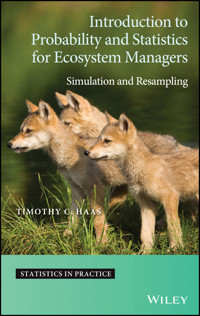
Explores computer-intensive probability and statistics for ecosystem management decision making
Simulation is an accessible way to explain probability and stochastic model behavior to beginners. This book introduces probability and statistics to future and practicing ecosystem managers by providing a comprehensive treatment of these two areas. The author presents a self-contained introduction for individuals involved in monitoring, assessing, and managing ecosystems and features intuitive, simulation-based explanations of probabilistic and statistical concepts. Mathematical programming details are provided for estimating ecosystem model parameters with Minimum Distance, a robust and computer-intensive method.
The majority of examples illustrate how probability and statistics can be applied to ecosystem management challenges. There are over 50 exercises – making this book suitable for a lecture course in a natural resource and/or wildlife management department, or as the main text in a program of self-study.
Key features:
- Reviews different approaches to wildlife and ecosystem management and inference.
- Uses simulation as an accessible way to explain probability and stochastic model behavior to beginners.
- Covers material from basic probability through to hierarchical Bayesian models and spatial/ spatio-temporal statistical inference.
- Provides detailed instructions for using R, along with complete R programs to recreate the output of the many examples presented.
- Provides an introduction to Geographic Information Systems (GIS) along with examples from Quantum GIS, a free GIS software package.
- A companion website featuring all R code and data used throughout the book.
- Solutions to all exercises are presented along with an online intelligent tutoring system that supports readers who are using the book for self-study.
Sie lesen das E-Book in den Legimi-Apps auf:
Seitenzahl: 365
Veröffentlichungsjahr: 2013
Ähnliche


















Table of Contents
Statistics in Practice
Title Page
Copyright
Dedication
List of figures
List of tables
Preface
Acknowledgments
List of abbreviations
Chapter 1: Introduction
1.1 The textbook's purpose
1.2 The textbook's pedagogical approach
1.3 Chapter summaries
1.4 Installing and running R Commander
1.5 Introductory R Commander session
1.6 Teaching probability through simulation
1.7 Summary
Chapter 2: Probability and simulation
2.1 Introduction
2.2 Basic probability
2.3 Random variables
2.4 Joint distributions
2.5 Influence diagrams
2.6 Advantages of influence diagrams in ecosystem management
2.7 Two ecosystem management Bayesian networks
2.8 Influence diagram sensitivity analysis
2.9 Drawbacks to influence diagrams
Chapter 3: Application of probability: Models of political decision making in ecosystem management
3.1 Introduction
3.2 Influence diagram models of decision making
3.3 Rhino poachers: A simplified model
3.4 Policymakers: A simplified model
3.5 Conclusions
Chapter 4: Statistical inference I: Basic ideas and parameter estimation
4.1 Definitions of some fundamental terms
4.2 Estimating the PDF and CDF
4.3 Measures of central tendency and dispersion
4.4 Sample quantiles
4.5 Distribution of a statistic
4.6 The central limit theorem
4.7 Parameter estimation
4.8 Interval estimates
4.9 Basic regression analysis
4.10 General methods of parameter estimation
Chapter 5: Statistical inference II: Hypothesis tests
5.1 Introduction
5.2 Hypothesis tests: General definitions and properties
5.3 Power
5.4 t-Tests and a test for equal variances
5.5 Hypothesis tests on the regression model
5.6 Brief introduction to vectors and matrices
5.7 Matrix form of multiple regression
5.8 Hypothesis testing with the delete-d jackknife
Chapter 6: Introduction to spatial statistics
6.1 Overview
6.2 Spatial statistics and GIS
6.3 QGIS
6.4 Continuous spatial processes
6.5 Spatial point processes
6.6 Continuously valued multivariate processes
Chapter 7: Introduction to spatio-temporal statistics
7.1 Introduction
7.2 Representing time in a GIS
7.3 Spatio-temporal prediction: MCSTK
7.4 Multivariate processes
7.5 Spatio-temporal point processes
7.6 Marked spatio-temporal point processes
Chapter 8: Application of statistical inference: Estimating the parameters of an individual-based model
8.1 Overview
8.2 A simple IBM and its estimation
8.3 Fitting IBMs with MSHD
8.4 Further properties of parameter estimators
8.5 Parameter confidence intervals for a nonergodic model
8.6 Rhino-supporting ecosystem influence diagram
8.7 Estimation of rhino IBM parameters
Chapter 9: Guiding an influence diagram's learning
9.1 Introduction
9.2 Online learning of Bayesian network parameters
9.3 Learning an influence diagram's structure
9.4 Feedback-based learning for group decision-making diagrams
9.5 Summary and conclusions
Chapter 10: Fitting and testing a political–ecological simulator
10.1 Introduction
10.2 EMT simulator construction
10.3 Consistency analysis estimates of simulator parameters
10.4 MPEMP computation
10.5 Conclusions
Appendix
Simpson's rule in two dimensions
References
Index
Statistics in Practice
Statistics in Practice
Series Advisors
Human and Biological Sciences
Earth and Environmental Sciences
Industry, Commerce and Finance
Founding Editor
Statistics in Practice is an important international series of texts which provide detailed coverage of statistical concepts, methods and worked case studies in specific fields of investigation and study.
With sound motivation and many worked practical examples, the books show in down-to-earth terms how to select and use an appropriate range of statistical techniques in a particular practical field within each title's special topic area.
The books provide statistical support for professionals and research workers across a range of employment fields and research environments. Subject areas covered include medicine and pharmaceutics; industry, finance and commerce; public services; the earth and environmental sciences, and so on.
The books also provide support to students studying statistical courses applied to the above areas. The demand for graduates to be equipped for the work environment has led to such courses becoming increasingly prevalent at universities and colleges.
It is our aim to present judiciously chosen and well-written workbooks to meet everyday practical needs. Feedback of views from readers will be most valuable to monitor the success of this aim.
A complete list of titles in this series appears at the end of the volume.
This edition first published 2013
© 2013 John Wiley & Sons, Ltd
Registered office
John Wiley & Sons Ltd, The Atrium, Southern Gate, Chichester, West Sussex, PO19 8SQ, United Kingdom
For details of our global editorial offices, for customer services and for information about how to apply for permission to reuse the copyright material in this book please see our website at www.wiley.com.
The right of the author to be identified as the author of this work has been asserted in accordance with the Copyright, Designs and Patents Act 1988.
All rights reserved. No part of this publication may be reproduced, stored in a retrieval system, or transmitted, in any form or by any means, electronic, mechanical, photocopying, recording or otherwise, except as permitted by the UK Copyright, Designs and Patents Act 1988, without the prior permission of the publisher.
Wiley also publishes its books in a variety of electronic formats. Some content that appears in print may not be available in electronic books.
Designations used by companies to distinguish their products are often claimed as trademarks. All brand names and product names used in this book are trade names, service marks, trademarks or registered trademarks of their respective owners. The publisher is not associated with any product or vendor mentioned in this book.
Limit of Liability/Disclaimer of Warranty: While the publisher and author have used their best efforts in preparing this book, they make no representations or warranties with respect to the accuracy or completeness of the contents of this book and specifically disclaim any implied warranties of merchantability or fitness for a particular purpose. It is sold on the understanding that the publisher is not engaged in rendering professional services and neither the publisher nor the author shall be liable for damages arising herefrom. If professional advice or other expert assistance is required, the services of a competent professional should be sought.
Library of Congress Cataloging-in-Publication Data
Haas, Timothy C.
Introduction to probability and statistics for ecosystem managers : simulation and resampling / Timothy C. Haas, Sheldon B. Lubar.
pages cm
Includes bibliographical references and index.
ISBN 978-1-118-35768-2 (cloth)
1. Ecosystem management – Statistical methods. I. Lubar, Sheldon B. II. Title.
QH77.3.S73H33 2013
333.72 – dc23
2013002861
A catalogue record for this book is available from the British Library.
ISBN: 978-1-118-35768-2
List of figures
List of tables
Preface
This textbook will be useful for readers who are either in training for or are in positions having to do with the management of environmental systems and/or wildlife populations wherein one of the decreed management goals is the protection of some part of the ecosystem, for example, wildlife that is at threat from anthropogenic forces. Examples of such positions include being a member of a forestry, fish and game, national parks, or environmental protection agency—or a wildlife advocacy organization such as the African Wildlife Foundation or the World Wildlife Fund. The prerequisites needed for grasping the ideas presented in this textbook are some familiarity with natural resources and a precalculus course.
This textbook has the following pedagogical features:
Several items are original to this textbook:
Acknowledgments
The author appreciates comments made on an early version of Chapter 10 by the participants of the 7th International Wildlife Ranching Symposium, Kimberley, South Africa, October 10–13, 2011.
List of abbreviations
m
-NN
m
-nearest-neighbor
AER
actual error rate
ANOVA
analysis of variance
BLUP
best linear unbiased predictor
CDF
cumulative distribution function
CPT
conditional probability table
CRS
coordinate reference system
CSR
complete spatial randomness
d.o.f.
degrees of freedom
DAG
directed acyclic graph
DL
description length
DM-group
decision-making group
EMAT
ecosystem management actions taxonomy
EMT
ecosystem management tool
EPA
Environment Protection Agency
ESA/NASA
European Space Agency/National Aeronautics and Space Administration
ESTDM
event-based spatio-temporal data model
FBLGDMD
feedback-based learning for group decision-making diagrams
FFT
fast Fourier transform
GIS
geographic information system
GLS
generalized least squares
GUI
graphical user interface
i.i.d.
independently and identically distributed
IBM
individual-based model
ICBEMP
Interior Columbia Basin Ecosystem Management Project
INTERCALV
intercalving interval
IQR
inter-quartile range
IUCN
International Union for Conservation of Nature
KECs
Key environmental correlates
LE
life expectancy
LOMAP
Local Model And Predictor
MA
maturation age
MCSTK
moving cylinder spatio-temporal kriging
MDLEP
minimum description length-evolutionary programming
MDL
minimum description length
MHD
minimum Hellinger distance
MLE
maximum likelihood estimate
MPEMP
most practical ecosystem management plan
MSHD
minimum simulated Hellinger distance
MSL
maximum simulated likelihood
MWRCK
moving window residual cokriging
MWRRK
moving window, regression, residual kriging
NEMBA
National Environmental Management: Biodiversity Act
NEMPAA
National Environmental Management: Protected Areas Act
NGO
nongovernmental organization
NP-hard
non-polynomial time hard
OC
operating characteristic
OGA
overall goal attainment
OITS
online intelligent tutoring system
OK
ordinary kriging
OLS
ordinary least squares
PAC
protected area complex
PA
protected area
probability density function
PDPF
probability density–probability function
PMF
probability mass function
POM
pattern-oriented modeling
Q-Q
Quantile–Quantile
QGIS
quantum GIS
SPPP
spatial Poisson point process
SSE
error sum of squares
SSR
regression sum of squares
SST
total sum of squares
TOPS
Threatened and Protected Species
USDA
US Department of Agriculture
WKT
well-known text
Chapter 1
Introduction
1.1 The textbook's purpose
The book Improving Natural Resource Management: Ecological and Political Models (Haas, 2011), in pages 206–207, provides a list of areas that ecosystem managers need stronger training in. This textbook provides such instruction in probability, statistics, simulation, and resampling methods. It is designed to be used either as a classroom textbook or as the main text supporting a self-study regime (with web-based aids) by practicing ecosystem managers who are unable to attend an instructor-led course.
Topics salient to ecosystem management, but rarely covered in introductory statistics textbooks, are introduced. These include
Influence diagrams are Bayesian networks that have decision and utility nodes. IBMs are also called .
Lesen Sie weiter in der vollständigen Ausgabe!
Lesen Sie weiter in der vollständigen Ausgabe!
Lesen Sie weiter in der vollständigen Ausgabe!
Lesen Sie weiter in der vollständigen Ausgabe!
Lesen Sie weiter in der vollständigen Ausgabe!
Lesen Sie weiter in der vollständigen Ausgabe!
Lesen Sie weiter in der vollständigen Ausgabe!
Lesen Sie weiter in der vollständigen Ausgabe!
Lesen Sie weiter in der vollständigen Ausgabe!
Lesen Sie weiter in der vollständigen Ausgabe!
Lesen Sie weiter in der vollständigen Ausgabe!
Lesen Sie weiter in der vollständigen Ausgabe!
Lesen Sie weiter in der vollständigen Ausgabe!




