


41,99 €
Mehr erfahren.
- Herausgeber: John Wiley & Sons
- Kategorie: Wissenschaft und neue Technologien
- Sprache: Englisch
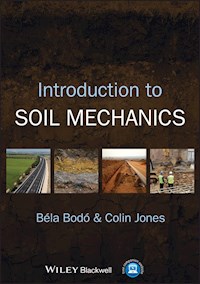
INTRODUCTION TO SOIL MECHANICS
Introduction to Soil Mechanics covers the basic principles of soil mechanics, illustrating why the properties of soil are important, the techniques used to understand and characterise soil behaviour and how that knowledge is then applied in construction. The authors have endeavoured to define and discuss the principles and concepts concisely, providing clear, detailed explanations, and a wellillustrated text with diagrams, charts, graphs and tables. With many practical, worked examples and end-of-chapter problems (with fully worked solutions available at www.wiley.com/go/bodo/soilmechanics) and coverage of Eurocode 7, Introduction to Soil Mechanics will be an ideal starting point for the study of soil mechanics and geotechnical engineering.
This book’s companion website is at
www.wiley.com/go/bodo/soilmechanics and offers invaluable resources for both students and lecturers:
- Supplementary problems
- Solutions to supplementary problems
Sie lesen das E-Book in den Legimi-Apps auf:
Seitenzahl: 430
Veröffentlichungsjahr: 2013
Ähnliche



















Contents
Preface
List of Symbols
Chapter 1: Soil Structure
1.1 Volume relationships
1.2 Weight–volume relations
1.3 Alteration of soil structure by compaction
1.4 California bearing ratio (CBR) test
1.5 The pycnometer
Supplementary problems for Chapter 1
Chapter 2: Classification of Cohesive Soils
2.1 Atterberg Limits
2.2 Consistency indices
2.3 Classification of soils by particle size
Supplementary problems for Chapter 2
Chapter 3: Permeability and Seepage
3.1 Coefficient of permeability (k)
3.2 Seepage velocity (υS)
3.3 Determination of the value of k
3.4 Field pumping tests
3.5 Permeability of stratified soil
3.6 Flow nets
3.7 Erosion due to seepage
3.8 Prevention of piping
3.9 Flow net for earth dams
Supplementary problems for Chapter 3
Chapter 4: Pressure at Depth Due to Surface Loading
4.1 Concentrated point load
4.2 Concentrated line load
4.3 Uniform strip loading (Michell’s solution)
4.4 Bulb of pressure diagrams
4.5 Vertical pressure under triangular strip load
4.6 Vertical pressure under circular area
4.7 Rectangular footing
4.8 Footings of irregular shape
4.9 Pressure distribution under footings
4.10 Linear dispersion of pressure
Supplementary problems for Chapter 4
Chapter 5: Effective Pressure (σ′)
5.1 Unloaded state
5.2 Loaded state
5.3 Flooded state
5.4 Types of problem
5.5 Effect of seepage on shallow footings
5.6 Ground water lowering (at atmospheric pressure)
5.7 Reduction of artesian pressure
5.8 Capillary movement of water
Supplementary problems for Chapter 5
Chapter 6: Shear Strength of Soils
6.1 Coulomb-Mohr Theory
6.2 Stress path (Lambe, 1964)
6.3 Effect of saturation
6.4 Measurement of shear strength
6.5 Thixotropy of clay
6.6 Undrained cohesion and overburden pressure
Supplementary problems for Chapter 6
Chapter 7: Consolidation and Settlement
7.1 Consolidation
7.2 The pressure-voids ratio curve
7.3 Forms of the σ′ –e curve
7.4 Coefficient of compressibility (av)
7.5 Coefficient of volume change (mv)
7.6 Estimation of settlement
7.7 Rate of consolidation
7.8 Pore pressure isochrones
7.9 Coefficient of permeability (k)
7.10 Time from similarity
7.11 Total settlement
Supplementary problems for Chapter 7
Chapter 8: Lateral Earth Pressure
8.1 Resistance to active expansion
8.2 The value of K0
8.3 Stress path representation (Lambe 1967)
8.4 Rankine’s theory of cohesionless soil
8.5 Rankine–Bell theory for c – ϕ soil
8.6 Rankine–Bell theory for c-soil
8.7 Pressure–force and its line of action
8.8 Wall supporting sloping surface
8.9 General formulae for c – ϕ soil
8.11 Height of unsupported clay
8.12 Wedge theories
8.13 Stability of retaining walls
8.14 Sheet piles
8.15 Anchored sheet pile walls
8.16 Effect of ground water
8.17 Stability of deep trenches
8.18 Bentonite slurry support
Supplementary problems for Chapter 8
Chapter 9: Bearing Capacity of Soils
9.1 Terminology
9.2 Shallow strip footing
9.3 Influence of footing shape
9.4 Shallow rectangular footing
9.5 Deep foundations
9.6 Standard penetration test (SPT)
9.7 Pile foundations (z/B>5)
9.8 Some reasons for choosing piles
9.9 Some reasons for not choosing piles
9.10 Effects necessitating caution
9.11 Negative skin friction
9.12 Stress distribution around piles
9.13 Load-carrying capacity of piles
9.14 End bearing resistance and SPT
9.15 Influence of pile section on Qu
9.16 Group of piles
Supplementary problems for Chapter 9
Chapter 10: Stability of Slopes
10.1 Short-term and long-term stability
10.2 Total stress analysis (cohesive soils)
10.3 Effective stress analysis (cohesive soils)
10.4 Stability of infinite slopes
Supplementary problems for Chapter 10
Chapter 11: Eurocode 7
11.1 Introduction
11.2 Recommended units
11.3 Limit states
11.4 Design procedures
11.5 Verification procedures
11.6 Application of partial factors
Appendix A: Mass and Weight
Appendix B: Units, Conversion Factors and Unity Brackets
Appendix C: Simpson’s Rule
Appendix D: Resultant Force and Its Eccentricity
Appendix E: References
Index
This edition first published 2013 © 2013 by John Wiley & Sons, Ltd
Registered OfficeJohn Wiley & Sons, Ltd, The Atrium, Southern Gate, Chichester, West Sussex, PO19 8SQ, UnitedKingdom.
Editorial Offices9600 Garsington Road, Oxford, OX4 2DQ, United Kingdom.The Atrium, Southern Gate, Chichester, West Sussex, PO19 8SQ, United Kingdom.
For details of our global editorial offices, for customer services and for information about how to apply for permission to reuse the copyright material in this book please see our website at www.wiley.com/wiley-blackwell.
The right of the author to be identified as the author of this work has been asserted in accordance with the UK Copyright, Designs and Patents Act 1988.
All rights reserved. No part of this publication may be reproduced, stored in a retrieval system, or transmitted, in any form or by any means, electronic, mechanical, photocopying, recording or otherwise, except as permitted by the UK Copyright, Designs and Patents Act 1988, without the prior permission of the publisher.
Designations used by companies to distinguish their products are often claimed as trademarks. All brand names and product names used in this book are trade names, service marks, trademarks or registered trademarks of their respective owners. The publisher is not associated with any product or vendor mentioned in this book.
Limit of Liability/Disclaimer of Warranty: While the publisher and author(s) have used their best efforts in preparing this book, they make no representations or warranties with respect to the accuracy or completeness of the contents of this book and specifically disclaim any implied warranties of merchantability or fitness for a particular purpose. It is sold on the understanding that the publisher is not engaged in rendering professional services and neither the publisher nor the author shall be liable for damages arising herefrom. If professional advice or other expert assistance is required, the services of a competent professional should be sought.
Library of Congress Cataloging-in-Publication Data
Bodo, Bela, (Engineer)Introduction to soil mechanics / Bela Bodo, Colin Jones.pages cmIncludes bibliographical references and index.
ISBN 978-0-470-65943-4 (pbk. : alk. paper) – ISBN 978-1-118-55387-9 (emobi) –ISBN 978-1-118-55388-6 (epub) – ISBN 978-1-118-55389-3 (epdf) 1. Soil mechanics. I. Title.TA710.B617 2013624.1′5136–dc23
2012040913
A catalogue record for this book is available from the British Library.
Wiley also publishes its books in a variety of electronic formats. Some content that appears in print may not be available in electronic books.
Cover image courtesy of Shuttlestock.comCover design by Steve Thompson
Preface
This book is intended to introduce the subject to students studying for BTEC Higher National Certificate/Diploma in Civil Engineering and Building Studies or for a Degree in Civil Engineering. It should also be practical reference to Architects, Geologists, Structural and Geotechnical Technicians.
The primary aim is to provide a clear understanding of the basic concepts of Soil Mechanics. We endeavoured to avoid the temptation of over-elaboration by providing excessively detailed text, unnecessary at this early stage of technical studies.
The purpose of this publication is threefold:
1. To introduce the student to the basics of soil mechanics.
2. To facilitate further advanced study.
3. To provide reference Information.
In order to satisfy the above requirements, the concepts of the subject are defined concisely, aided by diagrams, charts, graphs, tables and worked examples as necessary.
The text may appear to be excessively analytical at first sight, but all formulas are derived in terms of basic mathematics, except for a few requiring complicated theory, for those interested in working from first principles. They can be applied however, without reference to the derivation. The expressions are numbered and referred to throughout the text.
There are numerous worked examples on each topic as well as supplementary problems. All examples and problems are solved, many of them interrelated so that solutions can be compared and verified by means of several methods.
Some soil testing procedures are outlined only, as there are a number of excellent, detailed, specialized books and laboratory manuals available to cover this part of the subject.
There is some emphasis on the units employed and on the difference between mass and weight. This subject is discussed in Appendix A.
Béla Bodó and Colin Jones
Dedication
“I dedicate this book to my late wife Dorie.”
Béla Bodó
Acknowledgments
We wish to express our appreciation to Mr. Norman Seward, Senior Lecturer in Civil Engineering at the University of Wales College, Newport for his technical advice as to the presentation of the subject.
We are also grateful to Mr. Gregory Williams for his help in the production of this book.
We would like to thank ELE International for their support in providing product images.
List of Symbols
Chapter 1
CBR
California bearing ratio
Cr
Relative compaction
Dr
Relative Density
e
Voids ratio
Gs
Specific gravity
k
CBR Load-ring factor
M
Total Mass of sample
m
Moisture (water) content
mo
Optimum moisture content
Ms
Mass of solids
Mw
Mass of water
n
Porosity
P
CBR applied force
Pa
Percentage of air voids
Q
CBR Load gauge reading
Sr
Degree of saturation
V
Total volume of sample
Va
Volume of air
Vc
Volume of calibrating cylinder
Vs
Volume of solids
Vv
Volume of voids
Vw
Volume of water
W
Total weight of sample
Ws
Weight of solids
Ww
Weight of water
δ
CBR Penetration distance (delta)
γ
Bulk weight density (Gamma)
γ′
Submerged weight density
γd
Dry Weight density
γd
Dry Unit weight to be achieved by compaction
γs
Weight density of solids
γsat
Saturated weight density
ρ
Bulk mass density
ρd
Dry mass density
ρsat
Saturated mass density
ρ′
Submerged mass density
ρs
Mass density of solids
Chapter 2
Cd
Correction for dispersing agent
Cm
Meniscus correction
D
Equivalent particle diameter
D10
Effective size of a particle
f
Specific Volume change
H
Height from the top of the bulb to surface
hb
Length of bulb
HR
Height of centre of bulb to surface
LI
Liquidity index
LL
Liquid limit
Mp
Mass passing the nth sieve
Mr
Mass retained on the nth sieve
mT
Temperature correction
N
Number of blows
PI
Plasticity index
PL
Plastic limit
Pn
Percentage of soil passing the nth sieve
R
Mixing ratio
R′h
Recorded hydrometer reading
Rh
Corrected hydrometer reading
RI
Relative consistence index
SL
Shrinkage limit
T
Temperature
t
Time
U
Uniformity coefficient
u
Velocity of sedimentation
Vb
Volume of hydrometer bulb
Vo
Volume of over-dried specimen
≈
Volume at SL
x
Magnitude of linear shrinkage or swelling
Z
Saturation limit
η
Dynamic viscosity <eta>
Chapter 3
A
Cross-sectional area of specimen
a
Cross-sectional area of standpipe
As
Cross-sectional area of solids in specimen
Av
Cross-sectional area of voids in specimen
EPL
Equipotential line
FL
Flow Line
Fs
Factor of safety
GL
Ground level
GWL
Groundwater level (Water Table)
h
Head loss
HT
Total head at x
Hx
Head loss to point x
hx
Pressure head at x
i
Hydraulic gradient
iav
Average hydraulic gradient
ic
Critical hydraulic gradient
ie
Exit gradient
k
Coefficient of permeability
L
Length of flow path
Ne
Number of squares (head drops)
Nf
Number of flow channels
Nx
Number of head drops to point x
P
Hydrostatic force
Q
Flowrate
q
Quantity of flow in time (t)
R
Radius of influence
r
Radius to observation well
ro
Radius of central well
S
Seepage force
ux
Seepage pore pressure at x
Δh
Head Loss between equipotential line
υ
Discharge velocity
υs
Seepage velocity
Chapter 4
I
Influence factor
n
Number of elements on the Newmark chart
Q
Concentrated point load
q
Uniformly distributed load (UDL)
r
Radius
z
Depth
σ
Horizontal pressure
σv
Vertical pressure
τ
Shear stress
Chapter 5
dh
Total deformation of specimen of thickness h
hA
Artesian pressure head
hc
Capillary head
hs
Seepage pressure head
ic
Critical hydraulic gradient
mE
Equilibrium moisture content
mo
Optimum moisture content
pF
Soil suction index
PI
Plasticity index
Sr
Degree of saturation
Ss
Soil suction
T
Surface tension
u
Pore pressure
ucs
Pore pressure in the capillary fringe
uh
Static pore pressure at depth h
us
Seepage pore pressure
zc
Critical depth for piping
Δu
Small change in u
Δγ
Change in unit weight
Δσ
Small change in σ
Δσ ′
Small change in σ ′
δ
Deformation of specimen at time t
σ
Total pressure
σ ′
Effective pressure
σA
Artesian pressure
Chapter 6
A
Pore pressure coefficient
Pore pressure coefficient
B
Pore pressure coefficient
c
Cohesion
cu
Undrained shear strength
CD
Consolidated-drained test
CU
Consolidated-undrained test
ESP
Effective stress path
NCC
Normally consolidated clay
n
Proving ring constant
OCC
Over consolidated clay
p&q
Stress path coordinates
pf&qf
Stress path coordinates at failure
QU
Quick-undrained test
rx
Force dial reading at x
TSP
Total stress path
UU
Unconsolidated-undrained test
x
Strain gauge reading
Δud
Change in pore pressure due to Δσd
Δuc
Change in pore pressure due to Δσc
Δσc
Change in cell pressure
Δσd
Change in the deviator stress
ε
Strain at x
φ
Angle of friction
σn
Normal pressure
σx
Deviator stress at x
σu
Unconfined compression strength
τ
Shear stress
τf
Shear stress at failure
τp
Shear stress on a plain
τm
Maximum shear stress
Chapter 7
Ac
Area indicating completed consolidation
At
Area under an isochrone
av
Coefficient of compressibility
Cα
Coefficient of Secondary settlement () to consolidation
Cc
Compression index
Cv
Coefficient of consolidation
Dx
Dial reading at stage x
dHi
Initial settlement
E
Modulus of elasticity
e0
Initial voids ratio
ef
Final voids ratio
es
Voids ratio after swelling
ex
Voids ratio at stage x
H
Layer thickness
H0
Flow path
hx
Height of specimen at stage x
Ip
Influence factor
k
Coefficient of permeability
mv
Coefficient of volume change
OCR
Overconsolidation ratio
q
Bearing pressure
Tv
Time factor
t
Time
U
Average degree of consolidation
Uz
Degree of consolidation
u
Pore pressure at time t
u0
Initial pore pressure
ΔH
Long-term consolidation settlement
Δσ′
Effective consolidating pressure
δ
Depth factor (Delta)
μ
Poisson’s ratio (My)
σ′x
Effective pressure at stage x
Chapter 8
cu
Unconfined compression strength
cW
Adhesion between soil and wall
e
Eccentricity
Fφ
Factor of safety in terms of friction angle
fmax
Maximum compressive stress
fmin
Minimum compressive stress
Fs
Factor of safety
H
Height of wall
H0
Height of unsupported clay
K
Coefficient of lateral pressure
K0
Coefficient of earth pressure at rest
Ka
Coefficient of active earth pressure
Kf
Coefficient of earth pressure at failure
Kp
Coefficient of passive earth pressure
L
Length of slip surface
Mmax
Maximum bending moment
M0
Overturning moment
MR
Resisting moment
Pa
Active force
Pp
Passive force
PW
Force of water in tension crack
R
Force on wedge
T
Tension force in tie rod
zc
Pile penetration
z0
Depth of tension crack
δ
Angle of wall friction
φ′m
Mobilised friction
μ
Coefficient of friction
σa
Active earth pressure
σc
Cell pressure in triaxial test
σd
Deviator stress in triaxial test
σp
Passive earth pressure
σ′a
Effective active earth pressure
σ′p
Effective passive earth pressure
Average pressure
τf
Shear stress at failure
Chapter 9
Average undrained shear strength
Ae
End bearing area
As
Surface area of pile
B
Width of footing
c
Cohesion
F0
Overall factor of safety
Fs
Factor of safety
Ks
Average coefficient of earth pressure
l
Length of pile
N
Number of SPT blows
n
Number of piles
N ′
Corrected value of N
Bearing capacity factors
P
Failure load on pile
Q
Design working load
Qa
Allowable carrying capacity of pile
Qag
Allowable carrying capacity of pile group
Qe
End bearing resistance
Qf
Negative skin friction
QS
Shaft resistance
Qu
Ultimate carrying capacity of pile
Qug
Ultimate carrying capacity of pile group
qn
Net ultimate bearing capacity
qs
Safe bearing capacity
qsn
Safe net bearing capacity
qu
Ultimate bearing capacity
SPT
Standard penetration test
WP
Weight of pile
α
Adhesion factor (Alpha)
δ
Angle of friction between soil and pile (Delta)
η
Efficiency of pile group (Eta)
φ
Angle of friction
σ
Safe bearing pressure of footing
σn
Net bearing pressure of footing
Average effective overburden pressure
σ′o
Effective overburden pressure
Chapter 10
cu
Shear strength
F
Friction force
FC
Factor of safety with respect to cohesion
FS
Factor of safety
Fφ
Factor of safety with respect to friction
L
Length of slip surface
MD
Disturbing moment
MR
Resisting moment
N
Normal (or radial) component of W
NC
Stability number
R
Radius of slip circle
ru
Pore pressure ratio
S
Shear force
T
Tangential component of W
W
Weight
Chapter 11
The comprehensive list of symbols for EC7 is given in Eurocode 7. Geotechnical design Part 1: General rule. Only some of the symbols, applied in this book, are reproduced here:
Ed
Design value of the effect of actions
Edst;d
Design value of the effect of destabilizing action
Estb;d
Design value of the effect of stabilizing action
Fd
Design value of an action
Frep
Representative value of an action
Fs
Factor of safety
Gdst;d
Design value of destabilising permanent action
Gstb;d
Design value of stabilising permanent action
Qdst;d
Design value of destabilising variable action
Rd
Design value of resistance action
Sdst;d
Design value of destabilising seepage force
Td
Design value of total shear resistance
Udst;d
Design value of destabilising pore water pressure
Vdst;d
Design value of destabilising vertical action
Xd
Design value of a material property
Xk
Characteristics value of a material property
γG
Partial factor for a permanent action
γG;dist
Partial factor for a destabilising action
γG;stb
Partial factor for a stabilising action
γm
Partial factor for soil parameters (material property)
γQ
Partial factor for a variable action
γR;h
Partial factor for sliding resistance
Chapter 1
Soil Structure
Soils consist of solid particles, enclosing voids or pores. The voids may be filled with air or water or both. These three soil states (or phases) can be visualized by the enlargement of three small samples of soil.
Figure 1.1
Sample A: The soil is oven-dry, that is there is only air in the voids.Sample B: The soil is saturated, that is the voids are full of water.Sample C: The soil is partially saturated, that is the voids are partially filled with water.
The above three soil states can be described mathematically by considering:
1.1 Volume relationships
The expressions derived in this section will answer two questions:
In order to obtain these answers, the partially saturated sample (C) is examined. It is assumed, for the purpose of analysis, that the soil particles are lumped together into a homogeneous mass. Similarly, the voids are combined into a single volume, which is partly occupied by a volume of water. The idealisation of the sample, indicating the volumes occupied by the constituents, is shown diagrammatically in .
Lesen Sie weiter in der vollständigen Ausgabe!
Lesen Sie weiter in der vollständigen Ausgabe!
Lesen Sie weiter in der vollständigen Ausgabe!
Lesen Sie weiter in der vollständigen Ausgabe!
Lesen Sie weiter in der vollständigen Ausgabe!
Lesen Sie weiter in der vollständigen Ausgabe!
Lesen Sie weiter in der vollständigen Ausgabe!
Lesen Sie weiter in der vollständigen Ausgabe!
Lesen Sie weiter in der vollständigen Ausgabe!
Lesen Sie weiter in der vollständigen Ausgabe!
Lesen Sie weiter in der vollständigen Ausgabe!
Lesen Sie weiter in der vollständigen Ausgabe!
Lesen Sie weiter in der vollständigen Ausgabe!
Lesen Sie weiter in der vollständigen Ausgabe!
Lesen Sie weiter in der vollständigen Ausgabe!
Lesen Sie weiter in der vollständigen Ausgabe!




