


139,99 €
Mehr erfahren.
- Herausgeber: John Wiley & Sons
- Kategorie: Wissenschaft und neue Technologien
- Sprache: Englisch
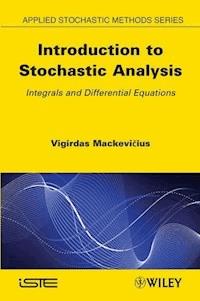
This is an introduction to stochastic integration and stochastic differential equations written in an understandable way for a wide audience, from students of mathematics to practitioners in biology, chemistry, physics, and finances. The presentation is based on the naïve stochastic integration, rather than on abstract theories of measure and stochastic processes. The proofs are rather simple for practitioners and, at the same time, rather rigorous for mathematicians. Detailed application examples in natural sciences and finance are presented. Much attention is paid to simulation diffusion processes. The topics covered include Brownian motion; motivation of stochastic models with Brownian motion; Itô and Stratonovich stochastic integrals, Itô's formula; stochastic differential equations (SDEs); solutions of SDEs as Markov processes; application examples in physical sciences and finance; simulation of solutions of SDEs (strong and weak approximations). Exercises with hints and/or solutions are also provided.
Sie lesen das E-Book in den Legimi-Apps auf:
Seitenzahl: 289
Veröffentlichungsjahr: 2013
Ähnliche


















First published 2011 in Great Britain and the United States by ISTE Ltd and John Wiley & Sons, Inc.
Apart from any fair dealing for the purposes of research or private study, or criticism or review, as permitted under the Copyright, Designs and Patents Act 1988, this publication may only be reproduced, stored or transmitted, in any form or by any means, with the prior permission in writing of the publishers, or in the case of reprographic reproduction in accordance with the terms and licenses issued by the CLA. Enquiries concerning reproduction outside these terms should be sent to the publishers at the undermentioned address:
ISTE Ltd 27-37 St George's Road London SW19 4EU UK
www.iste.co.uk
John Wiley & Sons, Inc. 111 River Street Hoboken, NJ 07030 USA
www.wiley.com
© ISTE Ltd 2011
The rights of Vigirdas Mackeviius to be identified as the author of this work have been asserted by him in accordance with the Copyright, Designs and Patents Act 1988.
Library of Congress Cataloging-in-Publication Data
Mackeviius, Vigirdas. Introduction to stochastic analysis, integrals, and differential equations / Vigirdas Mackeviius. p. cm. Includes bibliographical references and index. ISBN 978-1-84821-311-1 1. Stochastic analysis. I. Title. QA274.2.M33 2011 519.2'2--dc22
2011012249
British Library Cataloguing-in-Publication Data A CIP record for this book is available from the British Library ISBN 978-1-84821-311-1
Contents
Preface
Notation
Chapter 1. Introduction: Basic Notions of Probability Theory
1.1. Probability space
1.2. Random variables
1.3. Characteristics of a random variable
1.4. Types of random variables
1.5. Conditional probabilities and distributions
1.6. Conditional expectations as random variables
1.7. Independent events and random variables
1.8. Convergence of random variables
1.9. Cauchy criterion
1.10. Series of random variables
1.11. Lebesgue theorem
1.12. Fubini theorem
1.13. Random processes
1.14. Kolmogorov theorem
Chapter 2. Brownian Motion
2.1. Definition and properties
2.2. White noise and Brownian motion
2.3. Exercises
Chapter 3. Stochastic Models with Brownian Motion and White Noise
3.1. Discrete time
3.2. Continuous time
Chapter 4. Stochastic Integral with Respect to Brownian Motion
4.1. Preliminaries. Stochastic integral with respect to a step process
4.2. Definition and properties
4.3. Extensions
4.4. Exercises
Chapter 5. Itô’s Formula
5.1. Exercises
Chapter 6. Stochastic Differential Equations
6.1. Exercises
Chapter 7. Itô Processes
7.1. Exercises
Chapter 8. Stratonovich Integral and Equations
8.1. Exercises
Chapter 9. Linear Stochastic Differential Equations
9.1. Explicit solution of a linear SDE
9.2. Expectation and variance of a solution of an LSDE
9.3. Other explicitly solvable equations
9.4. Stochastic exponential equation
9.5. Exercises
Chapter 10. Solutions of SDEs as Markov Diffusion Processes
10.1. Introduction
10.2. Backward and forward Kolmogorov equations
10.3. Stationary density of a diffusion process
10.4. Exercises
Chapter 11. Examples
11.1. Additive noise: Langevin equation
11.2. Additive noise: general case
11.3. Multiplicative noise: general remarks
11.4. Multiplicative noise: Verhulst equation
11.5. Multiplicative noise: genetic model
Chapter 12. Example in Finance: Black–Scholes Model
12.1. Introduction: what is an option?
12.2. Self–financing strategies
12.3. Option pricing problem: the Black–Scholes model
12.4. Black–Scholes formula
12.5. Risk–neutral probabilities: alternative derivation of Black–Scholes formula
12.6. Exercises
Chapter 13. Numerical Solution of Stochastic Differential Equations
13.1. Memories of approximations of ordinary differential equations
13.2. Euler approximation
13.3. Higher–order strong approximations
13.4. First–order weak approximations
13.5. Higher–order weak approximations
13.6. Example: Milstein–type approximations
13.7. Example: Runge–Kutta approximations
13.8. Exercises
Chapter 14. Elements of Multidimensional Stochastic Analysis
14.1. Multidimensional Brownian motion
14.2. Itô′s formula for a multidimensional Brownian motion
14.3. Stochastic differential equations
14.4. Itô processes
14.5. Itô′s formula for multidimensional Itô processes
14.6. Linear stochastic differential equations
14.7. Diffusion processes
14.8. Approximations of stochastic differential equations
Solutions, Hints, and Answers
Bibliography
Index
Preface
Initially, I wanted to entitle the textbook “Stochastic Analysis for All ” or “Stochastic Analysis without Tears”, keeping in mind that it will be accessible not only to students of mathematics but also to physicists, chemists, biologists, financiers, actuaries, etc. However, though aiming for as wide a readability as possible, finally, I rejected such titles regarding them as too ambitious.
Most people have an intuitive concept of probability based on their own life experience. However, efforts to precisely define probabilistic notions meet serious difficulties; this is seen looking at the history of probability theory—from elementary combinatorial calculations in hazard games to a rigorous axiomatic theory, having a store of applications in various practical and scientific areas. Possibly, as in no other area of mathematics, in probability theory, there is a huge distance from the beginning and elements to the precise and rigorous theory. This is firstly related to the fact that the “palace” of probability theory is built on the substructure of the rather subtle and abstract measure theory. For example, for a mathematician, a random variable is a real measurable function defined on the space of elementary events, while for practitioners—physicists, chemists, biologists, actuaries, etc.—it is some quantity depending on chance. For a mathematician, the randomness is externalized by a probability measure on the measure space (space of elementary events with a σ-algebra of its subsets), which, together with the latter, constitutes a probability space, the primary notion of probability theory. On its basis, all the notions of probability theory, such as random variable, independence, expectation, variance, etc., are defined. For a practitioner, randomness is represented by a distribution function, which is well understood intuitively and can be used to define many of the above-mentioned notions, though with some loss of strictness and generality. Thus, every author of a book on probability theory has to look for a middle ground between strict abstract theory and accessibility for researchers in other sciences and even for mathematicians working in other areas of mathematics. The author of this book is no an exception.
A relatively recent area of probability theory, stochastic differential equations are receiving increasing attention by researchers and practitioners in various natural and applied sciences. First of all, this is related to the fact that “ordinary” (deterministic) differential equations, when modeling various real-world phenomena, usually describe only the average behavior of one system or another. However, real-world systems are most often influenced by many different random factors, also called perturbations. It appears that such perturbations, when they are sufficiently intensive, do not only “disorganize” the system forcing it to oscillate about the average behavior, but also qualitatively change the average behavior itself. It is clear that, in such a situation, deterministic equations cannot, in principle, adequately describe the system.
However, in stochastic analysis (theory of stochastic integration and stochastic differential equations) the problem of strictness-to-simplicity ratio arises much more strongly. Modern stochastic analysis is closely related with rather abstract areas of probability theory, such as general theory of random processes and theory of martingales. How can we avoid them when teaching the basics of stochastic differential equations? The author tries to present them in the spirit of “naive” stochastic integration. Just as in applications, the notion of a random variable is imperceptibly replaced by its distribution function, here we replace the very important notion of filtration (an increasing system of σ-algebras of events) by the intuitively easier notion of history, or past. Correspondingly, the notion of an adapted random process1 becomes easier to understand if by an adapted process we mean the one with values that, at every time moment, “belong to the history”, or, in other words, “depend only on the past”.
A result of all these methodical searches and “inventions” is that the textbook is written on two levels. The main level, which is devoted “for everybody”, contains a simplified theory of stochastic integration and stochastic differential equations, with some lack of rigidity and preciseness (though without any “cheating”). The author hopes that it will be understandable to everybody who is acquainted with the basics of probability theory in the scope of a standard elementary course, together with a minimal mathematical “ear”. The second level is devoted to a rigorous introduction to stochastic analysis for students of mathematics. The comments, definitions, detailed proofs, or their revisions written in this level are marked by the symbol .
To apply stochastic analysis in a treatment of real-world random processes, we have to construct one or another theoretical model and to know how to simulate it. Therefore, in the book (Chapter 13) much attention is paid to numerical solution of stochastic differential equations or, in other words, to their computer simulation.
We essentially restrict ourselves to the one-dimensional case. Passing to the multidimensional case is often related not with principal difficulties, but rather with technical inconvenience in using, for a beginner, complicated notation and formulas. However, for the reader’s convenience, in the last chapter, we present an overview of the main definitions and statements in the multidimensional case.
We use the double numbering of statements (theorems, propositions, etc.): the first number denotes the number of the chapter, and the second indicates the number of the statement within the chapter.
Though an enormous number of books and papers have influenced the contents of this book, the short reference list includes only those directly used by the author.
Almost all the graphs in the book were drawn by using the macro package , while the graph points were calculated by using Pascal programs in Free-Pascal environment.
The book essentially is a translation of the author’s book Stochastic Analysis: Stochastic Integrals and Stochastic Differential Equations (Vilnius University Press, 2005) from Lithuanian, complemented by the chapter with an application example in finance. The author would like to thank a large number of students of the Department of Mathematics and Informatics of Vilnius University and, especially, Kstutis Gadeikis. Thanks to them, the book contains significantly fewer mistakes and misprints.
Vigirdas Mackeviius
Vilnius, May 2011
1. As a process which, at every time moment, is measurable with respect to the corresponding σ-algebra from the given filtration…
Notation
Chapter 1
Introduction: Basic Notions of Probability Theory
1.1. Probability space
The main notion of probability theory is a probability space (, , P) consisting of any set of elementary events (or outcomes) , a system of events , and probability measure P. Though these objects form an unanimous whole, we shall try to consider them separately.
Sample space is any non-empty set. Its elements are interpreted as all possible outcomes of an experiment (test, monitoring, phenomenon, and so on) and are called outcomes or elementary events. They are often denoted by letter (possibly with some index(es)). Let us consider some examples.
Lesen Sie weiter in der vollständigen Ausgabe!
Lesen Sie weiter in der vollständigen Ausgabe!
Lesen Sie weiter in der vollständigen Ausgabe!
Lesen Sie weiter in der vollständigen Ausgabe!
Lesen Sie weiter in der vollständigen Ausgabe!
Lesen Sie weiter in der vollständigen Ausgabe!
Lesen Sie weiter in der vollständigen Ausgabe!
Lesen Sie weiter in der vollständigen Ausgabe!
Lesen Sie weiter in der vollständigen Ausgabe!
Lesen Sie weiter in der vollständigen Ausgabe!
Lesen Sie weiter in der vollständigen Ausgabe!
Lesen Sie weiter in der vollständigen Ausgabe!
Lesen Sie weiter in der vollständigen Ausgabe!
Lesen Sie weiter in der vollständigen Ausgabe!
Lesen Sie weiter in der vollständigen Ausgabe!
Lesen Sie weiter in der vollständigen Ausgabe!




