


5,98 €
Mehr erfahren.
- Herausgeber: Modern History Press
- Kategorie: Poesie und Drama
- Sprache: Englisch
"This book sees all. Not everything, but all. There's a difference." --John Lee Clark, author of How to Communicate
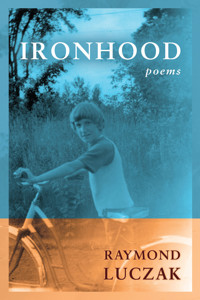
In Ironhood, the acclaimed poet Raymond Luczak recalls the neighbors and shopkeepers he once knew while growing up in Ironwood, Michigan during the 1970s and 1980s. They included a scruffy man who smoked cheap cigars while tending to his fragrant backyard garden, a cat-eyed woman who stood watch over a sea of typewriters, a bald jeweler whose dexterous fingers repaired a watch's minuscule innards, and tired cashiers in red smocks who dreamed at the western edge of town.
"These poems are an antidote to the language of shallow tourist marketing and cartoonish outlander stereotypes that so often seem to define Michigan's Upper Peninsula, a place much mythologized, but seldom seen and understood with any clarity of vision." --M. Bartley Seigel, author of In the Bone-Cracking Cold
"We meet the shops, landscape, and people of a working-class Iron Range town barely touched by waves of the revolutionary 1960s and 1970s. What emerges is an incisive exploration of growing up in a small town, where one can be suffocatingly known and intimately estranged at the same time." --Emily Van Kley, author of The Cold and the Rust
RAYMOND LUCZAK is the author and editor of 38 books, including Animals Out-There W-i-l-d, once upon a twin, and Compassion, Michigan. He lives in Minneapolis, Minnesota.
From Modern History Press
Das E-Book können Sie in Legimi-Apps oder einer beliebigen App lesen, die das folgende Format unterstützen:
Seitenzahl: 82
Veröffentlichungsjahr: 2025
Ähnliche


















Library of Congress Cataloging-in-Publication Data
Names: Luczak, Raymond, 1965- author
Title: Ironhood : poems / Raymond Luczak.
Description: Ann Arbor, MI : Modern History Press, 2025. | Series: Yooper Poetry Series ; 4 | Summary: “Ironhood is a lyrical memoir-in-poems that revisits Ironwood, Michigan, through the eyes of a Deaf, gay child growing up amid hardship, estrangement, and resilience. Luczak transforms memories of family, classmates, and small-town life into vivid portraits, balancing grief and alienation with wonder, defiance, and the enduring power of poetry”-- Provided by publisher.
Identifiers: LCCN 2025038975 (print) | LCCN 2025038976 (ebook) | ISBN 9798896560128 paperback | ISBN 9798896560135 hardcover | ISBN 9798896560142 epub
Subjects: LCGFT: Autobiographical poetry
Classification: LCC PS3562.U2554 I76 2025 (print) | LCC PS3562.U2554 (ebook) | DDC 811/.54--dc23/eng/20250903
LC record available at https://lccn.loc.gov/2025038975
LC ebook record available at https://lccn.loc.gov/2025038976
Author’s Disclaimer: It has been over 40 years since I lived in Ironwood, Michigan. Although almost every person named in the book has died, it has never been my intention to defame anyone while trying to recreate events, locales, and conversations from my memories of them.
Ironhood: Poems
Copyright © 2025 by Raymond Luczak.
All Rights Reserved.
Book #4 in the Yooper Poetry Series
979-8-89656-012-8 paperback
979-8-89656-013-5 hardcover
979-8-89656-014-2 eBook
Cover design: Mona Z. Kraculdy
Cover photograph: Unknown
Author photograph: Raymond Luczak
Published by
Modern History Press
www.ModernHistoryPress.com
5145 Pontiac Trail
Ann Arbor, MI 48105
Toll-free 888-761-6268
Distributed by Ingram Group (USA/CAN/AU/EU)
Eleanor Dallatorre Fraites
(1919–1999)
&
James P. Albert
(1958–2021)
Images from top to bottom: Downtown Ironwood, Year Unknown (Vintage Postcard, E.C. Kropp Company). Downtown Ironwood, Looking West on Aurora Street, 1990s (Raymond Luczak).
Contents
I.
One Day a Spaceship Will Land Right Here in Ironwood
II.
Mrofchak’s
The Bump in Front of Mrs. Kichak’s House
How Late the Night
Zarimba’s
Ada Marecki Valko
That One Time I Fell Asleep in the Garden Behind the Three-Stall Garage
Segueing
Colonial Skateland
Rosie Gust’s Polka Dance
The Watchdog
A. Lanfear Norrie School
Bricks Across West Oak Street
The Tire
The Curve
Lake Superior District Power Company Parking Lot
III.
The Winds of Ironwood
That One Time I Got Startled in Johnson Music Store
McLellan’s
Diamond Shoppe
News Record Printing and Supply
The Unfurling
The Lighthouse
Joseph S. Kutniewicz
1000 North Hemlock Street
Riggs Office Supplies
Unstrung
The Substation
Fur
Charles (“Chuck”) Lewinski
The North Country Sun
IV.
Mansfield Street Viaduct
Sacrifices
Nameless Men Wearing Those Caps
John (“Curley”) Krainak
My First History Teacher
Ronnie’s Camera and Sound
The Loner 1980
Raymond F. Burchell, D.D.S.
Modern Portrait
Pamida Discount Store
Gogebic County Fairgrounds
Tumbleweeding
Jacquart’s
Eleanor Dallatorre Fraites
James P. Albert
V.
Buttercups
Acknowledgments
Images clockwise from top to bottom: Chicago and Northwestern Railroad Depot, 2011. Pocket Park, Downtown Ironwood, 2025. Suffolk Street, Looking North, 2025. Ironwood Memorial Building, 2025. Norrie Park, 2014. Street Corner, 2017. Statue of Angel, All Saints Catholic Academy, 2025 (Mark Ehrke). House, East Aurora Street, 2025 (Mark Ehrke). Below the section number: Behind the former News Record and Printing Supply, 2025 (Mark Ehrke). Smiling Tower, 2011. Flag, 2014. Closeup of World War I Doughboy, 2014. All photographs are by Raymond Luczak unless otherwise noted.
One Day a Spaceship Will Land Right Here in Ironwood
One day spacecraft creatures
completely foreign to us
will land right here in Ironwood
and find us humans quite peculiar
from the way we wear hoodies,
mom jeans, and snowmobile boots,
noting how some of us inhale
weird white thingies in our mouths,
puffing off an odd scent that lingers.
If they’re lucky, they’ll land here
in the summer when the greenery throws
shade on every sidewalk crack
clogged with cigarette butts
where dogs sniff before choosing another
tree to inspect and spray piss.
They’ll notice the lushly-lined cave-ins
bordering the southern side of downtown,
wondering what had transpired there.
Or maybe not: They may have reasons
completely beyond our comprehension
for their visit. Maybe we’re just research,
something like how we’ve been trying
to probe further into the stars
with our powerful-but-never-enough telescopes
for answers that take years to decode
and dissect in a language of wonder
before the meaning is lost forever.
*
Will our extraterrestrials hover up and down
Aurora Street, from the old Pamida
perched on the western end of town,
passing St. Vincent de Paul’s Store
and the Flagstar Bank? Would they even catch
a whiff of Joe’s Pasties drifting in the air
while vrooming up to the Carnegie Library
on the eastern end of downtown?
Would they have the ability to scan back in time
the ghost skeletons of stores and movie theaters
long gone and yet as if they’re still in place,
waiting to be seen again by the X-ray eyes of nostalgia?
Would they marvel at the sight of men and women
donning gloves and hats and overcoats and boots,
and shaking their heads at the dizzying heights of snowfall,
slowing down the streetcars jammed on the rails?
Would our visitors look even further back to see the unruly
men not knowing English and yet desperate to work
for pennies an hour down in the pits of iron ore,
its residue a fatal kiss that could metastasize
deep in the lungs, sparking a nasty cough after another
until nothing more could be done but to lay there,
trying not to see the eyes of Death hovering,
an unscented cloud snaking around those awaiting
the last breath of such broken husbands and fathers,
still aching for a gasp of their Old World,
and then back to the pits of hell for more.
*
If our extraterrestrials didn’t have the ability to time-travel,
would they wonder about the loneliness
of repurposed storefronts having seen better days?
Would anyone recall stores like McLellan’s,
Johnson Music Store, and Carlson’s Supermarket?
All of them are ghosts, repainted and restructured inside,
filled with trinkets of dust and memory.
That’s assuming, of course, that they’ll easily grasp
the concept of capitalism and its effect on the environment,
especially when Ironwood’s mines run dry,
when its inhabitants seek employment elsewhere,
when footsteps begin to sound hollow in downtown.
Would our visitors even speculate who we are?
Just what would they communicate about us
back on their home planet? Would they agree
with our strangely contradicting values, or would they
harumph at our behavior with the sadness of superiority?
Or would they become our new immigrants,
ready to save our planet from its inevitable demise?
Or have they come here to mine the last of our resources
to save their own kind from dying?
*
Would our extraterrestrials be able to convey images
of this downtown, proliferating like asteroids spewing
forth one pawnshop after another,
with an occasional rifle shop for good measure,
like there’s one right next to a dentistry,
and a Ben Franklin crafts store,
filled with relics that seem commonplace
enough not to seem so holy and respected?
Yet it’s the largest store in downtown.
And what’s this about a tattoo shop,
its array of sterilized tools and fat binders
swimming with design possibilities?
Would our visitors speculate why
anyone would want to inject ink into their skins?
Aren’t intact bodies sufficient enough?
Why are we so inefficient with our modes of travel?
All those cars and trucks parked on the street
seem so slow. How is it possible
that we haven’t yet cracked the elegant formula
against gravity? Look at our visitors.
Their vacant eyes may look unsettling to us,
but we forget how we may look unsettling to them,
which brings us back to the question of how
we are leading our lives right here in Ironwood.
Images clockwise from top to bottom: West Oak Street, Looking West, 1990s. Norrie School, 1990s. Woods Across the Street on West Oak Street, 2017. West Oak Street, Looking East, 1990s. Power Lines, West Oak Street, 2017. All photographs by Raymond Luczak.
Mrofchak’s
after Joseph W. Mrofchak (1929–2015)
Suited up and clean-
shaven, he knew how to
cut my vision into angles,
refracting from silk
into seams that en-
twined perfectly
into plaid. His ties
sheened and shimmered
like pantyhose
in the heat of light
spilling between
the heavy curtains
that shielded us
from the mannequins
sporting the latest
blazers with nary
a price tag in sight.
Seeing him patrol outside
from inside the doorway,
he was the first man
who impressed me
not with his suits
but with his bearing:
crisp but never over-
bearing or demanding.
He knew how to crack
a necessary smile,
a well-practiced handshake.
He also understood the weight
of first impressions,
which he handed to me,
only that he didn’t know
how much it’d weigh
in the grubby hands of
a deaf boy who had
thought the whole world
of his purple girl’s bike
soon to wonder
whether he’d even find
his own path.
The Bump in Front of Mrs. Kichak’s House




