


Erhalten Sie Zugang zu diesem und mehr als 300000 Büchern ab EUR 5,99 monatlich.
- Herausgeber: TSB
- Kategorie: Gesellschafts- und Liebesromane
- Sprache: Englisch
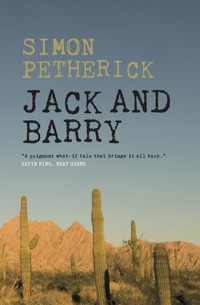
"A poignant what-if tale that brings it all back." KEVIN RING, BEAT SCENE It's December 1964 in Paradise Valley, Arizona. Republican Senator Barry Goldwater, who has just lost the Presidential election to Lyndon B Johnson, is driving alone one evening back to the house he shares with his wife, Peggy. On one side of the road, he sees a figure trudging back towards town and he stops to offer him a lift. So begins a highly unusual and emotional fictional friendship between Goldwater and the author, Jack Kerouac. Over the course of the next two days, the two men engage in a strange, wary exploration of each other's lives: one, an ebullient but bruised political animal; the other, a weary and almost defeated literary icon whose totemic novel, On The Road, was first published seven years before. Such an unlikely pairing brings about a soulful exploration of man's ambition and the bitter fruit it can deliver, set against the dramatic mountainous landscape of 1960s Arizona.
Sie lesen das E-Book in den Legimi-Apps auf:
Seitenzahl: 90
Veröffentlichungsjahr: 2024
Das E-Book (TTS) können Sie hören im Abo „Legimi Premium” in Legimi-Apps auf:
Ähnliche




















To Tamsin
Contents
Jack and Barry
It’s just after six o’clock on Saturday evening on December 5, 1964, and Barry Goldwater is driving a light blue Buick Riviera south down State Route 69 towards his home in Paradise Valley, just north of Phoenix, Arizona. Barry has had quite a tumultuous year: a month ago, he lost the Presidential Election to Lyndon B Johnson by one of the biggest margins in American electoral history. Back in June, he upset a lot of people by voting against the Civil Rights Bill on the floor of the Senate despite his lifelong active support of desegregation 12in his home state of Arizona; he believes government should stay out of peoples’ lives as much as possible. On top of that, he can’t stand for re-election as one of Arizona’s two Senators next month, because he had to forfeit that bid in order to stand for the Presidency. In the space of a few months, he’s become one of the most vilified politicians in America and he’s out of a job. Barry is fifty-five years old and he’s just spent two days photographing landscapes around the Hohokam villages near Lake Pleasant.
SR 69 isn’t a great road and the big Buick’s suspension rolls and heaves with the dips and potholes. He’s about ten miles north of the Valley and over to the west beyond Glendale he can see the sun begin its descent below White Tank Mountain. Pretty soon he’ll need to take a left fork off the highway and head in towards home. The road is quiet but up ahead on the other side of the road, maybe two hundred 13yards away, he sees a figure walking in the dust track beside the oncoming lane. Late to be out walking this time of year, he thinks.
Once he’s passed, Barry pulls the car across the highway over to the other side and rolls the wheels off the tarmac. He looks in the rear view mirror and can see the figure approaching in the evening light. He’s walking in a kind of loping but steady way. Barry rolls down the window and looks back down the track.
‘Hey fella, you need a lift into town? Getting kind of late out here.’
The walker approaches. He’s stocky, maybe 5-foot-eight or nine, wearing what looks like a seaman’s blue sweater and he’s got a leather bag swung over his shoulder. His workman’s jeans are dusty, his brown boots are dirty with dried mud. He has dark black hair and as he stops beside the car, Barry takes in the swarthy complexion, the clenched cheekbones, the thick dark eyebrows. 14
‘I’m heading northwest of the Valley,’ Barry continues as the stranger stays silent. ‘Near to that new Methodist church they’re building.’
The guy nods.
‘I know it,’ he says. ‘I do some work for them.’
‘You heading my way?’ Barry asks.
The man shrugs.
‘Kind of. I’m the other side of the mountain, Hummingbird Lane.’
‘I know it. I’ll drop you there, you’re not far out of my way.’
The guy nods and walks around the front of the car, lets himself into the passenger seat. There’s a skittering of stones as Barry gets the Buick back up onto the highway and they cruise on towards Phoenix.
Barry turns his head, his thick black-rimmed glasses flashing the evening sun which has cast his passenger into shade.
‘What are you, Mexican?’ he asks. 15
The guy looks at him for a moment, then nods.
‘Thought I spotted the accent,’ Barry says. ‘Had a great time down there last year.’ He takes his right hand off the wheel and extends it. ‘Barry Goldwater,’ he says.
Again, the fellow hesitates, then he reaches out to grip.
‘Juan Abatido,’ he says.
‘What do you do for the Methodists, Juan?’
Another pause.
‘I look after their garden. I’m a gardener.’
‘Oh. Peggy – that’s my wife – she’s been looking for a gardener. Maybe you’ve got some spare hours?’
‘Maybe.’
‘OK, we’ll see. It’s not so easy finding a gardener, she tells me. Where in Mexico you from?’
Juan waits for a second, then,
‘The City.’ 16
‘Down south, huh? Long way. Took Peggy to Mexico City for our honeymoon, thirty damn years ago. Stayed in the Ritz.’ He chuckles. ‘Not that I remember much of it.’
After a moment’s silence, Barry peers at the man once more and says,
‘Say, you got something else in you? Some American? You look as though you might. I’m half Jewish, if you want to know. We’re all half of something and half of something else, I guess.’
‘My mom was French Canadian, her family was from Brittany in France.’
Barry nods.
‘Thought so. Your parents back in Mexico?’
Juan shakes his head.
‘No, they’re both dead now.’
‘I’m sorry to hear that,’ says Barry. ‘I apologize for butting in.’
‘No apology,’ says Juan. ‘They did OK.’
‘You’re young though, to lose both your parents.’ 17
‘Am I? How old are you?’
Barry laughs. ‘I’m fifty-five, I’m what you call a genuine oldtimer. You’re, what, mid forties?’
‘You’re an inquisitive gentleman, Mr. Goldwater.’
‘Barry, call me Barry.’ He laughs again. ‘Peggy says there’s no anthill I won’t go poke my goddamn nose into.’
‘She sounds OK, your wife.’
‘Oh that she is, that she is. You got one?’
‘No, sir.’
Barry looks at him again.
‘Say, what are you doing out here walking along the highway this time of year, anyhow?’
‘Been out hiking a couple of days.’
Barry nods. ‘That’s just fine,’ he says. ‘We have the world’s finest hiking lands here in this state of Arizona. You got yourself a bedroll in there?’
‘And a skillet and a knife. And an old copy 18of the Diamond Sutra which I didn’t read.’
‘Say what?’
‘The Diamond Sutra. It’s a Buddhist text.’
‘Well now you do surprise me, Juan. A half-Mexican, half-French Canadian, Buddhist gardener. I’ll wager there aren’t so many like you in Paradise Valley or back in Mexico City, for that matter.’
Barry would be more surprised if he knew that his passenger wasn’t really called Juan Abatido but was in fact Jack Kerouac, author of On The Road. Jack’s been using the name Abatido since he’s been in Paradise Valley the last four weeks. He’s in the Valley incognito with his typewriter, trying to start another novel. He’s rented a tiny adobe hut the other side of Mummy Mountain from Barry’s expansive ranch. He has no idea why he told Barry he was gardening for the Methodists but now he’s taken by the idea of being a Mexican gardener. Maybe he could pursue that? He 19came up with the name Juan Abatido as a derivation of what his mother Gabrielle, or Mémère as he calls her, uses for him: Ti Jean, French for Little Jack. (Mémère, of course, is very much alive and is expecting him to be back home with her in St Petersburg, Florida, for Christmas. His sister Nin died in Florida just three months ago and of course he’s feeling guilty about not being with Mémère at this time.) Abatido is Spanish for dejected or low or, you know, beat. On The Road came out seven years before and Jack is sick to the very core of himself with the role of spokesman for the Beat Generation that the newspapers and TV have allotted him.
Barry turns left off State Route 69 onto West Glendale Road, a long, rough track with just a few houses scattered about, cactus and Joshua trees thriving in the sandy ground. They pass one house set back from the track which has some Christmas illuminations in the window. 20
‘You celebrate Christmas, Juan?’ asks Barry.
‘Sure,’ says Jack.
‘Peggy just loves Christmas,’ Barry says, smiling again. ‘We’re going to have all four kids back home with us this year, and two grandchildren. Boy, oh boy, it’s going to be a lulu.’
‘You’ll have to dress up as Santa, I guess?’ Jack asks.
‘Ho, ho, ho,’ says Barry.
There’s still just enough light for the car headlights to stay off and Barry’s on East Lincoln Drive now.
‘I can see the mountain,’ he says, pointing. ‘Where’s your place?’
‘You don’t need to take me all the way there,’ Jack says. ‘Just drop me here, I can walk the rest.’
‘No can do,’ says Barry. ‘I said I’d drop you home and that’s what I’ll do. Shall I take a left here?’
Jack nods and Barry swerves up onto a 21dusty track that begins to incline rapidly. Jack points directions at a couple of forks in the track and then he says,
‘It’s this place,’ looking towards a small, one-storey building surrounded by lemon trees. Barry pulls the car up and Jack lifts his leather bag out, steps out and leans back through the open passenger door window.
‘Thanks for the lift,’ he says.
‘My pleasure, Juan,’ says Barry. ‘Here —’ he pulls out a card from his wallet – ‘this is my address. The house is called Be-Nun-I-Kin. Peggy wants the garden all smart before the kids come for Christmas. Will you call by tomorrow and see what you can do?’
Jack looks at the card.
‘Sure,’ he says. He looks back at Barry, who’s smiling and getting ready to shift into reverse to head back down the hill. ‘Tough luck on that election, Barry,’ Jack says. And he turns and heads off towards the door of the little shack. 22
‘Well, I’ll be,’ Barry says to himself as the Buick rumbles down the stone track. ‘That’s one interesting fellow.’
Jack opens the wooden door of the adobe hut and drops his bag on the floor. There’s an unmade bed in one corner, a small gas stove next to a sink in another and a table set against one wall with a typewriter on it. At the back of the table is a neat stack of paper: the proof copies of Desolation Angels which he’s supposed to be correcting; there are inches of foolscap sheets, his collected notes on Buddhism for the book which will come out much later, Some of the Dharma. On the floor is a cardboard box half-filled with bottles. He walks over to the table, reaches down and lifts a bottle of rye whiskey from the box, then heads back outside.
The hut faces towards the peak of Mummy Mountain and the evening sky now is a cold purple. There are no other houses around 23




