


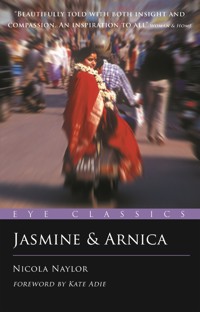
Erhalten Sie Zugang zu diesem und mehr als 300000 Büchern ab EUR 5,99 monatlich.
- Herausgeber: Eye Press
- Kategorie: Gesellschafts- und Liebesromane
- Serie: Eye Classics
- Sprache: Englisch
Since childhood, Nicola Naylor had been enthralled by India: "Images of goddesses and temples with monkeys, elephants and colourfully dressed people crowded my imagination. I wanted to go there. But my travel fantasies dissolved when I lost my sight as I was finishing university." Disregarding the warnings of others and her own private fears, Nicola Naylor set out on a journey through the India she had always imagined but had never seen. It was a dream she knew she must follow in order to come to terms with her blindness. As an aromatherapist, there was a practical aspect to her endeavor: to find instruction from the ancient techniques of the region which she could apply in healing others. But in daring to step into the unknown, Nicola found for herself a renewed trust in the world, and more importantly, rediscovered her self-belief. This is the inspiring account of her unique journey. Told with a vivid and evocative insight, Jasmine & Arnica is a story of a young woman's determination, a celebration of the power of vision beyond sight. It reveals what's closest to the heart and uncovers life's most precious, unseen joys.
Sie lesen das E-Book in den Legimi-Apps auf:
Seitenzahl: 462
Veröffentlichungsjahr: 2010
Das E-Book (TTS) können Sie hören im Abo „Legimi Premium” in Legimi-Apps auf:
Ähnliche




















PRAISE FOR JASMINE & ARNICA
“This is an account of one blind woman’s journey around the Indian subcontinent in search of a deeper understanding of aromatic oils. Nicola Naylor displays endless tenacity and courage to triumph over the limitations of her disability. It is a humbling insight matched by a painfully honest display of frustration and selfknowledge as Naylor tries to accept the boundaries within her life. She shares an appreciation of life ‘which most travellers cannot see to enjoy’. She allows us to experience pungent wafts of jasmine that creep up our noses, piercing wails of music that whistle in our ears and crisp saris that rustle under our fingertips. Her ‘third eye’ describes in detail a brightly coloured reel of people and places, images that dart vividly around in our mind’s eye. Jasmine & Arnica is inspiring.” Geographical Magazine
““I can only recommend that you read and discover that there are many ways to travel— and to see.”
Kate Adie
““Beautifully told with both insight and compassion, this remarkable story of one woman’s triumph over adversity will be an inspiration to all its readers.”
Woman & Home
“Inspiring story”
The Daily Mail
This Eye Classics edition first published in Great Britain in 2010, by:
Eye Books
7 Peacock Yard
Iliffe Street
London
SE17 3LH
www.eye-books.com
First published in Great Britain in 2001
Copyright © Nicola Naylor
Cover design by Emily Atkins/Jim Shannon Text layout by Helen Steer
The moral right of the Author to be identified as the author of the work has been asserted.
All rights reserved. No part of this publication may be reproduced, stored in a retrieval system or transmitted in any form or by any means without the prior written permission of the publisher nor be otherwise circulated in any form of binding or cover other than that in which it is published and without a similar condition being imposed on the subsequent purchaser.
British Library Cataloguing in Publication Data
A catalogue record for this book is available from the British Library
ISBN: 978-1-903070-76-5
To Philip Tata and Yvette Parker, without whom I may not have given life a chance.
CONTENTS
FOREWORD BY KATE ADIE
PROLOGUE
SETTING OFF
BOMBAY: GOUTAM, A GATEWAY TO INDIA
PUNE: PLANTS WITH DRS PARANJAPE AND RENADE
MADRAS:A PARSEE CALLED PEEROOZE
PONDICHERRY: MANOB AND THE AUROBINDIANS
TRIVANDRUM: FOOT MASSEURS VIJAY AND PADMA
COCHIN: A FAMILY OF THE PLANTATIONS
COIMBATORE: PEEROOZE’S PARENTS
COONOOR: SAVED BY SUSAN
MYSORE: JASMINE & ARNICA
COORG: NALINI, THE FIELD MARSHAL’S DAUGHTER
BANGALORE: A WOMAN’S WELCOME FROM SAGARIE
EPILOGUE
FOREWORD
So many of us travel without really looking. Taking the famous sights for granted, and day-dreaming or dozing or chatting while the countryside flashes by. Sometimes a scent lingers, or a sound pricks up the ears, but much disappears into a blurred memory. And the very business of travelling, the tickets, unreliable timetables, rapacious taxi-drivers and the question of whether queuing is regarded a quaint foreign custom, have all to be taken in one’s stride.
So, consider travelling in India for many months, with all these usual elements unseen.
Nicola Naylor has a rare insight into these matters, which was not chosen. Her formidable determination to travel and to participate — and to notice and observe — is a tour de force. And her unsparing analysis of her own behaviour when confronted with both the awkward details and the wider implications of travelling — mostly alone — is a remarkable example of self-knowledge.
I write as someone who’s got lost, been baffled by language, mislaid luggage, taken the wrong bus, got off trains at the wrong stop, been accosted by numerous dodgy strangers, forgotten my hotel room number, collided with rickshaws and bicycling vegetable vendors, taken a taxi-ride during which two of the wheels came off, and certainly wouldn’t dream of eating anything, never mind foreign, without taking a very good look at it — so Nicola’s Jasmine & Arnica strikes me as an object lesson in courage, yet without any self-pity.
And India comes alive as well — in descriptions that challenge all the usual notions of what someone who has lost their sight might be expected (by the rest of us) to experience.
I cannot imagine putting myself into the situations, on a daily basis, that Nicola deals with. And I can only recommend that you read and discover that there are many ways to travel — and to see.
Kate Adie Spring 2001
MAP OF SOUTH INDIA
The process of renaming some towns and cities started after the end of the British imperial period in 1947. Today, for example, Bombay is known as Mumbai, Madras is now Chennai, and Kolkata replaces Calcutta. However, the place names used on the map above and throughout the book were in general use at the time of writing.
PROLOGUE
When I reread my book now as a woman in my forties, I meet my younger selves. But it is not always that I am transported to India and that my encounter is with the woman in her thirties embarking on a life-changing journey of discovery. Sometimes I travel ten years further back in time to a South London psychiatric hospital and find an angry, broken young woman who had lost her sight and her mind. One reunion is energising, the other is still harrowing, but somehow I have reconciled them with who I am today.
If I linger in my own bleak company, on that hospital ward, I quickly recall the dark and the despair descending to deaden my soul. I saw no future and wanted to end my life. Yet, I have lived another twenty five years and journeyed to places I never imagined I would know. I so nearly cancelled my ticket and my life and I am ever grateful that I didn’t. I still wonder why I didn’t. I made my raft and chose to set sail again but part of me will always trawl the depths for the drowned, the stranded. I cannot forget that I nearly was one.
My mother’s depression led her to suicide. I was just fifteen and while she spent time convincing herself that there was no other way, she convinced me too. This was a very hard lesson to unlearn when my life was wrecked by blindness. I now value the extraordinary ability we have to survive, to make changes and to go places all the more because I spent so long only seeing solutions in exit signs.
As much as I wanted to share my personal journey in Jasmine & Arnica I did not want to make an arrogant or a trite “triumph over tragedy” story out of it. These are too often poorly disguised parables, or instruction manuals, cheerleading about how to face fear or conquer depression. I don’t believe that there are formulaic solutions to surviving life’s crashes and to suggest that there are can be cruel. Some years ago I watched my step mother in her final weeks of life, ravaged by cancer. She was a strong, determined middle-aged woman with everything to live for. She tried to visualise her cancer into submission. I watched while she clung to a healer, pleading her faith and belief that she could win. She added failure to her final despair because somehow she couldn’t follow the instructions in all those self-help books she had been reading. Travel books are not guide books. Mine is but one perspective.
Ordinary people, all of us, can do extraordinary things but not always. All our stories are individual and personal as are the inner and outer journeys that we make. That is what makes them refreshing and engaging. I hope that my story offers enough flavour to whet the appetite but leaves people to discover their own recipes. When I was in the early years of coming to terms with having lost my sight, I know I would have chosen to starve rather than to digest other people’s survival triumphs and their ways of overcoming disability.
I do not feel invincible or somehow protected from future blows that life may still deal me. A sailor may survive one storm but not the next, but at least he will face it prepared. Since my year in India, I have returned many times and to many other fascinating parts of the world. I have found love in marriage and motherhood. I have continued my writing, built a business and a home in London and in France.
Through my daughter, I have re-discovered my love of horse-riding and I am now passionately absorbed by an ambition to ride competitively in dressage before I become too old or too crippled. A back injury that resulted in surgery, a loss in some function of my left leg and continuing pain threatens to thwart my riding ambition for the second time in my life. Inside I scream “Isn’t losing my sight enough for one lifetime?” Yet my rage about this further disability, while hard to contain, is as pointless as ever.
I continue to be frustrated by the limitations and restrictions that my blindness imposes. I still love life and seek out what it has to offer. Yet I am frightened that it may bring more pain that I will not survive. My losses have not so much made me stronger, merely wiser to the pain. There is nothing for it but to continue to travel and not to rely on guide books too heavily.
Nicola Naylor Spring 2010
SETTING OFF
Beyond the doors of the terminal building a mass of people heaved against metal barriers. Men shouted, “Hotel, very good hotel?” or, “You are wanting a taxi?”. The heady smell of curry, perfumes and incense rose above the crowd as they jostled and shoved. Entangled in this mêlée of hot damp bodies scrummaging for space, I tried to fold away my cane. Then Goutam’s voice said, “Nicola?”
Instantly I saw the figure I remembered: small, agile, with masses of bouncy brown curly hair, glasses, a fine moustache, slim except for his paunch. I thought he returned my smile. “Let’s go,” he said. He was concerned to get me out of the clamouring crowd. I placed my hand next to his on the handle of the trolley and followed as he steered. We snaked through the milling people and I snuck my cane into my shoulder bag.
I have always been enthralled by India, even as a child. Images of goddesses and temples with monkeys, elephants and colourfully dressed people crowded my imagination well before I saw pictures of these things or learnt to which part of the world they belonged. As soon as I was able to locate them in India I wanted to go there. But nine years ago, my travel fantasies dissolved when a congenital problem led to the total loss of my sight as I was finishing my degree at university.
It shattered my life at a time when my peers were progressing with their careers and planning their weddings. I broke down and found myself confined to hospital for a year unable to come to terms with what had happened to me. When I came out, I continued my treatment as an outpatient. Living seemed worse than dying but I could not commit myself to either. I continued in a shell-shocked stupor of indecision and hopeless rage. Well-intentioned consolation, comparison, cajolement and encouragement from professionals, friends and family increased my pain, fury and loneliness. I escaped into a world of madness, full of vivid phantasmagoric hallucinations which, however frightening, were less terrible than the dark blind reality they displaced.
From the devastation I discovered small ways that led me back to life. In the following years I busied myself with home-making, professional retraining as an aromatherapist and business building. But I had not forgotten the temples and goddesses and monkeys of my childhood. By autumn 1992, I had become comfortable but stuck in my home, my success at work and the reassurance of a few good friends. I seldom ventured beyond the safety of my daily life, having a morning swim, working from home, walking my dog with a friend, and going to bed by seven in time for The Archers, my favourite radio soap. I had constructed these routines to support me through hard times but they slowly became more limiting than liberating. I wanted to shake up my rigidity, open up my boundaries, test my capabilities and challenge my concepts of how the world is or isn’t. India was suitably radical and provocative as it stands so climatically and culturally in contrast to my life in Britain, and I wanted the external travel to be significant enough to take me further on my internal journey in self-confidence, crossing borders which I would otherwise not cross, and experiencing new dimensions of myself by exposure to different aspects of life, and ways to live that life. My journey also had a professional motive. As a practising aromatherapist, I wanted to learn about massage and oil techniques in traditional Indian medicine.
I threw myself into three months of energetic planning — endless letters and telephone calls, networking to set up all the connections for touring the ayurvedic hospitals, which used traditional Indian herbal and healing techniques, aromatherapy centres, massage centres and private practitioners. To start with, I didn’t have any professional contacts but one address led to another. I also raised about £1,000 in sponsorship from the Paul Vander-Molen Foundation, the Guide Dogs for The Blind Association and The Metropolitan Society For The Blind, who seek to enable and enhance the quality of disabled people’s lives.
My friends were astonished when I told them my plans, which challenged their ideas of what a blind person can do. I too am often dumbfounded by the way non-sighted sight, my ‘third eye’ perception or a sixth sense can enrich my experiences of the world.
In India I survived, indeed thrived, on people’s fellowship and generosity, and gained an insight and involvement in the family and working lives of people from all parts of India. I stayed with Sikhs, Parsis, Syrian Christians, Hindus and Muslims, some anglicised Indians, some indianised Britons, some very ‘British’ ex-colonials and some very Indian Rajput (warrior class) Indians. This richness and diversity of cultural exchange came my way as a result of the close contact necessitated by my blindness. Each family I stayed with wanted to make arrangements with any relatives or friends to befriend and help me in other places I intended to visit. My eyes were opened to India by the privilege of this intimacy.
This account is an attempt to share an experience and an appreciation of life which most travellers cannot see to enjoy. I say ‘see’ because I am celebrating the non-sighted sight that sighted people struggle to comprehend. They find it hard to believe that I do what I do without physical sight, especially since I ‘look so sighted’. I see the world through a ‘third eye’: it includes mental mapping, memorising, calculating probabilities, and intuition. We all have these skills but since I lost my sight I have developed them — in a similar way, one of my friends, John, has built up his shoulder muscles so that he can propel himself on his crutches because he has no legs.
Despite the ways in which I have learnt to adapt, I am still dominated by sight. When I hear a tennis ball thud I turn my head, like most sighted people, and assume my eyes tell me where the ball has hit the ground. But, of course, it is my ears. Sighted people believe they are informed first and foremost by sight. My third eye is uncannily accurate and I trust my survival to it. “How did you know the dog was standing behind you? How did you know I just looked at my watch? How did you reach for that cup without fumbling?” I am often asked these questions — and, indeed, my prospective publishers requested justification of the visual descriptions I have given in this book. I have endeavoured to share my experience as lucidly as possible but when someone tells me that an object is yellow, I do not ask, “How do you know it is yellow? Are you sure your eyes see yellow?”
In India, I learnt how to let go of some of my solitude and privacy, I stopped retiring early to bed and found myself in more than one-to-one company. I was able at last to bring the fantasies of my childhood into reality. At last, the visual pictures I created in my mind’s eye came from this outer reality. My English teacher at school said, “William Blake sees angels in trees.” We all tittered and sniggered. I am older and wiser now.
It was with the unblinkered perception of my third eye that I set off for India: it makes sense of the inner as well as the outer world, and I kept it wide open.
I did not go to India in search of my soul or to ‘find’ myself. I had done that in the early years after I lost my sight. When I realised that I could carry on in a world I would never see again, I emerged with a powerful inner confidence and knew that I had found a new way of seeing the world.
On the plane to Bombay I itched to take the in-flight magazine from the pocket on the back of the seat in front of me. It was not because I wanted to pretend I could read it, but because I find it reassuring to flick through pages.
As a child with little sight and as an adult with none, I have behaved naturally in a sighted way. I put lights on when I don’t need them in the dark, I read hardback books before I go to sleep, and I look in mirrors to check my appearance.
My fingers plucked the textured fabric covering my seat as I worried about what my fellow passengers would assume if I picked up the magazine. No doubt they would draw the obvious conclusion based on the evidence of their eyes: I was seeing and reading. It would make explanations complicated if I needed a helping hand later to find the loo.
The air hostess came down the aisle distributing embarkation forms to be filled in by the non-national arrivals. She passed me one and disappeared, returning a little later to hand out menu cards. I wondered what was for lunch. When I had boarded not so long ago she had helped me to my seat. Soon she returned to collect the completed cards. I sensed her hovering over me expectantly. I passed her my card and asked, “Would you mind filling this in for me?”
She hesitated, momentarily confused. Then, disconcerted, she said quickly, “I’ll do it later. Have you got your passport?”
I found it deftly and caught her eye again when I handed it over. I sensed her wriggle inside, even though her movements were stiff. I felt mean — at least I hadn’t been reading the magazine as well.
Suddenly I was frightened of the honesty I would need to judge each encounter and to guide me on my travels. I would have to find the courage to be different from how blind people are expected to be. For the first time I felt a foreboding about the journey ahead.
When I first announced my plans to travel alone round India, people asked, “Aren’t you afraid?” I had become almost ashamed that I wasn’t. Friends wondered why I was not daunted by potential physical dangers: the unpredictable assaults and risks to someone single, female, blonde and blind.
In the aeroplane I realised that my fear was not how to negotiate my way around a strange country, but how to be neither too blind nor too unblind in my response to unfamiliar situations and people. I did not want to lose sight of myself and my hard-won acceptance of my disability.
My fingers slid over the magazine. I pulled them away and thought about getting a book out of my hand luggage instead. I was bored. I had several titles with me, regrettably all paperbacks because of the airline’s weight restrictions. I preferred hardbacks and have always liked to sit on the loo in the mornings with one held close to my face. This posture was force of habit from when I was a child and could snail my way through a book if I peered closely enough. No one would noticed me squinting and straining if I did it in the bathroom.
Instead I let my mind drift to my old friend Goutam Bhattacharya, whom I had not seen for eleven or twelve years. After I lost my sight my friends had become strangers to me. I had rejected them, pushed them aside: it was it too painful to see them getting on with life which seemed so worthwhile compared to mine. Goutam knew I had lost my sight but he had not heard from me directly until I had written to say I was intending to travel in India, and could I come to stay for a few days before I set off?
Goutam’s response had been prompt and positive. Of course I could come, and what did I want to do?
My friendship with Goutam had begun in Ludwigshafen while I was a student on a work placement and he was a young manager in a chemical company. We had spent evenings in many a Weinstube in the Pfalzwald, drinking sweet local wine, eating bratwurst and cabbage. Once we drove to Monte Carlo with another friend. We lost money in the casino, headed for the Côte d’Azur, ate fish on a French beach, and slept three in a dingy, noisy room because we couldn’t find anything better. On the way back we were refused entry into Italy and nearly arrested because of some irregularity in Goutam’s papers. We had to detour through Switzerland to get back into Germany, crumpled, sleepy and broke.
I had changed considerably since those days in Germany. Shock had torn me apart and I had put myself back together in a less higgledy-piggledy fashion. Still, I was nervous about incorporating my new self into our old friendships. On the one hand I wanted the difference in me to be recognised; on the other hand I didn’t want it to get in the way. I wondered whether Goutam was apprehensive too.
I thought of all the positive things I would tell him about the years he had missed. I had a thriving aromatherapy and manipulative massage practice in which I treated up to thirty people a week. I worked from home and had moved only two years before my departure for India to a larger house where I could set aside two rooms for my work. My trip was also to be a sabbatical, an opportunity to compare the therapeutic use of Indian herbal oils with the ones I was using. I was interested in the way they applied their oils through massage in ayurveda (ayu meaning knowledge, veda, life) and was the first aromatherapist to tour ayurvedic centres in India and observe their methods. Sadly, however, there was no research grant forthcoming from my professional organisation.
One of my clients, who ran his own business, said before I left, “What I find most admirable is not you going to India without sight and on your own on some wild research project, but the courage it takes to shut up shop and risk everything. You have built your practice up from nothing, and it provides you with your only source of income. What if you lose it all? I don’t think I could do it.”
I certainly felt nervous about jeopardising my financial and professional security, but it was important not to feel restricted or tied by commitments to work, family or friends. I had to trust my professional acumen and would have to rely on my personal strength in the event that my clients did not return. As it turned out, numerous clients telephoned my secretary in my absence to find out how I was, and I came back months later to a fully booked diary.
Thinking about my business reminded me of the further shock I had delivered to my friends before I left. I was amazed by how many people asked, “Had your jabs?”, assuming that I had. However, I have a liver condition associated with my eyesight, which means that I cannot tolerate alcohol, oily foods and certain drugs. The antimalarials and vaccinations on offer would not have agreed with me.
In any case, in keeping with natural health practice, I had decided to use primary health-care measures and herbal or homeopathic remedies to deal with medical problems if they arose. I met with horrified reactions and a few sparks flew in the heated debates that followed. I was generally considered foolhardy; now I was both stubborn and mad. But I lived to tell the tale, without even an instance of ‘Delhi belly’.
The secret of this success lay in precaution and common sense. I copied the Indians who befriended me in never taking food from street-sellers and being fastidious about washing my hands before and after eating. I stayed informed about and avoided areas with reported epidemics or malaria outbreaks. I took an excellent water filter, sought homeopathic first-aid advice and kept a list of emergency numbers of homeopaths to call in the event of sickness.
Of all the homeopathic remedies, the one I used most was arnica in its cream and tablet form, a cure-all for bruising. From my range of essential oils, jasmine’s heady luxurious scent relieved the prick of anxiety, which sometimes needled my resolve.
Towards the end of the flight the woman sitting next to me asked whether I had heard of Sai Baba. I told her that I knew he was a famous guru with an ashram outside Bangalore and a large number of devotees in England. She translated this for her companion occupying the window seat on her other side.
“Where are you from?” I asked, intrigued because I did not recognise the language.
“We are a party from Norway. It is our first time to see India. We are to do the Golden Triangle with the great palaces and the Taj Mahal. Then we go to this Bangalore to sit at the feet of Sai Baba. He is a man of many miracles, I believe. Do you think so? I hope he will be there.”
“I have no idea. Have you booked him? I didn’t know that tour operators included gurus in their itineraries,” I said, amused that spirituality could be so conveniently packaged.
“We are very fortunate.” She pulled out what must have been her tour brochure and pushed it into my hands saying, “Here is his picture.”
I passed over the photograph noncommittally, and handed it back. “I’m not good on gurus and miracles,” I said apologetically. We fell silent.
As I obeyed the request to fasten my seat-belt for landing, I tensed. Old anxieties surfaced as we bumped and bounced down the Bombay runway. At that moment, the prospect of walking through the airport with a white cane on the arm of an Indian ground stewardess provoked more horror in me than anything that India could ever throw at me.
I had never been able to bring myself to use a cane at home because of the stark associations with blindness that it stirred up. When I first lost my sight a guide dog was the only acceptable solution. I did not imagine that I would be able to use a cane in India to guide me around: the skill and technique of doing so required training, which I had resisted. However, I had reluctantly accepted that I needed some symbol to identify my disability for those times when I needed help. But when the moment approached to take out my cane, I realised I had underestimated my anxiety.
The engines were switched off. The captain made a curt announcement blaming our uncomfortable landing on the atrocious condition of the runway. The stewardess asked me to remain seated while all the other passengers got off. My Norwegian flight companions looked askance. Maybe they thought I was a VIP, or undeservedly getting special treatment. I moved obligingly to one side to let them climb past, and they left mystified.
By the time the aircraft had emptied I was truly agitated. Finally the stewardess returned with my embarkation card and a member of the ground staff to accompany me through the airport. I got up, unfolded my collapsible cane, placed a tight grip on my unease and the lightest touch on the chubby elbow of the Indian stewardess (the softer I touch, the more accurately I can sense someone’s movements) and followed her.
I sensed the suspicious stares of security guards as we passed through the airport building, feeling exposed by their scrutiny and disbelief. I twiddled the mala beads around my neck for distraction and thought back to a pre-departure conversation I had had with the friend who had given them to me. She forced me to look carefully at the way I always want to play down, even conceal that I am blind. She said, “It depends on how you see yourself. Disabled? Or enabled to have a greater and more unique experience of life?”
When I arrived at the airport I felt very disabled as I was marched through passport control carrying my cane. I wanted to be less self-conscious, less self-deprecating. My one consolation was the knowledge that there had been a time when I would have exploded in rage and terror at the indignity of my helplessness. I would have wrenched my hand free of the sweaty palm pulling me along to stride off and brain myself on the next inanimate object in my path. At least I had improved since those days.
With the stewardess I slipped my hand free of hers and placed my fingers gently but firmly on her elbow. They slid under the end of the cotton sari draped over her shoulder, and the soft fabric fluttered around my wrist as we moved on. All at once, I felt myself back in control, and the fear subsided. I began to experience the answer I would have given my friend had it been clearer at the time. I accepted that I was disabled because I was blind, but I started to learn that my lack of sight had given me the advantages of insight and heightened awareness.
So it was, in those early hours of the morning of my arrival, that India dawned through my third eye — the eye that senses the size and shape of movement and sees faces in the sound of blank space. I outlined a picture of the stewardess: her formality announced by her stiffness, her nervousness portrayed by her anxious clutching at me every time we took a step or rounded a bend. I saw the cleaners: the smooth sweep of their soft brooms followed by the trip-tripping of their thonged shoes and the drag of plastic buckets along the floor. I imagined the guards with barrel chests, their breath restricted by tight belts that paunched their bellies. The nuances of sound and smell were brushstrokes on the canvas that my visual cortex cannot leave blank for long.
I felt alert with excitement as we reached the conveyor belts and waited for my bag. I wondered whether it would still be dark outside, and then whether Goutam would recognise me after all this time. Sadly, the cane would mark me out now.
We waited a long time for my bag, probably because the zealous baggage handlers at Heathrow had labelled it with a ‘Diplomatic Baggage’ sticker to make it easily identifiable. At last it arrived with its stickers and frayed straps, and I was glad to have it back. I carried the lightness of being loved by my friends in this small bag filled with their goodwill gifts.
BOMBAY: GOUTAM — A GATEWAY TOINDIA
The night was steamy but not oppressive. A faint, quivering coolness thinned the air. A little beggar girl approached silently as we reached Goutam’s car. She tugged at my free side. I put my hand on her shawled head, felt the coarse cloth, and guessed she was Muslim from her covered head but could not gauge how old she was. Her shoulder brushed my hip, and I knew that she was not emaciated. Goutam paid her off and waved her away. He was embarrassed.
Goutam’s new Sierra was squeaky and sterile. This was India’s answer to the Range Rover, with the same high status, high fashion appeal. I was introduced to John, the driver, who took my bags and helped me into the front seat. Goutam climbed into the back.
As we swept smoothly down empty highways, skirted Bombay and headed for the north-eastern suburb where Goutam lived with his mother, the first taste I’d had of India disappeared outside the air-conditioned vehicle. Now there was nothing to convince me that I had travelled thousands of miles across the world. Neither sound nor smell penetrated, and all impressions of Bombay passed me by.
Goutam and I began to talk about the years in which we had not seen each other. I asked about his wife, Ratna, and his daughter, Rimi. “They are away at Ratna’s mother’s place in Calcutta just now. She is a widow and quite old. Of course, Ratna wants to be with her.”
“How long have they been gone?” I asked.
“Six months.”
“You must miss them both,” I said, “especially Rimi. How old is she now?”
“Two and a half,” he said. “You should see her. She is really cute and very bright.” His whole body came to life as he spoke of his daughter. Then he became introverted and quiet once more.
In the silence that followed, I asked John to open the window. Goutam raised a hand but let it fall back into his lap when he heard the purr of the glass descending.
Everything was still outside and the unexpected peace made me think of the last-minute warnings I had received of troubles in Bombay and other Indian cities. They had almost made me cancel my trip. I recalled a letter from a friend of a friend, Samantak Das. He was a university lecturer who had found some student guides to accompany me on my trip. He wrote:
I really do not know how to start this letter since it stands in such contrast to previous ones. I can no longer sanction your coming to India. Hans and Biju, your guides, were all set. And then on Sunday, 6th December all hell broke loose at Ayodhya. This incredible mess leaves no one knowing what state India will be in, in six months, or even six days from now. I always believed that Calcutta, being the most secular of India’s cities, would not fall prey to this collective madness. But as I sit here in the bucolic calm of Santiniketan typing this missive, perfectly normal people are trying to kill each other because of the way they cut their beards or wear their saris. The death toll all over India already exceeds a thousand, of which about 50 are in Bombay and some dozen odd in Calcutta. Reading over my letter, it does not seem coherent, but coherence is perhaps the first victim of such chaos. Despite my failure to live up to my earlier promises, I hope to hear from you again.
Now that I had arrived the drama of Samantak’s letter, radio and television news items, and travel agents’ reports of disruption seemed no more substantial than a play without a theatre. There was no sign of trouble in the Bombay through which we were driving.
When I asked Goutam where the street fires, mobs and barricades were to be found, he was nonchalant about the recent violence. I assumed it had been exaggerated. I was to learn otherwise before my trip ended.
Samantak’s letter had arrived less than eight weeks before my scheduled January departure, and I had bought my ticket. But the loss of my guides actually relieved me of one anxiety. I had been worried about the cost of feeding, transporting and accommodating them for five or six months, but now I did not know how I would manage alone. It was not until just after Christmas, with four weeks to go and with Goutam as my only contact, that I had a telephone call from a friend. She said, “I have a guide for you. He wants to go to India too.”
Tony came round one evening and in the course of our discussion I heard myself saying that I intended to go without a guide. I had realised that an English escort would dilute my experience because I would see through English eyes. I wanted my own impressions with a little local translation of the unfamiliar environment. Tony offered his help in return for a free trip, but I had found that I neither needed nor wanted it. I was liberated by this discovery and was recast in the role of the helper. I knew that I could go without him, but he could not go without me for he had neither the money nor the inclination to go by himself. I decided to use whatever help I could find through Goutam, or whoever I might meet while travelling. I gathered four other contact names and addresses from friends as a support base, and figured that if I were in extreme need, I could use some of my sponsorship money to pay for a private tour guide.
Both the riots and the absence of travel companions meant that uncertain times lay ahead but I was strangely unperturbed. Having got myself to Bombay, though, it was reassuring to be with Goutam and not under siege and alone in the airport.
Goutam’s mother welcomed us in from the porch. “Call me Aunty. I am Aunty to all Goutam’s friends. And this is Dolly.” She indicated a small dog darting around our legs.
She was smaller and less bent than I had expected, and I assessed her compact shape and size. The survival instinct had taught me to form impressions quickly. I operate like an animal picking up a predator’s vibrations from the ground. Aunty moved inside. She was not slow and I could not guess her age.
I was invited to sit and politeness prevailed, although I longed to roam around the room where my eyes could not take a wander to satisfy my curiosity. Central ceiling fans whirred briskly. Gotam and Aunty sat either side of me and asked about my journey. “Have some water. Drinking is very important,” Goutam said suddenly. He sounded upset by his oversight, but I hesitated. He encouraged me: “The water at home is boiled and filtered.” I accepted, not just because I was reassured but because I wanted to locate the kitchen.
Aunty moved to a room to my left off the sitting room and I heard the trickle of water filling a glass.
“You won’t be knowing our bathroom,” said Aunty, coming back with the water on a plastic tray, “but we are having a commode downstairs.”
Goutam explained that there was a western-style bathroom with toilet and shower downstairs, while upstairs it was Indian-style for squatting at ground level. “Is there paper downstairs, Ma?” I was relieved by the nod she gave as I did not feel ready to use my hand, which I had heard all about.
Aunty went on, “We are not having servants here staying all the time. That is most unnecessary. But I am having one girl coming every day to prepare everything. Of course, there is a sweeper and washer too.” Her body broadened with satisfaction and she wished me good night.
Goutam led the way upstairs to my bedroom and checked that I had everything I needed. “Tomorrow you can rest here and relax,” he told me. “It is wise not to go too quickly. I shall see you briefly before I go into the office. Aunty will be here all day. Good night.”
Unwittingly he had cancelled Christmas: I was feeling as impatient as a child on Christmas Eve about what excitements the next day would bring. I was itching to get out and unwrap all the mysteries of Bombay, and now it was decreed a day of rest. Did Goutam think he was God?
I was to discover that being impetuous and energetic was not compatible with the Indian approach to life. My desire to be on the move all the time was to rush and exhaust many of my Indian companions. By the end of the trip I had wrestled frequently with the frustration of plans thwarted or delayed because I was dependent on the willingness of naturally inactive people to act.
But I also came to respect their ability to be bored. Everywhere I went I found people who did not need entertainment the way we do in the West. They could sit and wait for something for hours without needing distraction, accepting the peace of emptiness.
I flicked the Bakelite light switch by the bed. It was in a cluster of round knobs mounted on hardboard against a wall. The wires were not sunk, the bulbs were bare. My bed had one bottom sheet over a thin mattress. It was simple and hammer-hard. I stretched out because I was warm and did not need to curl up against the cold as I often did during winter at home.
In the morning I was awakened by a cacophony of dogs barking, engines revving, clothes being slapped clean, birds and monkeys raucously beginning their day before the heat set in. We all had breakfast downstairs before Goutam left for the office. Aunty sat in her housecoat and I in my sarong, which kept slipping. There was porridge, which seemed out of place, and fruit that the servant girl had peeled and sliced for me, but the apple and sweet lime had been sucked dry by the heat.
After my bucket bath, swilling myself down with jugs of cool water taken from a pail in the centre of an oblong room with a cement floor, I let my hair dry in the sun on the upstairs veranda. I thought about my friend Laura, who had arrived here six years ago on her way south to an orphanage where she did a year’s voluntary work. Although I had not then been in contact personally with Goutam — I was still too raw and despondent to wish to be in touch with anyone — he had been happy to receive a friend of mine with only my letter of introduction. Laura had spent a few days here with the Bhattacharyas. I pictured her poring over street plans of Bombay, with a day bag on her shoulder, then heading off to pick up a rickshaw or bus into town.
I could not follow Laura’s lead in any of this and envied her independence. I longed to be free, able to explore where I pleased, and I felt cast down by my disability. The herons, wrens, hummingbirds, hoopoes and Paradise kingfishers who, I had thought, had woken me that morning dropped away as I realised that the strident noises all around came from crows, as commonplace and abundant as the pigeons that overpopulate London.
The morning took its slow course. I sat while Aunty proselytised on health, manners, dress, contraception, marriage, art and religion. A servant girl was squatting on her haunches to sweep the floor with wide circular movements as if she was churning milk in a pail.
“Do you go out much, Aunty?” I asked hopefully.
“Oh, yes, to the park, to the market and to my friends. We are always gallivanting.” She settled back in her chair. “Goutam says, ‘Mummy, you will be getting so tired, always out and about’. I am the chairman of the Ladies’ Club. Everything is just here in Chembur. If I am needing to go to Bombay, Goutam is sending John to drive me. He is a very good son.”
I felt encouraged. “Are you going to the market today?”
“No, there is no needing. It is a very dirty place. We would have to take the rickshaw. There is no John here right now and Goutam doesn’t like me going like that.”
“I thought you only needed John to go to Bombay. Anyway, it would be fun to go in a rickshaw. I’ve never done that.”
She wriggled her way around my pushiness. “Goutam would not be wanting me to take you in these three-wheelers. You are his guest. I am very independent-minded, very liberal, but even I am not going out much in these things now. You should not be traipsing through the dirty bazaar. My son is very careful of his mother.”
I was crestfallen. Goutam was a cautious man, but I wondered if Aunty was exaggerating his protectiveness because she was not as gregarious or as confident as she made out.
After lunch she suggested a nap. I took the cue and went obediently to my room. I could not settle so tidied my few belongings into heaps and bundles according to size and use. I took some arnica for bruising and jet-lag; its subtle homeopathic action relieved my aching head.
I began to wonder what I would find in the coming weeks as I observed ayurvedic practices. Would Indian herbalism include essential oils, which are the volatile extracts of plants produced through distillation and used in aromatherapy? An understanding of massage techniques and the use of plant oils in ayurvedic medicine would benefit my work in aromatherapy at home. I knew only that, like aromatherapy, ayurvedic medicine was closely associated with a tradition of massage in which the oils are rubbed into the skin to be absorbed into the bloodstream, where they take effect. The professional motivation behind my trip had given me a purpose and an itinerary, which promised deeper insights into Indian life than the cursory overview that journeying as a backpacker or as a member of a an organised tour would have offered. My special interest would give me an entrée into the workaday world: meetings with purveyors of herbal and aromatic oils and visits to massage centres.
But cooped up on that first day, I was only as able as the help available to me was willing. I was grounded and frustrated by kindness. Then I heard Aunty downstairs on the telephone to Goutam for the umpteenth time and felt cross with myself: I would have to learn how to manipulate the help on offer so that it would be useful rather than restricting.
Late that afternoon Aunty summoned a neighbour, Shobha, to walk me round the colony. Goutam and Aunty had lived for fifteen years in a modern private housing estate of thirty homes. There were three private roads lined with different styles of houses, each with a perfumed garden and thick, broad, strap-leaved foliage at the front. The two play areas echoed with creaking swings and high-pitched children’s chatter. A watchman restricted entry at the gates of the complex to authorised persons only.
Shobha was on study leave from Madras where she was due to take her medical exams. She glided along in her sari, tall and beautifully composed, and not half so impatient as I. The pace of life seemed to be measured in our stroll up and down the safe streets.
We took tea at 8.00 pm when Goutam returned from the office. There was a choice of sweet or salty biscuits. I was surprised to discover that salty meant a Ritz cracker. “You will be hungry,” Aunty insisted, despite my protests. “You people eat so early in your country. We are having dinner only at nine thirty. Goutam is always coming so very late home.”
I was pleased to find a traditional stainless-steel platter in front of me at dinner, because at lunchtime I had been honoured with a china plate which felt less authentic. By me were placed two round stainless-steel bowls like laboratory specimen dishes, but deeper. One contained dhal and the other wet cabbage curry. Aunty dolloped white rice on our plates and served fish to Goutam. I was the only vegetarian. Tonight, I wasn’t going to be the only person not using their hand to eat. I discarded the spoon and fork placed by my plate and experimented with my right hand as masher, mixer and shovel. It was glorious. Eating took on a new dimension, with touch and texture adding an interest far greater than that produced by sight and smell. To feel, squeeze and mix the rice with the gravy-like dhal, then scoop it into my mouth without it dropping unexpectedly from a fork, made it taste like ambrosia.
I kneaded and blended the food, anticipating the explosion of flavours. For once I knew what I was going to eat before I put it into my mouth — there were no scalding shocks. I was careful to use only my fingers, not my whole hand, and kept my left hand free, and away from the food: in India it is delegated to lavatorial purposes.
Goutam and I spent the rest of the evening telephoning, discussing and organising. I went to bed feeling optimistic because finally I had some appointments to see doctors with whom I had so far only exchanged letters — people seemed willing to see me at a moment’s notice. In particular, I had arranged to visit a Dr Renade and stay overnight in Pune, a hill station about half a day’s drive east of Bombay.
The next morning Aunty, my guide for the day, announced breezily at midday that she was ready to leave for Bombay. We had planned to depart at around ten that morning… I had spent the time listening to John squeaking a cloth over the car.
Another half-hour and we were on our way. Once again, the intriguing whirl and bother outside was muted by the drone of the air-conditioning and the sealed windows. I supposed that living in the midst of such commotion would tarnish its appeal quickly, but I was fascinated. At every crossroads the vendors of oranges, balloons and newspapers tapped on the closed glass along with mendicants. We were cocooned, protected from grabbing hands and the poisonous exhaust fumes of cheap grade diesel. I longed to tear down the glass barrier and absorb the life beyond.
We swerved, braked and horn-blasted our way through cars, people, beasts and bicycles for almost two hours towards Marine Drive down past Chowpatty Beach. We had planned to meet Goutam for lunch at his office in Nariman Point, but called first at the Bombay Ayurvedic Hospital where I hoped to observe some of their massage work. It seemed fatuous to worry that we were late for both engagements: no one else in India clung to western concepts of time management and punctuality.
We drew into the hospital drive and at last I could lower the window while Aunty went to find the right entrance. Some road labourers’ children splashed in the mud-filled trenches that ribboned the roads outside. Their mothers mixed concrete and dug the baked slippery earth over which they had first poured drums of water. The sacking over their corrugated iron shelters flapped back each time someone crawled into their home.
The hospital foyer was airy and cool. Our names were scribbled down on a notepad and carried through heavy closed doors to the doctor-sahib. Audience was granted. Nothing was said about our latecoming, but we had to sit and wait.
People passed us barefoot. Starched Florence Nightingale uniforms, a relic of colonialism, crackled by. Saris floated while the long skirts of domestics trailed in the dust they were sweeping. A one-legged man hopped past.
In that first meeting with an ayurvedic doctor I discovered a difficulty that I had not predicted: I could not fall back on sign language. Not seeing became a real impediment when explanations were given in language so garbled that it was as indecipherable as bad handwriting. The heavily accented English of the doctor-sahib, and all the other doctors around him, left me dumbfounded.
Aunty interpreted as best she could, but I did not glean much about the type of massage and oil treatments given at the hospital. I would have to learn by being present at a treatment, but was too late to see anything that day. I agreed to return the next morning when the sessions were to take place.
During our brief discussion, the doctor-sahib had been curious about my blindness. He swivelled in his chair for a while and spoke with a cluster of attentive juniors, then offered treatment in a noncommittal way. He told Aunty that he was convinced of a successful outcome. Politely but firmly I chose to ignore his comments. I had not asked for a consultation about my own health and was annoyed that he should interfere.
When I was young, and later when my sight was failing altogether, there had been an inevitable chasing after cures. Now I had settled on living life as it was, and had no intention of beginning another search that would probably cause as much upheaval to me as it had to lose my sight in the first place.
The next day I returned to the massage rooms with Goutam. A young doctor greeted us and gave us an explanation of pancha karma, the five-fold purification procedures — pancha means five and karma means actions — of ayurveda for eliminating the excessive doshas, or biological humours, from the body. Enemas and purgatives made of herbal decoctions and fatty oils provoke vomiting, excreting, urinating, bleeding and nose-blowing.
“It is written in the Vedas, our ancient Hindu scriptures,” said the enthusiastic young doctor, “that a dirty cloth cannot be dyed even though the best colouring material is available. We are therefore first removing the toxins and excess doshas. Only then can the patient benefit from further treatment to enrich and heal the tissues.”
After that I was glad to hear that we were not going to witness pancha karma. Instead we moved to the massage rooms, where ‘oleation’ and ‘sudation’ were in progress, two preparatory processes for the pancha karma. Oleation makes the pancha karma less exhausting for the patient, while sudation widens the natural channels, openings and pores of the body so that the doshas in the form of secretions localised in the tissues and skin can be brought from them and into the gastro-intestinal tract for easier elimination.
The general greasing and opening of every possible orifice through steam, hot oil and poultices were grouped under the generic heading of massage, which was what I had come to find out about. A drainage massage, to cleanse and improve the circulation using oils to detoxify, was familiar to me, but what went on here was a long way from the rhythmic, relaxing experience I offered my clients. I had to interpret the meaning behind the slithering, slapping and pounding as well as the explanations given by the doctor in his Indian English.
Suddenly it was my turn and, thank goodness, Goutam was naturally adroit in assessing what guidance I needed. First I was given hot rice poultices soaked in a solution of herbs and milk, then women encouraged me to pummel them up and down the stringy body of a three-year-old girl with polio. She wailed and whimpered while the assistants pinned her down and cried, “Harder, harder.”
“Don’t you think the poultices are rather hot?” I objected feebly, and immediately another was squashed into my hands.




