


28,99 €
Mehr erfahren.
- Herausgeber: John Wiley & Sons
- Kategorie: Wissenschaft und neue Technologien
- Sprache: Englisch
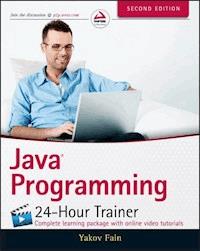
Quick and painless Java programming with expert multimedia instruction Java Programming 24-Hour Trainer, 2nd Edition is your complete beginner's guide to the Java programming language, with easy-to-follow lessons and supplemental exercises that help you get up and running quickly. Step-by-step instruction walks you through the basics of object-oriented programming, syntax, interfaces, and more, before building upon your skills to develop games, web apps, networks, and automations. This second edition has been updated to align with Java SE 8 and Java EE 7, and includes new information on GUI basics, lambda expressions, streaming API, WebSockets, and Gradle. Even if you have no programming experience at all, the more than six hours of Java programming screencasts will demonstrate major concepts and procedures in a way that facilitates learning and promotes a better understanding of the development process. This is your quick and painless guide to mastering Java, whether you're starting from scratch or just looking to expand your skill set. * Master the building blocks that go into any Java project * Make writing code easier with the Eclipse tools * Learn to connect Java applications to databases * Design and build graphical user interfaces and web applications * Learn to develop GUIs with JavaFX If you want to start programming quickly, Java Programming 24-Hour Trainer, 2nd Edition is your ideal solution.
Sie lesen das E-Book in den Legimi-Apps auf:
Seitenzahl: 835
Veröffentlichungsjahr: 2015
Ähnliche



















Table of Contents
Introduction
Who This Book Is For
What This Book Covers
How This Book Is Structured
What You Need to Use This Book
How To Read This Book
Conventions
Source Code
Errata
P2P.Wrox.Com
Lesson 1 Introducing Java
Why Learn Java?
Setting the Goals
The Life Cycle of a Java Program
JDK and JRE
Downloading and Installing Java SE
Installing JDK 8 for MAC OS
Installing JDK 8 in Windows
Your First Java Program: Hello World
Compiling and Running Hello World
Try It
Lesson Requirements
Step-by-Step
Lesson 2 Eclipse IDE
Introducing Eclipse IDE
Downloading and Installing Eclipse
Creating Hello Project in Eclipse
Creating the HelloWorld Class in Eclipse
Java Packages
Completing Code Generation
Additional Materials
Try It
Lesson Requirements
Step-by-Step
Lesson 3 Object-Oriented Programming with Java
Classes and Objects
Variables and Data Types
Declaring Variables
Final Variables
Primitive Data Types
Variable Scope
Wrappers, Autoboxing, and Unboxing
Program Comments
First Useful Program
Conditional Statement if
switch Statement
Inheritance
Method Overriding
Additional Materials
Try It
Lesson Requirements
Hints
Step-by-Step
Lesson 4 Class Methods and Constructors
Method Arguments
Method Overloading
Constructors
The Keyword super
The Keyword this
Passing by Value or by Reference
Variable Scopes
The Keyword static
Try It
Lesson Requirements
Step-by-Step
Lesson 5 Java Syntax: Bits and Pieces
Arrays
More About Strings
Loops
Debugging Java Programs
More About if and switch Statements
The Flavors of if Statements
Command-Line Arguments
Try It
Lesson Requirements
Step-by-Step
Lesson 6 Packages, Interfaces, and Encapsulation
Java Packages
Encapsulation
Access Levels
The Keyword final
final Variables
final Methods
final Classes
Interfaces
Marker Interfaces
Default Methods in Interfaces
Static Methods in Interfaces
Casting
Try It
Lesson Requirements
Step-by-Step
Lesson 7 Programming with Abstract Classes and Interfaces
Abstract Classes
Assignment
Solution with an Abstract Class
Polymorphism
Making the Interface Solution Polymorphic
Interfaces Versus Abstract Classes
Try It
Lesson Requirements
Step-by-Step
Lesson 8 Introducing the GUI with Swing
Swing Basics
Layout Managers
A Simple Calculator with FlowLayout
A Brief Introduction to Layout Managers
FlowLayout
GridLayout
BorderLayout
Combining Layout Managers
BoxLayout
GridBagLayout
CardLayout
Containers with Absolute Layout
More About Swing Widgets
Swing GUI Builders
Try It
Lesson Requirements
Step-by-Step
Lesson 9 Event Handling in Swing GUI
Introduction to Event Listeners
Teaching the Calculator to Calculate
Registering Components with
ActionListener
Finding the Source of an Event
How to Pass Data Between Objects
Design Pattern Model-View-Controller
More Swing Listeners
How to use Adapters
Inner Classes
Anonymous Inner Classes
Try It
Lesson Requirements
Step-by-Step
Lesson 10 Error Handling
Stack Trace
Java Exceptions
Exception Hierarchy
Try/Catch Blocks
Using the throws Clause
Using the finally Clause
Try-With-Resources
The throw Keyword
Creating Your Own Exceptions
Try It
Lesson Requirements
Step-by-Step
Lesson 11 Introduction to Collections
Arrays Revisited
Collection Interfaces From
java.util
Dynamic Arrays with ArrayList
Classes Hashtable and Hashmap
Class Properties
Classes Enumeration and Iterator
Class LinkedList
Class BitSet
Choosing the Right Collection
Try It
Lesson Requirements
Step-by-Step
Lesson 12 Introduction to Generics
Generics with Classes
Declaring Generics
Wildcards
Creating Custom Parameterized Classes
Bounded Type Parameters
Generic Methods
Try It
Lesson Requirements
Step-by-Step
Lesson 13 Lambda Expressions and Functional Style Programming
Imperative vs Functional Style
What’s Lambda Expression
Functional Interfaces
Methods Versus Functions
Passing Functions to Methods
Iterating Collections with forEach()
Lambdas Versus Inheritance and Polymorphism
Eliminating Inheritance
Interfaces Function and BiFunction
Try It
Lesson Requirements
Step-by-Step
Lesson 14 Working with I/O Streams
Byte Streams
Buffered Streams
Character Streams
Bringing Together GUI and I/O Streams
Data Streams
Utility Classes for Working with Files
The Class File
NIO.2: Using Files, Path, and Paths
What NIO Is About
Try It
Lesson Requirements
Step-by-Step
Lesson 15 Java Serialization
The Class ObjectOutputStream
The Class ObjectInputStream
The Interface Externalizable
Class Versioning
Serializing into Byte Arrays
Try It
Lesson Requirements
Step-by-Step
Lesson 16 Network Programming Basics
Reading Data from the Internet
Connecting Through HTTP Proxy Servers
How to Download Files from the Internet
Specifying Command-Line Parameters for FileDownload
The Stock Quote Program
Socket Programming
Why Use Sockets?
The Stock Quote Server with Sockets
Try It
Lesson Requirements
Hints
Step-by-Step
Lesson 17 Concurrency and Multithreading
The Class Thread
The Interface Runnable
Eliminating Inheritance
Sleeping Threads
How to Kill a Thread
Thread Priorities
Thread Synchronization and Race Conditions
Thread States
Wait and Notify
Closures in Java
Joining Threads
Goodies From java.util.concurrent
ReentrantLock Versus Synchronized
Executor Framework
A Brief Review of Concurrent Collections
Swingworker Thread
Try It
Lesson Requirements
Step-by-Step
Lesson 18 Introduction to GUI with JavaFX
JavaFX Application Basics
Using the E(fx)clipse Plug-in
Layouts
A Sample Application with the HBox Layout
A Sample Application with the GridPane Layout
Skinning with CSS
Event Handling
Properties and Binding
Try It
Lesson Requirements
Step-by-Step
Lesson 19 Developing JavaFX Calculator and Tic-Tac-Toe
Designing a Calculator with Scene Builder
Designing the Calculator GUI with Scene Builder
Handling Events in the Controller Class
Recognizing the Source of the Event
Passing Data from View to Controller and Back
Programming Tic-Tac-Toe
The Game Strategy
Designing Tic-Tac-Toe GUI with FXML and CSS
Implementing Game Strategy in Tic-Tac-Toe Controller
Handling the Tic-Tac-Toe Menu Play
Tic-Tac-Toe: What to Try Next
JavaFX on the Web and Mobile Devices
Try It
Lesson Requirements
Step-by-Step
Lesson 20 Stream API
Stream Basics
Intermediate and Terminal Operations
Parallel Versus Sequential Processing
Sorting Collections and Streams
Sorting Java Collections
Sorting Streams
Other Stream Sources
Creating Finite Size Streams
Creating Infinite-Size Streams
Short-Circuit Operations
Try It
Lesson Requirements
Step-by-Step
Lesson 21 Working with Relational DBMS Using JDBC
JDBC Driver Types
Installing Derby DB and Creating a Database
Sample JDBC Program
Processing Result Sets
The PreparedStatement Class
The CallableStatement Class
The ResultSetMetaData Class
Scrollable Result Sets and Rowset
Transactional Updates
Connection Pools and DataSource
Try It
Lesson Requirements
Hint
Step-by-Step
Lesson 22 Rendering Tabular Data in the GUI
JTable and the MVC Paradigm
The Model
Mandatory Callbacks of Table Models
Optional Callbacks of Table Models
Introduction to Renderers
Summary
Try It
Lesson Requirements
Step-by-Step
Lesson 23 Annotations and Reflection
Javadoc Annotations
Java Annotations Basics
@Override
@Deprecated
@Inherited
@FunctionalInterface
@Documented
Custom Annotations
Reflection
Run-Time Annotation Processing
Summary
Try It
Lesson Requirements
Step-by-Step
Lesson 24 Remote Method Invocation
Developing Applications with RMI
Defining Remote Interfaces
Implementing Remote Interfaces
Registering Remote Objects
Writing RMI Clients
Security Considerations
Finding Remote Objects
Try It
Lesson Requirements
Hints
Step-by-Step
Lesson 25 Java EE 7 Overview
The Big Picture
JCP, JSR, and Other Acronyms
Tiers of Java EE Applications
Containers Versus Application Servers
Profiles and Pruning
Why Java EE?
Try It
Lesson Requirements
Step-by-Step
Lesson 26 Programming with Servlets
The Big Picture
The Thin Client
How to Write a Servlet
How to Deploy a Servlet
Configuring Glassfish in Eclipse IDE
How to Create a Servlet in Eclipse
Deploying a Web Application as WAR
Browser-Servlet Data Flow
HTTP Get and Post Requests
Session Tracking
Cookies
URL Rewriting
Server-Side HttpSession
Filters
Asynchronous Servlets
Try It
Lesson Requirements
Step-by-Step
Lesson 27 JavaServer Pages
Embedding Java Code into HTML
Implicit JSP Objects
Overview of the JSP Tags
Directives
Declarations
Expressions
Scriptlets
Lesen Sie weiter in der vollständigen Ausgabe!
Lesen Sie weiter in der vollständigen Ausgabe!
Lesen Sie weiter in der vollständigen Ausgabe!
Lesen Sie weiter in der vollständigen Ausgabe!
Lesen Sie weiter in der vollständigen Ausgabe!
Lesen Sie weiter in der vollständigen Ausgabe!
Lesen Sie weiter in der vollständigen Ausgabe!
Lesen Sie weiter in der vollständigen Ausgabe!
Lesen Sie weiter in der vollständigen Ausgabe!
Lesen Sie weiter in der vollständigen Ausgabe!
Lesen Sie weiter in der vollständigen Ausgabe!
Lesen Sie weiter in der vollständigen Ausgabe!
Lesen Sie weiter in der vollständigen Ausgabe!
Lesen Sie weiter in der vollständigen Ausgabe!
Lesen Sie weiter in der vollständigen Ausgabe!
Lesen Sie weiter in der vollständigen Ausgabe!
Lesen Sie weiter in der vollständigen Ausgabe!
Lesen Sie weiter in der vollständigen Ausgabe!
Lesen Sie weiter in der vollständigen Ausgabe!
Lesen Sie weiter in der vollständigen Ausgabe!
Lesen Sie weiter in der vollständigen Ausgabe!
Lesen Sie weiter in der vollständigen Ausgabe!
Lesen Sie weiter in der vollständigen Ausgabe!
Lesen Sie weiter in der vollständigen Ausgabe!
Lesen Sie weiter in der vollständigen Ausgabe!
Lesen Sie weiter in der vollständigen Ausgabe!
Lesen Sie weiter in der vollständigen Ausgabe!
Lesen Sie weiter in der vollständigen Ausgabe!
Lesen Sie weiter in der vollständigen Ausgabe!
Lesen Sie weiter in der vollständigen Ausgabe!
Lesen Sie weiter in der vollständigen Ausgabe!
Lesen Sie weiter in der vollständigen Ausgabe!
Lesen Sie weiter in der vollständigen Ausgabe!
Lesen Sie weiter in der vollständigen Ausgabe!
Lesen Sie weiter in der vollständigen Ausgabe!
Lesen Sie weiter in der vollständigen Ausgabe!
Lesen Sie weiter in der vollständigen Ausgabe!
Lesen Sie weiter in der vollständigen Ausgabe!
Lesen Sie weiter in der vollständigen Ausgabe!
Lesen Sie weiter in der vollständigen Ausgabe!
Lesen Sie weiter in der vollständigen Ausgabe!
Lesen Sie weiter in der vollständigen Ausgabe!
Lesen Sie weiter in der vollständigen Ausgabe!
Lesen Sie weiter in der vollständigen Ausgabe!
Lesen Sie weiter in der vollständigen Ausgabe!




