


15,56 €
Mehr erfahren.
- Herausgeber: Iron Pen
- Kategorie: Poesie und Drama
- Sprache: Englisch
A posthumous collection of poems on the beauty of the seasons, creation, life and death, from beloved poet Catherine de Vinck. In the words of the Foreword by Mary Evelyn Tucker, the poetry of Catherine de Vinck, "calls us to ever greater awareness of who we are and where we dwell. She offers us glimpses of truth, not answers to our questions. She lights the path, sometimes with the brilliance of a single image. More often she surrounds us with the atmosphere of dusk—the twilight arising in our consciousness where mood and memory mingle."
Das E-Book können Sie in Legimi-Apps oder einer beliebigen App lesen, die das folgende Format unterstützen:
Veröffentlichungsjahr: 2023
Ähnliche













POEMS
JOURNEY TO THE MORNING LIGHT
CATHERINEDEVINCK
2023 First Printing
Journey to the Morning Light: Poems
Copyright © 2023 by Catherine de Vinck
ISBN 978-1-64060-770-5
The Iron Pen name and logo are trademarks of Paraclete Press.
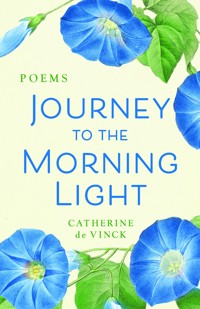
Cover art: Morning Glory by Pierre-Joseph Redouté (1759–1840), modified from the original, Swallowtail Garden Seeds
Library of Congress Cataloging-in-Publication Data
Names: De Vinck, Catherine, author.
Title: Journey to the morning light : poems / Catherine de Vinck.
Description: Brewster, Massachusetts : Paraclete Press, [2022] | Summary: “Poems of sorrow, joy, thanksgiving”-- Provided by publisher.
Identifiers: LCCN 2022019644 (print) | LCCN 2022019645 (ebook) | ISBN 9781640607705 (trade paperback) | ISBN 9781640607712 (epub) | ISBN 9781640607729 (pdf)
Subjects: BISAC: POETRY / Subjects & Themes / Inspirational & Religious | POETRY / Subjects & Themes / Nature | LCGFT: Poetry.
Classification: LCC PS3554.E928 J68 2022 (print) | LCC PS3554.E928 (ebook) | DDC 811/.54--dc23/eng/20220422
LC record available at https://lccn.loc.gov/2022019644
LC ebook record available at https://lccn.loc.gov/2022019645
10 9 8 7 6 5 4 3 2 1
All rights reserved. No portion of this book may be reproduced, stored in an electronic retrieval system, or transmitted in any form or by any means— electronic, mechanical, photocopy, recording, or any other—except for brief quotations in printed reviews, without the prior permission of the publisher.
Published by Paraclete Press
Brewster, Massachusetts
www.paracletepress.com
Digitally Printed
CONTENTS
FOREWORDBY MARY EVELYN TUCKER
PROLOGUE
I
ANGEL OF SPRING
II
ANGEL OF SUMMER
III
ANGEL OF FALL
IV
ANGEL OF WINTER
EPILOGUE
FOREWORD
CATHERINE DE VINCK CALLS US TO EVER GREATER awareness of who we are and where we dwell. She offers us glimpses of truth, not answers to our questions. She lights the path, sometimes with the brilliance of a single image. More often she surrounds us with the atmosphere of dusk—the twilight arising in our consciousness where mood and memory mingle.
I first met Catherine de Vinck in 1964 when I studied with her daughter, Anne Catherine, at Holy Child High School in Suffern, New York. Anne Catherine frequently invited me to her home for their family’s Sunday lunch.
The de Vincks lived in a large, rambling Victorian house in Allendale, New Jersey, overflowing with books. It was a joy for me to go there. To be liberated from boarding school for an afternoon was pure bliss. Being with a big family like my own, sharing a home-cooked meal, and savoring good conversation and laughter was memorable.
My recollection of Catherine from that time was of a vibrant, smiling woman with an engaging French accent. She was married to José, a professor, scholar, and translator. When they immigrated from Belgium in 1948 after the war, she didn’t know English or much about America—its society, customs, and values. Yet she sailed with José across the Atlantic to start a new life, as so many others had.
They raised six children with love, care, and grace, including their beloved Oliver, who was bedridden. With such a busy household and a husband immersed in translations of five volumes of Bonaventure’s writings, it is a wonder that Catherine could find a moment to write. But she did somehow, and managed to create hundreds of poems. They became the wellspring of our friendship.
I hold in my hands some of Catherine’s letters written over the years that always carried a new poem or two. I pick up her many books of poetry published by Alleluia Press, which her husband founded. The first one, A Time to Gather, was published in 1967 when she was 45. She continued to write poetry until she died at 99 on December 15, 2021.
I sit in wonder at what she has given to our world over these decades. Each poem carefully crafted, every thought creatively woven. How might one summarize her gifts? How shall we comment on her poetic talents and spiritual insights?
She holds her mind’s eye steady to illuminate the numinous beauty of the world and the palpable mystery that infuses it. She invites us into this great presence where everything—trees and forests, water and rivers, clouds and air, plants and stones—is alive and is speaking to us. Figures emerge as night moves in and darkness holds us in its silent embrace. Fox and deer, birds and rabbits pass through her vista from the nearby woods, capturing her imagination and expanding ours. They are part of the living world where she dwells.
Yet deep silence surrounds her imagination so that her poetic images arise from a state of reverie, from moments of grace, and from sustained vigilance. Each poem is a meditation painted with words springing from the depths of her soul. The alchemy she has created is medicine—a balm for the soul groping in the darkness, a buffer against heartbreaks that linger in the mind.
Catherine’s genius lies in the selflessness of these offerings. These are lyrics of love, an emotion she embraced with confidence and allowed to guide her. Just as she led her life giving to her family and friends, so she gave over to her muse. She welcomed the consolation of paper and pen in the middle of the night and in the hours of dawn and dusk. There she could open herself to the great unknown and listen. That listening has brought us hundreds of gems that continue to sparkle across time. Their light, their brilliance is needed now more than ever.
For she intuits that what is incarnate in land and sky, mountains and rivers reveals its presence in us, too. That numinous force, she affirms, will endure all the days of our life and beyond. With the daily flood of the world’s anguish comes an unnamed luminescence hidden deep within the changing nature of things. It is here that she animates hope.
This volume appears as a distillation of her decades-long immersion in poetry. Her spiritual journey is lucid here, drawing on her depths of contemplation. It is emboldened by mystery, shorn of convention, and free of traditional religious language. This signals an invitation for the reader to enter into metaphors linking the mundane and the marvelous, moving from the particular to the universal. Here is the way of prayer.
She acknowledges that her poetry is a place where words enwrap us. Yet she brings us beyond language to a sensibility where words are no longer needed, where “a presence, nameless and unnamable breathes forth its power” (“Geography Lesson,” p. 74). This is liberating, opening us to a space apart from tradition or scripture. Deftly, she draws us into fresh experiences and accessible intuitions, like a Zen koan resonating with life.
Her lyrical language ushers us gently into another realm of being, one where our consciousness is awakened beyond daily distractions. The fragmentation of existence is brushed aside for a moment and we catch a glimpse of that which is beyond the visible and yet apparent in the visible. The spontaneity of her imagination holds these poems together along with recurring themes that lure us in gradually—time and death, tragedy and loss, cosmos and nature, the unnamed and unknown.
In the end, her healing vision invokes a clear sense of living within deep time, subject to the unfolding dynamics of evolution that have birthed us. Here in “Waking in the Cosmos” she illustrates the identity we have with the cosmological powers and natural forces in which we dwell across time and space:
Within our blood
stars flash their signals,
rivers circuit their courses,
seas fluctuate rhythmically
while the dust of dead constellations
mingles with our bones.
Catherine celebrates our participation in the continuity of being—from the smallest atom to the largest star. This is what gives her work vitality in the face of loss and decay. She has steeped herself in the sensuous beauty of Earth and drawn in the vibrant powers of the cosmos so that we, too, can abide in reverence and embrace renewal.
—MARY EVELYN TUCKER
Yale University
PROLOGUE
MUSE
“I shall not die,
I shall not go away.
Just don’t ask me any questions,
I shall not answer.”
—IKKYÛ (1394–1481)
A full moon disk of hammered silver
appears in the east window
as the wind slowly rises in the woods
stirring the trees newly sheeted with leaves.
This is the hour of the night angel,
her pale wings rowing rhythmically
across the luminous evening.
What am I doing unfurling metaphors
as if anyone expects the tall ships of poetry
to roll up and offer safe passage
across strange seas? And yet the wind
still lifts great ribbons of song
from one side of the world to the other.
So I stand quietly on the quay of moonlight
and welcome the night angel, tender of gifts,
arriving from the outer reaches.
I
ANGEL OF SPRING
SPRING
When spring shakes open
the folds of her robe,
daffodils and violets fall out
petaling the brown earth
with pastels of light.
Where shall I be then?
Not counting the years,
but held in rapt attention
by the wafting scent,
by the wren, swallow, jay—
dashes of color ascending the sky—
going about their beautiful lives.
Nothing tentative here, a firm course,
an exact knowing of the direction
of air currents and wind streams.
I step outside of time
and lie down in fields of happiness—
What other name for what is nameless?—
and find myself made new again
in the ever greening world.
SUMMER
A white egret
floats across the blue sky
mirrored in the glassy water
where a tall heron
bends stiffly admiring
its reflection.
Nothing much,
yet enough to praise
the muskrat and the turtle,
enough to praise
the red wing and the goose,
above all enough to praise
the mothering power—
bearer of life beyond
the boundaries of mind,
the limits of language.
As the afternoon slides
into evening, I walk home
wrapped in darkness.
Behind the windows,
lamps open their corollas.
A slight wind, scented
with honeysuckle,
caresses my face.
Nothing much,
yet enough for joy.




