


0,99 €
Mehr erfahren.
- Herausgeber: DCO Books
- Kategorie: Gesellschafts- und Liebesromane
- Sprache: Englisch
An Alien First Contact Science Fiction Book
Life found on Jupiter, not Mars
An unmanned probe makes it through Jupiter’s stormy and turbulent outer atmosphere only to discover the planet’s surface can support life. Within minutes this is proved when the probe films its own destruction by wild animals.
Skilled NASA astronaut and pilot Alex Shaw is past his prime and side-lined by new technology, but when a captain is needed for a manned landing on Jupiter by an international space consortium, he is the obvious choice.
The Jupiter landing module is attacked by an alien lifeform while still in the upper atmosphere and loses all communications with the orbiting command space craft. Once landed the small crew make a startling discovery. A humanoid species is trying to exist with deadly and intelligent competing life out to destroy them.
Their declining society is matriarchal with the men forming a warrior caste. A romance begins between Alex and Seren, the Jovian general’s daughter, while fighting one last great battle for their species survival.
Can this cross-species love story continue?
Can the visitors help save the Jovian society?
Can the landing crew ever return to Earth?
Buy this book to find out.
Das E-Book können Sie in Legimi-Apps oder einer beliebigen App lesen, die das folgende Format unterstützen:
Veröffentlichungsjahr: 2024
Ähnliche




















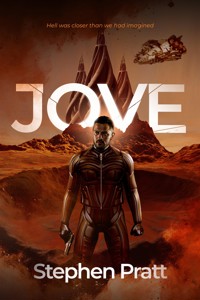
Jove
Hell was closer than we had imagined
Stephen Pratt
DCO Books
Jove
Copyright © Stephen Pratt, 2021
First Published 2021
DCO Books
eBook Edition published by
Proglen Trading Co., Ltd.
Bangkok Thailand
http://www.dco.co.th
eBook ISBN 978-616-456-039-0
All Rights Reserved
This book is a work of fiction. All names, characters, and other elements of the story are either the product of the author's imagination or else are used only fictitiously. Any resemblance to real characters, living or dead, or to real incidents, is entirely coincidental.
For Grandma and Grandad.
Better late than never.
Contents
Prologue
Chapter 1
Chapter 2
Chapter 3
Chapter 4
Chapter 5
Chapter 6
Chapter 7
Chapter 8
Chapter 9
Chapter 10
Chapter 11
Chapter 12
Chapter 13
Chapter 14
Chapter 15
Chapter 16
Chapter 17
Chapter 18
Chapter 19
Chapter 20
Chapter 21
Prologue
The machine squatted, spider-like, upon the arid plain. There was no sound except for the sough of the wind and the occasional sharp click of cooling metal from its descent engines. For a long time, nothing changed. Then, with a low whirring noise, a long probe slid from the machine’s underbelly, extending until its sharp tip dug into the ground. A screw turned, extracting samples of dry soil, carrying them back up to a miniature laboratory, where an X-ray spectrometer began determining the elemental composition of the dirt. Simultaneously, from the edge of the machine’s carapace, an anemometer sprouted, its cup-tipped arms blurring into a spinning disc as they caught the wind. At the rear of the machine, two telescopic arms unfurled a gauze net, holding it ready to capture any windborne particles, while from a snug compartment a high-resolution camera rose smoothly on a long mast, its lens irising wide to accommodate the nebulous, orange-tinged light.
The camera began turning slowly through 360 degrees, using the visible light to capture stereoscopic 3D imagery, while a laser rangefinder strobed the horizon. Measurements and panoramic images were downloaded to onboard computers, enabling them to create a topographic model of the terrain. Finally, in a flourish of seamless technology, a high-gain antennae blossomed into an inverted umbrella shape to begin beaming data to an unmanned orbiter waiting patiently in geo-stationary orbit 700 kilometers above.
The camera continued to pan and record, picking up no trace of the creatures that had crept stealthily to within ten feet of the machine. The closest of these prowlers raised its head to reveal two flat yellow eyes whose surfaces reflected nothing but a constant feral hunger. Beneath a heavy muzzle, thick lips drew back into a silent snarl, unsheathing a fearsome array of teeth. Powerful muscles quivered as the creature’s body tensed and, in unearthly silence, it launched itself at the alien intruder, hitting the heavy machine hard enough to rock it back and forth on its spindly legs. Other creatures joined the first, an entire pack rushing in to tear and slash at the tons of equipment with berserk ferocity. It took only a few moments for the pack leader to discover that their prey was indigestible, but by then the robust machine had been reduced to a tangled wreck. Frustrated, the first predator lifted its great head to the racing clouds, flared its ventral gills, and bellowed angrily into the ceaseless winds.
Chapter 1
I kept my eyes closed because of the pounding in my head. Willing myself back to sleep only quickened the painful rhythm. I groaned. An answering murmur from close beside me snapped my eyes open. Easing myself up on one elbow, I looked down at the sleeping girl. She was a stranger. I groaned again and, swinging my legs carefully out of the tangled sheets, I rose from the bed and silently crossed to the bathroom. As I stood relieving myself, disjointed images began parading through my head. Crowded bars filled with loud crashing music, a club, and the girl in my bed. Confronting myself in the bathroom mirror, I saw a face the right side of forty, with regular, thoughtful features starting to bear the lines of too many disappointments, too many unresolved dilemmas, too many restless nights.
My sorry reflection winced at me at the thought of morning-after small talk with a stranger. So, with desperate stealth, I gathered some clothes from the bedroom and, scooping up my keys, slipped out of the house, telling myself that by the time I got back she would be gone.
Driving past plush suburban houses with their beautifully landscaped and well-tended, emerald-green lawns, I made a hard right turn at a fashionable coffee house, and headed for the coast. Turning off the coast road, I pulled the Corvette in amongst endless ranks of grass-tufted dunes, and cut the rumbling engine. Early morning silence caressed my throbbing temples. Before me, the beach curved away, a great sweep of sand looking uncharacteristically somber in the feeble pre-dawn light. With the headache receding to a sullen thud, I reclined the seat and relaxed. Through the windscreen I could see the ocean, and soon the sun would be rising in a spectacle I never grew tired of.
Nevertheless, I must have dozed, because the demanding electronic warble of my cellphone startled me awake. I fumbled for it.
“Shaw.”
“Alex, sorry to be calling you so early.”
“Yeah, yeah.” I recognized the voice. It was Hammond, the chief administrator over at the space center. “What can I do for you Matt?”
“We’d like you to come in this morning, just as soon as you can.”
I was confused. “Why the urgency? I’m not scheduled–”
“This isn’t routine,” he answered quickly. “This is anything but routine.”
Suddenly, clear-headed, I gripped the phone tighter. “You got a real mission for me, Matt?”
The smug beep of an ended call was the only answer I got. Like a blessing, crimson light washed through the car. Looking out beyond the beach, I saw the sun’s fiery rays turning Atlantic breakers into dancing demons.
*
Hammond met me as I entered the administration building. Without a word, he took me by the arm and led me down a long, empty corridor. As we walked, I noticed how disheveled he looked in shirt sleeves with his tie yanked loose, and I noted the dark smudges under his eyes.
“What’s going on Matt?”
“In here.” He held a door open for me. It was a standard briefing room and, despite the air-conditioning, it smelled of stale sweat and intense discussion. There was another man in the room and, as we entered, Hammond introduced us. “Alex, I’d like you to meet Doctor Charles Kurtzman, chief satellite systems engineer at JPL.”
I managed a smile; it was all falling into place now. The Jet Propulsion Laboratory at Pasadena is where they put together the satellites that NASA places into orbit. One of the satellites must be in need of emergency repair, hence this early-morning briefing. As we moved into the room to sit amongst drifts of paperwork, I could feel the first slide of approaching disappointment. A mission to rescue a stricken satellite would be carried out by an unmanned, automated space vehicle. Automation had taken over space, reducing astronauts to the status of has-beens. There would be no fresh challenges for a redundant Shuttle pilot like me; no opportunity to sharpen my decaying skills. I held on to my smile.
“It looks as though you two have been at it all night.” I nodded in the direction of the paper-laden tables.
“We have,” answered Hammond. “And you’ll see why in just a moment. Doctor….”
Taking his cue, Kurtzman looked directly at me. Despite lack of sleep, his eyes were clear and bright. “What do you know about Jupiter, Commander?”
I must have looked confused because Hammond rescued me. “It’s not a code word for some new piece of equipment, Alex. The doctor is referring to the planet Jupiter, the big daddy of our solar system.”
“Oh, I see,” I responded, more confused than ever. Taking a moment to order my thoughts, I plunged in. “Well, up until a few years ago, Jupiter was thought to be nothing but a gas giant with a core of metallic hydrogen. Since then, the first Juno probe sent to the planet has disproved everything we thought we knew about Jupiter, when it discovered evidence of a solid surface hidden beneath the dense layers of gas. Turns out Jupiter isn’t a gas giant, after all. Naturally, that’s excited a lot of scientific interest. So much so that a second Juno mission incorporating a robotic orbiter and lander was launched. It recently arrived at Jupiter, and successfully touched down on the surface. Unfortunately, due to some unspecified malfunction, no data has been received. That’s it.” I shrugged.
“Well, that’s not quite it.” Kurtzman turned to a large screen set into one wall. “We did receive some pictures from the Jovian surface before the telemetry failure.”
The engineer picked up a remote and mashed a button. The screen flickered into life, showing the sort of grainy black and white picture normally associated with very old silent movies. The camera was panning slowly left to right across a flat landscape that stretched off toward what looked like a range of low hills.
“Those hills are some eight kilometers away,” Kurtzman commented helpfully.
I leant forward in my chair. “There’s some movement. What is it?”
“Vegetation,” answered Kurtzman matter-of-factly.
I almost fell flat on my face. “Vegetation! Plant life… That’s–”
“Wait!” He raised a hand to silence me. “Here comes the malfunction.”
Something surged up from the bottom of the screen to fill the camera lens with its dark bulk, then the picture tilted crazily and, in an instant, there was nothing but static.
Both men turned to look at me. My mouth was hanging open, so I closed it and swallowed before speaking. “What was that?”
Kurtzman turned back to the screen. Smiling smugly, he thumbed another button. “Here it is again at half speed.” The shape started up from the bottom of the screen, slower but still badly blurred and indistinct.
“These pictures have been computer enhanced. Due to atmospheric conditions, this is the best quality we can obtain, and you’ve just seen everything we ever got from the lander after it successfully touched down.” He froze the image and the dark mass hung there, poised to burst into the room with us.
Brow knotted anxiously, I rose unsteadily to my feet and walked slowly towards the flickering image. Reaching out with one hand, I pressed my fingertips to the charged screen. “What is it?” I murmured, half to myself.
Kurtzman answered, “All we know for sure is that it’s alive, sentient, and it displayed the behavior of a complex organism when it reacted aggressively to the lander.” He paused before adding, “Oh, and it lives on Jupiter.”
Hammond moved across the room to stand at my elbow. For a moment we both stood silently staring. When he spoke, his voice was a reverent whisper. “That’s right, Alex. Not only are we not alone, we’ve got neighbors.”
*
“How can anything live on a planet with a hydrogen-helium atmosphere?” We were all seated again, with me asking the questions between sips of hot coffee.
“As well as significant amounts of ammonia, sulphur, phosphorous, and methane,” put in Hammond gleefully.
Kurtzman sat facing us. “The atmosphere of Jupiter has a complex chemistry. That much can be deduced from its exotic appearance,” he began, steepling his thick fingers before him. “The atmospheric bands of varying colors that completely obscure the planetary surface are, in fact, cloud systems whirling at speeds of up to one hundred meters a second. A dense, turbulent atmosphere of jet streams, cyclones, and anti-cyclones. There’s even a single storm four times the size of Earth that has raged unchecked for hundreds of years. Yet, despite all this turmoil, the banded structure of the storm systems has always remained constant. We chose a cloud band of relative calm and stability some sixteen degrees north of Jupiter’s equator for the Jove lander to descend through. As the craft began its controlled descent, it first encountered cirrus clouds of ammonia crystals. Below them, it passed through clouds of ammonium hydrosulphide. At this point, the instruments began to measure small amounts of atomic oxygen, followed by a massive increase in nitrogen levels.” His voice became excited. “Then it plunged into dense water clouds and, finally” – he raised a single finger for emphasis – “nine kilometers above the aim point, it dropped below the cloud base into a breathable atmosphere with a temperature that would not only indicate life, but practically guarantee it!”
My coffee cup slipped through my fingers and bounced away ignored. I stared at Kurtzman as though he were mad, half expecting him to burst out laughing, unable to carry on with the absurd joke he was playing. But he wasn’t laughing; he just sat there staring back at me, his face unreadable. Yet I knew he was waiting for me to try and punch holes in his story, so I obliged.
“Jupiter is too far away from the sun; its influence is too weak to generate the life-giving temperatures you’re talking about.”
He answered without hesitation: “Jupiter is approximately five times as far from the sun as the Earth is. On Jupiter, the sun’s radiation has only four percent of the power it had when it passed the Earth. But the denseness of Jupiter’s atmosphere can more than compensate for that shortfall.” He paused, looking at me as though it were all too obvious. “The greenhouse effect,” he went on. “Global warming. A big problem here on Earth, but an asset on Jupiter, where the dense cloud cover traps the sun’s radiation, preventing it from dispersing quickly back into space, thus increasing the available sunlight’s efficiency by a factor of six.”
“You’re sure of all this?” I asked, looking skeptical.
Kurtzman leaned forward, his eyes locking with mine. “Everything we’ve ascertained from the lander points to a high likelihood of a living biosphere existing beneath Jupiter’s storms.”
I figured I’d acted as a sounding board for long enough, so I decided to cut straight to the chase. “Why are you telling me all this? Why the personal briefing?”
I half turned toward Hammond. The question was as much for him as Kurtzman. Hammond was looking at me expectantly, and I suddenly realized that I had underestimated both men. I simply hadn’t expected such vision from two people who were essentially bureaucrats. Or was it perhaps that my own disillusionment had eroded any expectations I might ever have had of people like them.
“A human mission…? You’re planning a human mission to Jupiter!” I could hardly bring myself to say the words out loud, half afraid I might shatter what seemed so fragile a concept.
Hammond, however, had no such reservations. “Alex, we’re going to put human beings onto the Jovian surface within the next five years. They’re going to meet with extraterrestrials and then come home again. How would you like to be one of them?” He beamed at me as though he had just suggested a trip to the mall.
My throat dried up. “Why me?” I croaked. It was all I could think of to say.
Hammond’s grin slipped a little but refused to leave his face. “Don’t sell yourself short. You’re an experienced orbiter commander … a former Navy test pilot. You’ve even flown combat sorties. If anything, you’re over-qualified.” He reached over to slap me lightly across the bicep. Uncle Matt letting me know what a silly boy I was being.
“Look,” he went on. “We’ve just finished a feasibility study, and the NASA directors are going to take the whole package to Congress within the next few weeks. Just before that, we’ll be going public, and when the press comes swarming, we’d like to have some names ready. So why don’t you take a few days to think it over.”
I didn’t need to think it over. A sense of excitement began to build in me, the certainty that I was going to Jupiter. It wasn’t a hard decision for me to make; it was hardly any decision at all. What else could I do but agree to this last chance of pulling something special and worthwhile out of the void of my existence.
*
The NASA chiefs broke the news that life had been discovered on Jupiter, and they rode a media wave all the way into Congress where – once they had weathered the storm of scientific disbelief – they proposed the Jupiter mission. Public opinion was galvanized but Congress began to balk at the cost of such a mission. Billions of dollars weren’t even mentioned by NASA’s space engineers; they were talking in trillions – many, many trillions. It soon became obvious that the national budget could never take such a strain. The morale of the American people teetered on the brink of an abysmal plunge. The president, seeing a second term in office slipping away from him, hastily called upon his scientific advisers for a way out. They advocated the setting up of an international mission, with NASA retaining its lead role.
The president duly addressed both houses of Congress, stressing that no single nation should “bear the mantle of Earth ambassador alone to the inhabitants of Jupiter” and that, in his opinion, any mission to Jupiter that was not a joint venture between the entire peoples of the Earth would have failed before it even left the launch pad. The media lapped this up, calling the speech an historic “one world, one vision” benchmark. The public loved it too, and the president’s aides even began talking about a third term.
Luckily for the president, his call for international collaboration didn’t fall on deaf ears abroad. The European Space Agency was the first to step up and offer its unlimited support. Followed by the Russians, the Chinese, and, more cautiously, every one of the private space-flight companies.
The most massive joint space venture in history was go.
Chapter 2
The 3G squeeze on my ribs felt like a farewell hug from an old friend. It seemed strange not being in the pilot’s seat as the Shuttle thundered upwards from the Cape. My eyes wandered about the orbiter’s spacious passenger section. A few feet away, the mission commander reclined, unmoving, his strong African-American features impassive, his eyes staring straight ahead. Ben Powell was an astronaut of vast experience, a veteran of the first Shuttle missions and a former military test pilot like myself. We’d got on well over the past three years of intensive work, meshing as only two ex-Navy flyers could. He was the boss and I was his number two. By the end of the three years, he had started calling me “son,” and that was high praise as far as I was concerned.
Side by side, directly in front of me, looking tense but not nervous, were the two Russians, Irina and Natalya. They were identical twins; Star City-trained cosmonauts and Olympic-standard gymnasts. Irina’s expertise was communications systems engineering; Natalya was a surgeon, space medicine specialist. They were also empathic.
Beside me, Kyoichi Hakamada, the Japanese mission specialist, looked relaxed and composed, his hands resting lightly on the arms of his couch, his lean frame hinting at a compact toughness. A planetary geologist who had come through his astronaut training at Johnson Space Center with top marks. He was young, but he possessed an ebullient confidence and a natural authority that made up for his lack of years.
Beside him, Professor Robert Guerin had his eyes squeezed tight shut and his hands rigidly clamped onto the sides of his couch. He was not an imposing individual, small of stature and soft of muscle from a lifetime of the kind of work that required a keen mind rather than a broad back. At forty, he was the oldest member of the crew, and his slight build was topped off by a bland, characterless face that fell far short of handsome. One had to look deeply into his eyes, an insignificant gray in color, to find a hint of the astute, logical mind lurking beneath the thinning thatch of reddish hair. The Frenchman had run into difficulties during his astronaut training, but had come through more by his sheer refusal to accept failure than by any driving passion to become an astronaut. A brilliant and well-respected astro-biologist, he couldn’t wait to get his hands on a native of Jupiter.
The muffled rumble of a reaction control jet told me we were about to dock with Orcon 1, the orbital assembly facility – a vast space station about to be utilized as a jumping-off platform for the Jupiter mission.
As we pulled ourselves hand over hand into the station’s interior, a large man descended enthusiastically upon us. “Welcome to Orbital Construction 1. My name’s Ed Chaffee, chief engineer. If you’d just like to float this way.”
Chaffee expertly span about on his own axis and shot away down a cramped passageway. We bobbed along after him until the passageway opened out into a large, console-lined chamber. Opposite the entrance, a single large window took up an entire bulkhead. Chaffee boosted himself across the chamber, coming to a halt before the wall of thick glass. I floated up beside him and took my first look at the craft that was going to carry us across 480 million miles of void and then back again.
The size of her staggered me; a tower block laid on its side couldn’t have matched her dimensions. Even festooned as she was with gantries, umbilicals, and interlocks, her graceful lines were still discernable. The others joined us, adding their stunned silence to mine.
Chaffee turned to grin down the line of our awe-struck faces. “Yeah, that’s about right. That’s the effect she has on everyone the first time they see her. Computer simulations and artist’s impressions don’t quite do it for you, do they? There she is, Galileo, humankind’s first interplanetary manned spacecraft. Trillions of dollars’ worth of cool equipment.” He slid his finger across a screen, and banks of floodlights flared into life, illuminating the craft’s forward quarter. “There’s the command module orbiter.”
I could clearly see the great swelling bulb of the orbiter, with its big, dish-shaped antennae and spiky fringe of outriggers, each bearing a nuclear generator. More screen tapping. Now, Galileo’s entire length lay starkly revealed. The three stages of liquid propellant rocket booster that would be needed to blast us off from the Jovian surface stretched away to disappear into the imposing bulk of the landing rig that was stuffed full of all the scientific and mechanical equipment we would need for surface exploration. The landing rig would also serve as a launch pad for the ascent. I craned my neck, looking for the one feature of Galileo’s complicated make-up that especially interested me. I spotted them slung low on the rocket’s cylindrical body – a pair of retracted, swept-back wings running the entire length of the craft. For me, they breathed life into what would otherwise be just another sterile spacecraft. Those wings had control surfaces that would react under my hands to the demands of the turbulent Jovian atmosphere. It was going to be the toughest piloting job ever. It was going to be everything I had ever wanted.
*
As well as the relative movement of the planets, the sun’s gravitational influence would also play a significant role in shaping the spacecraft’s trajectory to Jupiter. So, Galileo’s route would follow a curved trajectory rather than an arrow-straight path.
The launch window we’d been working toward had been chosen to enable Galileo to pass close enough to Mars for a gravitational slingshot, to achieve great savings in time and energy. Even with the assistance of Mars, the journey to the giant planet would take five years, so in order to further save resources during that time, we would all be put into hibernation. While we slept, onboard computers under the paternal guidance of mission control would handle all in-flight course corrections. The mission team back on Earth would also continue to monitor spacecraft systems big and small during our interplanetary cruise. The spacecraft had five advanced computer systems permanently online, each constantly checking each other’s performance, and another complete bank of back-up computers on standby. With one tracking sensor fixed on the sun, and another on the star Canopus, the computers were going to deliver Galileo into her pre-ordained orbit around Jupiter. Once there, they would wake us ever so gently.
*
I lay in my form-fitting hibernation pod, with the medics stooping over me. They’d just finished sticking needles into my arm, and I was beginning to feel a pleasant drowsiness. “Tell me, Doc,” I mumbled to none of them in particular. “What are we, crew or cargo?”
“You’ll get your chance, flyboy,” answered one of the indistinct forms, his voice drifting to me down a long, dark tunnel. “You’ll get your chance.”
*
I was jolted awake, overwhelmed with nausea. My face mask was lifted away. Something had gone wrong. I hadn’t slept. I was coming out of hibernation too soon. There was somebody standing over me. A woman. I was a child again; panic and guilt washed through me as though I were about to be discovered awake long after my bedtime.
“What’s going on?” My question emerged as a croak. The woman leant forward and I felt something pushing against my lips. A soothing liquid flowed into my throat, restoring it to life. My eyes focused until the figure resolved into one of the Russian twins. She was smiling. It must be Natalya, the medic, my woozy mind told me eventually. I smiled back, hurting my cracked lips.
*
“Preliminary ship status checks indicate everything normal. The journey from Earth went exactly as planned and we’re right on schedule.” Ben sat facing us, his large frame held immobile by the webbing on his chair. We were positioned about the orbiter’s roomy flight deck, anchored to various grab bars.
“Orbit trajectory steady. Galileo is now in a low orbit around Jupiter,” Ben confirmed, his face splitting into a huge grin.
There were answering smiles all round.
“So far, it’s been a walk in the park. Now comes the hard work.” He turned to me. “Alex, I want the lander prepped right away. I’d like to go for a launch on the first pass, and that’s four Earth days from now. It’ll mean working flat out, but you’ve all had plenty of rest, and Natalya tells me that everyone’s biometrics are good. She also tells me that your muscles have been taking it way too easy of late, so you should spend as much time as you can on the fitness machines.” More smiles. “Let’s get to it.”
*
It wasn’t like being in space at all. All that could be seen out of the viewport was a roiling, orange-red cloudscape. Even though I knew the nearest of those dense and disturbed clouds to be at least 500 kilometers away, to my un-aided eye they seemed to be pressing right up against the toughened, triple-glazed transparency of the window. Every now and then, a brief intense explosion of light would illuminate the burnt orange clouds from within – a dramatic reminder of the monstrous electrical storms that prowled Jupiter’s ionosphere.
The silent explosions gave the clouds a gut-dropping sense of depth, just as their pulsation lent the planet a moving, breathing quality. Unpredictable and deadly, the former gas giant beckoned and warned. As I stared into the swirling vapors, I reached out with my thoughts in an attempt to picture the creatures that might be living beneath those eternal storms. What were they doing at this exact moment? Feeding? Fighting? Reproducing and dying? Probably all of those things. And how would they react to us, the alien intruders? What sort of impact were we going to make on their world? I grinned. A brief and spectacular one if I didn’t pilot the lander successfully.
Ben interrupted my musings by floating his bulk into the couch next to mine. He didn’t speak; he just sat staring out of the laminated window. Jupiter entranced even the most hardened astronauts. Wordlessly, he handed me a communications sheet. It was a Jovian weather report from mission control. The Hubble Space Telescope had detected increased atmospheric activity in the region of the drop. Planetary meteorologists had applied the Hubble observations to their mathematical models and come up with a prediction of severe – even by Jovian standards – storms for the foreseeable future. I handed the sheet back.
“Looks like we’re in for a bumpy ride,” I said.
“You signed up for a bumpy ride.” Ben slapped the sheet. “According to this, you’ve got as much chance as an ant riding over Niagara on a matchstick.”
Silence descended for a moment and I stared out of the window, my mind racing. “The lander can take it. She’s put together like a brick outhouse,” I replied, keeping my voice level and steady, ignoring the nameless panic growing inside me. “Trust me, I know every inch of her. She’s tight, real tight.” I kept on talking, attempting to exude a confidence I didn’t feel. “She only has to make the one drop, and she can take the stresses.”
“Tough as she is, she wasn’t designed to handle such heavy turbulence,” Ben cut in, stabbing a finger toward the tempest-filled port. “There’s nothing standard about this. It’s a different beast.”
“But she’s capable of it,” I snapped back too quickly.
He didn’t hesitate. “On paper, maybe. In simulations perhaps, though I can’t recall any simulations that recreated a drop into weather like this.” He shook his head slowly. “You can’t do this, Alex; you’re a pilot, you know what the tolerances are.”
“I do. Better than anyone. And I’m telling you, she can make it.” I paused to take a deep breath before continuing. “Weather predictions always have been, and still are, an imprecise science, even back on Earth, let alone a planet over seven hundred million kilometers away.” I pointed at the sheet. “Which makes that an estimate, not a firm prediction.”
He looked sadly at me. “Yeah well, your faith isn’t being shared back home. Your ESR rating has dropped to thirty-five percent. What they’re saying is, you try to descend through that weather, and there’s a sixty-five percent likelihood you’re gonna break up.”
I turned back to the viewport, my mind chewing on the fact that mission control was predicting only a 35 percent chance of an expected safe return for the lander. I watched two continent-sized white spots conclude a strange dance in and out of the rushing storm systems, before slowly shaking my head. “They’re wrong, way wrong.”
Ben’s large, weightless hand descended onto my shoulder. Glancing over at him, I noticed that his features had shed their usual hard lines.
“Listen, son, we’re a long way from the politicians, the money men, the high-tech theologians. We’re so far away that even if Jupiter were to explode right at this moment, it’d be two hours before anyone on Earth knew anything about it.” He sighed heavily. “What I’m trying to say is that you’re under no pressure here; not from me, not from anybody.” He stabbed a finger at me. “You’re the pilot. Ground experts can make their pronouncements, but in the air every pilot relies on instinct. It’s entirely your call. When you leave me behind in this orbiter, all I’ll be doing is holding my breath for six months until we rendezvous again. If you say the drop’s on, then it’s on. If you say it’s off, then it’s off. Pilot to pilot, I’ll back your decision all the way.”
The idea of not going through with the mission had never occurred to me, and now here was the mission commander handing me just that alternative. It suddenly struck me that Ben Powell was the only person in the entire solar system who really cared whether or not I lived or died; cared enough to throw away what would be the crowning achievement of his career. How could I explain to this good man that the very thought of turning away from Jupiter filled me with a fathomless dread.
“I’ve often wondered,” I said quietly after a moment, “if I was picked for this mission because I’m such a good pilot or because I have no wife and family.”
Ben’s response came back quick and flat. “NASA doesn’t believe in suicide missions.”
I stared intently at him. “Right, and neither do I. I can do this, I know I can.” Willing him to believe in me, I saw his face set once more into those familiar hard lines.
“Y’know, you’re probably right.” Crumpling up the weather report, he flicked the flimsy ball off into zero G. “Go and make me proud, son.”
*
I was running some final checks on the lander’s flight deck when I noticed Natalya arrowing purposefully towards me, brandishing a loaded hypodermic. Swinging round to her, I frowned at the long needle. “That’s all I need, another jab. I already feel like a porcupine during the mating season.”
She looked at me curiously. “Really? You should not be feeling horny. That injection you had ten hours ago should have taken care of that.”
I felt my face redden. “No, no. I didn’t mean it that way.”
She arched her eyebrows at me.
“Look, just go ahead and do it,” I said, tugging at my sleeve. “What’s this one for anyway?”
“It’s a booster,” she answered. “When this takes effect, you’ll have an immune system like a sewer rat’s.”
“Just what I always wanted.”
“You may need it,” she said gravely. “It’s entirely possible that the instant we set foot upon the Jovian surface, our bodies will come under attack from completely alien micro-organisms.”
She pushed herself away from me, the hypodermic now empty. I hadn’t felt a thing. I smiled. “Who gives you yours?”
“I give it to myself.” She smiled back before executing a series of perfect zero-G backflips right across the flight deck and out of the hatch.
“I’ll just bet you do,” I said to myself. “I’ll just bet you do.”
Chapter 3
The numbers were counting down. My eyes flicked back and forth across the lander’s situation displays. All systems were go, all lights were green. Natalya sat beside me, co-pilot for the drop. Guerin and Hakamada were strapped in at their stations. Nobody spoke; nobody broke the leaden silence that had asserted itself upon the flight deck. We waited, the tension thickening about us, each of us aware that, though it scarcely seemed possible, the ship’s sensors suggested that the storm now raging just below us had grown even stronger.
I looked down at my hands, which were tightly fisted on my lap. There was nothing for me to do, there was nothing for any of us to do, and that was the worst of it. The computers were handling the separation and initial descent.
Three … two … one … I counted off in my head the last heart-aching seconds of safety and comfort and everything we knew.
A series of muffled thuds reverberated throughout the cabin; explosive charges blasting away the interlocks that held Galileo together. There was a jolt as powerful springs pushed the lander away from the orbiter, and I knew that three-quarters of Galileo’s entire length had just begun falling towards Jupiter, with us aboard.
“Ten-second burn coming up in thirty seconds,” Natalya informed us all.
I swallowed hard, unclenched my fists, and ran my eyes over the screens.
“Three … two … one … first burn,” she announced.
I didn’t feel a thing, but dynamic displays showed me that the orbital maneuvering engines had successfully injected us into the correct descent trajectory.
“Looking good, looking good,” I breathed.
A hissing, rushing noise came to my ears, low at first but steadily increasing in volume. Galileo began rocking from side to side. We were grazing the atmosphere and it felt exactly like racing along a pitted road in a badly-sprung car. Thermocouples on the craft’s underbelly were indicating a temperature of 1,200 degrees centigrade and rising. Our attitude was good, with the nose angled up 35 degrees. The buffeting increased, and I prayed the hull’s heat-resistant tiles could take it. If they began to shear off, then we’d fry.
“Plasma sheath forming,” Natalya reported in her flat monotone. Then, a moment later, “Hull ionization complete.”
We were traveling at Mach 24.5, encased in a falling star streaking across an alien sky, with the roar of incandescent gases all around us.
As we cut further into the atmosphere, the turbulence eased. It was time to reduce Galileo’s velocity. Two loud clunks set my teeth on edge. The computers displayed some dazzling graphics to show me that they were deploying the craft’s stabilizers, but I wanted to see for myself, so I activated the waist cameras. Two enormous blades of jointed metal were unfolding from the wings, their leading edges already beginning to bite into the speeding gases. Smiling, I watched the spreading wings flexing. Once they were fully deployed, the plummeting lander would be transformed into a soaring glider.
Somebody began pressing down hard on my shoulders. I gasped. Next to me, Natalya squirmed uncomfortably. My insides began to shift, as though they had a will of their own. No matter how many times I experienced it, the return of gravity remained an unpleasant experience. I glanced over at my Russian co-pilot. She looked shrunken in her seat. Our speed had dropped off dramatically; we were still falling, but no longer in an uncontrolled manner.
My seat harness began to chew into me, and I didn’t need the computers to tell me that they had just flared the rudder. Galileo came alive in a long swoop. I scanned the readings in front of me. We were flying at Mach 14.5 and descending 3,000 meters a minute, with a glide angle of 22 degrees. The computers began a series of S turns to slow us down still further. The roar of the gases eased to a soft rumble, like distant thunder, and I breathed more easily.
“What are we into, Kyoichi?” I spoke into the comms link that each of us wore attached to our pressure suits.
The geologist’s voice came back immediately. “Hydrogen, very cold, minus one-hundred degrees.”
Sensors on the outer hull were constantly analyzing the surrounding gases, to provide us with an up-to-the-second answer to our “what’s out there?” questions. I switched on the forward cameras. The screens showed nothing but a rosy hue infusing invisible hydrogen winds.
Natalya looked up from the calculations she had just completed on her thigh pad. “We’re fourteen thousand kilograms lighter than when we entered the atmosphere.”
“Guess we must have lost some tiles, after all,” I answered, unworried because we wouldn’t need the heat shield anymore anyway. We skimmed lower and slower in graceful computer-governed turns. The radar altimeter told me that we were now 100 kilometers above the Jovian surface. While Galileo banked and turned on her own, I sat on my hands, fighting down the desire to grab the controls and take her in on manual. Red splotches on the weather radar showed a spread of angry cumulonimbus across our glide path. Looking up at the forward screens, I saw that we were flying through a blizzard.
“Ammonia crystals.” Kyoichi answered my unasked question over the link.
Turning my attention back to the weather scope, I adjusted its catchment to its widest setting, and winced as the turmoil stretched on and on in every direction, a solid rampart of storm clouds extending far off the edges of the scope.
“We’re getting heavier.” Natalya was scribbling on her thigh again. “At this rate, we have one minute before we drop like a stone.”
“Kyoichi!” I yelled, trying to ignore the family of worms that had suddenly begun to party in the pit of my stomach.
His response came in a breathless rush. “It’s snowing ammonium hydrosulphide! We’re getting a heavy build-up of hydrocarbons on the outer hull and wings!”
The strident note of fear in Kyoichi’s voice snatched me back from the clutches of my own rising animal panic. To succumb now would be to betray all my years of training and accumulated experience, and I simply wasn’t going to let that happen, because they were everything I was. It took a deliberate effort of mind and body to force myself to reach forward and grip the control column. Familiar. It fitted my hands better than swiping and tapping touchscreens ever had, that was for sure. With my thumb poised over the stud that would disengage the automatic pilot and sever computer control, I paused. I took a heartbeat for myself because I figured I was owed it. This is it, I thought. This is my moment. This is my time. This is my world. Looking deep within me, I found no trace of doubt or fear; they had been replaced by the steel certainty that I was finally right where I ought to be. This was pilot’s work. I pressed the stud.
Galileo fell out of the sky. There was a booming roar and my innards crammed themselves up into my throat as though it were an emergency exit. The vertical speed readout blurred. We were hurtling towards the surface at several thousand meters a minute. Pushing forward on the control column, I bullied the stricken craft into a controlled dive, and prayed for lift. G-forces rippled my face into a clown’s mask as I fought with the sluggish controls. Somebody screamed. Metal groaned under the strain. Galileo’s nose twitched.
“Come on, baby. Come on, that’s it.” I pleaded with the great vehicle and felt her grudgingly respond, giving up a tiny degree of lateral movement.
Cyclopean mountains of roiling cumulonimbus loomed over us, and against all instinct I edged Galileo towards them. Within those clouds there would be vertical winds; winds powerful enough to strip away the hydrocarbon shroud that was dragging us to our deaths. It was a desperate maneuver, for I knew that those same winds could, with frightening ease, reduce us to a tumbling wreck.
Entering the clouds in a plunging dive, we hit the winds as though they were a solid object. The impact slammed us forward in our straps, driving the breath from our bodies. From all over Galileo came the sounds of equipment being torn loose. Fat sparks rained down on me as an overhead board blew. Ignoring everything, I gritted my teeth and hung on to the control stick. Through my head flashed the thought that a 35 percent ESR rating may have been a shade optimistic. We were still in a nose-down attitude but the vertical speed indicator had begun spinning in the opposite direction, telling me that we were now going straight up like an express elevator. A titanic updraft had us in its clutches, and the entire craft echoed with the pitiful sounds of metal being abused.
“Built like a brick outhouse. Built like a brick outhouse.” I invoked the mantra over and over in my mind, wincing at every screech and groan of the airframe. Up and up the superfast turbulence drove us. At this rate we’d soon be passing the orbiter. It occurred to me then that perhaps Jupiter’s atmosphere could never be penetrated, that maybe the planet’s vicious weather systems guarded her secrets too well to allow anything but a tiny probe to slip past them. Then the roaring winds spat us out.
As contemptuously discarded as a swatted fly, mankind’s technological masterpiece was sent spinning across the sky. I stamped on the rudder and wrestled the controls with a white-knuckle grip, trying to prevent Galileo rolling onto her back. For a while she fought against me, letting me know that she was upset at the treatment she was getting. Then, slowly, she came back.
We all sat there, too stunned to move or speak, letting the terror dissipate. Numbly, I operated the controls that would remove the shielding from the flight deck viewports. As the heavy shutters retracted with a series of thunks, an awesome panorama rushed forward to engulf our senses.
Even if our inadequate eyes had been able to capture it all, our human brains could never have encompassed it. Before us stretched an infinity of clear gases, while all around us mighty columns of vapor reared up colossally into the stratosphere. A distant sun poured an incandescent flood of diffracted light onto these great towers, lending their sculptured flanks an impossible solidity. Shafts of vivid scarlet and golden radiance lanced through bottomless grand canyons, creating a vista of boundless majesty. Galileo hung like a dust mote in the nave of a great cathedral, with just the ghostly hiss of the hydrogen winds rubbing against the hull to remind us that we hadn’t died and gone to heaven.
Natalya reached over and gripped my hand briefly. I returned the gesture without looking at her. My eyes were riveted on the great clouds rolling over us. A spectacle so stunningly beautiful it was intimidating. She broke the spell.
“The craft is now lighter than at any time since we entered the atmosphere.”




