


1,99 €
Mehr erfahren.
- Herausgeber: Quickie Classics
- Kategorie: Ratgeber
- Sprache: Englisch
Composed in classical Sanskrit by Vātsyāyana, the Kama Sutra is not merely a manual of sexual technique but a urbane treatise on householding, courtship, aesthetic refinement, and civic etiquette. In Richard Francis Burton's influential English edition, the text appears in ornate Victorian prose, surrounded by copious notes that gloss technical terms and compare customs across cultures. Issued privately in 1883 under the Kama Shastra Society to evade censorship, it blends philological care with ethnographic curiosity while staging the work for wary Anglophone readers. Burton—soldier-explorer, linguist, and indefatigable comparatist—served in India and read deeply in Oriental literatures; his encounters in bazaars and courts, and his interest in sexual ethnology, shaped this project. Working with F. F. Arbuthnot and Indian scholars, he combined translation with annotation, channeling the same anthropological impulse that informs his Arabian Nights and other taboo-challenging studies. This edition rewards readers of Indology, translation studies, and the history of sexuality: a classic of Sanskrit thought refracted through Victorian mediation. Read it both for its durable insights into pleasure and decorum, and as a case study in culture, censorship, and voice. Quickie Classics summarizes timeless works with precision, preserving the author's voice and keeping the prose clear, fast, and readable—distilled, never diluted. Enriched Edition extras: Introduction · Synopsis · Historical Context · Author Biography · Brief Analysis · 4 Reflection Q&As · Editorial Footnotes.
Das E-Book können Sie in Legimi-Apps oder einer beliebigen App lesen, die das folgende Format unterstützen:
Veröffentlichungsjahr: 2026
Ähnliche

















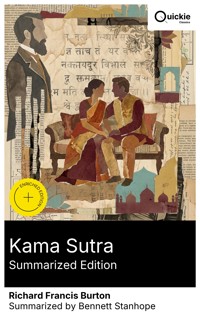
Kama Sutra (Summarized Edition)
Table of Contents
Introduction
Balancing prescriptive counsel with an ethnographic curiosity, and holding in tension the private urgencies of desire and the public architectures of rank, ritual, and reputation, Richard Francis Burton’s English rendering of the ancient Sanskrit Kama Sutra invites readers into a disciplined exploration of pleasure that is never merely hedonistic but instead a study of how intimacy, status, and self-fashioning converge within a culture’s codes, proposing fulfillment as an art taught as carefully as music or diplomacy, yet always contingent on context, character, and reciprocity, and steadfastly attentive to the ethics of mutuality.
Often classified as a didactic treatise on love, society, and conduct, the Kama Sutra originates in ancient India and is traditionally attributed to Vatsyayana; Burton’s English translation first appeared in the late nineteenth century, within a Victorian milieu that favored private circulation for writings on erotic subject matter. As a result, the book occupies two historical frames at once: the classical Sanskrit world it describes and the culture that mediated it for Anglophone readers. The setting it evokes is urban and courtly, attentive to household economies, refined leisure, and the protocols shaping companionship, marriage, and sociability across different ranks and professions.
As a reading experience, Burton’s rendition is both manual and mirror: a compendium of rules, observations, and typologies, and a reflective portrait of habits and ideals. The voice is composed and instructive, presenting classifications and examples in patient sequence, while the style bears the translator’s preference for ornate, occasionally archaic diction and notes that frame practices within comparative and historical commentary. Without relying on narrative suspense, the text nevertheless unfolds with accumulating interest as it moves from general principles to particular situations, surveying the arts of courtship, the management of domestic life, and the social roles of lovers and courtesans.
At its core lies a sustained inquiry into the place of pleasure within a complete life, where desire is coordinated with ambition, duty, learning, and reputation. The work treats intimacy not as a private indulgence but as a public art entangled with etiquette, education, and economic realities. It asks how people fashion themselves as desirable, how relationships are negotiated within networks of kinship and patronage, and how taste, timing, and temperament shape companionship. Questions of reciprocity and mastery, performance and privacy, and the training of the senses—music, fragrance, conversation, adornment—recur throughout, suggesting that fulfillment is at once ethical, aesthetic, and situational.
For contemporary readers, the book matters as a foundational document in the global history of sexuality and as a case study in cross-cultural translation. It offers a window onto premodern South Asian urbanity while also revealing how Victorian publishing practices filtered that world for modern audiences. Engaging with it encourages reflection on how norms travel, how terminology carries assumptions, and how authority—of text, translator, and tradition—is constructed. The work’s pragmatic attention to social desire invites comparison with today’s debates about intimacy and care, even as its historical frameworks prompt critical examination of hierarchy, gendered expectation, and power.
Reading Burton’s version requires attentiveness to its layered frames: the sutra form’s compact precepts, the translator’s lexical choices and commentary, and the constraints of the era that shaped what could be said and how. The tone oscillates between sober pedagogy and anthropological catalog, inviting appreciation and critique in equal measure. Approached this way, the book becomes less a compendium of instructions than a map of social intelligences—how people signal, interpret, and calibrate desire in structured environments. Its emphasis on skill, context, and demeanor rewards slow reading, revealing how a culture codifies intimacy without severing it from wit, prudence, and civic responsibility.
To encounter The Kama Sutra in Burton’s translation is to observe a conversation between antiquity and modernity about the governance of pleasure, the aesthetics of living, and the politics of representation. What endures is not merely information but a method: to treat intimacy as a learned craft bound to language, ceremony, and circumstance, and to examine that craft with clarity rather than coyness. In an age negotiating digital display, shifting norms, and plural identities, this disciplined attention to mutual formation—of self, partner, and community—offers a valuable mirror, illuminating how desire becomes legible, ethical, and meaningful within the textures of everyday life.
Synopsis
The Kama Sutra, an ancient Sanskrit treatise attributed to Vatsyayana, appears in English for modern readers most famously through Richard Francis Burton’s 1883 translation, prepared with F. F. Arbuthnot for private circulation under the Kama Shastra Society. Burton’s version presents the work as a systematic inquiry into desire, social conduct, and domestic life rather than a mere catalog of erotic matters. The translation frames the text within Victorian scholarly conventions while preserving its topical sequence. Approached in this way, the book is both a cultural document and a practical handbook, addressing how pleasure is to be understood, cultivated, and ethically situated in everyday society.
The treatise opens by defining kama—pleasure or desire—as one of life’s three aims, alongside dharma (duty) and artha (material prosperity). Vatsyayana’s premise is that desire should not dominate or be suppressed; it must be harmonized with duty and livelihood. He cites earlier authorities and compiles competing views into a coherent guide for householders in urban settings. The introduction clarifies scope, method, and audience, asserting moderation as a governing principle. Burton’s translation keeps this philosophical frame visible, signaling that the work proceeds from first principles before turning to prescriptions about conduct, companionship, and intimacy within a social and ethical order.
From this foundation, the text moves to the arts and refinements that make social life agreeable and relationships sustainable. It describes the cultivation of music, poetry, conversation, games, perfumes, dress, and other polite accomplishments that heighten mutual attraction and social esteem. Personal grooming, graceful manners, and situational tact are treated as ethical as well as aesthetic matters. The treatise discusses the roles of confidantes and messengers, the reading of signals, and the careful management of reputation. Burton’s version underscores this civilizing agenda, presenting attractiveness as a composite of character, skill, and decorum, rather than an exclusively physical or impulsive affair.
When turning to sexual union, the Kama Sutra treats intimacy as a patterned practice embedded in consent, timing, and temperament. It classifies personalities, preferences, and contexts to guide compatibility and considerate behavior. Attention is given to preliminaries, mutual responsiveness, and the tempering of excitement with restraint. The emphasis is not on explicit description but on balancing pleasure with respect, privacy, and social consequence. Burton preserves the text’s classificatory habit—its impulse to name types and stages—while aiming to make the material legible to his contemporaries, who might otherwise miss the ethical scaffolding beneath the practical counsel.
The work then addresses the acquisition of a wife, setting courtship within family networks, neighborhood life, and economic realities. It outlines desirable qualities, cautions against impulsive matches, and explores the use of intermediaries and tactful approaches. Customs around betrothal, the testing of affection, and the building of trust receive careful attention, as does the importance of reputation and mutual suitability. This section shows how personal desire is mediated by household interests and communal expectations. Burton’s translation presents these social matrices plainly, emphasizing procedure and prudence over romantic spontaneity while avoiding prescriptive rigidity.
Once marriage is established, the text turns to the duties and privileges of a wife, treating domestic harmony as a shared project. Topics include household management, the maintenance of affection, hospitality, and the handling of conflicts and jealousies. The wife’s discretion, social visits, and alliances with friends and relatives are discussed as tools for stability. Guidance also appears for times of separation, reconciliation, and the recovery of trust. Throughout, the emphasis falls on practical wisdom—how attentiveness, courtesy, and measured freedom help preserve respect and mutual delight. Burton transmits these sections in a tone that highlights their pragmatic and civic dimensions.
A more fraught portion examines relations with others’ spouses. Here, the Kama Sutra presents a descriptive account of motives, strategies, and safeguards while constantly acknowledging risks—legal, social, and moral. The discussion is prescriptive in technique yet cautionary in tenor, noting how intrigue undermines reputation and endangers households. Devices of secrecy, the role of go-betweens, and the reading of circumstances are cataloged, but the underlying message warns of consequences that exceed immediate gratification. Burton renders this material with a characteristic blend of literalness and distancing commentary, leaving readers to recognize its diagnostic, rather than celebratory, function.




