



1,99 €
Niedrigster Preis in 30 Tagen: 0,00 €
Niedrigster Preis in 30 Tagen: 0,00 €
Mehr erfahren.
- Herausgeber: Musaicum Books
- Kategorie: Fantasy und Science-Fiction
- Sprache: Englisch
Richard Francis Burton's '1001 Nights' serves as an acclaimed English translation of the classic Arabic tales. Known for its vivid imagery, evocative storytelling, and rich cultural exploration, Burton's rendition of the tales captures the essence of the Arabian Nights. This collection not only showcases the fantastical adventures of Scheherazade and her captivating stories but also provides readers with a deeper understanding of the cultural nuances and moral lessons embedded within each tale. Burton's literary style impeccably conveys the exoticism and allure of the East, making '1001 Nights' a timeless masterpiece in the world of literature. This work is a must-read for those seeking to delve into the enchanting realm of Eastern folklore and storytelling. Through Burton's skilled translation, readers can immerse themselves in a vivid tapestry of tales that have enchanted audiences for centuries. In this enriched edition, we have carefully created added value for your reading experience: - A succinct Introduction situates the work's timeless appeal and themes. - The Synopsis outlines the central plot, highlighting key developments without spoiling critical twists. - A detailed Historical Context immerses you in the era's events and influences that shaped the writing. - An Author Biography reveals milestones in the author's life, illuminating the personal insights behind the text. - A thorough Analysis dissects symbols, motifs, and character arcs to unearth underlying meanings. - Reflection questions prompt you to engage personally with the work's messages, connecting them to modern life. - Hand‐picked Memorable Quotes shine a spotlight on moments of literary brilliance. - Interactive footnotes clarify unusual references, historical allusions, and archaic phrases for an effortless, more informed read.
Das E-Book können Sie in Legimi-Apps oder einer beliebigen App lesen, die das folgende Format unterstützen:
Veröffentlichungsjahr: 2022
Ähnliche


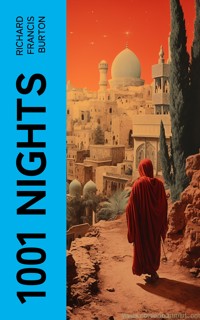





1001 Nights
Published by
Books
Introduction
A life is bartered for a story, and night after night imagination holds the blade at bay. In that primal bargain lies the pulse of The Book of the Thousand Nights and a Night, where narrative is not pastime but power, strategy, and mercy. The collection invites us to witness how tales travel—across rooms, across classes, across centuries—binding listeners and speakers in fragile truces. It is an art of survival and surprise, a theatre of wonder framed by peril, from which a literature of inexhaustible variety unfurls. Entering these pages, we find a world that prizes wit over brute force and curiosity over fear.
Sir Richard Francis Burton’s renowned English rendering, first issued privately for subscribers beginning in 1885, introduced an expansive, candid version of the Nights to Victorian readers. Burton did not invent the stories; he translated and annotated a medieval Arabic corpus often called the Arabian Nights, presenting it in multiple volumes, with further installments following in the late 1880s. His edition is distinguished by archaizing diction, copious notes, and a refusal to bowdlerize material that earlier translators had softened or omitted. It is both a translation and a cultural document: a nineteenth-century encounter with older narratives, shaped by the translator’s learning, tastes, and the era’s publishing constraints.
The Nights themselves are not the creation of a single author but a layered body of tales that took shape over centuries within the medieval Islamic world. Drawing on Persian and Indian story traditions and transmitted in Arabic, the corpus accumulated episodes, motifs, and frames as it traveled. European readers first encountered it widely through Antoine Galland’s early eighteenth-century French translation, which set the stage for later English versions. Burton’s project stands within this long chain of transmission, aiming to bring breadth, immediacy, and scholarly apparatus to a collection that is hybrid by nature—part folklore, part courtly entertainment, part urban anecdote, and part romance of the marvelous.
Its classic status rests on literary amplitude and generative form. The Nights accommodates a startling range: comedy and tragedy, fabliau and fable, courtroom intrigue and sea voyage, jinn-haunted fantasy and domestic realism. The frame-story technique—stories within stories, nested and branched—became an emblem of narrative possibility itself, influencing how later writers conceive sequence, interruption, and suspense. The work’s idiom is communal and performative: it presumes listeners, rewards improvisation, and courts surprise. By collecting diverse voices under one governing premise, the Nights models a literary commons in which high and low, sacred and profane, improbable and ordinary commingle without embarrassment.
Burton’s translation achieved notoriety and staying power because it foregrounded what many Victorians kept offstage. Privately printed for subscribers, it preserved erotic, satiric, and colloquial elements, and encircled them with extensive notes that sought to historicize customs, language, and beliefs. The style is deliberately antique, its lexical color deriving from archaism, regionalisms, and borrowings. Readers have long debated the effects of this choice: some find it grandly atmospheric, others mannered. Either way, the version marked a turning point in English reception, expanding what the Nights could contain and prompting later scholars and translators to clarify texts, sources, and editorial principles by agreeing with or reacting against Burton’s example.
At the heart of the collection lies a meditation on power and its checks. The frame presents a ruler undone by betrayal and a woman who answers violence with narration; from that counterpoise flows a thousand variations on justice, desire, loyalty, and fate. The tales test the reach of law and the force of mercy, the cunning of merchants and the impetuosity of princes, the seductions of wealth and the obligations of hospitality. Fortune turns swiftly; identities slip; truth reveals itself in disguise. Together they ask whether stories can discipline power, educate passion, and reconcile chance with meaning—questions as old as literature and as current as today’s headlines.
Form is the engine of that inquiry. The night-by-night rhythm builds expectation, and the art of interruption renders time pliable, as if dawn itself were a narrative device. Frames nest within frames, and characters become tellers, producing a hall of mirrors in which testimony, rumor, and dream jostle. This architecture legitimizes multiplicity: more than one perspective, more than one ending deferred, more than one moral proposed. It also honors memory as craft. Repetition, variation, and echo bind episodes together, so that the act of telling—recall, selection, embellishment—becomes the true protagonist of the work.
The settings of the Nights are cosmopolitan, reflecting the trade routes, courts, and neighborhoods of a connected world. Markets bustle; caravans depart; ships founder and arrive; palaces and workshops stand side by side. Baghdad and Cairo often serve as emblematic stages, and figures associated with the Abbasid era appear in many anecdotes, while islands, deserts, and distant ports expand the map. The marvelous is never far: jinn intervene, treasures surface, transformations occur. Yet the human fabric—contracts, friendships, marriages, jokes, errands—anchors the extraordinary in the ordinary, making wonder credible precisely because it emerges from recognizable social life.
The influence of the Nights on later writers is vast and traceable. Jorge Luis Borges reflected on its translators and labyrinths; Naguib Mahfouz reimagined its characters and moral dilemmas; Salman Rushdie drew on its exuberant multiplicity and defiant storytelling; Italo Calvino admired its combinatorial possibilities. Across languages, authors have adopted its frame device, cliffhangers, and play with nested narration to explore memory, migration, and identity. The collection’s capaciousness offers a toolkit rather than a template, inviting reinvention. Even when writers dissent from its fantasies or interrogate its assumptions, they do so in dialogue with a work that taught modern literature how to proliferate.
Reading Burton today means meeting a translation that is itself a historical artifact. It stands alongside earlier English versions, such as Edward Lane’s, and later modern renderings that draw on different manuscripts and editorial aims. Burton’s notes and concluding materials attempt to contextualize practices and vocabularies, sometimes illuminating, sometimes reflecting the biases of his time. The unexpurgated scope preserves elements essential to the collection’s texture, while the diction signals a deliberately staged English. Engaging this version profitably involves recognizing both its documentary value and its limits, and seeing it as one perspective within a multilingual, centuries-spanning tradition.
The Nights has long attracted critical reassessment, not least because nineteenth-century translations—including Burton’s—participated in the era’s broader Orientalist imaginations. A responsible reading today acknowledges that framework, distinguishes the medieval Arabic stories from later lenses, and attends to how translation mediates power and perception. Yet that very process—situating, comparing, questioning—enriches the experience. Burton’s edition opens doors: to the tales themselves; to debates about fidelity and freedom in translation; to the encounter between scholarly apparatus and oral-style storytelling. It becomes both library and threshold, inviting readers onward to other versions, studies, and retellings.
Why does this book still matter? Because it affirms that narration is a human instrument for confronting peril, negotiating authority, and enlarging possibility. Its frame turns listening into an ethical act; its episodes map the entanglement of law, chance, and desire; its forms model plurality without chaos. Burton’s translation, with all its idiosyncrasies, helped secure the Nights’ place in English letters and ensured that its energies remained vivid for generations of writers. In an age of fragmented attention, contested truths, and global interconnection, these tales remain timely: they teach how stories travel, how they defend life, and how they continue to make meaning.
Synopsis
Sir Richard Francis Burton’s The Book of the Thousand Nights and a Night, first privately issued in 1885 with further Supplemental Nights through 1888, presents a comprehensive Victorian-era English rendering of the medieval Arabic story-cycle known as the Arabian Nights. Burton’s version is notable for its vast scope, copious notes, and a concluding Terminal Essay that surveys sources and cultural contexts. At its core stands a frame narrative: a king, embittered by betrayal, vows a grim regimen that a vizier’s daughter seeks to interrupt. She proposes to tell stories night after night, shaping a structure in which narrative itself becomes the wager for survival.
The opening movement establishes the mechanics of the frame and the precariousness of the storyteller’s position. By arranging for her sister to prompt a tale at dusk, the heroine ensures an audience and a ritual: each narrative closes at daybreak at a moment of suspense, forestalling her fate. These initial nights introduce the collection’s concerns—justice and retribution, desire and restraint, human error and providence—while modeling an art of delay. The prose interlaces verse and anecdote, embedding exempla that link personal choices to broader social order without yet resolving the wider crisis that motivates the telling.
Early sequences revolve around encounters between mortals and the supernatural, notably the bargain-struck confrontations between merchants and jinn. In these episodes, storytelling is transactional: a threatened life is weighed against illustrative tales that plead for mercy. Narratives unfold within narratives, each layered account refracting themes of loyalty, oathkeeping, and the unforeseen costs of rash action. The nested structure cultivates ambiguity, allowing characters—and readers—to weigh competing claims of law, sympathy, and fate. This portion of the cycle calibrates suspense through escalating stakes, demonstrating how rhetorical skill and moral insight may temper power that appears absolute.
A later cluster of tales centers on the Abbasid court, where Caliph Harun al-Rashid and his companions move incognito through Baghdad’s markets and alleys. These nocturnal excursions bring rulers into contact with craftsmen, mendicants, and entertainers, creating vignettes that test governance at street level. Judgments are rendered, rewards and punishments meted out, and misrecognitions corrected, showing how authority can be both capricious and corrective. Comic misadventures mingle with grievous confessions, while careful coincidences knit disparate lives together. Through these cityscapes, the Nights examines surveillance, hospitality, and the porous boundaries between private household and public justice.
Travel and adventure cycles expand the collection’s geographic imagination. Most prominent are the Seven Voyages of Sindbad the Sailor, where maritime ventures confront marvels, hazards, and sudden reversals of fortune. Commerce, curiosity, and survival commingle as the voyager narrates perils to a land-bound listener, framing wealth as both windfall and burden. Encounters with prodigious creatures and uncanny islands foreground the limits of human foresight, while returns home prompt reflections on gratitude and expenditure. These episodes exemplify the Nights’ fascination with risk and reward, setting personal endurance against the wider currents of destiny, trade networks, and the sea’s ambiguous bounty.
Romance and wonder alternate with moral trials in tales of courtship, enchantment, and recognition. Magical devices, talismans, and shape-shifting beings complicate dynastic hopes and personal vows, while journeys to remote cities and abandoned palaces stage encounters with time’s decay. Stories such as those later known for ingenious contrivances or hidden hoards dramatize ingenuity and betrayal alongside steadfast love. In Burton’s Supplemental Nights, additional narratives, including widely popular orphan tales, extend the repertoire of motifs—youthful ascent, brigandage, and miraculous aid—without displacing the frame. Across them, devotion contends with ambition, and fate is as likely to restore as to overturn.
Comic and bawdy interludes present household stratagems, professional trickery, and courtroom puzzles. Here, sharp-witted slaves, resourceful women, and hapless officials trade ruses and lessons. Anecdotes about misdelivered goods, misheard oaths, and complicated inheritances probe the elasticity of law and the perils of literalism. Music, poetry, and anecdotal lore punctuate scenes in which improvised speech confers advantage. Even when outcomes hinge on coincidence, the tales privilege craft—verbal, artisanal, or social—over brute force. Misrule is corrected not only by decrees from above but also by community norms and the opportune deployment of humor, patience, and tact.
Burton’s translation shapes reception through an archaizing diction and a dense apparatus of notes that range across philology, ethnography, and comparative folklore. He preserves prose interlarded with verse and retains material often bowdlerized elsewhere, rendering social and erotic registers that Victorian print culture typically suppressed. His Terminal Essay surveys manuscript traditions, prior European versions, cultural practices, and the era’s debates about obscenity, placing the Nights within global literary currents while reflecting contemporary Orientalist perspectives. The resulting English text is both narrative and commentary, a performance of scholarship and staging that foregrounds how editing, translation, and gloss can direct meaning.
As the frame persists and stories accumulate, the Nights advances a meditation on power, peril, and the ethics of attention. Tales model how listening tempers judgment, how wit mitigates violence, and how fortune’s wheel spares neither the mighty nor the poor. Burton’s version preserves the collection’s multiplicity—its shifts of tone, its embrace of wonder and ordinary life alike—while recording the nineteenth-century gaze that transmitted it. The ending of the frame remains beyond the scope of this synopsis, yet its implications are clear: narrative can reconfigure the terms of rule and survival, leaving a legacy of imaginative breadth and moral inquiry.
Historical Context
The narrative world of the Thousand and One Nights, as encountered in Richard Francis Burton’s translation, is framed by the medieval Islamicate city, with Baghdad, Cairo, and Damascus as emblematic centers. The dominant institutions are the caliphate, sharia courts, guilds and markets, charitable endowments, and extended households. The tales’ frame story, of Shahrazad storytelling to delay execution, likely derives from Persian sources adapted into Arabic between roughly the 8th and 14th centuries. This milieu combined courtly ceremony with bustling bazaars, maritime caravans with desert routes, and a moral order informed by Islamic jurisprudence and custom, creating the social texture into which the tales are set.
Under the Abbasid caliphate, especially from the 8th to 10th centuries, Baghdad became a cosmopolitan hub. Translations from Greek, Persian, and Indian traditions enriched adab (belles-lettres), while scholars at institutions later remembered as the “House of Wisdom” pursued science and philosophy. The Nights reflect this urban culture: judges, poets, artisans, and tricksters circulate through palaces and markets; the caliph Harun al-Rashid, a historical ruler (reigned late 8th–early 9th century), appears as a character who tests subjects’ virtue. The stories echo a world where patronage, wit, and legal process mattered, while also satirizing bureaucratic excess and the caprices of rulers.
Trade knits the tales together. The Indian Ocean and Red Sea routes, guided by monsoon winds, linked Basra, Aden, and East Africa with Gujarat and Southeast Asia. Overland caravans connected Syria and Iraq to Anatolia and Iran. Economic life depended on caravansaries, shipyards, weigh-houses, and customs officials. Coinage in gold and silver facilitated exchange, while credit and partnership contracts enabled long-distance commerce. The maritime adventures of sailors and merchants, epitomized by figures like Sindbad, mirror these networks. Descriptions of cargoes, shipwrecks, and foreign ports reflect the era’s practical knowledge of navigation and risk, as well as curiosity about distant peoples and goods.
Legal and social institutions provide narrative scaffolding. Sharia courts adjudicate disputes; the qadi appears as a judge who dispenses justice or, in satire, is deceived. Charitable endowments (awqaf) fund mosques, schools, and hospices, shaping urban life. Slavery, a lawful institution across the premodern Mediterranean and Islamic worlds, appears in the tales through concubines, eunuchs, and domestic servants. Household seclusion and gendered spaces are evoked, along with women’s agency via wit, patronage, or property. These depictions are neither ethnography nor fantasy alone; they draw on recognizable practices while amplifying them into moral exempla, comic sketches, and marvelous adventures.
Religion structures the stories’ moral logic. Islam provides ritual frames—prayer, fasting, pilgrimage—and legal norms about contracts, inheritance, and sexual conduct. Pilgrimage routes to Mecca and Medina stitch together disparate settings and lend plausibility to journeys. The tales also incorporate pre-Islamic lore, astrology, and the unseen realm of jinn, reflecting a cosmology in which divine providence coexists with magic, talismans, and fate. Sufi motifs of repentance, generosity, and the testing of the soul surface repeatedly. Characters’ fortunes turn through a mixture of piety, prudence, and chance, mirroring the period’s intertwining of religious belief with everyday social practice.
Later layers of the Nights reflect Mamluk and Ottoman urban culture, especially in Cairo and Damascus from roughly the 13th to 18th centuries. Coffeehouses, which spread in the Ottoman domains from the 16th century, became venues for public storytelling; the hakawati’s art influenced the tales’ pacing and episodic suspense. Urban humor, trickster pranks, and scenes of guild life resonate with this environment. Changes in policing, taxation, and neighborhood organization under successive regimes shaped the cityscape of alleys, markets, hammams, and caravanserais that the narratives evoke. Thus the collection preserves memories of successive urban orders layered onto an earlier Abbasid imaginative core.
The textual history of the Nights is composite. A Persian prototype, often identified with the Hazār Afsānah, was adapted into Arabic and expanded over centuries. The earliest substantial Arabic manuscripts that survive date from around the 14th–15th centuries, many associated with Syria and Egypt. With the advent of print, Arabic editions appeared in the 19th century in Cairo (Bulaq) and Calcutta, alongside the Breslau edition in Europe. These printings standardized and circulated varying recensions. The stories’ fluidity—additions, omissions, rearrangements—reflects oral performance and manuscript copying practices, making any translation a selection from a moving textual target rather than a single fixed original.
European encounters with the Nights began decisively with Antoine Galland’s French version (1704–1717), which shaped readers’ expectations for generations. Galland included tales not found in his Arabic manuscripts—most famously Aladdin and Ali Baba—after hearing them from a Syrian storyteller, Hanna Diyab, in Paris. Translations and adaptations proliferated across European languages, often recast for polite society or for children, pruning sexual material and rough humor. The collection fed 18th- and 19th-century tastes for the “Orient,” influencing theater, opera, and painting. This early reception framed the Nights as exotic fantasy as much as social document, a duality later translators had to navigate.
In English, Edward William Lane’s translation (1838–1841) became influential for Victorian readers. Lane relied on Arabic printed editions available to him and appended extensive ethnographic notes on contemporary Egyptian manners and customs. He also expurgated passages dealing with sexuality and coarse language to meet prevailing moral standards and the expectations of family reading. Lane’s scholarship and elegant diction helped establish the Nights as a respectable classic while also fixing a sanitized image in the Anglophone imagination. Burton would later contest this sanitization, positioning his own project as both philologically attentive and unbowdlerized in content and annotation.
Richard Francis Burton (1821–1890) brought unusual experience to the task. He served in the British Indian Army in Sindh in the 1840s, studied South Asian and Middle Eastern languages, and undertook intelligence work. In 1853 he performed the Muslim pilgrimage to Mecca and Medina in disguise, later publishing an account. With John Hanning Speke, he explored East and Central Africa in the late 1850s. His consular career took him to Fernando Po, Brazil, Damascus, and finally Trieste. Across these postings he wrote prolifically on travel, ethnography, and sexuality, joining debates in the era’s emerging anthropological circles and cultivating a reputation for linguistic daring.
Victorian Britain provided both opportunity and constraint. Expanding imperial rule created administrative and scholarly infrastructures for gathering information about Asia and Africa. Learned societies and commercial publishers rewarded travel narratives and philology. At the same time, moral reform movements pressed for stricter regulation of print. The Obscene Publications Act (1857) empowered authorities to seize materials deemed indecent, and social purity organizations grew in influence. Public libraries and family reading norms encouraged expurgation. Burton’s milieu thus combined a hunger for “authentic” knowledge of the East with legal and cultural regimes that policed sexual content and constrained open discussion of intimate customs.
Burton’s Nights appeared in London by private subscription between the mid-1880s and late 1880s, under the imprint of the Kama Shastra Society of London and Benares, a semi-fictitious vehicle he used (with F. F. Arbuthnot) to skirt obscenity prosecution. Issued for “Subscribers Only,” the volumes were expensive and aimed at collectors and scholars rather than circulating libraries. He added an extensive “Terminal Essay” and dense footnotes on language, law, and sexual practices. This paratext transformed the translation into a hybrid of literature and ethnography, courting controversy while leveraging private printing and subscription to navigate the period’s legal constraints.
As a textual craftsman, Burton drew on the major Arabic printed editions then in circulation, notably the Cairo (Bulaq) and Calcutta recensions, and he consulted the Breslau text. He also worked in the wake of John Payne’s private English translation (early 1880s), which he read closely; contemporaries debated the extent of his dependence on Payne. Burton’s diction was deliberately archaic and polyglot, mixing Anglo-Saxon archaisms with Arabic terms and learned aside in Latin or French. His profuse notes gloss legal terms, urban institutions, and sexual slang, seeking to replicate what he took to be the texture of the original milieu for English readers.
The content Burton refused to suppress—slavery, concubinage, homoerotic allusions, and commercial sex—opened space for his broader theories about sexuality and culture. In the Terminal Essay he advanced the notion of a “Sotadic Zone,” a climatic-geographic band where he claimed certain sexual practices were prevalent, an argument reflecting 19th-century ethnological typologies rather than modern social science. His forthrightness collided with contemporaneous legislation, including the Criminal Law Amendment Act (1885), which intensified moral regulation in Britain. The translation thus became a cultural flashpoint: a test of how scholarship, erotic representation, and imperial knowledge could or could not coexist in public print.
Technological and commercial developments enabled Burton’s project. Steam presses, stereotype plates, and expanding postal networks made small-run, subscriber-only editions feasible. Book collecting had become a recognized gentlemanly pursuit, with clubs and private libraries eager for “unexpurgated” texts. Burton’s consular post in Trieste gave him time and access to Continental printers and correspondents. His wife, Isabel Burton, actively promoted and managed aspects of his literary affairs. After Burton’s death in 1890, she arranged commemorative editions and, controversially, destroyed some of his manuscripts, including material related to erotic scholarship, which shaped the archive available to later readers and scholars.
Reception was polarized. Admirers praised Burton’s erudition, breadth of annotation, and attempt to capture what he called the “Arab” spirit of the tales. Critics accused him of gratuitous obscenity and of leaning too heavily on earlier translators. Scholars in the 20th century have noted both his reliance on Payne and the independent value of his notes and stylistic choices. The Nights continued to be retranslated, with versions by later scholars and writers offering different balances of fidelity, clarity, and decorum. Debates about authenticity, censorship, and the translator’s voice, sharpened by Burton’s example, have remained central to the work’s Anglophone afterlife.
Modern scholarship has reassessed Burton within the larger history of Orientalism. Edward Said’s 1978 analysis highlighted how European representations of the East often served imperial interests and fantasies. While Burton wrote before this critique, his translation—combining ethnographic ambition, erotic curiosity, and sweeping generalizations—has been read through that lens. At the same time, historians of the medieval Islamicate world value the Nights as a repository of social types and urban scenes, while stressing its composite, performative nature. Thus Burton’s version sits at the intersection of Victorian knowledge-making and the layered textual tradition it sought to transmit and decode to Western audiences.`,`Culturally and economically, the worlds reflected in the Nights were shaped by crafts, guilds, and household production, as well as by imported luxuries—perfumes, textiles, spices—circulating through Indian Ocean and Silk Road networks. Technologies of writing and bookmaking matter too: the diffusion of paper into the Islamic world from the 8th century onward fostered rich manuscript cultures. Public baths, gardens, and endowments structured daily rhythms. Burton’s extensive glosses on coffeehouses, markets, and legal terms attempted to anchor such details for Victorian readers, connecting the marvels to institutions and practices that governed ordinary life in medieval and early modern Middle Eastern cities.`,`Politically, the collection spans multiple regimes—Abbasid, Mamluk, and Ottoman—whose administrative and military structures affected urban order. Patrols, tax farms, and guild regulation appear in anecdotes of night watches, inspectors, and market supervisors. The tales’ justice-restoring finales echo ideals of good governance, while recurring scenes of corruption, imposture, and sudden royal interventions critique the gap between law and practice. Burton’s comments frequently map these scenes onto legal doctrines and ethnographic observation, inviting readers to see the stories as windows onto past governance as well as moral parables, even as he sometimes overgeneralized from scattered narrative evidence to broad cultural claims.`,`Burton’s translation also reflects contemporary Victorian debates about science and classification. Philology, ethnology, and comparative religion sought universal patterns while relying on imperfect data and cultural preconceptions. Burton’s cataloging of sexual slang, his climate-based typologies, and his urge to trace motifs across India, Persia, and Arabia align with these impulses. Simultaneously, his insistence on unexpurgated text positioned him against a domestic culture of propriety. The result is a work that both mirrors Victorian knowledge systems and exposes their limits when applied to a heterogeneous, multi-century narrative corpus shaped by oral performance, manuscript variation, and shifting urban audiences.`,`Taken together, Burton’s 1001 Nights functions as a mirror with two faces. One face reflects the layered histories of the medieval and early modern Islamicate city—its trade, law, devotion, and entertainments—condensed into narrative form. The other face reflects late Victorian Britain—its imperial ambitions, scholarly networks, anxieties about sexuality, and print economy. By staging medieval tales within an apparatus of notes, essays, and private circulation, Burton made the Nights a critique of his era’s censorship and a participant in its Orientalist frameworks, ensuring that the book records not only an imagined past but also the conditions of its 19th-century transmission.
Author Biography
Richard Francis Burton (1821–1890) was a Victorian-era British explorer, linguist, translator, and diplomat whose work bridged travel narrative, ethnography, and literary scholarship. Renowned for his firsthand accounts of regions then little known to European readers and for unexpurgated translations of major Asian and Arabic classics, he became an emblematic, if controversial, figure of nineteenth‑century cross‑cultural inquiry. His writings combined philological rigor with a provocative readiness to describe customs that many contemporaries ignored or censored. From Arabia and East Africa to the Americas and the Balkans, Burton pursued fieldwork with unusual linguistic range, producing books that influenced geography, anthropology, and the English reception of non‑European literatures.
Burton’s early education was cosmopolitan, much of it on the European continent, where he acquired facility in Romance languages before immersing himself in Persian and Arabic. He matriculated at the University of Oxford but left without a degree, soon turning to service in the subcontinent. His intellectual formation drew on Orientalist philology associated with British and continental scholarship, as well as on classical Arabic and Persian poetry, Hindu narrative traditions, and Islamic historiography encountered through sustained language study. Travel writers and antiquarian compilers furnished models, but Burton favored direct observation and textual comparison, cultivating a style that alternated between meticulous footnoted analysis and vivid, often polemical, reportage.
Commissioned to the subcontinent with the East India Company army in the 1840s, Burton undertook linguistic and surveying duties in Sindh and the Bombay Presidency while studying local literatures. These years yielded early publications that mixed ethnography with travelogue, including Goa, and the Blue Mountains; or, Six Months of Sick Leave and Sindh, and the Races That Inhabit the Valley of the Indus, both from the early 1850s, followed by Falconry in the Valley of the Indus. He cultivated a method attentive to colloquial speech and social practice, compiling glossaries and observing religious rites, markets, and crafts. His prose, alternately caustic and encyclopedic, attracted notice and debate.
In the mid‑1850s Burton undertook a pilgrimage to the Islamic holy cities by adopting the dress and language of Muslim travelers—a hazardous enterprise under the political conditions of the day. His Personal Narrative of a Pilgrimage to Al-Madinah and Meccah offered one of the century’s fullest English accounts of the Hajj, combining topographical description, ritual detail, and philological excursus. The work drew acclaim for its scholarship and criticism for its audacity, and it fixed Burton’s reputation as a writer willing to cross cultural and ethical boundaries in pursuit of knowledge. It also showcased his capacity to integrate narrative momentum with documentary precision.
Burton next focused on the Horn of Africa and the inland lakes of East Africa. After an early expedition to Somaliland, he co‑led journeys with John Hanning Speke, reaching Lake Tanganyika and documenting trade routes, fauna, and ethnography. The question of the Nile’s sources prompted competing hypotheses and a famous dispute; Burton’s cautious assessments contrasted with Speke’s confident claims for Lake Victoria. He consolidated his findings in The Lake Regions of Central Africa and later contributed The Nile Basin, engaging geographic debates of the 1860s. He also traveled across North America and produced The City of the Saints, a detailed study of Utah and the Latter‑day Saints community.
From the 1860s Burton served as a British consul in postings that included West Africa, Brazil, the Levant, and, finally, the Adriatic, positions that afforded material for further books and allowed intensive translation. His corpus as translator is extensive: the unexpurgated, annotation‑rich The Book of the Thousand Nights and a Night, issued privately in the 1880s; The Kama Sutra (prepared through a private printing society); The Perfumed Garden; and The Ananga Ranga, among others. He also rendered and retold South Asian narratives in Vikram and the Vampire and issued the reflective poem The Kasidah, attributed to a fictional sage. These projects pressed against Victorian norms while arguing for candid, comparative study of world literatures.
Late in life Burton was honored with a knighthood and settled into a final consular post while continuing to edit, translate, and revise. He died in 1890, leaving a body of work remarkable for linguistic reach and breadth of subject. His legacy is complex: celebrated for audacity, erudition, and narrative verve, yet critiqued for the Orientalist frameworks and imperial vantage that shaped his gaze. Scholars continue to mine his annotations, coinages, and comparative notes, and new editions of his translations keep his name in circulation. As a stylist and as a mediator—however flawed—between languages and readerships, Burton remains a durable presence in discussions of exploration and world literature.




