


Erhalten Sie Zugang zu diesem und mehr als 300000 Büchern ab EUR 5,99 monatlich.
- Herausgeber: Nick Hern Books
- Kategorie: Poesie und Drama
- Serie: NHB Modern Plays
- Sprache: Englisch
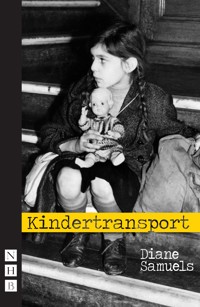
A modern classic about one woman's struggle to come to terms with her past. Brutally separated from her German Jewish parents at the age of nine, Eva is brought to England with the promise of a new life... Between 1939 until the outbreak of World War II, nearly 10,000 Jewish children were taken from their families in Nazi-occupied Germany and sent to live with foster families in Britain. Diane Samuels' seminal play, Kindertransport, imagines the fate of one such child. Now widely considered a modern classic, Kindertransport has been read and studied the world over. Kindertransport won the 1992 Verity Bargate Award and was subsequently staged by the Soho Theatre Company at the Cockpit Theatre in London in 1993. It also won the Meyer-Whitworth Award in 1993. Since its premiere the play has been revived several times. Watford Palace Theatre staged it in 1996, in a production that transferred to the West End. Renowned theatre company Shared Experience also revived the play to great acclaim for a regional tour in 2007. This edition includes several personal memoirs by German-born children whose lives were saved, and transformed, by the Kindertransport. Kindertransport is a SET TEXT for GCSE English Literature (AQA) and AS/A-Level English Literature (WJEC).
Sie lesen das E-Book in den Legimi-Apps auf:
Seitenzahl: 112
Veröffentlichungsjahr: 2013
Das E-Book (TTS) können Sie hören im Abo „Legimi Premium” in Legimi-Apps auf:
Ähnliche














Diane Samuels
KINDERTRANSPORT
NICK HERN BOOKS
London
www.nickhernbooks.co.uk
Contents
Title Page
Introduction
Thanks
Background to the Kindertransport
Personal Accounts of the Kindertransport
Production History
Dedication
Characters
Act One
Act Two
About the Author
Copyright and Performing Rights Information
Introduction
Three incidents led me to write Kindertransport. The first was a discussion with a close friend, in her late twenties and born into a comfortable, secure home, who described her struggle to deal with the guilt of survival. Her father had been on the Kindertransport and I was struck by how her parent’s feelings had been passed down to her. The second was the experience of another friend who, at his father’s funeral, overheard his mother recalling her time at Auschwitz. Until that moment he had had no idea that his mother had been in a concentration camp. The third was the ashamed admission by a fifty-five-year-old woman on a television documentary about the Kindertransport, that the feeling she felt most strongly towards her dead parents was rage at their abandonment of her, even though that abandonment had saved her life.
In 1989, I was a young mother with a one-year-old son and pregnant with my second child when I saw this TV documentary. I was struck at once by the ways in which parents and children struggled to deal with this desperate parting. I never intended to write Kindertransport as a modern history play. I wanted to explore the universal human experience of separation of child from parent, of refugee from the source of their culture or ‘motherland’. I let this theme mull, up to my ears in nappies and baby milk, for a while longer.
In 1991, I wrote a scene between two German Jews. A mother hovers over her nine-year-old daughter and hands a new coat to the child. It is too big because it must last for ‘next winter too’. She gives the girl a button and some thread and then coolly instructs her how to sew the one onto the other. By this time, my young sons were not yet one and not quite three. Artists are often drawn to the extremes of human experience in order to reflect also upon what is ordinary. ‘Kinder’, now in their seventies and eighties, have, on seeing the play, asked me, ‘How can you possibly understand my experience so deeply?’ I reply that as a young mother myself I couldn’t help but be touched by what had happened to them. I was compelled to get to the heart of the dilemma. Ask a child if they would prefer to be sent away to safety if their family is in mortal danger, and he or she will, in most cases, say that they’d rather stay and die with their parents. Ask a parent what they would do in the same situation and most would say that they’d send away their child to be safe. To be a parent is to live with this hidden contradiction. I wanted to try to face it.
In 2007, when the play was revived for a national tour of the UK, my eldest son was eighteen and left home to go to university. How Life reflects Art. I found myself watching actresses in auditions read the scene in which English Evelyn loads her daughter Faith with crockery for her student flat. Then I went home and hours later loaded my boy with mugs for his student flat. I wonder at how I could understand Evelyn’s suppressed heartache at Faith’s departure when my children were still so young and at home with me. But many parents, from the second their child is born, know too well that here begins the road to seeing their offspring on their way. The bittersweet task is to prepare their child to manage entirely without them.
Past and present are wound around each other throughout the play. They are not distinct but inextricably connected. The re-running of what happened many years ago is not there to explain how things are now, but is a part of the inner life of the present.
I interviewed a number of the ‘Kinder’ as part of my research. They were all very open about their lives and feelings. Many of their actual experiences are woven into the fabric of the play. Although Eva/Evelyn and her life are fictional, most of what happens to her did happen to someone somewhere.
I used to dedicate this play to those ‘Kinder’ and the rest of the 10,000 who left Europe over seventy years ago. Now I see that, by entering the exceptional experience of those children who caught the trains to safety when many of them, like Eva, were too young to bear it, a crucial connection can be made with the clinging child inside us all that never wants to let go, no matter what. So, now I dedicate the play also to those fortunate children who have the opportunity to leave their parents when they are ready. And to the parents who raise their children to take that leave. No child, as Evelyn must struggle so painfully to accept, can be ‘my little girl’, or boy, forever, if they are to thrive.
DIANE SAMUELS
London, 2008
Thanks
Many thanks to Libby Mason; Mark Ravenhill; Jack Bradley; Abigail Morris; Soho Theatre Company; Rena Gamsa; Dawn Waterman; Naomi Fulop; Erica Burman; and particularly to Ben and Jake.
Special thanks to the ‘Kinder’ who were interviewed as part of research for the play: Walter Fulop; Bertha Leverton; Paula Hill; Vera Gissing and Lisa who talked at length about their journeys and their lives.
Background to the Kindertransport
The Nazi gaining of power in the 1930’s signalled a huge escalation in anti-semitic activity. The first organised attack on the Jews was in April 1933 – a boycott of Jewish businesses was instigated and triggered much violence. A series of laws ensued, increasingly excluding Jews from public life. The most notorious of these were the Nuremberg Laws – the Reich Citizenship Act, depriving Jews of their citizenship, and the Act for the Protection of German Blood and German Honour. This latter law prohibited marriage or extramarital relations between ‘Jews and nationals of German or allied blood’ in order to ensure the survival of the German race. Later measures required that all Jewish passports were marked with the letter J – in addition Jews were banned from places of public entertainment and cultural institutions, had their driving licences revoked, their property confiscated and were often forced to live together in communal Jewish houses.
The killing of a German diplomat by a young Jew in Paris in November 1938 gave the Nazis the opportunity to engineer a huge increase in momentum. Thousands of Jewish businesses and institutions were destroyed and Jews were assaulted, killed and 30,000 herded into concentration camps. It was in response to this pogrom, known as Kristallnacht, that the Movement for the Care of Children from Germany was formed, rescuing almost 10,000 unaccompanied children, before the outbreak of war just nine months later.
Personal Accounts of the Kindertransport
I took a bus to Dovercourt where I was told help was needed at a refugee camp. This was in 1938 when the Committee for the Care of Children from Germany took over a holiday camp to act as a reception centre for Jewish refugee children.
Through this camp came children from Germany, Austria and even a few stray Sudetenlanders. At one time – when I first was there – nearly seven hundred children arrived every week, their passports altered so that all the boys were Jacob and the girls Sarah, carrying pathetic paper bags containing a few spare clothes and little else. The Germans had stripped them of everything that was worth a pfennig. The children had a big J marked on their passports so that everyone would know they were of the despised race. Their ages were at the youngest four and the oldest I remember was sixteen.
The camp was full. As many as came in had to be found places so as to allow room for the next batch. Some children went to relatives in America, many were taken in by families in Britain. Some were even sent to a settlement in Paraguay. Did they, I now wonder, ever come into contact with the Nazis who escaped from Germany and found haven there?
An impressive elderly lady, Anna Essinger – who had a school in Kent – was in charge of the camp and managed, somehow, to shape the ad hoc collection of volunteers into something of an effective organisation. It cannot have been easy: excitable young Viennese, less mercurial German ones, volunteers like myself who arrived by accident and a sprinkling of young Etonians and undergraduates meant there was plenty of energy all needing firm but diplomatic direction.
Dovercourt was important to me if only because it was an introduction to Jewish life. I got to know people there who have remained my friends ever since.
The atmosphere in the camp was highly emotional. The children old enough to understand feared what might be happening to their relatives still in Germany: the refugee staff knew only too well the horrors they had escaped but their friends had not. The whole camp was charged with anxiety and fear. It was there I first heard the word angst and appreciated what it meant.
One evening one of the Austrian volunteers wanted to celebrate a birthday and a half dozen others and myself went to a local hotel for dinner. A change from camp fare where horse meat took the place of beef was something to look forward to. Halfway through the soup, a telephone call came from the camp. A rumour was going round that a pogrom was under way in Vienna: we were needed quickly to help. We rushed back to the camp. It was impossible to describe the situation. Imagine seven hundred contagiously frightened, crying, wailing children milling about the huge and echoing dining hall. The Viennese staff, poor souls, were in almost as bad a state, anguished and caught up in total fear.
We tried to get news of what was happening in Vienna. London apparently knew nothing. Lines to Vienna were blocked as were those to Berlin. Finally we got a contact with Vienna via Czechoslovakia and learned that on that occasion the rumour was false: there was no pogrom.
Then came one of the most moving experiences of my life. It was not going to be easy to stop what had by then become mass hysteria. Shouting above the noise was impossible – if anything it made matters worse. Then one of the older Jewish helpers began to sing. First by himself, a Hebrew hymn which everyone, even the youngest child would know. It was a hymn which I believe had a message of hope and courage in adversity. And the effect gradually spread until within minutes the entire hall was filled with the sound of voices united in song. There was something almost unearthly about such poignant, passionate emotion. Even today, if I ever think of that moment when from wailing the voices changed to singing, my hair stands on end.
The winter of 1938 was a sharp one. At Dovercourt the sea actually froze and when one night high tide and winds combined to break the sea wall, the sea flooded into the camp and we had to carry children through thigh-deep, very cold water to safety. I got pneumonia for my reward and was chased into Dovercourt hospital. After a month or so I returned to the children, who by that time had moved into the old workhouse at Barham near Ipswich, a spooky place complete with cells, mortuary and graveyard.
Shortly after that the war started, no more children came in from the continent and I returned to the land.
HUGH BARRETT
a volunteer at Dovercourt – one of the major reception centres for the Kindertransport children
Freedom, liberty, human dignity, civil rights, democracy – words and phrases used in the free world to describe the rightful elements of the human condition. If however, in these recessionary times, some if not all of these ideals have a hollow ring, we can at least hope for better days to come. For we may, provided we keep within the law, say and do what we believe to be right and what we believe to be just.
Imagine, however, a society terrorised by a one-party state machinery, where none of this was possible; where the mere label Jew meant the robbing of the individual’s humanity and a destiny of extermination.
Faced with this situation, our beloved parents in a spirit of total selfishness chose for us the gift of life, offered by the combined efforts of concerned Jews and Christians, fortunate to be living in the oldest democracy in the world.
Although on arrival, the path for many of us was not exactly strewn with roses, the majority worked hard – grateful for the opportunities denied to the one and a half million children who perished in the holocaust.
Former Kindertransport refugees have made their mark in every sphere of human endeavour. It is salutary to mention that the theatre in which you find yourself tonight was designed by architect Edward Mendelsohn, who came to this country on a Kindertransport in 1939.
PAULA HILL




