


1,99 €
Mehr erfahren.
- Herausgeber: Quickie Classics
- Kategorie: Abenteuer, Thriller, Horror
- Sprache: Englisch
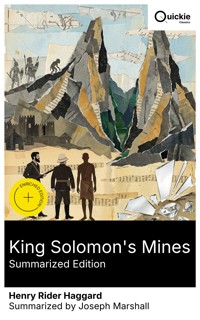
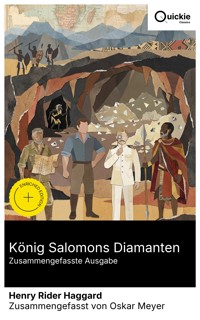
King Solomon's Mines, narrated with dry understatement by hunter Allan Quatermain, follows a hazardous trek to Kukuanaland to find a missing man and the fabled diamond lode. A cryptic Portuguese map leads the party over desert wastes, the twin peaks called Sheba's Breasts, and into frozen caverns, before they are drawn into revolt against the despot Twala under the baleful eye of Gagool. Brisk, episodic, and wry, the novel fuses battle spectacle with ethnographic detail, founding the late Victorian lost world romance. Henry Rider Haggard shaped this tale from years in southern Africa as a colonial official and farmer, where he witnessed Zulu courts, frontier violence, and the rituals of chieftaincy. His ear for languages and taste for exploration narratives supplied confident geography and ceremony. Written amid a renewed hunger for romance, and informed by his folklore interests, the book tests courage, loyalty, and authority. This unabridged Lost World Classic suits readers of adventure and students of empire alike. Read it for its taut storytelling and for the debates it provokes about exploration, conquest, and mythmaking, delivered through vivid landscapes and indelible characters. Quickie Classics summarizes timeless works with precision, preserving the author's voice and keeping the prose clear, fast, and readable—distilled, never diluted. Enriched Edition extras: Introduction · Synopsis · Historical Context · Author Biography · Brief Analysis · 4 Reflection Q&As · Editorial Footnotes.
Das E-Book können Sie in Legimi-Apps oder einer beliebigen App lesen, die das folgende Format unterstützen:
Veröffentlichungsjahr: 2026
Ähnliche















King Solomon's Mines (Summarized Edition)
Table of Contents
Introduction
Between the glitter of legend and the grit of survival, King Solomon’s Mines asks what risks people will embrace in pursuit of wealth, honor, and meaning. First published in 1885, Henry Rider Haggard’s novel helped define late-Victorian adventure fiction, blending treasure-hunt suspense with the allure of an unmapped interior. Set in southern Africa during the nineteenth century, it follows a small expedition into remote territory in search of a storied cache said to be linked to King Solomon. This unabridged edition preserves the brisk, atmospheric storytelling that established Allan Quatermain as one of literature’s enduring adventurers.
Allan Quatermain, a seasoned hunter and trader, narrates in the first person when two Englishmen—Sir Henry Curtis and Captain John Good—seek his guidance. One of them hopes to find a missing brother who vanished while pursuing the fabled mines; a brittle map and rumor are their only leads. Quatermain agrees on practical terms, and the trio, with hired companions, strikes northward across desert, mountains, and scrub. The setup promises deprivation, delicate diplomacy, and sudden reversals rather than puzzle-box clues, and the journey continually forces its leaders to weigh caution against the momentum of hope.
Quatermain’s voice is laconic, observational, and tinged with dry understatement, a memoirist’s cadence shaped by fieldcraft and fatigue. Haggard’s style favors clean, forward-driving scenes: camp routines, maps consulted by firelight, long marches punctuated by flashes of danger. Descriptions of landscape are vivid without ornament, while set pieces build quickly from mischance to decision to action. The tone marries romance to pragmatism; even in moments of marvel, the narrator tallies food, cartridges, and distances. The effect is a classic expedition chronicle whose momentum rests as much on character and endurance as on the rumor of treasure.
At its core, the novel turns on competing desires—security versus glory, loyalty versus self-preservation, knowledge versus myth. It probes the ethics of command under duress, the bonds forged by shared risk, and the seductions of treasure as both promise and peril. Maps, markers, and proverbs test the boundary between legend and geography, while the party’s negotiations with communities they encounter emphasize language, trust, and performance. Even the mines operate as an idea as much as a place, concentrating anxieties about scarcity and the human cost of acquisition. These concerns keep the narrative taut without reliance on secrets that cannot be mentioned here.
Because it arose from a British imperial context, the book also reflects the attitudes and hierarchies of its era, including depictions and assumptions that contemporary readers will rightly scrutinize. Reading it today invites critical attention to power, otherness, and representation alongside admiration for craft and pacing. The text’s energy and resourcefulness coexist with moments that expose the limits of its vantage point, making it a useful primary document of Victorian popular imagination. Approached with awareness, it offers opportunities to discuss how adventure narratives shape ideas about place and people, and how literature can be both thrilling and ethically complicated.
Quatermain’s self-assessment underscores another thread: aging, mortality, and the arithmetic of risk. He presents himself as cautious rather than heroic, a professional who counts odds and makes bargains, and this restraint grounds the set pieces in credible decision-making. Competence—tracking, bargaining, navigation—supplants bravado, while camaraderie balances solitude. Moments of humor lighten the hardships, and the group’s differing temperaments create friction that tests purpose without tipping into melodrama. Such elements give the novel a durable emotional architecture that rewards close reading beyond spectacle, revealing how practical choices accumulate into moral character over the long arc of an expedition.
This unabridged Lost World Classic preserves the novel’s original cadence, regional detail, and period diction, inviting readers to experience its momentum as it was first told. As a travel narrative, a treasure quest, and a study of leadership under strain, it still speaks to contemporary questions about ambition, responsibility, and the cost of desire. Its pages carry the exhilaration of forward motion and the sober calculus of survival. Encountered with curiosity and care, King Solomon’s Mines remains both a landmark of adventure fiction and a stimulus to thoughtful conversation about the stories we pursue and the values that guide us.
Synopsis
King Solomon’s Mines, first published in 1885 by H. Rider Haggard, is a foundational adventure novel narrated by the seasoned hunter and trader Allan Quatermain. Written in a brisk, first-person style, the story blends frontier realism with mythic geography, sending its protagonists toward a fabled hoard in unexplored Africa. The narrative introduces themes of survival under extreme conditions, the lure of wealth, and the ethical ambiguities of exploration. It also reflects late-Victorian attitudes about empire and race, which modern readers may scrutinize. Within this framework, the book structures its suspense around a hazardous expedition whose goal is both treasure and knowledge of a missing man.
At the outset in Durban, Quatermain meets Sir Henry Curtis and Captain John Good, Englishmen seeking news of Sir Henry’s missing brother, last heard pursuing the legendary mines attributed to King Solomon. Quatermain possesses a centuries-old map, supposedly left by a dying Portuguese explorer who claimed to have reached the treasure but never returned. Reluctant yet pragmatic, Quatermain agrees to guide them across the interior in exchange for a share and assurances for his son should he die. Their compact sets a tone of sober risk calculation rather than romance, positioning the quest as a last throw for aging professionals rather than youthful adventurers.
They assemble a small caravan with porters and supplies suited for a long, water-scarce route. Among the party is Umbopa, a dignified Zulu whose bearing exceeds his station, hinting at deeper purposes. Quatermain evaluates him warily yet recognizes his intelligence and courage. The plan exploits scant geographical hints: two stark peaks known as Sheba’s Breasts, a desert crossing, and a high pass possibly leading to an isolated highland. As they leave colonial settlements behind, the narrative shifts from outfitting detail to logistical challenges—rationing, hunting, navigation—while emphasizing camaraderie forged by shared risk. The expedition’s objective remains uncertain, but its path becomes inescapably committed.
The first major ordeal is the desert, a grueling stretch where heat, glare, and scarcity of water dictate every decision. Haggard dwells on the mathematics of survival—miles, rations, the timing of marches—and on Quatermain’s fieldcraft, lending realism to an improbable quest. The group faces fatigue, illness, and losses typical of such travel, learning the landscape’s severe rhythms. When at last the twin mountains loom, hope is tempered by the dangers of altitude and cold. A precarious ascent through a hidden pass, guided by traces left by earlier travelers, evokes the sense of following ghosts into a region where maps surrender to memory.
Beyond the pass lies a fertile but guarded territory ruled by the Kukuana, a centralized people with disciplined warriors, formal courts, and ritual observances. The foreigners are seized, scrutinized, and marched to the capital, where King Twala presides with harsh authority. His adviser, the ancient Gagool, embodies a fearful knowledge of tribal custom and taboo. The newcomers’ oddities—especially Good’s clipped whiskers and clothing—provoke both amusement and dread, which they cautiously exploit to secure temporary safety. Quatermain observes these institutions with a mixture of respect and ethnocentric bias, noting military organization and ceremonies while recognizing that their presence has already stirred political tensions.
As audiences and tests pile up, the travelers discover that internal dissension shadows Twala’s rule. Umbopa steps forward as more than a porter, aligning himself with a claim that predates the current monarch. The Englishmen confront a moral dilemma: whether to remain neutral collectors of information or to intervene, risking their lives and the fragile stability around them. Strategy becomes as crucial as marksmanship. Negotiations, oaths, and displays of technology intersect with indigenous procedures for establishing legitimacy. Throughout, Quatermain’s narration emphasizes calculation over bravado, presenting leadership as a matter of restraint, alliances, and reading the stark motives that drive men to violence.
The tension culminates in open conflict, described with attention to formations, terrain, and the psychology of fear under pressure. Twala’s severity and Gagool’s inscrutable counsels bring menace to every encounter, while acts of personal courage on both sides complicate simple judgments. For the protagonists, survival depends on discipline, limited ammunition, and a willingness to trust unfamiliar allies. The narrative refrains from easy triumphalism, charting close calls, wounded pride, and the cost of decision. Without disclosing outcomes, this sequence tests the compact formed at the journey’s outset, measurements of honor, and the extent to which foreign expertise can influence a sovereign society’s fate.
With political matters temporarily decided, attention turns back to the legend that drew the party north. Guided by lore preserved among the Kukuana and by fragments from the old map, they enter ancient places attributed to King Solomon’s time—caverns, corridors, and chambers that suggest a long-vanished administration of wealth. The atmosphere shifts from martial to archaeological suspense, as traps, inscriptions, and uncanny silences evoke a civilization’s caution against trespass. The explorers balance avarice with prudence, weighing what to take, what to trust, and how to leave. Haggard keeps final revelations close, stressing mood, peril, and the haunting costs of possession.
King Solomon’s Mines endures as a template for the lost-world adventure: a pragmatic narrator, a map to an unlikely treasure, a perilous traverse, contact with a formidable society, and a chambered space where wealth and history converge. Beyond suspense, the novel interrogates the allure of riches, the bonds of comradeship, and the price of interference in other peoples’ affairs. It also bears the imprint of its era, inviting critical reflection on imperial perspectives embedded in its thrills. Without relying on its ultimate secrets, the book’s lasting power lies in how it marries calculated risk to wonder, charting a frontier between myth and experience.
Historical Context
Published in 1885 by Cassell & Company in London, King Solomon’s Mines emerged at the height of late Victorian imperial expansion. British public discourse was saturated with Africa after the Berlin Conference of 1884–85 codified European claims on the continent. Institutions such as the Royal Geographical Society promoted exploration through lectures, medals, and maps that circulated in newspapers and periodicals. Popular fiction increasingly embraced “imperial romance,” with adventure narratives by contemporaries like R. M. Ballantyne and Robert Louis Stevenson finding large audiences. Haggard’s novel answered this moment’s appetite for geographic discovery, scientific-sounding detail, and moralized danger, framing Africa as both mystery and arena for tested character.
Henry Rider Haggard had lived and worked in southern Africa between 1875 and 1882, serving in colonial administration in Natal and the Transvaal. He was present during the 1877 British annexation of the Transvaal under Sir Theophilus Shepstone and witnessed the tensions that preceded the Anglo-Zulu War of 1879 and the First Boer War of 1880–81. Drawing on these experiences, he published Cetywayo and His White Neighbours (1882), a study of Zulu and Transvaal affairs. That knowledge shapes the novel’s attention to southern African landscapes, oral traditions, chieftaincy politics, and frontier law, even as the story itself unfolds in a fictionalized interior realm.
The novel arose amid a celebrated age of exploration that fixed Britain’s gaze on Africa’s interior. David Livingstone’s missions and travels (1850s–1873), Richard Burton and John Hanning Speke’s Nile expeditions, and Henry Morton Stanley’s widely reported journeys turned geography into mass entertainment. Newspapers serialized dispatches, while public lectures and lantern slides translated routes, rivers, and mountain chains into national drama. New instruments, from chronometers to improved rifles, underwrote confidence in disciplined expeditions. Haggard’s tale adopts the rhetoric of the travelogue—routes traced on a map, provisions inventoried, hazards catalogued—channeling the authority and suspense that exploration literature conferred on narratives of distant places.




