


Erhalten Sie Zugang zu diesem und mehr als 300000 Büchern ab EUR 5,99 monatlich.
- Herausgeber: Parthian Books
- Kategorie: Gesellschafts- und Liebesromane
- Sprache: Englisch
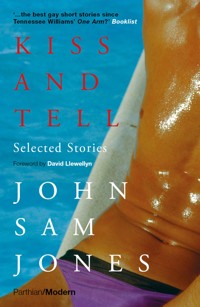
'Are these the best gay stories since Tennessee Williams' One Arm?'' – Booklist Selected for the first time in a single new edition, these sensual stories by prize-winning author John Sam Jones reveal lucid prose and complex lives. Moving through city steam rooms, rugged North Wales mountains and estuaries facing other places. Risky sex, new romance and easy understanding, a mortgage on a semi or keeping a lid on it all for the sake family, status and belief... Including previously unseen work, and a foreword by David Llewellyn.
Sie lesen das E-Book in den Legimi-Apps auf:
Seitenzahl: 298
Veröffentlichungsjahr: 2023
Das E-Book (TTS) können Sie hören im Abo „Legimi Premium” in Legimi-Apps auf:
Ähnliche



















Contents
About John Sam Jones
Praise for John Sam Jones’s fiction
Dedication
Title Page
Tidy: an introduction by David Llewellyn
Welsh Boys Too
The Birds Don’t Sing…
Sharks on the Bedroom Floor
The Wonder at Seal Cave
But Names will Never Hurt Me
My Velvet Eyes
The Magenta Silk Thread
Etienne’s Vineyard
Pocket Sprung and Nested
Fishboys of Vernazza
The Fishboys of Vernazza
Just Beyond the Buddleia Bush
A Particular Passion
The Wedding Invitation
Eucharist
Food For Thoughts
Between the Devil and the Virgin
Mischief and Deep Secrets
Gifts
The View from Sasso Fermo
Fridolin’s Dance
Kiss and Tell
Medi’s Wedding Dress
Copyright
John Sam Jones was born in Barmouth on the north-west coast of Wales in 1956. After secondary school at Ysgol Ardudwy in Harlech he went on to study biology at Aberystwyth University, and then theology as a World Council of Churches Scholar in Berkeley, California. He realised he was gay as a teenager at the beginning of the 1970s and began his life-long coming out at the age of eighteen.
His collection of short stories –Welsh Boys Too – was an Honor Book winner in the American Library Association Stonewall Book Awards. His second collection was the acclaimedFishboys of Vernazza, which was short-listed for the Wales Book of the Year. He has also published two novelsWith Angels and Furies andCrawling Through Thorns. He published a memoirThe Journey is Home, Notes from a Life on the Edge in 2021 which also appeared in Welsh, translated by Sian Northey, asY Daith Ydi Adra, Stori Gŵr ar y Ffin.
After working in ministry, education and public health for more than thirty years, John lives with his husband in a small German village a stone’s throw from the Dutch border.
Praise for John Sam Jones’s fiction
‘This hugely enjoyable collection of short stories by John Sam Jones provides an insight into everything from the desire to be a parent to being coshed with a stubby fencing picket following a disappointing woodland liaison… poignant, often touching stories lead one to conclude that we are what we are but considering the deep-seated prejudice which unbelievably still exists in the 21st century, some of us are more comfortable facing the truth than others.’The Big Issue
‘Welsh Boys Too, addressing the lives of gay men in contemporary Wales, was immediately recognised as a ground-breaking moment in Welsh writing in English… in this new collection of ten well-crafted stories, Jones writes as a returned native confronting the entrenched prejudice that has too often driven Welsh gay men into permanent exile… it reminds us that gay Wales is not just a minority concern.’Planet
‘Jones writes sensitive, skillful and fat-free stories. This book is a must… and would make an excellent starting-point for anyone wishing to dip into queer fiction for the first time.’gwales.com
‘John Sam Jones created a storm with his first collection of stories,Welsh Boys Too, about homosexuality in Wales. Now he has followed up his award-winning book with another sensual collection of stories… A former chair of the advisory body on gay and lesbian issues to the Assembly, Jones is not one to shy away from the questions faced by his characters… clever, poignant and perceptive.’The Daily Post
‘Offers an alternative definition of what it means to be a man in Wales… breaks free of old clichés of masculine identity.’New Welsh Review
‘An interracial gay couple baby-sits the two young children of a friend for a weekend; a high school boy grapples with his emergent sexuality while looking for support from the conservative adults in his life; and a mentally disturbed woman seeks vengeance against the brother who slept with her husband, in John Sam Jones’sWelsh Boys Too. These intriguing short stories look at homosexuality through the lens of Welsh culture, subtly linking homophobia to other kinds of discrimination – racism, religious intolerance – with objectivity and sensitivity.’Publisher’s Weekly
‘Welsh Rarebit –John Sam Jones’s charming, thoughtful collection of Welsh stories,Welsh Boys Too, is a joy to read. Contemporary, yet timeless, these tales of young men living in rural Wales have a pathos and dignity to them that sustains this slim, but vibrant collection. Rustic homophobia tends to be insidious rather than blatant, and Jones’s subtlety of language and style highlight this, as does the wild, unsophisticated backdrop of the slopes of Cader Idris, or the seagulls circling the cliffs of the barely inhabited island of Enlli. Unsophisticated these men may be, unscathed they are not – but they are survivors, and their stories are as uplifting as they are sad. Treat yourselves.’ Sebastian Beaumont inGay Times
‘Welsh Boys Toois a bold and adventurous collection of stories inspired by the lives of gay men in Wales. Funny, poignant and ultimately revealing, it introduces John Sam Jones as a new voice in the world of Welsh fiction. After spending years away from home, studying in California and as a chaplain in Liverpool, Jones returned to North Wales to be saddened by the prevailing homophobia within society and began, through writing, to explore the lives of the gay men who lived there. In a sequence of short, pointed stories, seen through the eyes of eight men, he discloses, in an often humorous manner, how they try to live their lives in a society where rejection is second nature.’The Western Mail
‘…John Sam Jones has balanced this short anthology well; each story earns its space and does not take away from any of the other works presented. An example of this balance is the collection’s ability not to shy away from sex whilst not sensationalising it either.’ Adam Lewis inGair Rhydd
‘Cymreictod ynddo’i hun yw un o’r pethau sy’n ein gwneud ni’n fwy cul… ac mae’r iaith Gymraeg yn arf yn erbyn pobl hoyw. Dyna un rheswm pam fod Cymro Cymraeg wedi penderfynu cyhoeddi ei straeon byrion Cymreig eu naws yn uniaith Saesneg… MaeWelsh Boys Toogan John Sam Jones yn gasgliad o wyth stori fer sy’n trafod gwahanol agweddau o fywydau dynion hoyw yng Nghymru.’ Cerys Bowen,Golwg
‘The eight quite short stories in this thin yet evocative first-ever collection of queer fiction from Wales open the door, with fluid charm, on yet another culture’s take on coming out, AIDS, homophobia and domestic togetherness. Though undeniably contemporary there is at the same time an other-worldliness to the author’s world; the familiar is filtered through the gaze of a culture which is as distinct from that of America, or even England, as, for example, Italy’s might be, or that of Greece. Makes for fiction that’s both absorbing and entertainingly anthropological.’ Richard Labonte
‘Packing eight stories into a slim paperback, Jones is a paragon of economy. In the five-page ‘But Names Will Never Hurt Me,’ he gives us everything necessary to understand why the 17-year-old protagonist, who has already made his affectional choices, decides that ‘Rent boy … didn’t sound so bad.’ In nine unhurried pages, ‘The Magenta Silk Thread’ reveals exactly why a 77-year-old war widow is attending her best friend’s son’s wedding and taking the train rather than getting a lift to it. Altogether, these stories present a cross-section of a new embattled minority within an old one–Welsh gay men. Jones’s examples embrace both terms of their identity. Several proudly speak Welsh, and all must come to terms with dour Welsh Calvinism as they do the public dance of appearances that being gay often requires. Jones makes them all vivid and sympathetic, not least by changing narrative perspective from story to story, from first-person subjective to third-person omniscient and even to second-person imperative.’Ray Olson, Booklist, American Library Association.
For Jupp
Kiss and Tell
John Sam Jones
Tidy: an introduction
David Llewellyn
I first encountered the stories of John Sam Jones in my first few months of living in Cardiff. I’d been out and proud while studying at Dartington College, a leftfield art school in rural Devon, but moving to the city was my first real experience of a ‘gay scene’.
Before then, my interaction with queer culture was limited to films and books. I read William Burroughs’Naked Lunchas a precocious, wide-eyed 14-year-old, and at sixteen watched Derek Jarman’sSebastianein my bedroom on a black and white portable TV. Channel 4’s adaptation ofTales of the Citysent me to Armistead Maupin’s charming page turners, while Vito Russo’sThe Celluloid Closetand the documentary based on it changed the way I would watchBen Hurforever.
Many of the books were by American writers, the novels telling stories set on the other side of the world or in the recent past. What I was missing was a sense of myself on the page. I was a working class kid from the valleys and I fancied boys; there wasn’t anyone like me in anything I read.
Over those first few months in the city I went to bars and clubs and met lots of new friends, some of whom were involved in the arts. While working on a film script that never became a film the producer gave me a copy of the recently publishedWelsh Boys Too; the cover a sepia image of a man’s bare chest and shoulder in close-up, the tip of a Roman-type sword pressed against his flesh.
Here were stories of the gay boys of Wales, the index of titles accompanied by character names like Dyfan, Rhodri and Gethin. For someone who had gone to art school pronouncing ‘year’, ‘here’, ‘hear’ and ‘ear’ exactly the same, it was refreshing, and though some of those stories were about the difficulties of coming out in the era of AIDS and Section 28 there were also gleeful tales of sex, romance and acceptance.
Re-reading them after twenty years I felt an almost Proustian rush seeing a mention of the gay travel guideSpartacus,which once graced the coffee tables of more affluent friends and the shelves of Waterstones’ ‘Lesbian & Gay’ section, becoming a digital-only publication in 2017. Other stories are a reminder of how far we’ve come. If we were to set them in the present day, some of the characters living with their ‘special friends’ might now be living with husbands or long-term partners or boyfriends, without the need for euphemisms.
I first read them around the time I came out to my immediate family, which I can only describe as a beautiful anti-climax. I’d been prepared for them to cut me off, to banish me from ever darkening their doorstep again. To my pleasant surprise my parents said they already knew, and my then-teenage brother said, ‘Tidy.’
It shouldn’t have been a surprise, but I grew up in a place where gay men were ridiculed and despised in everyday speech, even by the occasional school teacher. When I was outed in my last year it began months of insults, culminating in one changing room fight and a later punch in the face from a complete stranger. In reading these stories from our recent past we can only hope things in Wales have changed – and continue to change – for the better.
In that sense, these stories are unavoidably of their time, but read with all this hindsight what struck me is how fresh they feel. InSharks on the Bedroom Floorwe’re reminded of the slate industry’s historic ties to slave plantations in the Caribbean, a point that resonates in the age of Black Lives Matter and the downing of statues. The theme of family recurs throughout, and the domestic scenes are beautifully observed, even when things are almost unbearable, as inThe Wedding Invitation,its protagonist Seth experiencing the opposite ofHiraeth. I am fairly confident that whatever your age, you will recognise relatives, friends and maybe even lovers in these pages.
In many stories Welsh identity is as important a theme as sexuality. Characters to-and-fro between north Wales and the cities of northwest England, each hinting at something more than simply ‘home’, ‘freedom’ or ‘escape’. Others return from further afield, like California’s Bodega Bay, or are bound for the continent, to Etienne and the Ligurian coast.
Another motif I noticed while rereading these storieswas that of myths, legends and storytelling. A gay uncle’s reading of Prince Caspian turns a bedroom carpet into shark infested waters. Elsewhere there are references to theMabinogion,whileFishboys of Vernazzaadds a strange and sexy slice of magic realism to the mix.
Language and landscape run through this collection like an interwoven thread. Language – English, Cymraeg, and even Castellano – can be a means to keep secrets, or the way in which a secret is discovered, and Jones has fun throwing mono- and bilingual characters into a room, with all the tender intimacies and interpersonal conflicts that ensue.
Though many of the stories are rooted in north Wales, these are also tales of arrival and departure and the journey in between. For every small town boy there is a proud gay man striding across the world stage, but it’s when describing the Welsh landscape that the writing truly soars. The descriptions of Ynys Enlli and the Llŷn Peninsula in particular make many of these stories a precursor to the more recent phenomenon of queer nature and travel writing, as embodied in books by Mike Parker, Luke Turner and Philip Hoare.
Historically much of gay life happened behind closed doors or in the shadows. It wasn’t until the second half of the last century that queer pubs and clubs became a common enough sight in larger towns and cities, and meetings between gay men were, by necessity, often furtive and illicit. In making their presence felt, the characters you’ll meet here are often outdoors, swimming and hiking and travelling along country lanes, or simply basking and frolicking in the sunshine.
For John Sam Jones, the fictional journeys embarked upon by his characters have often been a reflection of his own peripatetic life. In the 1980s he lived in California, and more recently, in Brexit’s aftermath, he left Wales for Germany with his German husband. It’s therefore appropriate and timely that this collection of his short stories accompanies an autobiography, and that its title isThe Journey is Home.
David Llewellyn is a novelist and script writer based in Cardiff. His most recent novel,A Simple Scale (Seren) was shortlisted for the Polari Prize.
Welsh Boys Too
The Birds Don’t Sing…
Vorsicht! The word was written in bold red capitals that drew my eye; in smaller black lettering the warning of extremely dangerous high voltage,Hochspannung… Lebensgefahr!, was almost unreadable after fifty years of weather. The concrete post bearing this token of concern for human life was streaked with rust from the bolts that fastened the sign to it and the barbed wire it supported. I noticed the stains, the colour of iodine and dry blood, reaching down into the bouquet of carnations laid at the post’s base by some earlier tourist to the site and tried to order the chaos of thoughts stumbling into each other. After staring at the intense whiteness of the carnations for a long time I decided that whoever had laid them couldn’t possibly be called a tourist.
The same thought process led me to wonder what label I could give myself; yesterday, wandering through the old market place and nosing around the cathedral with my thrusting zoom lens I’d certainly been one. And a few days before, scrambling along the Orla Perc mountain ridge, the Eagle’s Path, with maps and a compass, the breathtaking snow-capped peaks inviting potentially fatal lapses in concentration, I’d been a hiker or a walker. But here, in this place, without the identity offered by such labels, I didn’t know who I was.
We’d chosen Zakopane for two reasons: no cheap charter flight, and a friend’s recommendation. Some of the boys from the Gay Outdoor Club had been there and spent a ‘…spectacular… wonderful… brill’ week walking in the Tatra Mountains. Gwyn had said that it was like having a Snowdonia the size of Wales to explore, but then, Gwyn was such a size-queen anyway and always professed to things being bigger than they were. And after that last trip to Gran Canaria, when there just hadn’t been enough sick bags to go round all the lager louts on the midnight flight home, I’d vowed never to fly charter again, so a holiday package by coach seemed like a good idea.
Griff, who always read the guide books for weeks before we ever booked anything and memorised town plans, major street names and sights worth seeing, knew from theRough, theBlue and theLet’s Go that Zakopane had a past. Poland’s well-heeled metropolitan consumptives had secured the town’s reputation as a fashionable health resort in the 1870s. These were followed by artists and intellectuals from Kraków, their bohemian colony thriving long into the dying days of the Austro-Hungarian Empire. Then came the skiers, followed by the walkers and climbers. It was the arty connection that had finally sold it to Griff, who’d come to think of himself as one of a new breed of intellectuals since he’d won the chair at an important regional eisteddfod. And I suppose I knew, too, that he’d memorised the names of the bars, saunas and cruising areas mentioned inSpartacusand that Griff wanted to add a Pole or ten to the list of foreign nationals he’d knelt before.
For as long as the weather had remained warm and sunny, Zakopane and its surroundings hadn’t disappointed us; we’d come to walk in the mountains and we’d done six hikes in as many near perfect days. We could tick off the Rysy, the Copper and the Sunburnt Peaks, the Upper and Lower Frogs, the Ox Back and The High One; names, unpronounceable in Polish, that conjured up the myths and legends of the highlanders who’d once lived on their slopes. On the shore of Czarny Staw, the Black Lake, resting after a hard climb, I’d taken Griff roughly, almost violently, on a smooth, sun-warmed slab of granite. Swimming, afterwards, and bathing one another in the ice-cold water, our cocks shrank to a size that even Gwyn, for all his exaggerating, could only have mocked. On another afternoon, in a high Alpine meadow, deep in the folds of a tumbling sheet of yellow mountain leopard’s bane, Griff held me to the ground and pushed deeply into me; in the peace that came after sex we lay in one another’s arms and watched a golden eagle circle on a thermal. They’d been good days. In the evenings we’d eaten at the Watra or the Jerus, drank coffee in street cafés and only much later gone to Janina’s bar to sip iced vodka and flirt with the two waiters, Leszek and Jakub. Neither had played hard to get.
The mist and rain had begun to fall into the valleys of the Tatras on the eighth day, and Zakopane winced under the burden of a swirling damp that pressed its rooftops low. I’d read for most of the day while Griff cruised the park and cottaged in the public toilet by the bus station. In the late afternoon we’d met for coffee and sticky pastries in the hotel lounge. Griff’s bit of rough in the bushes had left him feeling chilled, however, and he soon left to loll in a hot bath. I stayed in the lounge to eat just one more sticky pastry and wonder what we might do for the remaining days if the weather didn’t improve. Licking my fingers clean of the syrup from the pastry my eye was caught by the questioning gaze of a striking older woman whom I took, from the elegance of her dress, to be German. As she walked towards me, I realised that all the tables in the lounge were occupied by groups of hotel guests, their plans frustrated by the weather, sharing anecdotes: The regal architecture of Kraków… The excitement and sheer terror of the raft ride through the Dunajec Gorge… The rickety local buses… When she asked if she might join me at my table her American accent, though surprising my earlier assumption, made me relax.
Over a small pot of coffee that the waiter had brought us, I discovered that Marlene taught German literature at the University of California in Berkeley, that her husband never came on any of her trips to Europe, and that she was in Poland to visit her sister. I felt easy with her. She was interesting, liked to talk and didn’t ask too many questions. She was German, but had left for America in 1947; she had three grown up sons, all lawyers like their father, and her mother, at ninety-three, still lived in a resplendent Victorian in San Francisco’s Pacific Heights. She ordered aperitifs for us both and continued her story.
They’d had a difficult war, according to family legend, but since she’d been born in 1932, her memories were mostly those of a happy schoolgirl. She recalled that her mother’s American citizenship had created some problems and that they’d had to go to the police station almost every day to register. She remembered, too, that her father, a theology professor, had brushed with the Gestapo because of his professional relationship with Dietrich Bonhoeffer. Then there had been the business with her little sister, Hannelore. Some of the California sunshine went out of her face when she explained that they took all children with Down’s Syndrome to a state hospital, though they had managed to hide her right up until 1943.
I had begun to feel uncomfortable as the bleakness of the memories hardened Marlene’s face. I sensed that her immediate thoughts, worlds away from the words she’d spoken, might bring us to the edge of an intimacy that would be improper after so little time. I told her that we, Griff and I, were in Zakopane to walk, and as I said it, I realised that she’d become embarrassed by my unease.
Marlene eventually breached the silence that had cut between us like a mountain gorge. She asked whether Griff was a special friend. I knew that she knew. When she began to talk about her son Matt and his lover Kip, I realised that what Griff called ‘gay man’s mother’s intuition’ had seen through me. Eased by the new understanding between us she had become animated once again. She explained how she’d tried to persuade Matt and Kip to make the trip to Europe with her, but Kip had balked at the idea, as had Matt who didn’t consider those tens of thousands with pink triangles as his brothers. I heard myself say that I’d go with her. For hours afterwards I tried to convince myself that I was only going because of the rain.
We moved away from the blood stained concrete post with its bouquet of carnations. We walked on in the silence that had closed over us as we’d stood before the huge mound of women’s hair; a silence that numbed as we looked into the eyes of a child with Down’s, sitting on the infamous doctor’s knee, smiling from a photograph. It was an external silence only; inside me was a screaming bedlam. At the railway tracks, overgrown with wild grasses and purple-headed thistles, we sat on one of the iron rails. Overwhelmed by the malignity of the scene, I recalled the frightened eyes and the hate-scarred faces of the people in my own village. I’d been interviewed for a television programme about the age of consent for gay men. I heard again their insults and their jibes. I smelled the dog shit that someone had put through our letterbox and the paint of the wordsQueers Out daubed on our garage doors. As my thoughts became too painful I turned away.
‘The birds sing beautifully here,’ I offered after a while. Marlene, her face haunted, looked into my eyes.
‘No,’ she corrected, ‘they say Kaddish and recite Psalms, but they do not sing. The birds don’t sing in Auschwitz.’
Sharks on the Bedroom Floor
Rhodri
The first you knew of the pirates’ ambush was the blow to your head. In the disorientation that followed, and to the sound of excited screeches and a gutsy ‘Com’on mi hearties’ from the children, you worried whether Justin had put his pyjama bottoms back on after you’d made love. Your unease became palpable on realising that they might discover your own morning stand bulging in your boxer shorts if they got under the duvet. Sensational headlines from tabloid newspapers jarred your mind. And where had the knotted condom ended up after you’d fallen asleep in Justin’s embrace?
Penri, his left eye covered by a make-shift eye patch, jarred his knee unknowingly against your erection and pushed onto your aching bladder as he raised the pillow and struck again, hitting you hard across your bare chest. Tirion, by far the more placid of the two but looking fierce brandishing a loofah, bounced into the air before launching herself with a near primal scream across Justin, who caught her before she fell from the deck of the imaginary ship into the sea of sharks on the bedroom floor. You lifted your nephew an arm’s length into the blue sky above the besieged schooner, dropped him gently into Justin’s arms beside his sister, and avoiding the sharks that snapped at bare feet and indecent exposure, escaped to the bathroom.
Justin
You had always seemed more at ease with Tirion and Penri, probably because you never felt the need to second-guess the multiplicity of motives, ignoble or otherwise, behind your actions like Rhodri did. You pacified the marauding pirates by agreeing to read more ofPrince Caspian and the children’s adventures (two of whom just happened to be called Tirion and Penri) in Narnia. They liked it when their uncle Justin read to them in English. Sometimes they stopped you to ask the meanings of words and you would realise again that they spoke only Welsh with their parents in a home where the use of English was not encouraged. You remembered the heated argument with Gwydion, their father, who’d maintained that because English was so dominant anyway, discouraging its use in their home wouldn’t disadvantage the children. You, whom Rhodri considered as English as Colman’s Mustard but retaining ancestral vestiges of taste for Caribbean spices that were much less bland, had suggested that Gwydion’s politics might have skewed his acute intelligence. Loving you for the stability brought to Rhodri’s life, Gwydion had reacted with uncharacteristic tolerance, thinking deeply about what you’d said. But then he hadn’t changed his mind. After that family storm, your reading to the children, whenever they came to stay, had become a mission. As well as all of Lewis’ Narnia tales you read them Roald Dahl and even poems by Larkin and Robert Graves; how many times had they shouted ‘Again uncle Justin… Again’ after the final ‘I was coming to that’ inWelsh Incident?
Rhodri
When you came back into the bedroom you found the stricken schooner re-imagined; Justin the Dwarf was propped up against the pillows, a child nuzzling under each arm, and they were rowing in a boat, eastward around the tip of a magical island. Tirion brought her index finger up to her mouth sharply with a ‘Shhh!’ and explained to you in Welsh, her excitement overflowing, that they’d reached a good bit. Justin, with a wink and a smile, carried on reading in a suitably dwarfish voice: ‘Beards and bedsteads! So there really is a castle, after all?’ You pulled on your jeans and wondered how different the scene might be if the children weren’t just borrowed; if they were yours and Justin’s how quickly would they tire of being read to and become thediawliaid bach, the little devils their mother claimed them to be?
Before you’d finished laying the table for breakfast, you heard Penri’s crying, quickly followed by an avalanche on the back stairs. When he burst into the kitchen you took in the disaster that had befallen the little chap: so bound had he been by the magic of Narnia, he’d peed himself. Taking him up into your arms, you told him that it didn’t matter and that life was hard when you were five and a half. Consoling Penri wasn’t made any easier once Tirion arrived in the kitchen. Grumpy and disconsolate because Justin the Dwarf had stopped reading and begun to strip the bed of the wet sheet and mattress cover, she teased and baited her little brother and said that she’d be sure to tellMamabout him wetting uncle Rhodri and uncle Justin’s bed.
Tirion
Carelessly pushing a spoon around your cereal bowl trying to fish out the last pearls of soggy puffed wheat you explained why Quaker’s were nicer than Tesco’s own brand.
‘Sugar Puffs are just too sweet and not at all healthy,’ you’d just announced with authority, prompting Justin to ask if you’d done a degree in breakfast cereals. Laughing at his suggestion, you added, rather too seriously for a nine-year-old, that you’d like to study history at university because you liked learning about the Celts and slates and you liked readingY Mabinogion. And when you grew up you were going to teach at a university just like your mother. But you didn’t know what physics was yet, except that it was science and that your mother was the only one of her kind.
‘What do you know about slates, then?’ Rhodri asked, laughing. You talked about your class project on the Penrhyn Quarry at Bethesda where some people your mother calledein cyndeidiau had slaved.
‘The biggest slates are over 700 millimetres long – they’re called ‘queens’,’ you explained, stretching out your arms. You described with precision how the great slabs of slate were docked, split and dressed.
‘I can’t remember exactly how they came out of the mountain – they were exploded.’
Justin asked if you’d learnt about John Pennant and his son Richard, the men who’d first opened up the quarry in the 1780s? Shaking your head you looked blank while Penri shrieked with delight as one of the nameless barn cats caught one of the starlings that had settled on the lawn to feed.
Justin
After the committal of the dead starling in a coffin that had been shaped from an empty Quaker Puffed Wheat carton, you drove off with Tirion to the nursery to look for Spiked Speedwells, Anchusas, Blue African Lilies, and anything else blue for the new border. Your vision for the six and a half acres of hill-side that rolled gently down to the river Clwyd included a succession of small gardens each planted up in one colour and linked by arbours of clematis and honeysuckle and climbing roses;Compassion was your favourite, with its pinky-apricot flowers and heady scent. Rhodri’s grand plan for Hafod Ilan Hall, which you bought after your office syndicate scooped nearly eleven million on the lottery, is to open the place up as a stress management cum retreat centre with workshops on reflexology and aromatherapy, relaxation and massage as well as courses on time management. There would be lots of beautiful, quiet places for your hefty-fee-paying executive guests to unwind from the self-importance of their corporate worlds.
Tirion
Driving together to the nursery, you weren’t sure what you wanted to ask uncle Justin, whom you knew very little about. You knew that uncle Rhodri was your daddy’s brother and that he’d been your mammy’s best friend when they were students in Aberystwyth. Perhaps uncle Justin had been in Aberystwyth too? It did seem to you as though he’d always been around, at least for as long as you could remember. There were pictures of him in the albums from the time when Penri had been born or perhaps a few pages before… But he wasn’t in Mammy and Daddy’s wedding pictures, so perhaps he hadn’t been in Aberystwyth! That he didn’t speak Welsh hadn’t been enough of a difference to arouse curiosity; after all, Mrs Gittins, the lady who cleaned the house didn’t speak Welsh and neither did your best friend’s father. For that matter, lots of the people your mother worked with at the university, who sometimes came to the house, couldn’t speak Welsh. You couldn’t remember when the shiny blackness of his skin had become tangible as the difference that had kindled your fascination in him. Perhaps it had been after seeing something on the television about Tutsis and Hutus in Rwanda; you remembered how you’d liked the sound of those names, voicing them over and over and asking your mother if uncle Justin was from there. She’d laughed and said that he was from Liverpool, where you’d been once, to the theatre to seeJoseph.
Rhodri
Watching his sister and uncle Justin driving away after the starling’s funeral, Penri threw a tantrum, jealous that Tirion was getting the greater share of Justin’s attention. Quietly regretting that you hadn’t taken Tirion for the morning, you tried reading to him fromPrince Caspian, but still he cried. You sang one of the nonsense action songs you’d learnt at theUrdd summer camp at Llangrannog more than twenty years before (with thigh slapping, hand shaking and head tapping), but that made Penri screech even louder. You tried to lift him, to offer him reassurance, but Penri hammered his clenched fists against your chest. You thought about giving him a good slap across the back of his legs to give him something to cry about; that had been your own mother’s way and it had always seemed to have the desired effect. But you knew well enough that Gwydion and Eleri had never hit their children; their discipline was based on ‘time-out’ and loss of privileges. As sternly as you could, you sent Penri into the back living room and told him to stay there until he was ready to be sociable. To your great surprise the tactic worked; in less than ten minutes Penri came into the kitchen, his face bright and smiling (but still a bit red around the eyes) asking, ‘Can we let the chickens out and collect the eggs from the hen house?’
Tirion
No… Uncle Justin hadn’t been in Aberystwyth… He knew uncle Rhodri from work… Yes, they’d both worked in the same office at the hospital for a while until he’d moved to the personnel department… That’s right, before they’d stopped working and gone to live in Hafod Ilan.
‘And have I got a mammy? Yes, she still lives in Liverpool with my father.’
You laughed because he’d given you the wrong answer.
‘No, I mean like my daddy’s got my mammy.’
Perhaps sensing that you were working something out or to give himself a moment to think, Justin asked you if you knew the name for the relationship between your mother and father. Thoughtfully, you spoke some terms in Welsh and after a few moments’ word searching in your English vocabulary you said, ‘They’re married and they’re husband and wife.’ You caught on to his word game.
‘Have you got a wife, then?’ you asked.
‘You know I haven’t got a wife, Tirion… I’ve got uncle Rhodri.’
You went quiet for some minutes and then asked perplexedly what their relationship was called, ‘You can’t both be husbands, can you?’
Justin




