


Erhalten Sie Zugang zu diesem und mehr als 300000 Büchern ab EUR 5,99 monatlich.
- Herausgeber: Books on Demand
- Kategorie: Poesie und Drama
- Sprache: Englisch
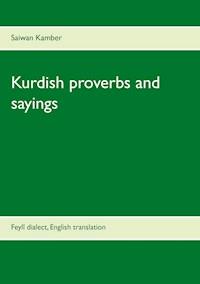
Kurdish proverbs and sayings A collection of proverbs and sayings from Ilam and Kermashan translated into English. The Kurdish texts are written both in Latin and Aramaic alphabets and where needed additional information is given so the reader can understand the core meaning of the proverb. To further help the reader with better understanding of the proverbs a glossary is added at the end of the book.
Sie lesen das E-Book in den Legimi-Apps auf:
Seitenzahl: 59
Veröffentlichungsjahr: 2015
Das E-Book (TTS) können Sie hören im Abo „Legimi Premium” in Legimi-Apps auf:
Ähnliche


















To my dear parents
Jasim and Lamieh, my heroes.
And to my beloved daughter Madjan.
Acknowledgments
I would like to thank the following people for their help with shaping this book
Jasim Kamber
Lamieh Say
Ebrahim Jahanbakhsh
Table of Contents
Dedication
Acknowledgments
Foreword
Feylî alphabet
Chapter A
Chapter B
Chapter C
Chapter Ç
Chapter D
Chapter E
Chapter Ê
Chapter F
Chapter G
Chapter H
Chapter Ii
Chapter Î
Chapter J
Chapter K
Chapter L
Chapter M
Chapter N
Chapter P
Chapter Q
Chapter R
Chapter S
Chapter Ş
Chapter T
Chapter Ü
Chapter W
Chapter X
Chapter Y
Chapter Z
Glossary
References
Foreword
The purpose of this book is to give the reader an insight into the proverbs used within the Feyli dialect of Kurdish.
Furthermore, it is a way to preserve and propagate the Feyli dialect.
The book begins with an explanation of how the Latin letters are used. In order to preserve the correct pronunciation and prevent misunderstandings, each word is written exactly as they sound. I believe it to be of outmost importance since there are words that sound very similar to each other but have different meanings.
To ensure that the proverbs spirit is not lost, I haven’t always translated them word for word.
Where necessary, I have added additional comments for the proverbs to be understood correctly. The comments can be found below the English translation in [].
The book ends with a glossary consisting of "difficult" words.
Happy reading.
Feylî alphabet
The author assumes the Kurmancî alphabet (ü is an exception).
The reader will also find capital letter L in some of the words. These L's correspond to the American L in App(L)e and (L)eg. It is pronounced normally when in the beginning of a word.
There are two other ways to write L => ll and ł. As there are no standard to follow, the author has chosen L. Letters that are repeated stresses the letter. For example Kirr, Wirr, Xirr.
A
Adetê daştî le şîrî – Terkê nîyekey le pîrî
A habit learned as a child – Can’t be getting rid of when old
Agir bê dükeL nîyew
No fire without smoke
Agir ki keftew, terr u hişk neyrê
The burning fire distinguishes not between wet and dry
Agir we agir nîyekujyêdew
One can not extinguish fire with fire
Agir xase dem u dü, bira xase ne çü şü
Fire is well, lit or smoky, brother is good but not as the husband
AqiL we işare, nezan we kutek
The wise with a nod, the stupid with a cudgel
Aqiweti ziLm kirdin, cewr kîşane
Misery is the evildoer's salary
Ard de teyre qert key?
Do you borrow flour from a thief?
Ardi berü le tîwiLê nîyewisê
Chestnut flour does not stick to his forehead
Ardi naw dirrig (Dirrigi naw ard)
Flour among thorns
[Confused]
Aşi çill kêwanû
Forty (old) women’s soup
[Too many cooks spoil the broth]
Asin we jengi xwey darizyêd
Iron rots of its own rust
[One who creates his own problems]
Asîyaw girrmey tîyey u ardê dîyar nîye
There are a lot of noises from the mill, but no flour is showing
[Much ado about nothing]
Aw le asîyaweyl keft u deng u bas temam bü (Aw le asîyaw bikefê)
When the water flows in the water mill all discussions stops
Aw le desi narijyê
Water doesn’t drip through his fingers
[Stingy]
Aw le yê cî bimêni genyê
Stagnant water stinks
Aw u agir mawiL neyrin
Water and fire gives you no respite
Aw we peLe we qert nîyeyd
He does not borrow water to the monsoon (autumn rain)
Aw wisya tu newis
If the water stops, don´t you!
Awi jîrê key
The water under hay
[Hidden intent]
Awê ki rişya cemew nîyewd (Awig rişya girdew nîyew)
One can not collect spilled water
Awi zûrdar werew biLênî çû
Strong waterflow, flows upward
Awman we yê cû nîyeçû
Our water does not run into the same river
[Does not get along]
Awi zel deyd?
Do you water the reed?
[Meaningless work]
Axiri yarî cenge, axiri dûsî dujmenî
Helpfulness ends with brawl, friendship ends with enmity
Ayimi qeün; Mirdin u le qewr nanê (naninê) gene
A fat man´s death and his burial is painful
Ayim firexwer du car mirê
The gluttonous dies twice
Ayim ta le esp nekefê espsiwarî yad nîyegrê (Sûwar ta nerrimê, sûwarî yay nîyegrê)
As long as you have not fallen off the horse, you will not learn how to ride
Ayim xweş-hisaw, şerîk maL merdime
The generous one has part in peoples homes




