


16,99 €
Mehr erfahren.
- Herausgeber: John Wiley & Sons
- Kategorie: Geisteswissenschaft
- Sprache: Englisch
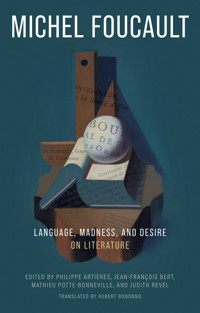
As a transformative thinker of the twentieth century, whose work spanned all branches of the humanities, Michel Foucault had a complex and profound relationship with literature. And yet this critical aspect of his thought, because it was largely expressed in speeches and interviews, remains virtually unknown to even his most loyal readers. This book brings together previously unpublished transcripts of oral presentations in which Foucault speaks at length about literature and its links to some of his principal themes: madness, language and criticism, and truth and desire.
The associations between madness and language — and madness and silence — preoccupy Foucault in two 1963 radio broadcasts, presented here, in which he ranges among literary examples from Cervantes and Shakespeare to Diderot, before taking up questions about Artaud's literary correspondence, 'lettres de cachet', and the materiality of language. In his lectures on the relations among language, the literary work, and literature, he discusses Joyce, Proust, Chateaubriand, Racine, and Corneille, as well as the linguist Roman Jakobson. What we know as literature, Foucault contends, begins with the Marquis de Sade, to whose writing — particularly La Nouvelle Justine and Juliette — he devotes a full two-part lecture series focusing on notions of literary self-consciousness.
This volume makes clear the importance of literature to Foucault's thought and it is an indispensable text for anyone interested in his work and intellectual development.
Sie lesen das E-Book in den Legimi-Apps auf:
Seitenzahl: 255
Veröffentlichungsjahr: 2026
Ähnliche
















CONTENTS
Cover
Title Page
Copyright
Editors’ Introduction
Notes
Note on the Text
Language and Madness
Note
The Silence of the Mad
Notes
Mad Language
Notes
Literature and Language
Session 1: What Is Literature?
Notes
Session 2: What Is the Language of Literature?
Notes
Lectures on Sade
Notes
Session 1: Why Did Sade Write?
Notes
Session 2: Theoretical Discourses and Erotic Scenes
Notes
Contributors
End User License Agreement
Guide
Cover
Table of Contents
Title Page
Copyright
Editors’ Introduction
Note on the Text
Begin Reading
Contributors
End User License Agreement
Pages
iii
iv
vii
viii
ix
x
xi
xii
xiii
xiv
xv
xvi
xvii
3
5
6
7
8
9
10
11
12
13
14
15
16
17
18
19
20
21
22
23
24
25
26
27
28
29
30
31
32
33
34
35
36
37
38
39
40
41
43
45
47
48
49
50
51
52
53
54
55
56
57
58
59
60
61
62
63
64
65
66
67
68
69
70
71
72
73
74
75
76
77
78
79
80
81
82
83
84
85
86
87
88
89
90
91
92
93
94
95
96
97
99
101
102
103
104
105
106
107
108
109
110
111
112
113
114
115
116
117
118
119
120
121
122
123
124
125
126
127
128
129
130
131
132
133
134
135
136
137
138
139
140
141
142
143
144
145
146
147
148
149
150
151
152
153
154
155
156
167
168
Language, Madness, and Desire
On Literature
Michel Foucault
Edited by Philippe Artières, Jean-François Bert, Mathieu Potte-Bonneville, and Judith Revel
Translated by Robert Bononno
polity
Originally published in French as La grande étrangère. A propos de littérature by Michel Foucault© Éditions de l’École des hautes études en sciences sociales, 2012
English translation © Robert Bononno, 2026
This English edition published by Polity Press in 2026
Selections of poetry from “Simulacre,” “Le Point cardinal,” “Glossaire j’y serre mes gloses,” “Bagatelles végétales,” and “Marrons sculptés pour Miró” are reprinted from Mots sans mémoires, by Michel Leiris.
© 1969 Éditions Gallimard, Paris.
Polity Press Ltd.65 Bridge StreetCambridge CB2 1UR, UK
Polity Press Ltd.111 River StreetHoboken, NJ 07030, USA
All rights reserved. Except for the quotation of short passages for the purpose of criticism and review, no part of this publication may be reproduced, stored in a retrieval system or transmitted, in any form or by any means, electronic, mechanical, photocopying, recording or otherwise, without the prior permission of the publisher.
ISBN-13: 978-1-5095-7202-1
A catalogue record for this book is available from the British Library.
Library of Congress Control Number: 2025945623
The publisher has used its best endeavours to ensure that the URLs for external websites referred to in this book are correct and active at the time of going to press. However, the publisher has no responsibility for the websites and can make no guarantee that a site will remain live or that the content is or will remain appropriate.
Every effort has been made to trace all copyright holders, but if any have been overlooked the publisher will be pleased to include any necessary credits in any subsequent reprint or edition.
For further information on Polity, visit our website:politybooks.com
Editors’ Introduction
“At one time, I read a great deal of what is referred to as ‘literature.’ In the end, I rejected many of them because of inability, most likely because I didn’t have the right code to read them. Now [1975] we have books such as Under the Volcano and The Opposing Shore. A writer I like very much is Jean Demelier; I was very impressed with Le rêve de Job. Tony Duvert’s work as well. For those of my generation, great literature was American literature, it was Faulkner. It’s reasonable to assume that having access to contemporary literature through foreign literature alone, whose source one can never reach, introduces a kind of distance with respect to literature. Literature was the great unknown.”1
In this 1975 interview about Jacques Almira’s Le voyage à Naucratis (the manuscript of which he received in the mail), Foucault indulged in a rare description of the literature in his library.2 As we can see, this short list is very diverse. The range of Foucault’s readings extended from young authors like Jean Demelier3 and Jacques Almira to Julien Gracq. At the same time, he expressed his admiration for Thomas Mann, Malcolm Lowry, and William Faulkner,4 an admiration that, in 1970, led him to visit Faulkner’s world, traveling the Mississippi River valley all the way to Natchez. Foucault’s history as a reader has yet to be fully explored. According to his brother, in their childhood home in Poitou, two separate libraries confronted one another: one was paternal—learned, medical, and off limits—and resided in the office of his father, a surgeon; the other was maternal, literary, and open. There, Foucault discovered Balzac, Flaubert, and classical literature. At school, where he was educated by members of the Catholic clergy, he read Greek and Latin.5 It was on the Rue d’Ulm, where he had access to the amazing library of the École Normale Supérieure, one of the leading public libraries in France, which held poetry and philosophical treatises, critical essays and historical texts, that Foucault was able to experience a form of unrestricted reading. In the ENS library, maintained by Maurice Boulez, he deconstructed an order of discourse, and literature appeared before his eyes.6 Daniel Defert, in his chronology in Dits et écrits, provides some additional information: Foucault read Saint-John Perse in 1950, Kafka in 1951, Bataille and Blanchot in 1953, followed the progress of the nouveau roman (including the work of Alain Robbe-Grillet), discovered Raymond Roussel in the summer of 1957, the authors associated with Tel Quel (Philippe Sollers, Claude Ollier) in 1963, reread Becket in January 1968.
We cannot overlook the importance of Foucault’s foreign travels in 1956: daily trips to the archives of the Maison de France in Uppsala and the Centre de civilisation française in Warsaw had a significant effect on Foucault’s close relationship to literary language. Amid the solitude of the Swedish and Polish winter, Foucault read a great deal—René Char’s poetry was his bedtime reading—and taught literature. It was there, surrounded by two languages that were foreign to him, that he underwent his first great experience with writing, there too that he taught French several hours a week and several courses on French literature, including a memorable lecture on love in French literature from Sade to Genet. In Sweden, Foucault led a theater club, where he put on several contemporary works with his students.7 In 1959, in Cracow and Gdansk, he gave lectures on Apollinaire. More anecdotal evidence in the history of Foucault the reader is found in his meetings, while in Uppsala, with Claude Simon, Roland Barthes, and Albert Camus, who had come to receive the Nobel Prize. Just as, toward the end of his life, he frequented several young writers (Mathieu Lindon, Hervé Guibert) without ever “discussing” literature, it is likely that he read these authors without ever entering into a dialogue with them, just as he never met Maurice Blanchot, claiming that “he admired him too much to become friends with him.”8 During the early 1960s, Foucault engaged in an intimacy with literature that is apparent from an examination of his preparatory notes for the History of Madness. An investigation of the archives of institutionalization, registers from Bicêtre, as well as lettres de cachet served initially as a literary experience, which he would later describe to the historian Arlette Farge in the introduction to Le désordre des familles.9 Foucault was drawn to the beauty of the poetics of the archive, these pure graphic existences, which he himself referred to as “the course that literature would follow from the seventeenth century onward.”10
Nonetheless, he continued to guard himself against such intimacy. For example, Foucault describes his first encounter with the work of Raymond Roussel, an author to whom he devoted an entire book in 1963, as follows: At the José Corti bookstore, “I found my attention drawn to a series of books of that faded yellow color used by publishing firms of the late nineteenth century … I came upon the work of someone I had never heard of named Raymond Roussel, and the book was entitled La Vue. Well, from the first line I was completely taken by the beauty of the style.”11
The “great unknown” would, in fact, be a clandestine moment; for Foucault was not just a demanding reader and a writer whose style, with the release of each of his books, came to be admired and recognized. Reading him closely, at a time when we have access not only to his major publications but also to his collected writings (Dits et écrits) and his lectures at the Collège de France, it has become clear that the philosopher’s relationship with literature—the documents contained in the present volume are a magnificent testimony to this—was complex, critical, and strategic.
In reading the many prefaces, interviews, and lectures that Foucault devoted to literature in the 1960s (whether they address writers such as Blanchot and Bataille directly or examine the traditional units of literary criticism in terms of a critique of the author or a general description of the space of language), and in recalling that these texts not only form an insistent counterpoint to the great “archaeological” works but reveal, even within those works, a discrete echo through their references to Orestes or Rameau’s Nephew (The History of Madness), to Sade (Birth of the Clinic), or to Cervantes (The Order of Things), we obtain a better grasp of the singularity of this concern for the literary. Although it forms an integral part of the attitude of an entire generation and prolongs an insistent component of French thought that consists in treating fiction and poetry as touchstones of the philosophical act (a standard against which Bachelard, Sartre, and Merleau-Ponty are successively measured), Foucault’s concern takes the form of an intensification of his own discourse. An intensification or, rather, a permanent doubling, that is to say, tentative, extreme, expressing both the order of the world and its representations at a given moment (which we know of, from the development of Foucault’s research, as the archaeological description of a “system of thought”) and what, paradoxically, would represent, in spite of everything, the dimension of excess, the immoderate, the outside. Where the great early works, notwithstanding the variations in their specific object (madness, the clinic, the birth of the social sciences), analyzed just how much our way of organizing discourse about the world owed to a series of historically determined divisions, the texts on literature, which are contemporary with them, appear, on the contrary, to employ an entire range of strange figures—intransigent writers, frozen words, labyrinths of writing—that embodied, if not an explicit refusal, at least a notable exception. Only once do the “orientation of the books” and that of Foucault’s literary texts overlap. This occurs in Death and the Labyrinth,12 his book on Raymond Roussel, the only work in which historical and epistemic inquiry appear to have completely disappeared, to be reformulated, indirectly, in terms of precisely that which brings about the failure of the order of discourse: a gesture, no doubt—that of writing—but also something that immediately implies a way of using literature as a strategy. Throughout this period Foucault is led to simultaneously maintain, to bring into play both the non-specificity of literature and its opposite, its strategic centrality. In the first case—that of archaeological inquiry—literature possesses no specificity in comparison with other discursive productions (official documents, treatises, excerpts from archives, encyclopedias, scholarly works, private letters, journals); in the second (“literary” texts), it is a question of expressing, within literature itself, a relationship between a posture and procedures of writing that, because they appear in a particular form, engender something like an experience of dis-order, the realization of a rupture: a matrix of change, an operator of metamorphosis. In short, the implacable correlation of words and things, on the one hand, and this strange finding, on the other, that what can be said is sometimes impossible to think—a strange disjunction that introduces an entire field of experimentation in which discourse could also free itself of its own codes or the unequivocality of what it presents to the reader: “Roussel’s enigma is that each element of his language is caught up in an indenumerable series of contingent configurations. A secret much more manifest but also much more difficult than that suggested by Breton: it does not reside in a ruse of meaning or in the play of unveilings but in a concerted incertitude of morphology, or perhaps in the certitude that a variety of constructions can articulate the same text, authorizing incompatible but mutually possible systems of reading—a rigorous and uncontrollable polyvalence of forms.”13
Two remarks can be made about this. On the one hand, this “outside” that literature represents for Foucault with regard to his own analyses is inseparable from an intentional gesture. It is not literature as such that is invested with this vertiginous polyvalence of forms, the downward motion of our order of the world toward the gulf of its own confusion, but the gesture that bears it along: literature as strategy, that is to say, a certain use of literature, the implementation of procedures, and the work of internally destroying the economy of narrative, which involves the construction of a battlefield against the hegemony of meaning. On the other hand, this “outside” exceeds the definition Blanchot had given it and that Foucault himself had used beginning in the mid-sixties. This was the acknowledgment of the dissolution of the link between “I think” and “I speak,” the unrestricted seepage of language outside itself. It is also, immediately, the establishment of another mode of being of discourse, one that escapes the dynasty of representation and engages material processes for constructing those structurally resistant words, which, depending on the situation, can be: inaudible, scandalous, unclassifiable, untranslatable, undecidable, fragmentary, aleatory, inconstant, vertiginous.
By the end of the 1960s, this strange relationship to literature seemed to dissipate. There are, no doubt, many reasons for this; but there are three that bear commenting on. The first has to do primarily with the abandonment of the privilege of the discursive over other forms of practice. The order of discourse is an order (historically determined) of the world; it is one of the modalities through which we organize our relationship to things, to ourselves, and to others, but it does not represent an exclusive model. Occasionally, a discursive order precedes and establishes other divisions (for example, the birth of an institution, a type of physical procedure, social exclusion), sometimes it even seems to be the result. Similarly, the “disorder” of a certain use of literature is one attempt among others to fracture the order of the world, for there are other strategies, speech not mediated by writing being one example. But there are also ways of “guiding one’s own behavior” that serve as so many strategies of rupture, of questioning, or of overturning the order of the world. From this point of view, the gradual abandonment of the field of literature as a “duplication” of Foucault’s own research can be attributed to the desire to extend his own inquiry to broader themes—this time presented in terms of power and resistance. Literary writing, used as an engine of war, can certainly find its place here, but it no longer represents the paradigm.
The second pertains to the difficulty of justifying a decision. We spoke of the uses of the literary and procedures of writing: this requires will, for it entails a project. Yet the old idea—no doubt still replete with phenomenological reminiscences—according to which it is around the intersection of literature and madness that speech capable of “unhinging” language is wound, makes the problem of a project hard to discern. What then can we say about the will of someone like Louis Wolfson14 or Jean-Pierre Brisset?15 And even when this will is made explicit, what of Foucault’s increasing interest, beginning in the early 1970s—and, especially, following that other experience with speech represented by his involvement with the Groupe d’information sur les prisons (GIP)—with the transition to a collective dimension? How can we connect “dis-order” (whether it involves the deconstruction of the linguistic code, the questioning of an institution, or the refusal of the objectification of his own identity) to shared practices integral not only to a unique subjectivity but to nonhierarchical subjectivations? Here, we find a renewed questioning of the elimination of certain “literary cases” from the established order and a much more general inquiry into the political modalities of the resistance involved: from this point of view, the muffled roar of battle is anything but a literary metaphor.
And finally, the third pertains to the abandonment of the figure of the “outside,” explicitly recognized by Foucault (the outside is a myth), and the reinvestment of the notion of the difference possible inside history—inside relationships of power, inside words spoken and endured, broken images and those that, in spite of everything, we continue to reproduce. The question then becomes one of how we might, from within a certain epistemic and historical configuration, from within the “network of the real” deployed by a certain economy of discourse and practice at a given moment—in short, from within a grammar of the world as historically determined—unearth and reverse connections, shift lines, move points, hollow out meaning, and reinvent equilibria. The stakes are, of course, theoretical, but they are also, immediately, political. Can we, from within this history, which makes us what we are (that is, think the way we think, speak the way we speak, act the way we act), free ourselves of those determinations and paradoxically establish the space (always internal) of a different speech or way of life? It is this problem, very clearly revealed throughout his work on literature, that will now continue to haunt Foucault: the possible overcoming and historical determination of what we are must be conceived not in terms of a contradiction, but in terms of compossibility. We are very distant, here, from the transgression so important to Bataille or the Blanchotian outside.
Foucault’s comments about literature, which compose the present volume, fall within this perspective; they share a common feature that makes their presence in the “Audiography” series hardly accidental. All are oral commentaries made over a period of less than ten years—between 1963 and 1971—but each of them maintains a particular relationship to writing and language. The first two documents are complete transcriptions of radio broadcasts that were made on French radio in January 1963. During the broadcasts, Foucault read several excerpts from texts by Shakespeare, Cervantes, Diderot, Sade, Artaud, Leiris, and others.
The second group consists of two lectures on “Literature and Language” given in Brussels in December 1964, while the third is a long, unpublished typescript for a two-part essay presented in 1971 at the University of Buffalo. This was part of an oral experiment (conducted on at least three occasions) for a study of the Marquis de Sade for which the manuscripts have been preserved. Bringing them together in this way, it is not the irony of a subjectless language trying to find expression or that of a form of neutral writing constrained to become speech that we would like to present; on the contrary, returned to the written page, they contain elements of a polymorphous uneasiness with exteriority, materiality, and the ruses of discourse, an uneasiness for which Foucault, reluctant to claim authorship, became, for a while, the mouthpiece.
Notes
1.
“La Fête de l’écriture,” interview with J. Almira and J. Le Marchand,”
Le Quotidien de Paris
, no. 328, April 25, 1975, 13; published in
Dits et écrits
, ed. Daniel Defert, François Ewald, and Jean Lagrange (Paris: Gallimard, 1995), vol. 2, text no. 154.
2.
Jacques Almira, with a degree in philosophy and literature, is the author of a number of novels and short stories. He received the Prix Médicis in 1975 for
Le voyage à Naucratis
(Paris: Gallimard, 1975).
3.
Jean Demelier, writer and painter, was born in Poitiers in 1940. He was a friend of Samuel Beckett and Pierre Klossowski. He gained critical recognition with the publication of his first two novels,
Le rêve de Job
(Paris: Gallimard, 1971) and
Le sourire de Jonas
(Paris: Gallimard, 1975).
4.
See “Truth, Power, Self: An Interview with Michel Foucault,” in P. H. Hutton, H. Gutman, and L. H. Martin, eds.,
Technologies of the Self: A Seminar with Michel Foucault
(Amherst: University of Massachusetts Press, 1988), 9–15.
5.
Denys Foucault, quoted in Philippe Artières, Jean-François Bert, Frédéric Gros, and Judith Revel, eds.,
Cahier Foucault
(Paris: L’Herne, 2011).
6.
Librarian at the ENS on the Rue d’Ulm and brother of the composer Pierre Boulez.
7.
Based on documents held in the archives of the Alliance Française, available at the Uppsala University library.
8.
Daniel Defert, “Chronologie,” in
Dits et écrits
, vol. 1, 43.
9.
Arlette Farge and Michel Foucault,
Le désordre des familles: Lettres de cachet des archives de la Bastille
(Paris: Gallimard “Archives,” 1982).
10.
Michel Foucault, “The Lives of Infamous Men,” in
Power: Essential Works of Foucault, 1954–1984
, vol. 3 (New York: New Press, 2001), 173.
11.
Michel Foucault, “An Interview with Michel Foucault by Charles Ruas,” in
Death and the Labyrinth
, with an introduction by James Faubion and a postscript by John Ashberry, trans. Charles Ruas (New York: Continuum Collection, 1986), 173.
12.
Michel Foucault,
Raymond Roussel
(Paris, Gallimard, 1963), published in English as
Death and the Labyrinth.
13.
Michel Foucault, “Speaking and Seeing in Raymond Roussel,” in
Aesthetics, Method, and Epistemology—Essential Works of Foucault, 1954–1984
, vol. 2 (New York: New Press, 1999), 27; our emphasis.
14.
Louis Wolfson, an American writer born in 1931, was diagnosed as schizophrenic early on. His text
Le schizo et les langues
, which was written in French, was published in 1970 by Gallimard, with a preface by Gilles Deleuze. It received considerable critical acclaim, as evidenced by Foucault’s text “Sept propos sur le septième ange” (in
Dits et écrits
, vol. 2, text no. 73, 13–25).
15.
Jean-Pierre Brisset (1837–1919) was a pastry chef, grammarian, writer, inventor, a security guard at the railway station of Angers, elected “prince of thinkers,” and made a saint of the pataphysical calendar. The pataphysical calendar was created by the College of Pataphysics. The term “pataphysics” itself was coined by the French writer Alfred Jarry, who defined it as “the science of imaginary solutions.” Since its inception, it has had numerous proponents. André Breton, Jules Romains, Raymond Queneau, and Michel Foucault were attentive readers of his work. Michel Foucault republished
La grammaire logique
(Paris: Tchou, 1970) and provided an introduction, “Sept propos sur le septième ange” (in
Dits et écrits).
Note on the Text
This book is based on typed transcriptions of oral presentations given by Michel Foucault in the form of radio broadcasts or lectures. The versions presented here are the most literal possible, but the transition from the spoken to the printed word imposes certain editorial interventions. Errors or inaccuracies in the transcription have been corrected or completed based on the manuscripts Foucault used to prepare his oral presentations. Punctuation and paragraph breaks have, in some cases, been altered to improve readability, although we made every effort to comply with Foucault’s intentions. Illegible words in a typed or handwritten manuscript are indicated in the text by the editors.
The critical apparatus in the notes is limited to a discussion of manuscript variants whenever it was felt these were significant or where there were breaks in the typescript. We also included bibliographic and biographical information for authors who might be unfamiliar to readers.
Language and Madness
In 1963 Michel Foucault gave five talks on the subject of language and madness for a radio program known as The Use of Speech, which was broadcast nationally by RTF France III. Jean Doat, an actor and writer with a background in theater and television, was the producer. These five broadcasts, presented once a week over a period of five weeks, were titled “Celebratory Madness” (January 7, 1963), “The Silence of the Mad” (January 14, 1963), “Persecution” (January 21, 1963), “The Body and Its Doubles” (January 28, 1963), and “Mad Language” (February 4, 1963). The series of talks given by Foucault was introduced as follows:
Michel Foucault, in writing the history of Western societies, has used madness as his touchstone. Every society, every culture, assigns madness a very specific place, preparing a defined structure for it in advance; thus, the group of so-called reasonable men is defined in opposition to the mad on the basis of its proscriptions.
This series of broadcasts contains four segments. In the first, the author defines the points where madness erupts into language. He analyzes the different forms of pathological language. He presents texts written by patients and read by actors, as well as recordings of dialogues between patients and clinicians.
In the second part, Michel Foucault shows how madness has been represented in language. He examines the character of the madman in Shakespeare and Corneille (the character of Éraste in Mélite, or The False Letters).
In the third part, Foucault describes the experience of madness within language itself and exposes certain links between the literary experience and madness among writers such as Gérard de Nerval and Raymond Roussel.
Roussel was treated by the great psychopathologist Pierre Janet, who describes Roussel’s case in one of his works, where he is given the name Martial.1
Finally, Foucault discusses artificially provoked madness, and no one could better illustrate this last aspect of language and madness than Henri Michaux.
In this volume, we present “The Silence of the Mad” and “Mad Language,” the second and last broadcasts, because of the mirror structure they employ and their focus on literature. The other three broadcasts are largely devoted to the single question of the language of the mad. When Foucault asks the actors to read passages from literature, no reference is made to the edition from which the texts are taken, which is a potential source of error in the printed reproduction of the spoken text. In the case of foreign literature, where the problem of translation arises, we have made use of the Pléiade editions available at the time Foucault presented his broadcasts, while respecting the cuts made within the text by Foucault, which are here indicated in square brackets.
Note
1.
Pierre Janet described Roussel’s case under the name Martial in
De l’angoisse à l’extase.
Martial was the name of the main character in
Locus Solus
, the play and later the novel of the same name by Raymond Roussel. Pierre Janet,
De l’angoisse à l’extase. Études sur les croyances et les sentiments
, vol. 1:
Un délire religieux; La croyance
, vol. 2:
Les sentiments fondamentaux
(Paris: Alcan, 1926, 1928).
The Silence of the Mad
Jean Doat: Michel Foucault, you have agreed to give a series of talks for our program, The Use of Speech, on the language of madness. That’s correct, isn’t it? The first broadcast in the series took place last week and was called “Madness and Celebration.” What’s the subject of your second presentation?
Michel Foucault: Well, I’d like to devote today’s broadcast to something that concerns the opposite, the other side of celebration, which would be the silence of the mad. But I believe you have an objection to make and I feel we should talk about it because, Jean Doat, you’re a man of the theater and are kind enough to produce this broadcast. I have the impression you’re not completely in agreement with me about my interpretation of the respective roles of celebration and theater with respect to madness. I have the impression that theater turns its back on celebration, turns its back on madness, that it tries to attenuate their powers, to control their force and subversive violence in favor of the beauty of representation. The theater, ultimately, destroys the participants, the participants of the celebration, to bring to life the actors on one side and the audience on the other. In place of the mask of celebration, which is a mask of communication, it substitutes something made of cardboard or plaster, something more subtle but which conceals and separates.
J.D.: Well, I can tell you that it’s not a strictly personal opinion. I believe, along with many others, especially with good master Alain,1




