


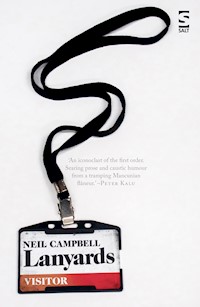
9,59 €
Mehr erfahren.
- Herausgeber: Salt
- Kategorie: Gesellschafts- und Liebesromane
- Sprache: Englisch
The third part of Neil Campbell's Manchester Trilogy, in which our struggling young writer finds love with a girl called Cho. Where a love song to Manchester becomes a love song to Cho. Lanyards explores how the jobs we wear around our necks dictate the ways we are identified. Building on the previous novel in the trilogy, Zero Hours, our protagonist finds himself on universal credit, taking agency jobs, moving from learning support work in schools and colleges to call centre jobs and back again, via a failed attempt at getting a job as a driver on the Metrolink tram network. Lanyards portrays the comic and poignant moments of working life. All the time reflecting back on the football career the narrator might have had were he not injured, his life as a writer, his experiences of being in a mixed race couple with the Hong Kong born Cho, the Manchester Arena bombing, the continuing success of his beloved Manchester City, the child sex abuse scandals in football, the disparities of wealth in contemporary Britain, and the death of a childhood friend that continues to haunt him.
Das E-Book können Sie in Legimi-Apps oder einer beliebigen App lesen, die das folgende Format unterstützen:
Veröffentlichungsjahr: 2019
Ähnliche















LANYARDS
by
Neil Campbell
SYNOPSIS
The third part of Neil Campbell’s Manchester Trilogy, in which our struggling young writer finds love with a girl called Cho. Where a love song to Manchester becomes a love song to Cho.
Lanyards explores how the jobs we wear around our necks dictate the ways we are identified.
Building on the previous novel in the trilogy, Zero Hours, our protagonist finds himself on universal credit, taking agency jobs, moving from learning support work in schools and colleges to call centre jobs and back again, via a failed attempt at getting a job as a driver on the Metrolink tram network.
Lanyards portrays the comic and poignant moments of working life. All the time reflecting back on the football career the narrator might have had were he not injured, his life as a writer, his experiences of being in a mixed race couple with the Hong Kong born Cho, the Manchester Arena bombing, the continuing success of his beloved Manchester City, the child sex abuse scandals in football, the disparities of wealth in contemporary Britain, and the death of a childhood friend that continues to haunt him.
PRAISE FOR THIS BOOK
‘Lanyards is an understated work of authenticity & truth about those ordinary lives trucking on, trying to matter. A story of quiet ambition & never truly giving up on what life once promised, this is a love song to Manchester past and present, & an ode to aspiring writers everywhere.’ —LISA BLOWER
‘Lanyards is a warmer yet equally righteous Factotum for the 21st Century temp-contract, gig-economy UK.’ —GLEN JAMES BROWN
‘Campbell’s capacity to make the ordinary absolutely fascinating continues in this, the third novel in the Manchester Trilogy. Blackly humorous, witty and brimming with powerful observation, Lanyards is both touching and gritty, a must-read addition to the working-class genre.’ —KERRY HADLEY-PRYCE
PRAISE FOR PREVIOUS WORK
‘An iconoclast of the first order. Searing prose and caustic humour from a tramping Mancunian flâneur.’ —PETER KALU
‘Neil Campbell’s Zero Hours is a poetic, emotionally-charged reflection of what it means to live and work in the city today. Its Mancunian voice is so distinct it’s not like reading a novel at all but like having a conversation with modernity itself. Zero Hours is sharp, funny and moving – a wonderful evocation of Manchester life.’ —LEE ROURKE
‘A 21st century Mancunian take on Post Office by Charles Bukowski. If you liked Post Office then you’ll almost certainly like this.’ —SCOTT PACK
‘Campbell’s narrator is a young working-class man from Manchester. Throughout the novel he works a number of zero hours jobs, first at a mail-sorting depot, later at a number of libraries. There is nearly always something to dishearten our man, be it his duties, colleagues, managers, or just the constant uncertainty that comes with this kind of employment. Besides work, the narrator has a number of unsuccessful attempts at relationships, and sees the face of his city change, losing its character to gentrification. There’s a stop-start feel to reading the novel itself: as with zero hours work, the present moment is all, and even the immediate future uncertain.’ —DAVID HEBBLETHWAITE, David’s Book World
‘Campbell is a realist writer, and Zero Hours is probably even more true to life and purposefully undramatic than its predecessor. And this is no bad thing, because he is a poet with a knack for describing ordinary episodes that strike an expectedly emotional chord. He is also deeply concerned with place and the indelible imprint left on a person by the sites that represent lodestones of their past.’ —RONNIE MCCLUSKEY, Storgy
‘Zero Hours is the second volume of Neil Campbell’s Manchester trilogy. Honestly, if ever a novel deserved literary accolades and bouquets it’s this one. Zero Hours possesses more energy, grind and determination than a decade of Bookers. If there was any justice it should be jumping off the bookshelves.’ —JOE PHELAN, Bookmunch
Lanyards
NEIL CAMPBELLis from Manchester. He has appeared three times inBest British Short Stories, and his debut novelSky Hookswas published in 2016. He has four collections of short stories published, and two poetry chapbooks. Recent stories have appeared inThe Lonely CrowdandFictive Dream.
Published by Salt Publishing Ltd
12 Norwich Road, Cromer, Norfolk NR27 0AX
All rights reserved
Copyright © Neil Campbell,2019
The right ofNeil Campbellto be identified as the author of this work has been asserted by him in accordance with Section 77 of the Copyright, Designs and Patents Act 1988.
This book is in copyright. Subject to statutory exception and to provisions of relevant collective licensing agreements, no reproduction of any part may take place without the written permission of Salt Publishing.
Salt Publishing 2019
Created by Salt Publishing Ltd
This book is sold subject to the conditions that it shall not, by way of trade or otherwise, be lent, re-sold, hired out,or otherwise circulated without the publisher’s prior consent in any form of binding or cover other than that in which it is published and without a similar condition including this condition being imposed on the subsequent purchaser.
ISBN 978-1-78463-171-0 electronic
for Naomi
Contents
Lanyards
Lanyards
IT HAD A SILVER FRAME and there was red padding over the handlebars with BMX written on in white letters. They’d got it from Asda. The spokes were sparkling and I didn’t want to go outside and get the bike dirty. But my Dad sat me on it and pushed me off, and I cycled to Houghy’s on Oakwood Avenue. Houghy was my best mate and came out on his Raleigh Burner and we tried the basic tricks of BMX like bunny hops and endos. Bunny hops were where you lifted both tyres off the ground, with your hands on the brakes, and hopped around. An endo was where you held the front brakes and leaned forward so that the back wheel went in the air. More than once we ended up on our arses. There were kids like Wisey who went to bike parks and did tricks on ramps. There was a place in Ashton-under-Lyne. But I was happy cycling around the Audenshaw streets. I had a sore arse for the first few days that’s all. There was a footpath that ran past the end of my parents’ back garden and we set up a jump on the path. Just a few bricks piled one on top of the other, and an old piece of wooden board resting against them for a ramp.
There was an old garden shed attached to the back of the house, made of the same bricks as the house and with a slanting slate roof. Inside it smelled of the linseed oil we used on cricket bats. There were shelves inside that my Dad had attached to the walls, and a little bench at waist height against the back wall. There was all kinds of stuff in there like tins of old paint, and all his tools in a plastic tool box that had different levels to it, and old jam jars with nails in them. There was a bag of sand on the floor and a tub of Polyfilla that was white with a blue lid. Houghy had gone in the shed when I opened it, put something in his pocket. He watched as I stood my bike up on its end and angled the bike into the corner of the shed before pushing the wooden door closed. There was a latch on the outside and a padlock with a tiny key. The lock was fiddly, but it closed properly. I forgot to ask what he put in his pocket, but I think that shed is where Houghy first got himself some glue.
The Dombovand’s sweetshop was right near my primary school, close to Mandy Blackburn’s house and just around the corner from where Wisey lived. Two-minute walk for them every morning, lucky sods.
It was summer, around the time of the World Cup. Me and Houghy went in the shop and after we came out and walked around the corner I stood there eating the Mars bar I’d paid for. He pulled a pile of football stickers out of his back pocket.
‘You nicked them?’ I asked.
‘Piece of piss,’ he said.
I couldn’t believe it. A good fiver’s worth.
‘Your turn next time,’ he said.
‘Me? Well okay.’
Next time, I walked right in and with Houghy beside me stuffed a pile of the stickers in my back pocket. The woman behind the counter stared right at me as I did it. She didn’t approach. Instead she appeared to phone someone, probably the school. Houghy said we should run but I walked back up to the counter and put the stickers down and ran out.
In school the next day I expected a bollocking but nobody said anything and I guessed they’d let me off.
Houghy approached me in the playground. ‘Why did you grass me up at Dombovand’s?’
‘I never grassed you up.’
‘Why did I get told off then?’
‘I don’t know.’
He kicked me in the shins. I kicked him in the balls. He grabbed me in a headlock and I punched him in the stomach. The dinner ladies stood around watching, and Mrs Burrows came and shouted at us. After fighting again at lunch, we were made to stand in silence next to the climbing frame, red faced and a bit embarrassed, while all around us everyone tucked into their school dinners. I looked at some of the plates and bowls: some had coleslaw, some sloppy mashed potato, some purple yoghurt, some semolina.
Me and Houghy went to Audenshaw High School and would go and get our hair cut at a place called Snips. From Hazel Street we cut through behind the Pack Horse, going down Poplar Street and coming out on Guide Lane past Hooley Hill. Then we walked up the hill past where the Junction pub used to be, past the ticket office for Guide Bridge train station, past the church and then right, beyond the Boundary pub and the Corpy Arms to the little shop on the main road to Ashton.
Most of the chairs were full and so only Houghy could sit down. I stood awkwardly behind the door and in front of the coats. There were newspapers on a table. Hairspray, shaving cream and condoms on the shelves in front of the mirrors. Hair in clumps on the floor. A framed picture on the wall advertising a gig for a band called The Paris Angels.
I looked into the mirror at the bloke getting his haircut and he was staring at me. There was this other bloke that Houghy pointed out. He was in the far chair getting his hair cut by the younger barber, Steve. And this bloke had about three strands of hair combed over, and he said to Steve, ‘can you thin it out a bit on top?’
Houghy sat in Steve’s chair and then finally Lawrence waved me over. I sat down in the warm leather chair and Lawrence started cranking it up so he wouldn’t have to bend over. I always had to try and remember the exact words to say to him. But, did I wait for him to ask me or did I just say it? After he’d put the cape over me he just stood there looking in the mirror. I looked back.
‘How would you like it?’ asked Lawrence.
‘All shaved off?’
‘Sorry?’ he said, pointing to his hearing aid.
‘Shaved.’
‘What number?’
‘Eh?’
‘What number do you want? Two, three or four?’
‘Two.’
‘What?’
‘Two.’
‘Okay,’ he said.
I watched in the reflection as Houghy touched the point on his head where the stitches were. I felt a bit guilty. We’d been playing golf on the paddy fields a few weeks before and I’d accidentally hit him over the head with a golf club.
Lawrence was almost done when I heard Houghy moan in the other chair.
‘Oh, sorry lad,’ said Steve, having hit a stitch with the scissors.
The next morning it was pissing down as I walked along Stamford Road. I saw Houghy near the tuck shop. When I went into my form room, the Old Chemistry Lab, the next morning, there was uproar. I did look quite different. I remember Mr Miller shaking his head at me and looking rueful. My hair was still wet from the rain and I ran my hands through it, spraying the lads next to me.
I remember a job we had to do when I worked in a warehouse. First, we had to scrub away all the pigeon shit. After that Rennie got the wide sweeping brush and pushed it all into one big heap. I bent over with the shovel and tipped it all into the battered metal bin. Then we lifted the bins onto the flatbed truck and wheeled it down the corner past the bogs and into the lift. Once down to the ground floor, I picked up the handle of the flat-bed truck, and with Rennie sat on the back, dragged the truck through the warehouse and out to the skip in the shadow of the MacDonald Hotel that was once the BT building on London Road.
For two days we went back to our normal warehouse tasks of picking and packing. Then the paint was finally delivered, along with rollers and brushes. The foreman said we had a maximum of two days to do it and that it wasn’t the ‘Sistine fucking chapel.’
We put on our new overalls. I used a screwdriver to flip back the lid of the first tin of paint, and as I did it, flicked some onto Rennie.
‘You fucking prick,’ he said.
‘Sorry, mate.’
I poured the paint into the plastic frame and put the roller in and rolled it up and down, getting an even spread of paint on the wall.
‘Fucking hell you don’t have to fuck around, just get the fucking paint on the wall. They’ve only given us this ’cos there’s fuck all else to do,’ said Rennie.
‘Might as well do a proper job.’
‘Fuck that. You make a start with that. I’ll sort this fucking radio out.’
It was the kind of radio station where the DJ talks bollocks and there are adverts for local businesses, and the music is a mixture of smooth classics and contemporary shite.
‘Hey, we could put the cricket on today. Test match,’ I said, stretching up towards the ceiling with the roller.
‘Nah, fuck that,’ he said. ‘You’re dripping paint all over the place.’
‘That’s what we’ve got the overalls for.’
‘You need to get the fucking extension on that.’
When Rennie went down the corridor to the toilets, I took off my gloves and started searching through the stations on the radio. Finally, I heard something good. I was hoping that the DJ hadn’t said the name of the song before it started. He hadn’t. He said it at the end. It was ‘Factory’ by Bruce Springsteen.
I was still sitting down when Rennie came back in.
‘Break time, is it?’ he said.
‘Oh, you’ve had your shit now have you?’
‘Nah, just read the paper.’
‘Who put you in charge anyway?’
‘One of us has to be. We need to get this done in two days.’
‘You shouldn’t go for a shit every hour then, should you?’
‘We could drag this out, you know. Get a week out of it.’
‘We’d get bollocked for that.’
When we’d finally finished we came back down to the ground floor with the empty paint pots on the back of the flat-bed truck.
‘What do you want, a fucking round of applause? You could have had that done in a day if you ask me,’ said the foreman.
‘We just wanted to do a proper job,’ I said.
‘Proper job? There’s more paint on your fucking overalls than there is on them walls. Dump those paint pots in the skip and then get back here.’
We did what we were told. It was warm outside, by the skip. But something in it stank so we came straight back.
‘Can I just ask,’ said Rennie to the foreman, who was sorting out deliveries for the following morning, ‘what are we going to use the store room for anyway?’
‘It is where we are going to keep the paint.’
‘For painting what?’




