


6,99 €
Mehr erfahren.
- Herausgeber: No Exit Press
- Kategorie: Gesellschafts- und Liebesromane
- Sprache: Englisch
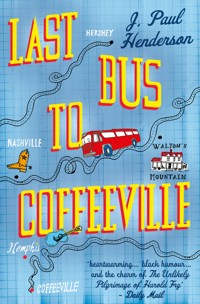
World Book Night 2016 title Longlisted for the 2016 International Dublin Literary Award Nancy Skidmore has Alzheimer's and her oldest friend Eugene Chaney III once more a purpose in life - to end hers. When the moment for Gene to take Nancy to her desired death in Coffeeville arrives, she is unexpectedly admitted to the secure unit of a nursing home and he has to call upon his two remaining friends to help break her out: one his godson, a disgraced weatherman in the throes of a midlife crisis, and the other an ex-army marksman officially dead for forty years. On a tour bus once stolen from Paul McCartney, and joined by a young orphan boy searching for lost family, the band of misfits career towards Mississippi through a landscape of war, euthanasia, communism, religion and racism, and along the way discover the true meaning of love, family and - most important of all - friendship. Charming, uplifting and profoundly moving, Last Bus to Coffeeville is a chronicle of lives that have jumped the tracks; a tale of endings and new beginnings; a funny story about sad things. 'A fascinating and poignant novel' Zarina de Ruiter,Woman's World
Das E-Book können Sie in Legimi-Apps oder einer beliebigen App lesen, die das folgende Format unterstützen:
Veröffentlichungsjahr: 2014
Sammlungen
Ähnliche


















In memory of Amanda and Stanley
Contents
Prologue
Part One: DISLOCATIONS
Chapter One: Gene and Nancy
Doc’s Birthday, Uncivil Times, The Delta, Freedom Riders, Androcles and the Lioness, Oaklands, The Field of Cotton, Hershey, The Missing Years, The Promise, A Visit to the Doctor’s
Chapter Two: Bob
Mississippi, Under the Radar, The Congo, Cuba, Dead or Missing in Action, The Dentist, Crawford, The Dry Cleaner, The BarbedWire Flag, Deterioration
Chapter Three: Jack
Fog, Weather, Flies, Hair, The Cuckold, A Changed Man, The Plan, Men with Blue Eyes, The Fish Tank, Friends Reunited
Chapter Four: Eric
Headaches, The British Israelites, The Great Pyramid, The Eye of the Storm, Slow but not Deaf, The Kindness of Strangers, The Hair in the Plughole, Chocolate, Fred Finkel’s Living Room
Part Two: LOCATIONS
Chapter Five: Two Mountains and a Plateau
Missing Persons, The Fire Tower, Leaving Three Top Mountain, Walton’s Mountain, Way Down Yonder, An Aura of Fake and the Smell of Horseshit, Alex with a Kiss, The Missing Ear, Open Mike’s Open Mic
Chapter Six: Nashville
Missed Deaths and Dreams, The Bible According to Otis Sistrunk, The Protestant Vatican, Opals and Cigarette Butts, Warren Kuykendahl’s Special Cups, The Revival – Aztec Two Step Style, The Honky-tonk Thief, Altercation in Plaid, Memphis
Chapter Seven: Coffeeville
The Lorraine Motel, Ducks, Kudzu, Wanda and George, Desperately Seeking Susan, Halloween, Crossing the Rubicon, The Day of Rest
Epilogue
Copyright
Prologue
‘It’s started, Gene.’
The voice was deeper than he remembered and older sounding, but there was no mistaking whose voice it was. In the same instant he also understood the meaning of what she said.
‘I’ll be right over, Nancy,’ he answered.
It was only after he put the phone down that he realised he had no idea where Nancy was.
Eight word conversations can have their limitations.
Part One
DISLOCATIONS
1
Gene and Nancy
Doc’s Birthday
Eugene Chaney, or Doc as most people called him, sat on the back terrace of his house drinking coffee and wondering if the birds were singing off-key. He decided they were and shouted at them: ‘Keep your damn beaks shut!’
In truth the birds sang no differently, neither better nor worse than usual. They stared at Doc as he settled back into his chair. They were used to his moods, but today he seemed different. Today he was: it was his seventy-second birthday.
Eugene Chaney III had retired from practice seven years earlier and eased himself effortlessly into a life of what his neighbours described as misanthropy. Doc would have balked at this description. He was unsociable yes, and made no effort to meet new people, but a misanthrope? No.
On the day he retired, Doc threw away the suits and bow ties that had characterised his professional life and replaced them with plaid shirts and corduroy pants. His white hair had grown long and was combed back in the style of Grandpa Walton, a character in a television series of his younger years. He had also grown a thick moustache in the fashion of Frank Zappa, a rock musician of his youth, and started to smoke again.
Daily life for Doc was no longer exacting. He would wake on a morning, walk downstairs and turn on the television. Most days he would read. Sometimes he would walk or drive places. He did things to fill time, to kill it stone dead. In the evening he would drink two glasses of red wine, impatient for the day to end, and at night sleep fitfully, his dreams disturbed. He was tired all the time.
The anniversary of his birth, however, always took a different turn. It was the one day of the year he allowed himself to look back on his life and consider its limitations. It was a dangerous, if necessary, safety valve.
He would question how a man could reside on a planet for seventy-two years and still live only ten miles from where he was born. He would meditate on a lifetime of helping others while unable to help himself, and ponder why he now preferred his own company. Above all, he would reflect on life’s fragility, its lack of rhyme or reason, and the unbearable pain of loss.
Eugene Chaney had become a doctor by default, through lack of imagination.
Doc came from a long line of doctors. His great grandfather, Robert Chaney, although having no medical qualifications per se, had made a name for himself and something of a small fortune for his family by selling what amounted to little more than snake oil. On the proceeds of Robert’s sales, his grandfather, Eugene Chaney, had gone to medical school and become a legitimate general practitioner, as had his own father, Eugene Jr.
In the small town where the family lived, the name Eugene Chaney became synonymous with medicine, and it was fully expected that Eugene Chaney III would also follow the well-trodden family path. Doc didn’t disappoint. If not filled with a burning desire to help people, he was at least interested in maintaining an accustomed standard of living and, if honest, coveted the social standing conferred by the title doctor.
With a natural and easy understanding of all things scientific, and with no other career in mind, Doc enrolled at Duke University’s School of Medicine in the fall of 1960. He drove to North Carolina in a brand new car, a present from his parents. Life was good and life could only get better. For a time it did but then it didn’t. How true to life, life can sometimes be!
As it transpired, Eugene Chaney graduated from Medical School with little or no interest in either maintaining his accustomed standard of living or achieving the social standing he’d once desired. He did, however, leave university with an almost obsessive need to wash his hands and, after the trauma of dissecting his allocated cadaver, an aversion to eating beef that lasted four years.
Of more concern for a man who would be a doctor for the next forty years of his life – and potentially more so for the communities he served – was that he graduated with absolutely no interest in medicine. Fortunately, this lack of concern was compensated by a basic competence on Doc’s part, and an awareness of his own limitations: he was happy, if not relieved, to refer patients to specialists when unsure of the correct diagnosis.
Patients came to him in differing states of vulnerability. Doc saw parts of their anatomy he preferred never to see again, and on a daily basis witnessed the corrosion of once healthy bodies now racked by disease and old age. The position of power he enjoyed and the onus of responsibility he suffered time and again overwhelmed him. He was expected to change lives for the better, but more often than not found himself managing expectations, explaining to patients the chronic nature of their conditions, and on occasion having to break news of the worst possible kind.
Unlike his patients, Doc appreciated how inexact a science medicine actually was, and likened himself to no more than a small-town garage mechanic who tried to figure out electrical faults on high-ticket European imports. In fact, no one was more surprised than he was when one of his patients actually recovered. His greatest and only fulfilment was syringing ears filled with wax.
Although Doc would have never been described as unsociable at this stage in his life, neither by any stretch of the imagination would he have been considered a people person. It might be surprising to learn, therefore, that amongst his patients he enjoyed the reputation of a kindly man, and was credited with a sympathetic manner; all remarked on the calm and reassuring nature of his voice. It was his patients, in fact, who had started to refer to him as Doc, rather than Doctor, and the moniker had stuck.
Doc’s first full-time position was in a small town in Maryland, located at the base of the Catoctin Mountains and surrounded by apple orchards. Ominously for future repartee, the doctors in the practice all quipped that they were MDs in MD.
The small town boasted Ten Police Officers for Every Man, Woman and Child. After his own recent experiences with the police, Doc wasn’t sure whether to feel reassured or threatened by this statement, and for many years would wonder where the supposed twenty officers assigned to his wife and child had been on the day of their deaths. Certainly not protecting them.
Four years after arriving in Maryland, Doc fell in love for the second time in his life. It also proved to be the last time. Her name was Beth Gordon, a twenty-five year old florist who operated a small concessionary close to where he worked.
Doc had been invited to dine at the house of another practice doctor, and had thought it fitting to take a bouquet of flowers for his colleague’s wife. He didn’t look forward to the evening and could predict from experience how it would unfold. The doctors from the practice would talk matters medical and debate plans expansionist, while their wives would talk amongst themselves, swap recipes for apple desserts and suggest suitable matches for Doc. (Doc was the only unmarried doctor in the practice and therefore considered eligible.)
There were two people working in the florists when Doc walked through the door, but it was Beth who’d greeted him: ‘Hi, how can I help you?’ she’d asked.
‘I’m looking for some flowers,’ Doc had replied.
‘Well, you’ve come to the right place, then. This shop is full of them.’
Doc had immediately liked her. He’d explained what the flowers were for and asked her to choose something appropriate. As Beth busied herself picking out flowers, matching their colours and choosing background foliage, they chatted easily – sparring with each other rather than aimlessly chit-chatting. Finally, Beth wrapped the flowers in cellophane and completed the presentation bouquet with a bow ribbon. As Doc was leaving – and halfway through the door – he turned to Beth and asked if she’d like to accompany him to the dinner party that evening.
‘Sure, why not,’ Beth had replied.
‘Well, just try and make something of yourself, then. No jeans! I’ll pick you up at seven.’
Two years later they were married.
‘I don’t suppose you want to get married, do you?’ Doc had asked.
‘Sure, why not,’ Beth had replied. ‘Who to?’
Doc had then slipped a ring on her finger. The next day they returned to the jewellers and exchanged it for something Beth thought more suitable.
‘Okay with you?’ she’d asked.
‘Okay by me,’ he’d replied. ‘By the way, you do realise I’ll be the titular head of the family, don’t you?’
‘Sure darling, and all the emphasis will be on the first syllable,’ Beth had replied.
Beth was pregnant within the year, and nine months later Doc became father to a 7lb 3oz girl – Esther. How something so small could bring so much happiness into their lives sometimes baffled him. Often, when he looked down on his daughter’s still and sleeping form, he thought his heart would literally burst. The unfulfilment of Doc’s professional life paled into insignificance as he now gloried in the completeness of his family life.
Such feelings, however, would last for no more than a year. Shortly after his daughter’s first birthday, Beth and Esther were killed by a giant donut.
The accident happened on an autumn day custom-built for convertibles: the temperature was warm, the air still, and the humidity non-existent. The Chaneys’ blue Corvette Stingray was usually driven by Doc but, at Beth’s request, he’d taken the family station wagon to the surgery that morning: she needed to run errands and wanted to make the most of the weather before it turned.
Beth rolled back the car’s roof, secured Esther’s chair firmly to the passenger seat and headed downtown. The warmth of the sun on her face and the breeze that rustled her newly short hair felt good. Beth had driven the route a thousand times before and could probably have driven it blindfold. At the intersection near the heart of the downtown district, she slowed to a halt, looked left, looked right, left again and then pulled out. Neither driving school nor her own driving experiences had ever suggested that she look upwards to check for falling donuts. Perhaps this was an oversight.
The giant donut had slipped from a crane in the process of attaching it to a tall advertising pylon adjacent to a donut shop. Without warning, it crashed down on the Stingray and crushed the car. Death for both Beth and Esther was instantaneous. Death for the doctor, however, would be prolonged and extend over a period of forty years. Their memory would be a constant in his life: as fresh as daisies and as dry as old leaves.
No words or damages paid can ever alleviate such loss, and at times like these God wisely removes himself to the sidelines – an anonymous spectator hoping to pass unnoticed. All that had been important to Doc had gone, and that day his soul died. The same day, he also lost his appetite for donuts.
Maryland and its memories began to suffocate him. He broke into a cold sweat every time he passed the intersection where the accident had happened, and involuntarily clenched his fists when he saw the giant donut – a new one – affixed to the pylon. Beth and Esther turned up in too many places for life to be comfortable, and when his father phoned to tell him of his decision to retire and inquire of his son if he’d be interested in taking over the practice, Doc readily agreed. The day he left Maryland was the last time he saw the town; he never set foot there again. He carried with him the remains of his erstwhile family: two small urns, one smaller than the other.
Doc’s parents had aged comfortably over the years, and he again looked forward to spending time with them. The occasion he’d last seen them had been Thanksgiving holiday of the previous year, and then they had still appeared as the archetypal old couple: the kind that telephone companies might use to encourage sons and daughters to phone home, or travel companies feature as model senior citizens journeying to visit grandchildren. Arriving to take over his father’s practice, however, Doc had been shocked to find them old people.
It had happened suddenly, and nothing had prepared him for the change. The phone calls and letters of the intervening year had given him no clues, signalled no warning. He wondered if signs of their decline had already been visible on that Thanksgiving visit, but that he’d been too consumed by his own grief to notice. There was no mistaking now, however, that his mother was seriously ill.
Aware of their son’s own pain, neither she nor his father had mentioned her cancer to him. The cancer proved terminal, and Doc and his father could only watch as it cruelly ravaged and consumed her body. As his mother faded, so too did his father’s spirit. The humour that once characterised and defined the man’s being disappeared and he shuffled around the house a mere shadow of his former self. Three years after his return, Doc’s mother died of a broken body and, six months later, his father of a broken heart. They now lay buried side by side in a small cemetery behind the Episcopal Church they’d attended, the church in which they’d been married and the church in which Eugene had been baptised.
In little more than an eight-year period of his young adult life, Doc suffered losses that would, for most people, have been spread over a lifetime, or never happened at all. Whether consciously or unconsciously, he withdrew from the world and into himself, protected from further loss by a shell of gruff exterior. For the next forty years, he would shed no fresh tears.
As the sun rose in the sky and the day of his seventy-second birthday grew hotter, Doc moved his chair into the shade, poured himself another coffee and lit a cigarette. Having unravelled the threads of his life, he now drew them together and refined them into a litany of advice he believed all fathers should impart to their children. Children, he maintained, should be prepared for everything that life might throw at them.
He believed they should be told that their lives would probably get worse rather than better, that they would encounter more difficulties than easy streets, and should learn to come to terms with disappointment. They should be told that they would fail more times than they would succeed, that they would be lucky to find careers that fulfilled them and would, in all probability, be bored stupid for much of their professional lives. Their hearts would be broken, and they would endure relationships that went up in flames or collapsed into rubble; sometimes they would know why, but most times they wouldn’t. They would suffer bereavement and loss, and for long periods of time simply exist. For all these experiences they wouldn’t be a better or worse person, only a changed person.
Once old, they should compare photographs of themselves as a child with how they were then. They should focus on the eyes: it would be their eyes that would tell the real story of their lives, not the lines on their faces or the loose skin hanging from their chins. Assuredly, their eyes would be sadder; there would no longer be a twinkle there but weariness, a hunted look.
Doc believed that if children knew such cataclysms were possibilities that could strike their lives at any time, the lucky ones would more likely appreciate the providence of their blessed lives, while the unlucky would learn to savour the fleeting moments of happiness allowed them. In particular, he would urge both groups to remember and appreciate the people who had shared in, and were often the reason for their happiness. Always remember to take photographs, he would have advised them. Don’t forget the photographs!
And then, five years ago, Nancy had unexpectedly phoned and renewed a relationship that had ended close to forty-five years earlier. In all probability it would end again within the year, and once more at Nancy’s choosing.
Uncivil Times
When the clock struck midnight on December 31, 1959, few could have foreseen the troubled years that lay ahead for the nation or prophesied the forces about to be unleashed. The time of Eisenhower had been one of consensus, and its spirit unquestioning and complacent. The parents of Doc and people their age had little appetite for self-criticism. They had lived through the Great Depression and fought a World War, and their lives were now comfortable. They had every reason to celebrate rather than criticise the America of their birth.
Change, however, was in the air, ruffling the growing hair on their children’s heads and tapping into their consciences. By the time Doc enrolled at Duke University’s Medical School, his generation was already starting to question the nation’s values, especially in the area of race. Negroes, they noted, were still discriminated against in almost all walks of life, and stores, restaurants and hotels remained segregated. They intuitively recognised that racial prejudice was wrong, an unquestionable evil.
Before arriving in Durham, Doc had experienced little of the prejudice that Negroes endured on a daily basis. The town he grew up in had been essentially white, and consequently there had been no racial divide. His early life had also been sheltered, and the success of the high school football team or finding a date for the prom had always taken precedence over any national issues that might have stirred the day.
Duke University changed this. Friends he made there were of the intellectual variety, people who placed emphasis on creativity and originality. By nature, they were more disposed to question and reject traditional and dominant values, and Doc came under their sway. Two friends, in particular, were instrumental in steering him down the path of civil rights activism. Galvanised by a black student sit-in at a segregated Woolworth’s lunch counter in nearby Greensboro, they joined the Congress of Racial Equality and, in conjunction with another student called Steve Barrentine, started to organise regular meetings and activities on campus. It was at one such meeting that Doc met Nancy.
Twenty people were gathered in Steve Barrentine’s apartment that night. It was the first meeting Doc had attended, and the only two people he knew there were his friends, neither of whom had thought it important to mention that, as a new arrival, he would be expected to describe his own experiences of racial discrimination and suggest ways of combating the unconscionable status quo. Consequently, when called upon to do so, Doc was taken by surprise.
Flustered by having to address the meeting with no thoughts prepared, he started by sensibly admitting that he had few experiences of racial discrimination to recount. He then joked that he’d have probably befriended more Negroes had they had air-conditioning in their houses. ‘All the Negroes I knew were poor,’ he said, ‘and let’s face it, who needs poor friends when it’s ninety-eight degrees in the shade?’
There was a stunned silence. People let out small gasps of air, shook their heads and examined their shoes in particular detail. Doc noticed only one person in the room stifling a laugh: a scrawny-looking girl sitting cross-legged on the floor smoking a cigarette. The silence was punctured – and Doc saved – by a loud and deep guffaw from the kitchen. A well-built Negro came into the room and walked towards Gene with his hand outstretched.
‘I don’t know who you are, man, but I think you jus’ nailed it. I ain’t got no air-conditionin’ an’ I ain’t got no civil rights, neither. Ain’t no way they not linked. Hell, if the governmen’ jus’ give me an’ my people some o’ the ventilation you white folks have, we’d be on our way to equality!’
As the man who’d spoken these words was the only black person in the room, the others started to smile and nod their heads. ‘Good thinking, Bob,’ Steve Barrentine said. ‘I think we should make that a discussion point for our next meeting.’
Doc imagined that if mud ever became animate, then it would sound like Bob Crenshaw: he’d never heard such a deep and resonant voice. He took Bob’s proffered hand with a greater enthusiasm than he usually accepted hands, and made a mental note not to wash until back in his apartment.
‘Glad to meet you, Bob – and thanks for speaking up when you did. I was beginning to feel like Jesus on the cross out there. They appear to hold you in some regard.’
‘Only reason they do is cos I black, an’ they ain’t,’ Bob smiled, taking Gene to one side. ‘I could say any ol’ damn shit an’ they’d still agree with me. By the way, what you said then was jus’ plain dumb, man. This ain’t no audience fo’ jokes, Gene. Folks here is humourless – well-meaning, but too worthy fo’ their own damn good. You wanna get a drink an’ be humorous some place safe?’
‘Sure,’ Gene said (as we’ll call him during his time at Duke; just as we’ll call black or Afro-Americans, Negroes – as they too were called at the time).
‘Hey, Nancy,’ Bob called over to the scrawny girl. ‘We’re goin’ fo’ a drink. You comin’?’
Nancy nodded and went to get her coat. ‘Let’s go to my place,’ she said.
The three of them left together, and Gene, who had arrived at the apartment on foot, climbed into the passenger seat of Bob’s battered old car.
‘This the firs’ time you been in a black man’s car?’ Bob asked.
‘First time,’ Gene replied, ‘so drive carefully. I have a promising career ahead of me.’
Bob let out one of his deep guffaws: ‘Ha!’
Nancy lived in a house rather than an apartment, and unlike most students at the university didn’t share with others. She threw her coat over an armchair and took three beers from the refrigerator. When she handed one of the bottles to Gene, she introduced herself as Nancy Travis.
‘This is a really nice house, Nancy,’ Gene said. ‘It’s the size of my parents’!’
‘Nancy’s a rich girl, ain’t you, Nancy,’ Bob teased. ‘A rich girl from Miss’ippi. How would yo’ daddy feel if he knew a black man was sittin’ on yo’ couch, Nance?’
‘He’d be fine with it,’ Nancy replied, with what Gene took to be a hint of exasperation in her voice. ‘Black people come and go in our house all the time.’
‘Yea, but I bet they’s servants.’
‘They’re also friends, and some of them we look upon as family. That’s what people here don’t understand. They simply see Miss’ippi as a boogey man. It’s a lot more complicated than that.’
‘I jus’ messin’ with you, girl. No need to get antsy.’
‘Who’s antsy…?’
‘You two seem to know each other well,’ Gene interrupted. ‘How did you meet?’
‘At one of the meetings,’ Nancy answered. ‘A girlfriend of his brought him and then dropped out of the group. We got stuck with him. She dropped him too, by the way, and I can’t say I blame her.’
Bob excused himself to use the bathroom. ‘How you know I didn’ drop her?’ he called out.
‘But you’re friends, right?’ Gene asked.
‘I guess so,’ Nancy laughed. ‘But there are times when he drives me nuts!’
Bob came back into the room and picked up the phone. ‘Okay if I use the phone, Nance?’ Nancy nodded her approval. Bob dialled a long number, grunted a few times into the mouthpiece, hung up and then announced he had to leave: some urgent business had come up. ‘You okay to get back by yo’self, Gene?’
Gene looked at Nancy to make sure it was okay for him to stay.
‘I’ll take him back,’ Nancy said.
‘Will you be at the next meeting?’ Gene asked him.
‘Hell no,’ Bob said, as he pulled on his coat. ‘I can think o’ better things to do with my time ’n listen to Steve Barrentine talk ’bout air-conditionin’. One mo’ thing, Nance – you gotta stop wearin’ that top. Looks like it’s made outta some ol’ bathmat!’
Gene was right in supposing that Nancy had been trying to suppress a laugh at his inappropriate comments during the meeting, but on closer examination proved to be nowhere near as scrawny as he’d first imagined her to be. She was in fact slim rather than skinny, about 5 feet 6 inches tall and really quite beautiful. She had large green eyes, expensively uniform teeth and thick strawberry-blonde hair. She also spoke with a seductively lazy drawl, and Gene found himself drawn to her.
When Nancy stopped the car outside his apartment building, he asked for a date. She paused before agreeing and then paused again. ‘There’s something you need to know about me, Gene,’ she said. As he waited for her to continue his heart dropped, and he feared she was going to tell him that she preferred the company of women or was addicted to prescription drugs. But what Nancy said was this: ‘I’m from the Delta, Gene. The most I’ll ever be able to cook for you is a grilled cheese sandwich.’
The Delta
Nancy Travis came from a rich family that owned large tracts of land in the Mississippi Delta. The temperature on the day of her birth had been 100.4 degrees Fahrenheit – the exact same temperature as her mother’s womb – and the day’s accompanying humidity had made for an easy transition into the world. Her parents’ money and privileged position similarly ensured that her passage through life would, in all probability, be smooth and uncomplicated.
The Travis family owned 6,000 acres of fertile land in the county of Tallahatchie, and grew cotton on topsoil estimated to be twenty-seven feet deep. The nearest small town was Sumner, and the nearest large town Clarksdale. The Travis family had moved there from Virginia in 1835, two years after the territory was opened for settlement, and with a cohort of slaves transformed the wilderness and swamps into some of the richest land in the state. In the nineteenth century they survived malaria, yellow fever, the Civil War, Reconstruction and the floods of 1882–84; and in the twentieth century embraced the new technologies of machinery and pesticides, and survived the floods of 1931 and 1933.
The family enjoyed a life of advantage, and a lifestyle that came with money. They gave lavish parties; flew to New York for opening nights and shopping trips; holidayed in Europe and the Caribbean; had a reserved suite at the Peabody Hotel in Memphis; and Hilton Travis, Nancy’s father, went on safari to Africa. Black cooks prepared their meals; black maids cleaned their house; and black gardeners tended their grounds.
Nancy was the youngest of four children, accidental. Her mother, Martha Travis, had borne her first three children while still in her twenties: Nancy was conceived in her mother’s forty-third year. (Bob, with his usual sensitivity, had told Nancy she was lucky not to have been brain-damaged.) There was a gap of some fourteen years between Nancy and her closest sibling. She had one brother and two sisters: Brandon, Daisy and Ruby. She became the centre of attention and, for many years, was treated like a family pet.
Brandon had attended the state’s agricultural college in Starkville and now helped his father run the farm. Daisy and Ruby had married early and well, Daisy to a dentist in Memphis and Ruby, Nancy’s favourite, to another farmer in neighbouring Leflore County. Nancy was the first member of her family to attend university.
Martha and Hilton Travis wanted the best for their youngest daughter. The first three of their children had grown up in times that placed greater emphasis on training in social and cultural activities than on academic studies – Brandon had attended college purely to acquire practical knowledge. They realised, however, that unlike that of her siblings, Nancy’s future would much more depend on the schools she attended and the education she earned.
Before the Supreme Court ruled in 1954 that all public schools be desegregated, Mississippi’s schools were already poor. The private academies opened by White Citizen Councils in response to that ruling, only served to further weaken the standard of education in the state. At the age of twelve, therefore, Martha and Hilton Travis enrolled Nancy in a private girls’ school in Richmond, Virginia; and in 1960, Nancy enrolled herself at Duke University. Herein lay the roots of Nancy’s dualism when confronted with the issues of race and racial prejudice.
Nancy was a child of Mississippi but became a stranger to it. She loved the state of her birth, and the Delta more so. Above all she loved her parents and family. She intuitively knew her parents to be good people, and could never remember them treating the Negroes who worked for them with anything other than kindness and consideration. When she’d told Bob that household servants were considered friends – and some as part of the family – she hadn’t been exaggerating.
At school and university, however, the environment was different. Many of the students were from northern states, whose families were politically more progressive or liberal by nature. They looked upon Mississippi as exotic, and Nancy was forever being placed in the position of being its spokesperson, and with increasing difficulty its defender.
The first – and worst – such occasion happened barely a year after Nancy had arrived in Richmond, when the badly beaten body of a fourteen-year-old Negro boy was pulled from the Tallahatchie River. His face had been mutilated: his nose was broken, his right eye missing, and there was a hole in the side of his head. The boy’s name was Emmett Till. He came from Chicago and had been visiting relatives in a county adjacent to Tallahatchie. He’d either wolf-whistled a white woman or called her Baby; no one was quite sure.
It was decided by some, however, that Till had insulted the nearest thing to an angel walking God’s planet. Condemned as an uppitynigra who didn’t know his place, Till was dragged from his bed three nights later and brutally murdered. Those who killed him went to bed that night with their consciences clear, and the jury that acquitted them of his murder at the ensuing trial, similarly returned to their beds untroubled.
The murder of Emmett Till horrified Nancy and her parents as much as it disgusted the nation. She refused to defend the actions of those responsible or excuse the ignorance and bigotry that caused them to act the way they did. She believed they were uncharacteristic of Mississippians, aberrations. Eventually, however, she came to wonder if this was really so.
As Nancy spent more time away from home, she became increasingly distanced from the romantic memories of her childhood idyll. In succeeding visits to the Delta, the scales that blinded her while living there gradually fell from her eyes. She started to notice the poverty and the gulf that divided the lifestyles of the privileged white few from the unfortunate black many. She saw the Negroes’ cabins for what they were – shacks, more suited to hens than humans: leaking roofs, broken windows repaired with cardboard, torn screens and no plumbing. She noticed too, the deep creases in the Negroes’ faces, and the look of their being much older than their actual years. More disturbing still for her was the realisation that her own family’s wealth was built on such poverty.
Nancy’s parents were paternalistic in the best sense, but within that word lay the dichotomy. The relationship between them and their Negroes was never one based on equality. In reality, her parents viewed them as children whose care was their obligation. In return for this care was an unspoken understanding that Negroes would pay them certain dues: they would defer to their judgements, never speak back, contradict or – God forbid – sass them.
Privately, her father criticised the ways of Mississippi, bemoaned the fact that Negroes could never expect justice from white juries, and recognised the anomaly of black people being barred from exercising democratic rights in what, supposedly, was the world’s greatest democracy. He would admit that change had to take place, but maintained that such change could only come from within – and that it would be slow. The worst thing that could happen, he argued, was if outside pressure was brought to bear on the state. He held that it was always easier for people to be influenced by principle the further they were from a situation.
Apart, however, from taking out a subscription to the Delta Democrat Times, the state’s only liberal newspaper, her father appeared to do little if anything to bring about change. He protested the verdict of the Emmett Till trial, for instance, but only in private. In truth, Hilton Travis could never afford to be seen as a ‘nigger lover’ by the surrounding white communities. The decade of the sixties might have dawned in America, but in Mississippi the year was still 1890.
At Duke, Nancy joined in the civil rights movement, but with the proviso that she would never take part in any activities within Mississippi. Despite all her soul-searching and new-found insights, when the moment of truth came she proved as incapable as her father of taking any kind of action there. She believed such undertakings would be tantamount to throwing bricks through her parents’ windows, and she could predict the hurt and embarrassment it would cause them. She was as much a prisoner of Mississippi as her father, tied to the place of her birth, her home and her family.
Freedom Riders
Gene and Bob struck up an unlikely friendship. Bob would swing onto campus in his worn-out car at no particular time, and with no prior notice. If Gene didn’t have classes to attend or his cadaver to dissect, they would grab a bite to eat or drink a coffee together. Oddly for two people who’d met through a mutual interest in civil rights, they talked about anything and everything but civil rights: Bob’s time in the army, the country of Vietnam where he’d been stationed and of which most Americans still hadn’t heard; Gene’s cadaver, their backgrounds, their hopes and Nancy.
Although Bob always arrived unexpectedly, there came a time when Gene could predict his arrival. The muffler on Bob’s car was as old as the rest of the vehicle and could be heard from at least six blocks away; in its wake would trail a pall of blue smoke.
‘Why don’t you get yourself a new car?’ Gene once asked him.
‘Hell man, I’m black an’ no job. I start drivin’ roun’ in an El Dorado or some such automobile, an’ the police gonna think I’d stole it or was pimpin’ girls. I prefer the low-profile approach to life, man: under the radar.’
‘How can you possibly think you have a low profile when you’re driving around making such a damned racket? Some of my friends in the Medical School already think you’re dealing drugs and, what’s worse, that I’m buying them from you!’
‘Well that jus’ plain racist! See what me an’ my brothers have to put up with?’ He paused for a moment and then turned to Gene. ‘I don’t suppose you in the market?’
‘Give me a break, Bob! I don’t want to get kicked out.’
‘Jus’ thought I’d ask.’ He paused, and with a mischievous grin on his face said: ‘Nancy smokes dope… bes’ grade too. Gets it from me. She got no problem doin’ business with a black man.’
‘Nancy smokes dope? I didn’t know that,’ Gene said, unable to disguise his surprise.
‘How long the two o’ you been goin’ out – four months?’ Bob asked.
‘About that.’
‘An’ you ain’t never see’d her smoke pot?’
‘No.’
‘Well that’s ’cos she don’t. I was jus’ foolin’ with you, Med’cine Man. Ha!’
‘Jesus, Bob! Why do you do that? Why do you always screw with people.’
‘I guess it the black man’s burden, Gene. I ain’t got no choice in the matter, man. How else we gonna get things movin’? Gotta cause us a few waves or that tired ol’ man rowin’ his boat ashore ain’t never gonna reach dry land.’
‘Well, just make sure you don’t sink him,’ Gene said.
‘You a one to talk,’ Bob countered. ‘People still aksin’ me ’bout yo’ air-conditionin’ speech!’
Gene didn’t take the bait. He’d learned from Nancy that sometimes the best way to deal with Bob was to ignore him. ‘I’m off to class,’ he said. ‘See you at the meeting tonight. I gather it’s an important one.’
‘You bet yo’ sweet ass,’ Bob said. ‘An’ don’t fo’get to bring Nance with you. She’ll be scared shitless by this ’n. We talkin’ Miss’ippi, man. Ha!’
As usual it was Steve Barrentine who took charge of proceedings. He explained to the gathered few (still no more than twenty attended these meetings), that the Congress of Racial Equality (CORE) had decided to test the effectiveness of a recent ruling by the Supreme Court that interstate bus stations could no longer discriminate against interstate travellers – whatever the local custom. Segregation of waiting rooms, restaurants and toilets had theoretically been ended.
‘But we all know what theory is, don’t we?’ Steve continued.
‘Theory?’ Bob suggested.
‘Exactly!’ Steve replied, taking Bob’s comment seriously. ‘And if we don’t challenge it, that’s just what it’s going to stay. We have to make sure it does become practice. For this reason, CORE’s organising a bus expedition through the Deep South. It’s leaving Washington in early May and then heading towards Mississippi and picking up additional activists on the way. Whatever the provocation, all responses will, as usual, be peaceful and non-violent.
‘They’ve asked us to provide three volunteers, and I’m glad to say we have them. Bob, Nancy, Gene: take a bow will you. You have our thanks.’
The meeting broke into applause. Bob stood up with a big grin on his face and bowed theatrically. Gene and Nancy just looked at each other: it was the first either of them had heard of this. Bob winked and mouthed: ‘I’ll explain later.’
When the meeting finally ended, Nancy marched up to Bob. ‘My place. Now!’
‘How could you, Bob?’ she shouted at him when he walked through the door. ‘You should have asked us first! Gene and I still have classes to attend and assignments to turn in. We can’t suddenly drop everything. And I’ve told you before: I’m not going to Mississippi.’
‘Aw c’mon, Nance. It’s almos’ the end o’ the semester. Classes an’ exams will be overed with by then, an’ if you ain’t finished yo’ work you can get extensions. We talkin’ two, maybe three weeks o’ yo’ lives. This a chance fo’ you – fo’ the three of us – to do somethin’ useful fo’ a change, steada jus’ jawin’ the whole time. An’ it’ll be fun. You can get off the bus in Alabama, Nance. Ain’t no need fo’ you to go to Miss’ippi.
‘An’ Gene, yo’ cadaver ain’t goin’ no place, man. He’ll wait fo’ you. Not like he’s gonna miss you cuttin’ into him, is he? He’ll be prob’ly glad o’ the rest: give him a chance to get his strength back!’
The three of them joined the bus in Richmond, Virginia. The first few days were uneventful: they got out of the bus, ate food at still segregated counters and then climbed back on to the bus; the only danger any of them could foresee was haemorrhoids. In North Carolina, however, things started to change. After the bus arrived in Charlotte, one of the black riders went into the bus station’s barbershop and asked for a trim. Refused his haircut, he in turn refused to leave the premises and was thereupon arrested for trespassing. The bus rolled on without him, and in Rock Hill, South Carolina, three riders were attacked by a waiting crowd.
In Atlanta, the Freedom Riders – as they now called themselves – divided into two groups and headed to Birmingham, Alabama, in two separate buses: a Trailways and a Greyhound. Bob, Gene and Nancy climbed aboard the Greyhound bus, and Bob lay down on the back seat and fell fast asleep. When a rock sailed through a window six miles from Anniston, he remained sleeping; the incendiary bomb that followed similarly failed to wake him.
The riders quickly disembarked. Fending off blows from the Klansmen who now surrounded them, it took a moment for Gene to realise that Bob was still on the blazing bus. After checking that Nancy was in no immediate danger, he rammed a peaceful and non-violent fist into the nearest face and climbed back on to the Greyhound. He fought his way through the flames and smoke to the backseat, where Bob still slept. He slapped him hard on the face, yelled at him, pulled him to a sitting position and slapped him again. Bob woke up, and fortunately for both of them his reflexes kicked in. Together they scrambled off the bus and reached safety only seconds before it exploded. Nancy burst into tears and Gene put his arms around her.
‘Man, that the las’ time I takin’ sleepin’ pills!’ Bob said.
It was a more sober group of people that continued the journey through Alabama. They were attacked again in Birmingham and three of them hospitalised. In Montgomery it got worse and, there, the journey came to its end.
The city police commissioner of Montgomery had refused to provide the Freedom Riders with any sort of protection, and when they arrived at the city’s Union Bus Terminal they were immediately surrounded by a hostile crowd of some 3,000 people. Fist fights broke out and, once again, the Freedom Riders were forced to defend themselves. White women joined in the affray this time, swearing at the girl riders and swinging purses at them.
Nancy was hit but unhurt, and Gene and Bob managed to escape with only cuts and bruises. Black bystanders at the Bus Terminal were less lucky: some had their bones broken and some set on fire. US Marshals and the National Guard appeared the next morning, but by then the civil rights activists had already decided to call it a day. Gene, Nancy and Bob returned home. Mississippi, they figured, would be worse still.
Life for the three of them returned to normal. Their friends in the civil rights group hailed them as heroes and Gene, in particular, drew praise after Bob recounted how the Medicine Man had saved his life on the Aniston road. But for the time being they placed activism on hold. Bob returned to the business of being Bob, and Gene and Nancy focused on each other.
Androcles and the Lioness
‘They’re just two of the sweetest people, Gene. I can’t believe they’re so nice. You’re sure they are your parents?’
Nancy and Gene had spent Thanksgiving holiday with Gene’s family, and were now returning to Durham.
‘I remember them hanging around the house a lot when I was growing up, so I’m guessing they are,’ Gene replied. ‘Anyway, why does their niceness surprise you? Are you saying that I’m not nice?’
‘You’re nice enough,’ Nancy said, patting him on the knee. ‘At least you don’t get on my nerves. But your parents are more sociable than you are. You have to admit that.’
‘It’s not a matter of sociability. I just don’t like small talk. I’m no good at it, and I always end up saying something stupid.’
‘Tell me something I don’t know!’ Nancy laughed. ‘And drive faster, will you? The movie’s going to be over by the time we get home.’
‘I’m driving the speed limit, Nancy, and I’m not getting a ticket just to make the start of some dumb art movie. Anyway, a snail has a faster pace than those films. We could turn up ten minutes from the end and still understand the plot.’
‘It’s not just the plot, silly; it’s the meaning and the nuances. You’re such a Philistine, Gene. Do you know that? I’m trying to bring some culture into your life and this is the thanks I get.’
‘I’ve got enough culture in my life already. I’m going out with you, remember.’
‘Oh hush! The only culture in your life is television. If it was up to you, all we’d ever do is stay home and watch stupid game shows. We wouldn’t go to the theatre, we wouldn’t go to museums or art galleries, and we probably wouldn’t even go to concerts. How many times do I have to tell you that you can’t live life on a couch or in a laboratory? There are too many places to see, too many other experiences to be had.’
‘And how would any of that be of help to my patients? If they come to me and I can’t figure out what’s wrong with them, what am I supposed to tell them? “I’m sorry, Mrs Forrester, I can’t quite put my finger on what’s ailing you at the moment, but if it’s of any consolation I could always tell you about the Fellini film I saw the other night or show you some of the snapshots I took when I was vacationing in London last summer”.’
‘Just drive, Gene! You might not have any interest in a life but I do, and I’m not prepared to waste mine stuck in a car with you.’ She then prodded him in the ribs and Gene flinched.
‘For God’s sake, Nancy, don’t do that when I’m driving! You’ll cause an accident.’
Nancy started to laugh and prodded him again.
‘I’m warning you, you do that one more time and I’ll stop the car and make you walk. I’m not kidding!’
‘Of course you are. You’d never do anything to hurt me. You love me too much.’
‘I must have been drunk when I told you that.’
‘You didn’t have to tell me. I knew it already. I know you better than you know yourself – and I know for a damned fact that you can drive over sixty and not get us killed!’
‘You’ve never said that you loved me,’ Gene grumbled. ‘Do you?’
‘Maybe. You should know if a person loves you.’
‘Why won’t you say it, though?’
‘Because,’ Nancy teased.
‘Because what?’
‘Just because.’
She smiled at him, snuggled closer and rested her head on his shoulder. Gene bent towards her and kissed her on the forehead.
‘I don’t know if we’ll ever get married, Gene, but I think you’ll always be my friend. You’d do anything for me, wouldn’t you?’
‘Not right at this moment, I wouldn’t.’
Nancy raised her head from his shoulder, kissed his ear and ran her tongue inside it. ‘You’re sure?’
‘Don’t, Nancy!’
They made it back to Durham in time for the film, and afterwards drove to a newly opened restaurant. It had a rustic feel to it, sawn-timbered tables and benches, and the food on the menu was down-home.
‘Would you like to talk about the film, Gene, or would that embarrass you?’
‘The only thing that embarrasses me is the fact that I shelled out five bucks to see it! I don’t speak French, Nancy. How the hell am I supposed to discuss a film that I haven’t even understood?’
‘The movie was subtitled, Gene. You were supposed to read the subtitles!’
‘I couldn’t. I didn’t have my glasses with me.’
‘Why didn’t you say something, then? We could have left early.’
‘Because you were enjoying it – and I was happy to waste two hours of my life for the enjoyment of yours. Remember that next time you’re stuck in a car with me, will you?’
Nancy smiled and pinched his cheek. ‘You poor baby,’ she said. ‘Why do you put up with me? If you treated me this way I’d dump you in a lake.’
The meal passed in similarly discordant harmony, and when the check came Nancy took care of it. ‘My treat,’ she said. ‘You paid for the film.’
They got up to leave and Nancy gave a short scream. ‘God, Gene. Look at that!’ she said, holding out her index finger. ‘Do you think I should go to the Student Health Centre?’
Gene examined her finger. A large splinter had embedded itself in the flesh and the wound was bleeding. ‘There’s no need for us to go to the Health Centre. I can take care of this.’ He wrapped Nancy’s finger in a paper napkin and then helped her to the car.
‘It hurts, Gene. I mean, really hurts! You wouldn’t believe the pain I’m in. I think I’m going to faint.’
Gene kept his face straight and drove them to his apartment. There he had Nancy lie down on the couch. He took a pair of tweezers from a small case he kept in the bedroom, and holding Nancy’s finger with one hand and the tweezers in the other started to pull the splinter, slowly, carefully.
‘Ow-ow-ow, Gene! You’re hurting me!’
‘Stop fidgeting, Nancy! It’s almost out. Please, just keep still!’
But Nancy didn’t. She pulled away from him and the splinter broke off in the tweezers, leaving a small sliver below the surface.
‘Shit, Nancy! I’ll have to use a needle now. Why can’t you just do as you’re told for once?’
He saw tears welling in her eyes and involuntarily started to laugh.
‘It’s not funny, Gene!’
‘I’m sorry, Nancy. I know it’s not. But one day we’ll look back on this and laugh.’
‘You really think so? God, you can be such a jerk! It’s your fault I got this splinter in the first place. It was you who insisted we go to that damn restaurant. Why did you have to take me there?’
‘Because you were telling me in the car how much you liked new experiences. We’d never been to that restaurant before, and so eating there was a new experience. It’s impossible to please you, Nancy. Have you ever thought about that?’
Nancy pushed her lips into a pout, and Gene went to the kitchen to retrieve a needle from a small sewing kit his mother had bought him when he’d first gone to university. While he was there, he poured a large glass of brandy for Nancy.
‘This is how it was done in the olden days, before anaesthetic,’ he said, handing her the glass. ‘People had limbs sawn off and bullets extracted, and all they had to dull the pain was alcohol. I’m pretty certain a glass of brandy will do it for a splinter.’
‘It’s goddamn 1962, Gene! We’re not living in the olden days! I knew we should have gone to the Health Centre. They’d have given me a local anaesthetic.’
‘They wouldn’t have even given you a beer! Now stop being such a milquetoast and drink it.’
He struck a match and ran the flame along the needle, and then waited for it to cool. Once Nancy had calmed, he took a firmer hold of her finger and carefully picked at the flake.
‘I hate you, Gene. Really hate you,’ Nancy slurred. ‘I’m never going to be nice to you again.’
Gene smiled. ‘Will I notice the difference?’
‘You know you will, you big lug.’
Gene continued to work on Nancy’s finger until no trace of the wooden fragment remained. He then dabbed the wound with antiseptic and covered it with a Band-Aid.
‘You want me to drive you home?’
‘No, I’ll stay the night here. If my finger falls off I’ll need someone to put it back on. And don’t for a minute think that I’ve forgiven you, because I haven’t.’
Rather than unpack her overnight bag, Nancy cleaned her teeth with Gene’s toothbrush and then climbed into bed. Gene joined her there and she nuzzled up to him.
‘I’m sorry for being such a wuss, Gene. I’m not very good with pain. And I didn’t mean those horrible things I said to you. You know that, don’t you? It amazes me how you cope with my moods; you do it so well. Anyway, thanks for saving me tonight. I’ll always be able to count on you to save me, won’t I? You’re my very own Androcles.’
‘Who’s Androcles?’
Nancy rested on an elbow and looked down on him. ‘You’re telling me you don’t know who Androcles is? You’ve never read the story of Androcles and the lion?’
‘No. I’ve never heard of him or the lion.’
‘God, Gene! This is what happens when you live your life on a couch.’ She punched him on the arm and then rolled on to her back. ‘You should be ashamed of yourself. And I’m definitely not being nice to you now!’
‘I wouldn’t expect any patient to be nice to me, Nancy. It’s against medical ethics. I could get thrown out of school.’
‘Well, in that case, get ready to be thrown out of school then, because my ethics are more than okay with it!’
There are billions of people in the world, and many millions of them in the 1960s lived in the United States. In theory, and with time, Gene and Nancy could have fallen in love with hundreds of other people. They did, however, fall in love with each other, and believed each to be the fulfilment of the other’s life; the proverbial needle discovered in their own backyard haystack. They talked of a future together and of marriage.
Like all couples they argued – maybe more than most – but they felt comfortable arguing, and doubted the nature of any relationship characterised by a lack of argument. The sun set on many of these differences of opinion, and days would often pass without any sort of communication between them, until one or the other would break the deadlock with a phone call or a visit.
It was the occasional silences when they were together, however, that confused and worried Gene. They could be lying side by side, either touching or only inches apart, when Gene would suddenly sense a gulf between them of unfathomable and mysterious depth. Nancy would be in her own world, distant and unreachable, lost in thoughts she’d never share or admit to having.
‘Penny for them,’ he used to say.
‘Nothing to buy,’ she’d answer with a forced smile.
‘You know I love you, don’t you?’
‘Of course you do,’ she’d answer, and then move away from him. Gene would lie there uncertain.
In the summer of 1963, however, things between them were good, and Nancy invited Gene to spend the last week of August with her and her family in the Delta.
Oaklands
Gene and Nancy flew to Memphis and were met at the airport by Nancy’s sister, Ruby, and the heat of an oven. While Gene struggled with the suitcases, the two sisters ran to each other and hugged. Catching up to Nancy, Gene held out his hand to Ruby, who brushed it aside and hugged him. She told him she was pleased to meet him after hearing so much about him for so long, and teased Nancy for not bringing him home sooner.
‘I think she was afraid you’d fall in love with me,’ Ruby said.
Slightly shorter than her sister, Ruby was also darker complexioned and had the blackest of hair. She also carried more weight than Nancy, but the kind of weight Rubens had been happy to immortalize.
Driving south into Mississippi, Ruby asked Gene what Nancy had told him about the Delta.
‘Only that it’s flat,’ Gene replied.
‘Oh boo, Nancy. Shame on you,’ she said. ‘You didn’t tell Gene how it got its name?’
‘No,’ Nancy said. ‘Are you going to?’
‘Damn right I am, sister. Now listen up, Gene, because all your friends back home’ll want to hear this. It’s called the Delta because it’s shaped liked a D. Delta’s the Greek name for a D. Did you know that?’
Gene nodded.
‘Anyway, it stretches two hundred miles from Memphis in the north to Vicksburg in the south – there’s a big Civil War battlefield there – and at its widest point it’s no more than eighty-five miles. So if you draw a straight line from Memphis to Vicksburg, and then a curved one from Vicksburg to Memphis taking in the widest point, you get the letter D. Now that’s interesting.
‘Mom and Pop live in Tallahatchie County, but there are eleven others. I live in Leflore County, that’s another one, so that leaves ten. Nancy, are you going to tell Gene what the names of the other ten are?’
‘No,’ Nancy said. ‘I doubt Gene’s that interested.’
‘You are interested too, aren’t you, Gene? Your friends back home’ll want to know this as well.’
Gene said he was interested.
‘In alphabetical order,’ Ruby continued, ‘they are Bolivar, Coahoma, Humphreys, Issaquena – that’s my favourite name – Quitman, Sharkey, Sunflower, Tunica, Washington and Yazoo. And do you know how many acres the Delta has? Four million! Did you know that, Nancy?’
‘No,’ Nancy said. ‘I don’t know why you just don’t buy a bus and set yourself up as a tour guide.’
‘I could do that,’ Ruby laughed. ‘I love this place. I wouldn’t live anywhere else in the whole world – and I’ve been to lots of places too, Gene. I’m going to die here and be buried here. Make the soil even more fertile. You might want to make a note of this too, Gene, but the soil here is twenty-seven feet deep. It’s the best soil in the whole damned country!’
‘That’s because Miss’ippi was the last state to emerge from the mud.’
‘Oh boo, Nancy. Don’t come bringing any of your eastern ways back home with you. You know you love it too. Say you do or I’m stopping the car right now.’
‘I do,’ Nancy said.
‘That’s what she’ll be saying to you soon, Gene. I dooo. I dooo.’ Ruby then burst out laughing and didn’t stop for what seemed like three miles.
Nancy rolled her eyes, but it was clear she enjoyed every second of her sister’s company. ‘Don’t take what she says too seriously,’ she whispered to Gene. Gene smiled, but sat there feeling uncertain again.
‘How’s Homer doing?’ Nancy asked.
‘He’s doing fine, doll. In fact, I’d go so far as to say mighty fine. He treats me well and buys me presents. If he’d just do something about his damned last name, life would be perfect.’
‘Homer’s last name is Comer,’ Nancy told Gene.
‘Can you believe it? Homer Comer! I’m Mrs Homer Comer, for God’s sake! He was once stopped by the police in Memphis for going through a red light, and when he told them his name was Homer Comer they thought he was taking the P-I-S-S. Homer Comer! I ask you. He almost got his sweet fanny hauled off to jail that night. I mean, it’s like you being called Gene Bean or Gene Mean, Gene. What parent does that to a child – and to their child’s wife?’




