


Erhalten Sie Zugang zu diesem und mehr als 300000 Büchern ab EUR 5,99 monatlich.
- Herausgeber: Nick Hern Books
- Kategorie: Poesie und Drama
- Serie: NHB Modern Plays
- Sprache: Englisch
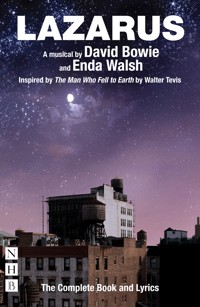
'I'm a dying man who can't die.' Thomas Newton came to Earth seeking water for his drought-ridden planet. Years later he's still stranded here, soaked in cheap gin and haunted by a past love. But the arrival of another lost soul brings one last chance of freedom... Inspired by the book The Man Who Fell to Earth by Walter Tevis and its cult film adaptation starring David Bowie, Lazarus brings the story of Thomas Newton to its devastating conclusion. Written by Bowie with the playwright Enda Walsh, and incorporating some of Bowie's most iconic songs, Lazarus was first performed at New York Theatre Workshop in 2015, starring Michael C. Hall and directed by Ivo Van Hove. The production transferred to London in 2016.
Sie lesen das E-Book in den Legimi-Apps auf:
Seitenzahl: 85
Veröffentlichungsjahr: 2016
Das E-Book (TTS) können Sie hören im Abo „Legimi Premium” in Legimi-Apps auf:
Ähnliche















LAZARUS
A musical by David Bowieand Enda Walsh
Inspired by The Man Who Fell to Earth by Walter Tevis
NICK HERN BOOKS
London
www.nickhernbooks.co.uk
Contents
‘This Way or No Way, You Know I’ll Be Free’Introduction by Enda Walsh
David Bowie
Enda Walsh
Walter Tevis
Original Production Details
Lazarus
‘The New Colossus’ by Emma Lazarus
Acknowledgements
Copyright and Performing Rights Information
This Way or No Way, You Know I’ll Be Free
Enda Walsh
David Bowie had passed me a four-page document to read so we could begin our discussions on writing a new story with his songs, and based upon the character of Thomas Newton from the Walter Tevis novel The Man Who Fell to Earth – which David had famously played in the Nicolas Roeg film. In the room was the theatre and film producer Robert Fox and David’s right hand, Coco Schwab. As I started to read those four pages, the room was very quiet.
Earlier, I had been feeling very calm and detached as I walked towards David’s building with Robert – as we stood in the elevator, as that ridiculously wide office door opened, and Mr David Bowie was standing there. He hugged me and the first thing he said to me was, ‘You’ve been in my head for three weeks.’ We sat and we chatted about my work (he had read everything) and why I was writing the way I was – and what themes kept returning into my plays like a nasty itch. I spent that whole morning and now this first hour of our first meeting in a state of serene self-confidence.
It was only at the moment when he said, ‘This is where I’d like to start,’ when he pushed those four pages towards me, that I was hit with the realisation that I was sitting opposite this cultural icon – this man who had created so much and influenced so many. This bloody genius. David Fucking Bowie. I felt like a child – and at that point of silently ‘reading’ – a child who had once the ability to read words but had forgotten how to read. I scanned the first page and all I heard was interference – my own insecurities screaming at me.
I stopped reading, took a deep breath and read from the first line again.
David had written three new characters around Thomas Newton (the stranded alien, seemingly immortal and definitely stuck). There was a Girl who may or may not be real; a ‘mass murderer’ called Valentine; and a character of a woman who thought she might be Emma Lazarus (the American poet whose poem ‘The New Colossus’ is engraved on the base of the Statue of Liberty) – a woman in this case who would help and fall in love with this most travelled of immigrants: Thomas Newton.
At the centre of these four pages was a simple, powerful image: Thomas Newton would build a rocket from debris. His mind, having further deteriorated, would torture and tease him with the dream of escape; and in his imprisonment – in his room in this big tower – Newton would try one last time to leave.
So this is where we started.
We talked around the characters and the themes of the book. On isolation and madness and drug abuse and alcoholism and the torment of immortality. And there was a lot of talk about the beauty of unconditional love and goodness. We talked about characters finding themselves out of control – about the story sliding into a murky sadness and quick violence – about characters having drab conversations about television snacks – the everyday bending quickly and becoming Greek tragedy. The celestial and the shitty pavement.
For the first few meetings, Coco stayed silent and listened to us (until she couldn’t listen to us any more maybe!), and then she asked, ‘Yeah, but what happens?’ It was a fair question and one that we would return to – but we weren’t there yet. We needed to get a sense of the themes of it and its atmosphere and its world. The narrative trajectory of a man wanting to leave Earth and being helped by some and stopped by others – this was there in David’s four pages and would remain in our story, but the events of the story would emerge later.
And then there were the songs.
David handed me a folder of lyrics and CDs he had put together. ‘Some of these you’ll know.’ It was a bloody funny thing to say. We would hammer out the story together, but initially he wanted me to choose the songs we would use. I guess he had lived with some of them for years and there must have been unshakable associations – maybe it would be easier for me to listen to them coldly from a purely narrative perspective.
His lyrics often arrive cut-up and opaque – so it was rarely about listening to the words and sticking it into the story. It was about the emotion, rhythm and atmosphere of those songs – and having the characters riding that wave and accessing their souls, where they could lyrically go to those strange places.
We talked about the form – the shape of the story arriving broken and a little shattered. We talked about a person dying and the moments before death and what might happen in their mind and how that would be constructed onstage. We started talking about escape, but we ended up talking about a person trying to find rest. About dying in an easier way.
Newton would spend his last moments trying to stop a bullying mind that kept him living. Physically it didn’t matter to us whether he was on Earth or in the stars at the very end. We wanted Newton – in his terms – to feel at rest.
No matter how plays come out, you always end up talking about yourself. David was certainly the most superb shapeshifter – one of the greatest ever collaborators too – someone who could walk his colleagues in directions they’d yet seen. But for me he remained personal in his work and spoke about where he was at that moment in really truthful terms.
Lazarus arrived at both of us with its own swagger and shape and emotion. It’s a strange, difficult and sometimes sad dream Newton must live through – but in its conclusion, he wins his peace.
David Bowie
David Bowie was born in Brixton, London, on 8 January 1947. Between the late 1960s and the mid-’70s, he experimented with boundaries of musical genres and the potential of live performance and multimedia as applied to music, creating and discarding a variety of personae while releasing albums including The Man Who Sold the World, Space Oddity, Hunky Dory, The Rise and Fall of Ziggy Stardust, Aladdin Sane, Diamond Dogs, Young Americans (featuring ‘Fame’, his first US Number 1 single) and Station to Station.
In 1976 Bowie relocated to Berlin, enlisting Brian Eno and Tony Visconti to begin recording the albums that would become known as his ‘Berlin Trilogy’: Low, ‘Heroes’ and Lodger. In 1980 he made his Broadway debut in The Elephant Man and released the Visconti co-production Scary Monsters (And Super Creeps) followed in 1983 by his biggest US commercial success to date, Let’s Dance, co-produced with Nile Rodgers. Between the mid-’80s and early ’90s, he worked with his band Tin Machine, collaborated with the dance company La La La Human Steps, and composed music for Hanif Kureishi’s The Buddha of Suburbia.
In 1992 Bowie released one of rock’s first CD-ROMs, Jump. In 1995, reunited once again with Eno, he produced the experimental Outside album, followed in 1997 by Earthling and in 1999 by ‘hours…’, the year he became a Commandeur dans L’Ordre des Arts et des Lettres.
Bowie’s next project in 2002 was another recorded collaboration with Tony Visconti entitled Heathen. The accompanying live dates in Europe and America saw performances of Heathen as well as the classic Low, both played in their entirety. A year later the Reality album was launched with the world’s largest interactive ‘live by satellite’ event and was followed by the rapturously received and critically acclaimed A Reality Tour of the world.
2006 saw Bowie return to acting with the Christopher Nolan-directed box-office topper The Prestige, adding to a cinematic CV including Nicolas Roeg’s The Man Who Fell to Earth, Martin Scorsese’s The Last Temptation of Christ, Tony Scott’s The Hunger and Nagisa Oshima’s Merry Christmas, Mr. Lawrence.
In May 2007, Bowie was the inaugural curator of the highly successful ten-day High Line arts and music festival in New York. That June, he was honoured at the 11th Annual Webby Awards with a Lifetime Achievement Award for pushing the boundaries between art and technology. Later in 2007, Bowie starred as himself in an acclaimed episode of Extras, Ricky Gervais’ BBC/HBO series.
2012 saw the dedication of a plaque in Heddon Street, London (the scene of the Ziggy Stardust cover shoot), commemorating the fortieth anniversary of the release of Ziggy Stardust and the Spiders from Mars – and of course the extraordinary influence of David himself.
In 2013, it was announced that the David Bowie Archive had given unprecedented access to the prestigious Victoria and Albert Museum for ‘David Bowie is…’, an exhibition curated solely by the V&A in London. Marking the first time a museum has been given access to the David Bowie Archive, the exhibition has gone on to break records in the US, Berlin and France. ‘David Bowie is…’ has made recent stops in Australia and the Netherlands, and will continue to tour the world for the foreseeable future.
On 8 January 2013, on his sixty-sixth birthday, David Bowie suddenly and without fanfare, released a new single entitled ‘Where Are We Now?’, and announced the release of a new album titled The Next Day. Bowie’s twenty-seventh studio album and first in ten years, The Next Day, hit Number 1 in nineteen countries, and was critically lauded the world over. In 2014, David Bowie’s fiftieth year in music was commemorated with the release of the compilation Nothing Has Changed




